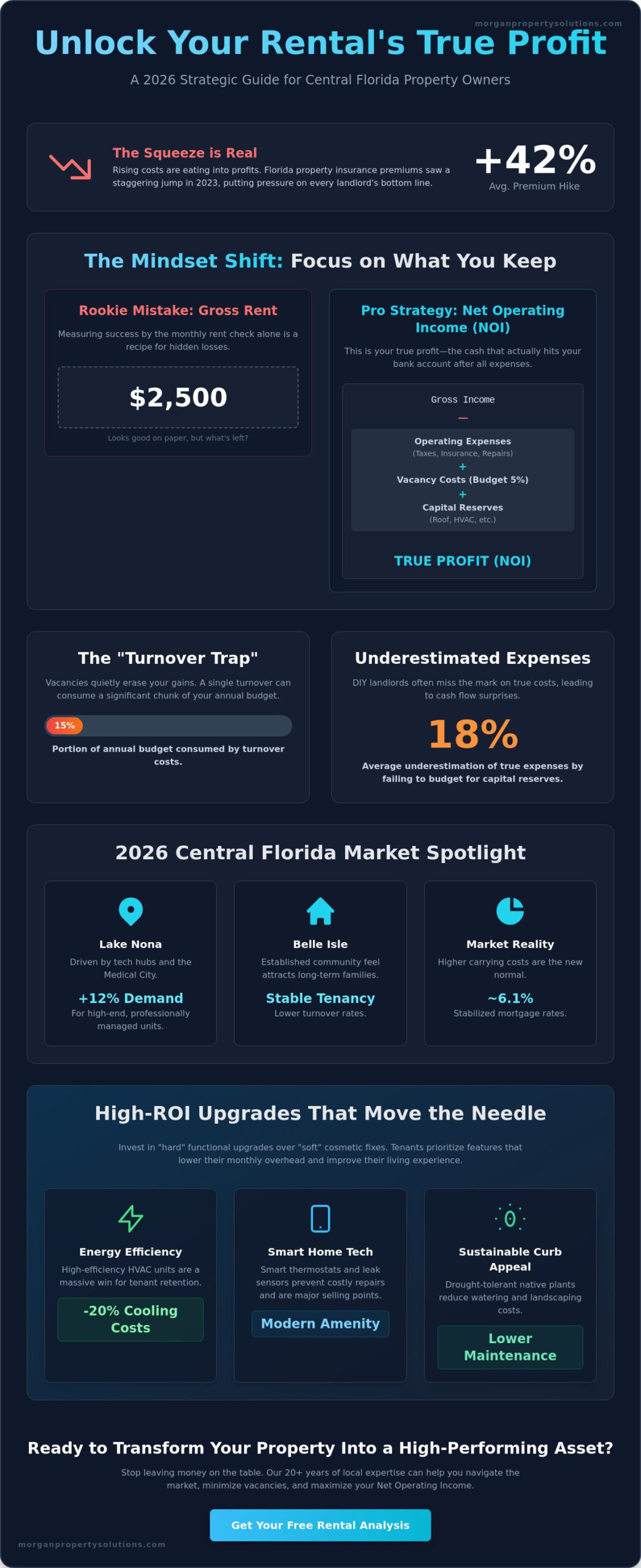
Did you know that Florida property insurance premiums jumped by an average of 42% in 2023, according to data from the Insurance Information Institute? It is a staggering figure that has many Central Florida owners feeling the squeeze on their bottom line. You probably started your real estate journey looking for financial freedom, but lately, it might feel like your passive income is being swallowed up by rising maintenance costs and tax hikes. We understand that the stress of managing tenant requests and the fear of a long vacancy can make landlording feel like a full time job you never asked for.
The good news is that learning how to make your rental property more profitable in this shifting market is simpler than you might think. We have spent over 20 years helping local owners turn struggling units into high performing assets, and we are here to guide you through the process. This 2026 guide reveals the exact strategies we use to minimize vacancies, slash unnecessary expenses, and finally get your cash flow back on track. We will walk you through setting the right rent price, finding stable tenants who stay for years, and managing your property so it actually feels like a hands-off investment again.
Key Takeaways
- Shift your focus from gross rent to Net Operating Income (NOI) to truly understand what you’re keeping at the end of every month.
- Identify the specific energy-efficient upgrades that Central Florida tenants are prioritizing and willing to pay a premium for in 2026.
- Learn how to make your rental property more profitable by navigating the latest insurance shifts and claiming the tax deductions most landlords miss.
- Avoid the “Turnover Trap” by uncovering the hidden costs of vacancies that can quietly erase an entire year’s worth of rent increases.
- Discover why professional management is a strategic profit center that saves you time while offering vendor discounts you can’t get on your own.
The 2026 Reality Check: Why Rent Isn’t Your Only Profit Lever
By 2026, the Florida rental market has matured into a space where simple “door-knocking” landlording no longer cuts it. If you’re still measuring success solely by the size of the monthly rent check, you’re likely leaving money on the table. Focusing only on gross rent is a rookie mistake that ignores the hidden leaks in a portfolio. True success in the current Central Florida climate requires a shift toward a Net Operating Income (NOI) mindset. This means you prioritize what you actually keep in your bank account, not just what you collect from a tenant on the first of the month.
We’ve seen a significant move away from transactional relationships. Today’s most successful investors treat their properties as a service-based business. When you provide a high-quality living experience, you reduce turnover costs, which often consume 15% of an annual budget. Learning how to make your rental property more profitable in 2026 involves optimizing every line item, from smart home energy savings to preventative maintenance schedules that stop $2,000 repairs before they start.
Understanding the Central Florida Market Dynamics
The “Buy Box” for a smart investor has changed. In 2026, localized demand in areas like Hunters Creek and Belle Isle is driven by proximity to the expanding tech hubs and the Lake Nona Medical City. While Orlando continues to grow, these specific pockets offer different yield profiles. For instance, Belle Isle’s established community feel often attracts long-term families, while Lake Nona sees a 12% higher demand for high-end, professionally managed units.
For investors looking to diversify their portfolio with specialized niche markets like equestrian estates or high-value acreage, coloradohorseproperty.com provides a look at how such properties are valued in other high-demand regions outside of Florida.
With mortgage rates stabilizing around 6.1% in early 2026, your strategy must account for higher carrying costs than the previous decade. You can’t rely on explosive appreciation alone to bail out a cash-flow-negative property. Understanding fundamental real estate investment principles is vital for identifying your property’s sweet spot. This involves balancing competitive pricing with the premium services that modern Orlando tenants expect. If you want to see how this works in practice, our team at Orlando property management can help you analyze these specific neighborhood trends.
The Formula for True Rental Profitability
To find your real numbers, you need to look past the surface. The math is simple, yet many people get it wrong. Your real profit follows this path: Gross Income – (Operating Expenses + Vacancy + Capital Reserves). It’s a common trend for DIY landlords to underestimate their true expenses by 18% because they fail to set aside funds for “big ticket” items like roof aging or HVAC replacements.
- Operating Expenses: These include taxes, insurance, and day-to-day repairs.
- Vacancy: Even in a hot market, you should budget for a 5% vacancy rate to stay safe.
- Capital Reserves: Think of this as a savings account for the house itself.
When you master these numbers, you understand how to make your rental property more profitable without just raising the rent and risking a vacancy. Rental ROI is the total return including tax benefits and equity paydown. By looking at the full picture, you can make informed decisions that build long-term wealth rather than just chasing a temporary cash influx.
High-ROI Upgrades: What Actually Moves the Needle in Florida
Deciding where to invest your next $1,000 can feel like a guessing game. You might be tempted by a fresh coat of trendy paint, but in the 2026 market, “hard” upgrades that improve function usually beat “soft” cosmetic fixes. If you are looking for how to make your rental property more profitable, you have to think about the tenant’s monthly overhead. In Florida, that almost always means the power bill. High-efficiency upgrades don’t just help the planet; they keep your tenants in place longer because they can actually afford to live there.
Smart home tech is another area where a small investment pays off. Leak sensors are a perfect example. Water damage accounts for a large percentage of property insurance claims in Central Florida. A simple sensor under the kitchen sink or near the water heater can alert you to a problem before it ruins your subflooring. Smart thermostats also allow tenants to manage cooling costs from their phones, which is a major selling point during an Orlando August.
Curb appeal matters too, but it needs to be sustainable. For homes in areas like Lake Nona, stick to drought-tolerant, native plants. This reduces the need for constant watering and expensive landscaping crews. It’s about creating a look that stays sharp even when the heat index hits triple digits. If you need more specific advice on local market trends, our team can guide you through the process of selecting the right improvements.
The ‘Green’ Advantage for Your Bottom Line
Energy efficiency is a top amenity for 2026. Replacing old bulbs with LED lighting is a quick way to modernize a space. More importantly, upgrading to a high-efficiency HVAC unit can reduce cooling costs by 20 percent. This is a massive win for tenant retention. While solar panels are a bigger commitment, they are becoming more viable for long-term holds. For properties with larger lawns, smart irrigation systems prevent those massive water bill spikes by adjusting for Florida’s frequent rain showers.
Pet-Friendliness as a Profit Center
Being pet-friendly is one of the easiest ways to understand how to make your rental property more profitable. Since roughly 70 percent of renters have pets, saying yes instantly expands your pool of potential applicants. You can manage the risk by using tools like PetScreening to verify animal behavior and vaccination records. To keep the home in good shape, consider installing luxury vinyl plank flooring. It looks like wood but handles claws and spills much better than traditional materials.
The Hidden Profit Killers: Vacancy and Turnover
Many landlords focus solely on raising rent to boost their bottom line. However, a single empty month can destroy your annual gains. This is what we call the “Turnover Trap.” If your property sits vacant for 30 days, you lose 8.3 percent of your yearly income instantly. For a home renting at $2,000, that is a $2,000 loss that a small monthly rent hike cannot easily recover.
When a tenant leaves, you aren’t just losing rent. You’re paying for professional cleaning, fresh paint, minor repairs, and marketing fees. Industry data from 2024 shows that a typical turnover costs between $2,500 and $5,000 depending on the property size and condition. If you want to know how to make your rental property more profitable, the answer often lies in keeping the tenants you already have. A retention-first strategy focuses on building a partnership. We suggest checking in 90 days before a lease ends to address small maintenance issues that might otherwise push a tenant to look elsewhere.
The Math of Retention vs. Rent Hikes
Let’s look at the numbers. If you push for a $50 monthly rent increase and your tenant moves out, you gain $600 over the next year. But if that move results in just one month of vacancy at a $2,100 rental rate, you’ve actually lost $1,500 for the year. Keeping rent steady or offering a modest $25 increase for a two-year renewal often yields higher net profits. You can also make your home more attractive by offering deposit-free renting benefits. This reduces the upfront cost for high-quality tenants and helps you fill units faster without sacrificing security.
Screening: Your Best Defense Against Future Costs
The most expensive mistake any landlord can make is placing the wrong person in their home. A “bad” tenant leads to late payments, property damage, and potential legal fees. Following the 2026 standard for screening criteria in Florida is your best defense. We look for a 3:1 income-to-rent ratio and a consistent history of long-term stays at previous residences.
- Red Flag: A “job hopper” who changes employers every six months.
- Red Flag: A history of moving every 12 months for the last three years.
- Green Flag: A tenant who asks about long-term lease options during the initial tour.
Attracting “long-haul” tenants starts with clear marketing that highlights community stability and responsive management. This approach is a key part of how to make your rental property more profitable because it targets residents who value a home over a temporary landing spot. By focusing on stability, you eliminate the constant cycle of cleaning and re-listing that drains your bank account.
Optimizing Operations: Taxes, Insurance, and Pricing
Owning a rental in Florida during 2026 requires a sharper eye on the ledger than ever before. If you’re wondering how to make your rental property more profitable, you have to start by scrutinizing your fixed costs. Insurance premiums in Florida have risen significantly over the last few years, but you aren’t necessarily stuck with the first quote you receive. Many landlords find success by investing in wind mitigation inspections. Improving your roof’s rating or installing impact-resistant windows can often shave 10% to 15% off your annual bill. It’s a proactive move that pays for itself quickly.
Don’t leave money on the table when tax season rolls around. Many owners forget they can deduct the mileage for travel to inspect their properties or the specific square footage used for a home office. Depreciation is another heavy hitter. It’s a non-cash expense that can drastically lower your taxable income, even if your property’s value is actually increasing. When you combine these deductions with smart pricing, the difference in your year-end take-home pay is substantial.
Orlando is a unique market where demand fluctuates based on tourism cycles and school calendars. Using dynamic pricing allows you to adjust your rates based on these trends. For example, you might raise rents by 5% to 8% during peak spring and summer months when families are looking to move. Conversely, ignoring a $150 HVAC tune-up in April usually leads to a $3,000 emergency replacement during a July heatwave. Contractors often charge a 20% premium for after-hours calls. Staying ahead of repairs is one of the easiest ways to protect your margins and keep your tenants happy.
Financial Housekeeping for Maximum Cash Flow
Take a close look at your mortgage terms this year. If interest rates have shifted in your favor, 2026 could be the right time to refinance and lower your monthly overhead. You should also maintain a dedicated Capital Expenditure (CapEx) fund. Setting aside a small percentage of rent each month ensures you won’t feel the sting when a big-ticket item like a water heater fails. To keep your income predictable, using an online portal for payments is a game changer. It eliminates the “check is in the mail” excuse and ensures consistent, on-time collection.
Staying Legal to Avoid Costly Fines
Florida’s Landlord-Tenant laws saw several updates in early 2026, specifically regarding security deposit timelines and notice requirements. Falling out of compliance can lead to legal disputes that wipe out months of profit in a single week. A professional lease agreement is your best defense here. It clearly defines responsibilities and prevents expensive misunderstandings. If you need help staying current, check out the templates on our Landlord Resources page to keep your business protected. Learning how to make your rental property more profitable is much easier when you aren’t losing money to avoidable legal fees.
The Scale Factor: Why Professional Management is a Profit Center
Many Florida landlords view property management fees as an expense they should avoid. If you’re looking for how to make your rental property more profitable, you should actually look at management as a profit center rather than a cost. When you manage a home yourself, you’re trading your most valuable asset for a handful of tasks that don’t actually build wealth. That asset is your time.
Think about the opportunity cost. If you value your time at $100 per hour and you spend ten hours a month dealing with maintenance calls, tenant disputes, and accounting, you’ve just “paid” $1,000 for DIY management. Professional managers leverage vendor discounts you can’t get as a solo owner. Because we handle hundreds of properties, we get bulk pricing on everything from HVAC repairs to roofing. These savings on labor and materials often offset a large portion of the management fee itself.
Emotions often cloud financial judgment. It’s hard to tell a tenant you like that their rent is going up by 7 or 8 percent, even if that’s the current market rate. Professional managers eliminate this bias. We use hard data to make decisions that protect your bottom line. Choosing the right partner is the most effective way to learn how to make your rental property more profitable without sacrificing your personal life. You’re finally transitioning from having a demanding part-time job to owning a true investment.
Making Real Estate Simple
At Morgan Property Solutions, we focus on simplifying the complex parts of owning a rental. We’ve spent over 20 years building local experience in the Orlando market, so we know exactly what local tenants expect and what the laws require. Our A+ rating from the Better Business Bureau serves as a marker of the trust and reliability we’ve built with our clients since we started.
Next Steps for Your Investment
Are you ready to see the true potential of your Florida home? You can get a professional rental analysis to see exactly where you’re leaving money on the table. We provide the peace of mind that comes with support every step of the way, ensuring your property stays occupied and well-maintained. If you’re tired of the DIY headache, contact Morgan Property Solutions today to see how we can help your investment grow.
Start Growing Your Florida Portfolio Today
Navigating the Florida real estate market in 2026 requires a shift in perspective. You’ve seen that focusing on high-ROI upgrades like energy-efficient HVAC systems can actually lower your long-term costs. It’s also clear that managing hidden killers like vacancy rates and rising insurance premiums is just as vital as collecting a rent check. Understanding how to make your rental property more profitable comes down to these small, strategic adjustments that protect your bottom line over the long haul.
We know that juggling these details can feel like a full-time job. That’s why we’re here to help you simplify the process. With over 20 years of Central Florida experience and an A+ BBB Rating, Morgan Property Solutions has developed proven systems to reduce vacancy and boost profits for owners just like you. You don’t have to navigate these changes alone. We’ll be your partner every step of the way to ensure your investment thrives.
Ready to boost your rental’s ROI? Let’s simplify your property management today.
You have the tools to succeed. We’re excited to see your portfolio grow this year.
Frequently Asked Questions
Is it better to raise the rent every year or keep a good tenant?
It’s usually better to keep a high-quality tenant by offering a modest 3% to 5% increase rather than pushing for a full market rate that causes a move-out. A single month of vacancy can cost you $2,000 or more in lost revenue and turnover cleaning. Keeping a reliable person reduces your stress and protects your cash flow over the long haul.
What are the highest ROI home improvements for a rental property in Florida?
Upgrading to energy-efficient windows and installing luxury vinyl plank flooring offer the best returns in the Florida market. This type of flooring handles the 70% average humidity levels much better than carpet or laminate. These updates help you figure out how to make your rental property more profitable by reducing long-term maintenance costs and attracting tenants who stay longer.
How much should I set aside for maintenance and repairs each month?
You should aim to save 10% to 15% of your monthly rental income for maintenance and future repairs. This ensures you’re prepared for the “1% rule,” which suggest setting aside 1% of the property’s total value annually for larger projects like AC replacements. Having this fund ready means you won’t feel the pinch when an unexpected $500 plumbing issue pops up on a Sunday afternoon.
Are smart home features actually worth the investment for a rental?
Yes, installing a smart thermostat and keyless entry pads can increase your rental value by $25 to $50 per month. Tenants in 2026 value the convenience of remote temperature control and the security of not carrying physical keys. These features also allow you to monitor vacant units more effectively, which helps keep your utility bills lower during turnover periods.
How do I deal with rising property insurance costs in Florida?
You can lower your premiums by scheduling a wind mitigation inspection to prove your roof and windows meet current 2026 safety codes. Many Florida landlords see a 10% to 25% reduction in costs after installing hurricane straps or impact-resistant glass. Shopping your policy every 12 months with an independent agent ensures you aren’t paying more than the current market average.
Can I manage my own property and still be as profitable as a pro?
You can manage your own property, but owners who use professional management often see 10% higher net returns due to better vendor rates and shorter vacancy times. A pro handles the 2:00 AM calls and strict legal compliance so you don’t have to. Learning how to make your rental property more profitable often involves delegating the day-to-day tasks to experts who know the local laws inside and out.
What is the average vacancy rate in Orlando for 2026?
The projected average vacancy rate for Orlando in 2026 is approximately 5.4% based on recent Florida housing market trends. This means most well-maintained homes are staying occupied for about 11 months out of the year. Keeping your property in top shape and pricing it correctly helps you stay below this average and ensures your income remains steady.
How do I legally handle pet fees and deposits in Florida?
You can charge a non-refundable pet fee or a monthly pet rent, but you must never charge these for documented service or emotional support animals. Florida law requires you to treat these animals as medical tools rather than pets. For standard pets, a $300 fee is common, but always make sure your lease clearly outlines the rules to avoid any confusion later. Providing recommendations for professional pet services like Noah’s Pet Hotel & Spa is another great way to build rapport with tenants and encourage long-term residency.

Article by
Oliver Overton-Morgan
Oliver Overton-Morgan is a full-time Real Estate Broker since 2003, with years of experience helping thousands of people purchase and sell real estate throughout Central Florida. He holds a Graduate Realtor Institute designation, LCAM, and has held licenses in good standing as a Florida Mortgage Broker and a Notary Public. Oliver immigrated to central Florida in 2001, and within 5 years Oliver built a successful Real Estate brokerage in central Florida, where he recruited over 75 Sales Associates with 25+ million in sales production.