
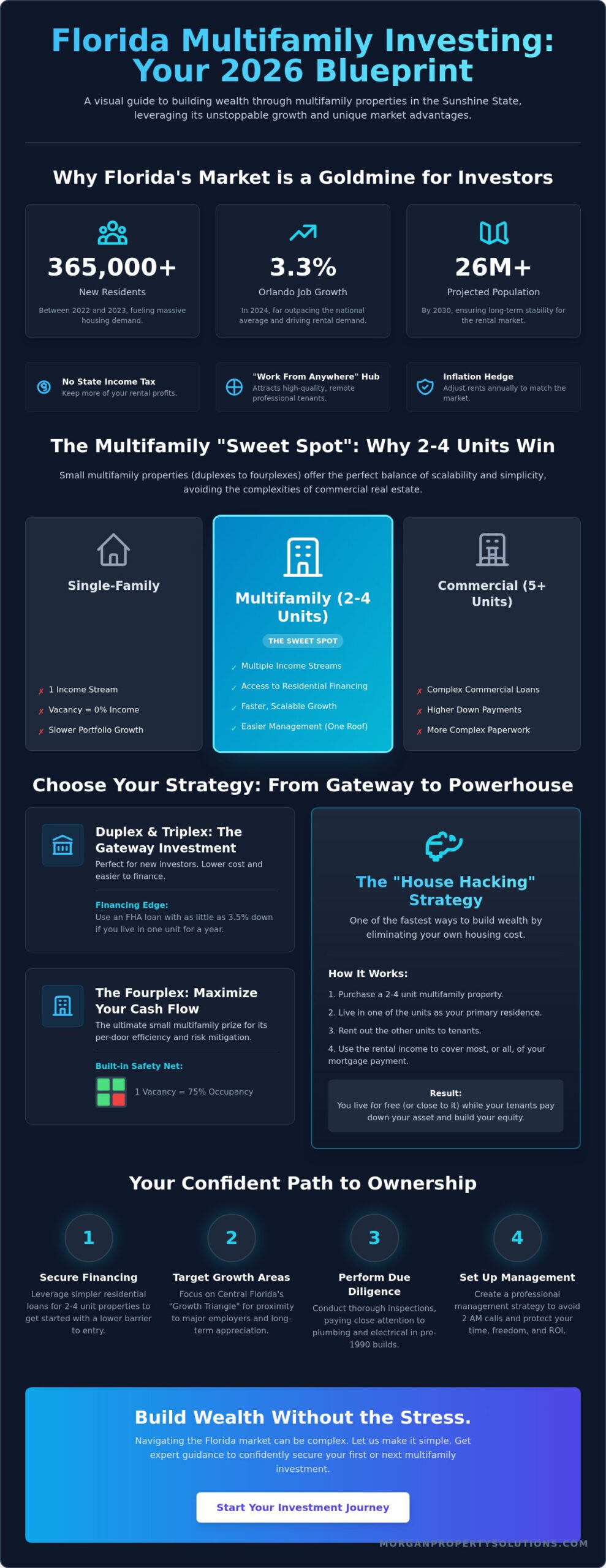
Florida’s population grew by more than 365,000 residents between 2022 and 2023 according to the U.S. Census Bureau, and that momentum is carrying us straight into 2026. You probably already know that this growth makes investing in multifamily homes florida a massive opportunity, but it’s also natural to feel a bit uneasy. Maybe you’re worried about those rising insurance rates you’ve seen in the news, or you’re stressed about the idea of managing tenants from a distance. It’s tough to know which Central Florida neighborhoods are actually expanding and which ones are just talk.
While the I-4 corridor is a primary focus for many, diversifying into the Southwest Florida coastal market can be equally rewarding, and The Anchor Point Group is a dedicated resource for investors looking to expand into that region.
We believe that building wealth shouldn’t be a source of constant stress. This guide will show you how to navigate the market with a simple, manageable process that delivers steady monthly cash flow and reliable long-term appreciation. We’re going to walk you through a strategy that prioritizes growth and professional management, so you can enjoy the benefits of ownership without the expert-level confusion. We’ll look at the specific neighborhoods poised for the most growth in 2026 and how to protect your bottom line from rising costs.
Key Takeaways
- See why Florida’s steady job growth and migration trends make multifamily properties a reliable “sweet spot” for building wealth in 2026.
- Discover how “house hacking” a small residential property can help you live for free while your tenants pay down your mortgage.
- Find out which neighborhoods in Central Florida’s “Growth Triangle” offer the best proximity to major employers and long-term appreciation.
- We’ll guide you through the specific financing and inspection steps for investing in multifamily homes florida so you can buy with total confidence.
- Learn how to avoid the stress of 2 AM maintenance calls by setting up a management strategy that prioritizes your freedom and ROI.
Why Florida Multifamily is Still a Smart Move in 2026
Starting your journey in investing in multifamily homes florida can feel like a big step, but it’s actually one of the most reliable ways to build wealth today. We call multifamily properties the “sweet spot” for residential investors. Instead of managing one single-family house, you’re looking at a single property with two, three, or four units. This setup lets you scale your portfolio faster while keeping your financing and maintenance under one roof. It’s a practical way to grow your assets without the complexity of commercial buildings.
Florida’s economic outlook for 2026 remains incredibly strong. The state continues to lead the nation in net migration. According to the Florida Chamber of Commerce, the state’s population is projected to reach over 26 million by 2030, which means the demand for housing is not slowing down. When you combine this growth with the fact that Florida has no state income tax, your rental profits stay in your pocket. At Morgan Property Solutions, we focus on Making Real Estate Simple so you can focus on your goals without the stress.
Understanding the basics of real estate investing is the first step toward financial freedom. In Florida, the combination of job growth in the tech and healthcare sectors and a high quality of life creates a perfect environment for landlords. We are here to guide you through the process, ensuring you feel confident in every decision you make.
The Resilience of the Rental Market
By 2026, many residents are choosing to rent for longer periods. High interest rates and shifting demographics mean that more families and young professionals are looking for high-quality rental units. Multifamily properties act as a powerful hedge against inflation because you can adjust rents annually to match the market. Central Florida hubs like Orlando and Tampa are seeing steady demand. Orlando’s job growth rate was 3.3 percent in 2024, far outpacing the national average, and that momentum is carrying right into 2026.
The Lifestyle Factor: Why People Keep Moving Here
Choosing Your Property Type: Duplexes to Fourplexes
When you start investing in multifamily homes florida, you’ll quickly see that the industry draws a hard line at four units. Anything with five units or more is considered commercial real estate. This transition requires different loans, higher down payments, and much more complex paperwork. Sticking to duplexes, triplexes, or fourplexes allows you to use residential financing. This is a huge advantage for your first few deals because it keeps the process simple and familiar.
Many of our clients love the house hacking strategy. You live in one unit and let your tenants’ rent cover the mortgage. It’s one of the fastest ways to build wealth because it lowers your personal cost of living while you gain equity. Plus, managing one building with four units is often less stressful than managing four separate houses across town. You only have one roof to worry about, one foundation to monitor, and one yard to mow. It’s a much more scalable way to grow your portfolio.
Duplexes and Triplexes: The Gateway Investment
These properties are perfect for getting your feet wet. Since they usually cost less than larger buildings, they’re easier to finance. You can often use an FHA loan with as little as 3.5% down, provided you live on-site for at least a year. When you’re looking at older Florida builds, pay close attention to the utilities. Some older duplexes aren’t sub-metered, meaning you might end up paying the water bill for everyone. If you’re feeling overwhelmed by these details, our landlord resources can help you organize your due diligence process.
The Fourplex: Maximizing Your Cash Flow
The fourplex is often seen as the ultimate prize in small multifamily investing. It offers the best “per-door” efficiency. You aren’t just buying one home; you’re buying four income streams under one roof. This setup provides a built-in safety net. If one tenant moves out, your occupancy only drops to 75%. In a single-family home, a vacancy means your income drops to 0% instantly. This risk mitigation makes the fourplex a very stable choice for long-term growth as we head into 2026.
Where to Buy: The Best Central Florida Neighborhoods
When you’re looking at investing in multifamily homes florida, you’ll quickly notice a pattern called the “Growth Triangle.” This region connects Orlando and Tampa, creating a massive economic engine. It’s not just about tourism anymore. We’re seeing a shift where the space between these cities is filling up with residential and commercial developments. If you can find a duplex or triplex along the I-4 corridor, you’re positioning yourself in what experts call the “Path of Progress.”
Success in real estate often comes down to timing. You want to find neighborhoods where the city is currently investing in infrastructure. Look for new Brightline station announcements or major highway expansions. These projects usually signal that a surge in residential demand is coming. By the time a new shopping center opens, prices have usually peaked. Getting in early allows you to build equity while the neighborhood matures around your property. Proximity to massive employers like AdventHealth, which employs over 80,000 people across Florida, ensures a steady stream of potential renters who need to live close to work.
Orlando and Lake Nona: Innovation Centers
Orlando has grown far beyond its theme park roots. While Disney remains a massive employer with over 70,000 local cast members, the real story for investors is Lake Nona. This 17-square-mile community is home to Medical City, a life sciences cluster that includes the UCF College of Medicine and the VA Medical Center. This hub attracts high-earning professionals who prefer long-term rentals over short-term stays. Lake Nona is a magnet for high-quality, long-term tenants because of the high concentration of specialized, high-paying medical and tech jobs. If you’re managing these types of assets, our team at Orlando Property Management can help you navigate the specific demands of this high-end market.
The Tampa Bay Area: Coastal Growth
The Tampa and St. Pete corridor offers a different vibe but equally strong returns. In 2023, the Tampa metro area saw a population increase of nearly 50,000 people, which keeps rental demand high. Waterfront-adjacent multifamily properties are a different beast than inland options. They often command higher rents, but you’ll need to account for higher insurance costs and stricter maintenance needs due to the salt air. Because competition for these units is fierce, you need a solid process to pick the right residents while investing in multifamily homes florida near the coast. We always recommend reviewing our screening criteria to ensure you’re protecting your investment in these high-demand coastal spots.
The Buying Process: Financing and Regulations
Buying a property with multiple units is a bit different than picking up a single-family home; it’s more like acquiring a small business. You’ll want to start by getting pre-approved for a loan specifically designed for multifamily properties. Lenders look at these deals through a different lens, often factoring in the potential rental income to help you qualify. Getting this paperwork ready early ensures you can move fast when a good deal hits the market.
Once you find a property, your next move is a specialized Florida home inspection. You can’t skip the wind mitigation report or the four-point inspection. In Florida, these documents are vital because they directly impact your ability to get affordable coverage. A good inspector will check the age of the roof and the condition of the electrical panels to ensure there aren’t any hidden surprises that could sink your budget later.
By 2026, insurance requirements for multi-unit buildings have become more predictable thanks to state-level reforms passed in previous years. However, you’ll still need to account for updated flood zone maps and mandatory replacement cost valuations. Finally, you’ll reach the closing table. This part of the journey is much smoother when you have a trusted partner by your side to review the settlement statement and ensure the prorated rents and security deposits are handled correctly.
Financing Your Florida Dream
You have several paths when investing in multifamily homes florida. An FHA loan is a popular choice for those who plan to live in one unit, as it allows for a down payment as low as 3.5%. If you’re looking for something more flexible, many investors prefer a Debt Service Coverage Ratio (DSCR) loan. These focus on the property’s cash flow rather than your personal income; lenders typically look for a ratio of 1.20 or higher. If you’re already an owner, a 1031 exchange can help you swap a current asset for a larger multifamily building while deferring capital gains taxes.
Florida Landlord-Tenant Laws You Must Know
Florida is widely recognized for its landlord-friendly legal environment, which is a major draw for investors. The eviction process is generally straightforward if a tenant stops paying rent, but you must follow the rules exactly. For example, you have 15 days to return a security deposit if there are no claims, or 30 days to notify the tenant if you intend to keep a portion for repairs. It’s also a legal requirement to hold these funds in a Florida-based banking institution. To make sure your paperwork is airtight, you can find helpful templates and guides at these landlord resources.
Simplifying Success: Why Management is the Key
Many new owners fall into what we call the self-management trap. It starts with the idea that handling everything yourself will save a few hundred dollars a month. In reality, that decision often costs thousands in lost ROI. Between legal compliance and the physical toll of 2 AM emergency maintenance calls, the “savings” disappear fast. Investing in multifamily homes florida in 2026 requires a high-tech, high-touch approach that most individual owners just can’t maintain on their own.
By 2026, tenant expectations have shifted toward a fully digital experience. Residents want to pay rent, sign renewals, and submit repair requests through streamlined online portals. This digital transformation is supported by the state’s enterprise infrastructure; for instance, you can explore data center Miami to see how 3EX Hosting provides the backbone for these types of services. We provide the management tools so you don’t have to build them, ensuring you get paid on time without the stress of chasing down physical checks. We handle the hard stuff so you can actually enjoy the profits from your investment.
Maximizing ROI Through Efficiency
Professional management is about more than just fixing leaky faucets. It’s about protecting your bottom line through rigorous tenant screening. We look deep into rental histories and background checks to find residents who will treat your property with respect. This reduces the high costs associated with evictions and frequent turnover. To stay competitive in the 2026 market, we also offer deposit-free renting options. This modern approach allows you to attract a wider pool of qualified tenants by lowering their upfront move-in costs, which helps fill vacancies much faster than traditional methods.
The Value of a Trusted Partner
Morgan Property Solutions brings more than 20 years of local experience to your side. We’ve managed properties through various market cycles and understand exactly what Florida renters are looking for. You don’t have to carry the weight of these buildings by yourself. Our team acts as your expert guide, making sure every detail is handled with care and precision. When you’re investing in multifamily homes florida, having a seasoned partner means you can scale your portfolio without losing your peace of mind. We take pride in being a dependable resource for owners who want to grow their wealth while keeping things simple.
If you’re ready to take the next step, let’s have a quick conversation about your goals and how we can help you reach them.
Start Building Your Florida Portfolio Today
As we look toward 2026, the opportunities in the local market are hard to ignore. Success comes down to picking the right Central Florida neighborhoods and understanding the nuances of financing for everything from duplexes to fourplexes. It’s about more than just buying a building; it’s about creating a sustainable income stream that lasts. We know the regulations can feel overwhelming, but they don’t have to be a barrier to your success.
Investing in multifamily homes florida is a proven path to wealth when you have the right support. With our A+ BBB rating and over 20 years of experience in the local market, we’ve refined a full-service approach that covers buying, selling, and management. We’re here to take the stress off your plate so you can focus on the results. Ready to simplify your investment? Let’s chat about your Florida real estate goals!
We’re excited to help you make your next big move a successful one.
Frequently Asked Questions
Is a multifamily home a better investment than a single-family home in Florida?
Multifamily homes often provide better cash flow because you have several income streams under one roof. While single-family homes might see 4% annual appreciation based on historical Florida Realtors data, multifamily units offer a safety net. If one tenant leaves, you aren’t at 0% occupancy. It’s a smart way to start investing in multifamily homes florida because it scales your portfolio faster than buying separate houses.
How much down payment do I need for a duplex in Florida?
You’ll typically need 20% to 25% down for an investment duplex, but owner-occupants have much more flexible options. If you live in one of the units, an FHA loan allows for a 3.5% down payment according to 2024 federal guidelines. For a $500,000 property, that’s the difference between $17,500 and $100,000 upfront. We’re here to help you navigate these financing hurdles so the process stays simple.
What are the biggest risks of investing in Florida real estate in 2026?
Rising insurance premiums and climate costs are the primary hurdles for investors in 2026. Data from the Insurance Information Institute showed Florida property insurance rates jumped 42% in a single year recently, which directly impacts your monthly profits. You also have to watch interest rate shifts from the Federal Reserve. We recommend factor in a 10% buffer for unexpected maintenance to keep your investment stress-free.
Can I manage a Florida multifamily property if I live in another state?
How do I calculate the potential rental income for a triplex or fourplex?
Start by totaling the market rent for all units and subtracting a 7% vacancy factor to stay realistic. You should check 2026 median rents on platforms like Rentometer to see what similar units in the neighborhood actually earn. Don’t forget to deduct operating expenses like taxes and utilities. This gives you your net operating income, which is the most honest look at what you’ll actually pocket each month.
What is the average cap rate for multifamily properties in Orlando?
The average cap rate for Orlando multifamily properties usually stays between 5% and 6.5% according to recent market reports. In high-demand spots like Lake Nona, you might see lower rates around 4.5% because property values are so high. It’s a very stable return compared to national averages. This stability makes investing in multifamily homes florida an attractive choice for people who want a dependable, long-term wealth strategy.
Do I need special insurance for a multifamily property in Florida?
You need a dwelling fire policy, often called a DP3, instead of a standard homeowner’s policy. These are designed for landlords and cover the structure plus your liability if someone gets hurt on the property. In Florida, you’ll likely need a separate windstorm or flood policy depending on your specific zone. It’s vital to get this right so you’re protected from the 100-year storms we sometimes face.
What happens if one unit in my multifamily home goes vacant?
If one unit in a triplex goes vacant, you still have 66% of your income arriving to help cover the mortgage. This is the beauty of the multifamily model; a single vacancy doesn’t mean you’re paying the whole bill yourself. You’ll use that time to refresh the space and find a new tenant. Most units in Florida’s popular hubs fill within 20 to 30 days if they’re priced correctly.

Article by
Oliver Overton-Morgan
Oliver Overton-Morgan is a full-time Real Estate Broker since 2003, with years of experience helping thousands of people purchase and sell real estate throughout Central Florida. He holds a Graduate Realtor Institute designation, LCAM, and has held licenses in good standing as a Florida Mortgage Broker and a Notary Public. Oliver immigrated to central Florida in 2001, and within 5 years Oliver built a successful Real Estate brokerage in central Florida, where he recruited over 75 Sales Associates with 25+ million in sales production.