
What if the final sale price of your home is actually the least important number in your real estate transaction? It sounds backwards, but the figure on the contract doesn’t tell you what’s actually landing in your bank account. Many homeowners focus on the big headline price, but mastering how to calculate seller net proceeds florida is what truly determines your next move. It’s completely normal to feel a bit stressed about hidden fees or those confusing documentary stamps that are unique to the Sunshine State. You’ve worked hard for your home equity, and the last thing you want is a surprise at the closing table.
We’re here to help you find a clear and predictable path to your payout. This guide shows you exactly how to master the math, including the state-mandated $0.70 per $100 deed tax and those tricky property tax prorations. We’ll break down the “Big Three” expenses and explain how to handle HOA estoppel fees that can sometimes climb well over $500. By the end of this 2026 guide, you’ll have the confidence to negotiate like a pro and ensure your settlement statement is exactly what you expected.
Here is what we’ll cover to help you prepare for your sale:
- The real difference between your home’s sale price and your actual take-home pay.
- How to calculate seller net proceeds florida by accurately factoring in commissions, mortgage payoffs, and prorated taxes.
- A clear breakdown of Florida’s $0.70 per $100 documentary stamp tax and other state-specific closing fees.
- Why title insurance customs change depending on whether your home is in Orange, Seminole, or Osceola county.
- How strategic pricing and minor, high-impact repairs can maximize your cash more effectively than major renovations.
- A step-by-step guide to the math so you can walk into negotiations with total confidence.
What Are Seller Net Proceeds and Why Do They Matter?
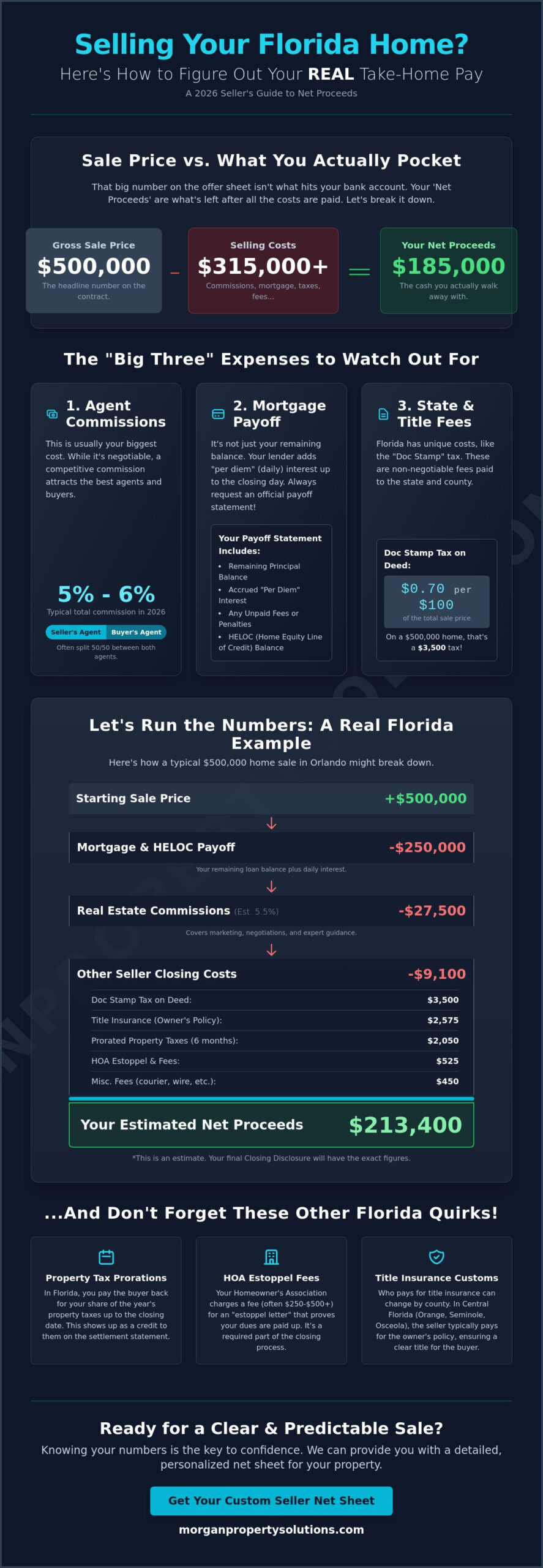
Imagine you just accepted a $500,000 offer on your Orlando home. It feels like a win. But that big number isn’t what you’ll actually see in your bank account on closing day. Understanding What Are Seller Net Proceeds is about looking past the contract price to see the real money you’ll have for your next down payment or retirement fund. Essentially, your net proceeds are the funds left over after every lien, commission, and Florida tax is satisfied. It is the only number that truly dictates your financial reality after the keys change hands.
For many Central Florida families, the gap between the sale price and the take-home pay can be a shock. Learning how to calculate seller net proceeds florida early in the process helps you avoid that “closing table surprise.” It’s not just about being prepared; it’s about having the confidence to negotiate. When you know your bottom line, you can make smarter decisions about which offers to accept and which ones to walk away from. This clarity allows you to plan your next move with a realistic budget, ensuring you don’t overextend yourself on your next home purchase.
Net Proceeds vs. Gross Sale Price
In the 2026 real estate market, the gross sale price is simply the starting point of a much larger equation. While the gross price is the “sticker price” on the contract, your net proceeds represent your actual profit after expenses like agent commissions and state taxes are subtracted. There’s often an emotional gap here. It’s easy to get attached to a high offer, but if that offer comes with heavy seller concessions, your net might actually be lower than a slightly smaller offer with fewer strings attached. Netting is the most important number because it’s the only one you can actually spend.
Why Estimates Change Before Closing
Calculations often shift as you get closer to the finish line. One major reason is your mortgage payoff. Since interest accrues daily, the amount you owe on the day you close will be slightly different than it was when you first listed the home. Property tax prorations also play a huge role. In Florida, where the average effective property tax rate is around 0.82%, you’re responsible for taxes up until the day of sale. If you close in June, you’ll owe the buyer a credit for the first half of the year. Your Closing Disclosure is the final source of truth, providing a line-by-line breakdown of every penny just before you sign. If you want to explore more about the local market, our real-estate-articles offer deeper insights into Florida’s unique selling environment.
The ‘Big Three’ Expenses That Impact Your Florida Home Sale
Once you’ve set your sights on a listing price, it’s time to look at the three largest buckets that will dip into your equity. While every transaction has its own quirks, these primary expenses typically represent the bulk of your closing costs. Getting a handle on these figures is the most effective way to learn how to calculate seller net proceeds florida without feeling overwhelmed by the paperwork. Beyond the obvious numbers, you’ll also need to account for smaller “invisible” costs like final utility balances and prorated HOA fees to ensure your math stays accurate.
Understanding Real Estate Commissions in 2026
Commissions are usually the largest single expense for a seller. In the current 2026 market, total commissions often range between 5% and 6% of the sale price, with an average around 5.57%. Since the 2024 NAR settlement, these structures have become even more flexible. You aren’t strictly required to pay the buyer agent’s fee, though many sellers still choose to offer a competitive rate (often 2% to 3%) to attract the widest pool of qualified buyers. This fee isn’t just a cost; it covers professional photography, high-end marketing, and the expert negotiation needed to drive your price higher. Remember, these rates are negotiable, and a skilled real estate seller representative can help you find a balance that protects your bottom line.
Handling Your Mortgage and Home Equity Lines
Your mortgage payoff is more than just the balance you see on your mobile app. To get a true number, you must request an official payoff statement from your lender. This document includes “per diem” interest, which is the daily interest that accumulates until the very moment the loan is paid off at closing. If you have a Home Equity Line of Credit (HELOC), you’ll need to freeze that account early in the process. Any delay in getting these statements can stall your closing, so it’s best to handle this as soon as you have a signed contract. These details are a vital part of how to calculate seller net proceeds florida because even a few days of extra interest can shift your final total by hundreds of dollars.
Finally, don’t forget about title-clearing expenses. If there are any outstanding liens or judgments against the property, these must be paid in full before the title can transfer to the new owner. You’ll also need to budget for Florida-Specific Closing Costs like the documentary stamp tax on the deed. In most counties, this tax is $0.70 for every $100 of the sale price. On a $500,000 home, that’s a non-negotiable $3,500 that goes directly to the state. By addressing these “Big Three” early, you can walk into your closing with a clear, stress-free view of your financial future.
Florida-Specific Closing Costs You Can’t Ignore
While the big numbers like commissions and mortgage payoffs take up the most space on your mental ledger, Florida has a few unique rules that can catch you off guard. If you’re trying to figure out how to calculate seller net proceeds florida accurately, you can’t overlook the state-specific taxes and local customs that vary from county to county. These aren’t just suggestions; they’re standard parts of the Florida real estate landscape that help keep our state infrastructure running and our property titles clear. Understanding these fees helps you move from a rough guess to a solid, bankable number.
The Florida Documentary Stamp Tax Explained
The biggest state-specific cost you’ll face is the Documentary Stamp Tax on the deed. In almost every Florida county, the rate is set at $0.70 for every $100 of the home’s sale price. For example, if you sell your home for $400,000, you’ll owe $2,800 in doc stamps. This is almost always a seller-paid expense. While it might feel like just another fee, these funds are vital for the state. They support various Florida programs and infrastructure projects that help maintain the value of our communities. It’s a non-negotiable part of the math, so be sure to bake it into your estimates from the very beginning.
Title Insurance: Who Picks Up the Tab?
One of the most confusing parts of a Florida closing is the owner’s title insurance policy. In many states, there’s a hard rule about who pays, but in Florida, it’s often dictated by local custom. In Central Florida counties like Orange and Osceola, it’s traditional for the seller to pay for the owner’s policy and choose the title company. However, in other areas, the buyer might take on this cost. This policy usually costs about 0.5% of the sale price, or roughly $5 to $6 per $1,000 of value. Because these rules aren’t set in stone, having a trusted local expert by your side is essential for navigating these regional quirks during negotiations.
Don’t forget the smaller logistical fees that round out your settlement statement. You’ll likely see a recording fee, which is a small charge from the county clerk to officially file the new deed. If your home is part of a Homeowners Association, you’ll also need an estoppel letter. This is a formal document from the HOA stating exactly what you owe in dues or violations. These fees typically range from $100 to over $500, with some larger communities charging even more. Mastering these details is the final step in learning how to calculate seller net proceeds florida so you can walk away with a clear picture of your bank balance.
A Step-by-Step Guide to Calculating Your Net Cash
Organizing your figures into a clear sequence is the best way to move from a rough guess to a bankable number. While we’ve already covered the specific fees, the way they stack up determines your true “walk-away” figure. This methodical approach is the most reliable way to understand how to calculate seller net proceeds florida without missing the small details that often hide in the fine print. By running these numbers now, you can enter negotiations with a firm grasp of your bottom line and avoid any last-minute stress.
The Simple Manual Formula
You don’t need a complex spreadsheet to get a very close estimate of your final check. The basic formula is straightforward: Sale Price minus the total of your Liens, Commissions, Taxes, and Fees equals your Net Proceeds. When you’re running these numbers, it’s smart to use a conservative sales price and a slightly higher estimate for your mortgage payoff. This accounts for the daily interest we discussed earlier. A great pro tip is to keep a $1,000 buffer in your math. This extra room covers those small, last-minute repairs or minor buyer credits that frequently pop up after an inspection. For a deeper look at specific market trends that might affect your pricing, feel free to browse our real estate articles for more expert guidance.
The Property Tax ‘Wildcard’
Florida’s property tax system is often the biggest surprise for sellers because we pay in arrears. This means the bill you pay in November covers the current calendar year. If you sell your home before that bill is paid, you’ll owe the buyer a prorated credit for the months you lived there. This calculation is a vital part of knowing how to calculate seller net proceeds florida because the timing of your sale can change your net by thousands of dollars. To get an accurate figure, find your most recent bill from the county property appraiser and divide it by 365 to find your daily tax rate. Then, multiply that by the number of days you’ve owned the home since January 1st.
Mastering these steps ensures you won’t be caught off guard when the final settlement statement arrives. If you want a professional partner to handle the complexities of your transaction and protect your equity, our team at Morgan Property Solutions Inc. is ready to provide the expert seller representation you deserve. We can help you refine these numbers and ensure every detail is handled with care, so you can focus on your next chapter with total peace of mind.
How to Maximize Your Take-Home Pay in Central Florida
Once you have mastered how to calculate seller net proceeds florida, your mindset should shift from calculation to optimization. It’s one thing to know what the fees are; it is another to proactively keep more of your money where it belongs. Every decision you make from the moment you list your home until the day of closing has a direct impact on your final bank deposit. By focusing on high-impact strategies rather than just crossing your fingers for a high offer, you can significantly improve your actual take-home pay and protect the equity you’ve worked hard to build.
Strategic pricing is often your most powerful tool for maximizing profit. In our local Central Florida market, overpricing a home is one of the fastest ways to lose money over time. When a home sits on the market too long, it accumulates holding costs like property taxes, high insurance premiums, and constant maintenance. These expenses quietly erode your equity every single week. A home that is priced right from the start usually generates more interest and stronger terms, which often means fewer requests for expensive seller concessions or credits.
You should also be selective about where you put your money before listing. Major renovations rarely return 100% of their cost in a sale. Instead, focus on minor repairs that boost curb appeal or fix obvious inspection red flags. If an inspector finds an issue, negotiating a reasonable credit is often better than trying to manage the repair yourself. This keeps the transaction on track and prevents the “equity bleed” that happens when last-minute contractors charge premium prices for rush work. Professional representation is about having an expert who knows how to defend your equity when these requests come in, ensuring your “walk-away” number stays intact.
Timing the Market for Better Returns
In 2026, we are seeing specific seasonal patterns across Orlando and Lake Nona. While many people wait for the spring rush, selling when inventory is lower can sometimes lead to a much quicker closing. Speed is a financial strategy. A fast closing reduces the daily interest you owe on your mortgage payoff and stops the clock on those recurring bills like HOA dues and utilities. We help our clients look at the “net over time” to ensure they aren’t losing more in monthly expenses than they would gain by holding out for a slightly higher price.
Working with a Supportive Ally
The team at Morgan Property Solutions Inc. believes in making the complex parts of real estate feel simple and manageable. We have helped sellers in Belle Isle, Hunters Creek, and the surrounding areas navigate these numbers with total confidence. Our approach is built on guidance and partnership, ensuring you have a steady ally at every phase of the process. We don’t just want you to sell; we want you to succeed and move forward with peace of mind. Get a professional equity analysis for your home today.
Step into Your Next Chapter with Clarity
At Morgan Property Solutions Inc., we bring over 20 years of Central Florida expertise to every transaction. Our team provides the detailed, transparent financial reporting you need to make informed decisions in Orlando, Lake Nona, and Tampa. We don’t just act as your representatives; we serve as steady allies present throughout every phase of your journey. Ready to see your real numbers? Let’s talk about your home’s value. We look forward to helping you simplify this transition and move forward with total confidence.
Frequently Asked Questions
What is the largest expense when selling a home in Florida?
The real estate commission is typically the largest expense you’ll face when selling your Florida home. In 2026, this total usually ranges from 5% to 6% of the final sale price. This fee is split between the listing agent and the buyer’s agent, covering professional marketing, photography, and the negotiation expertise needed to successfully close the deal.
Do I have to pay taxes on the profit from my home sale in Florida?
You might owe capital gains taxes on your profit, but many sellers qualify for a significant exclusion. If the home was your primary residence for at least two of the last five years, you can often exclude up to $250,000 in profit as a single filer or $500,000 as a married couple. It is always best to check with a tax professional to see how these federal rules apply to your specific situation.
Who pays for title insurance in Orange County, Florida?
In Orange County, the seller traditionally pays for the owner’s title insurance policy and chooses the title company. This is a local custom that also applies to neighboring Osceola County, though the “who pays” rule can change in other parts of the state. Because these costs are negotiable, they often become a key point of discussion during the initial offer stage.
How are property taxes prorated at closing in Florida?
Since Florida property taxes are paid in arrears, you’ll owe the buyer a credit at closing for the portion of the year you owned the home. For example, if you close on July 1st, you will provide a credit for approximately half of the year’s estimated tax bill. This ensures the buyer has the necessary funds to pay the full bill when it arrives in November.
What are Florida Documentary Stamp Taxes on a deed?
Florida Documentary Stamp Taxes are a state-mandated transfer tax on the deed, currently set at $0.70 for every $100 of the sale price in most counties. On a $500,000 sale, this amounts to a $3,500 expense. This is a non-negotiable cost that the seller is legally required to pay to the state at the time of the property transfer.
Can I calculate my net proceeds myself without a title company?
You can certainly estimate your take-home pay yourself using the formulas we’ve discussed, but a professional net sheet is much more reliable. Learning how to calculate seller net proceeds florida helps you set realistic expectations early on. However, your real estate representative or title company will provide the final, line-by-line breakdown to ensure every prorated fee and daily interest charge is perfectly accurate.
What happens if my net proceeds are negative?
If your net proceeds are negative, meaning you owe more than the home’s value after all closing costs, the transaction is considered a short sale. In this scenario, your lender must agree to accept less than the full mortgage balance to allow the sale to proceed. This is a complex process that requires specialized guidance to navigate the bank’s requirements and protect your financial interests.

Article by
Oliver Overton-Morgan
Oliver Overton-Morgan is a full-time Real Estate Broker since 2003, with years of experience helping thousands of people purchase and sell real estate throughout Central Florida. He holds a Graduate Realtor Institute designation, LCAM, and has held licenses in good standing as a Florida Mortgage Broker and a Notary Public. Oliver immigrated to central Florida in 2001, and within 5 years Oliver built a successful Real Estate brokerage in central Florida, where he recruited over 75 Sales Associates with 25+ million in sales production.