
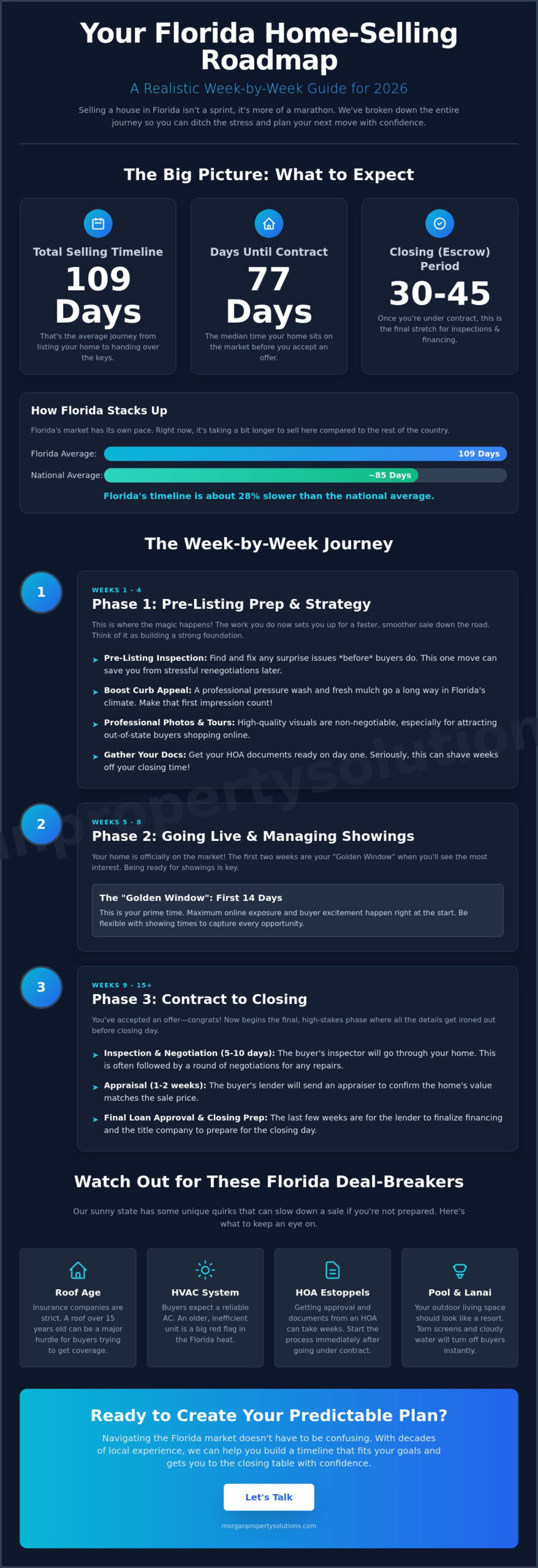
Did you know that the average timeline for selling a house florida homeowners navigate is currently 109 days? That’s about 28.2% slower than the national average. It’s a surprising figure for many sellers who remember the fast-paced frenzy of a few years ago. In 2026, the market has shifted toward buyers, and homes are sitting for a median of 77 days before going under contract. If you’re feeling a bit of anxiety about timing your move or worrying about HOA approval delays, you aren’t alone.
We know that uncertainty is the hardest part of any real estate transition. It’s frustrating when you can’t see the path ahead clearly. Our goal is to replace that stress with a predictable plan. We’ve put together a realistic, week-by-week breakdown of the Florida home-selling process to help you plan your move with total confidence. You’ll get a clear calendar of events and specific tips to avoid common closing delays. This way, you can focus on your next chapter instead of watching the clock.
Key Takeaways
- Understand why the realistic timeline for selling a house florida residents experience in 2026 typically spans three to five months from start to finish.
- Learn how a pre-listing inspection during your first month of prep can prevent stressful renegotiations and surprise repairs later.
- Discover why the first 14 days on the market are your “Golden Window” and how to handle showings while keeping your sanity intact.
- Get a clear breakdown of the high-stakes negotiation period during the inspection and appraisal phases to keep your closing on track.
- Find out how having your HOA documents ready on Day 1 can shave entire weeks off your total schedule.
What Does the Typical Florida Home Sale Timeline Look Like in 2026?
Selling a home in Florida is a bit of a marathon, not a sprint. While we’d all love to sign a contract over the opening weekend, the reality in 2026 is a bit more measured. Generally, you should prepare for a three to five-month journey from the moment you decide to sell until you’re finally handing over the keys. This timeline for selling a house florida homeowners navigate is influenced by a market that has shifted into a more balanced, buyer-friendly environment compared to the frenzy of previous years.
Our state has its own unique personality that dictates the pace of a sale. We deal with seasonal residents who often shop during the winter months and climate considerations that can occasionally pause activity. Understanding the real estate transaction process is a great foundation, but you also have to account for Florida-specific hurdles like HOA estoppels and specific roof age requirements for insurance. Setting a realistic timeline for selling a house florida requires looking at three distinct phases: your initial preparation, the active listing period, and the stretch from going under contract to the final closing table.
The Quick Glance: Florida Timeline Averages
Data from early 2026 shows that the median time a single-family home sits on the market statewide is about 77 days. However, your specific city can change that number. For example, earlier this year, Sarasota County saw a median time to contract of 59 days, while Manatee County was closer to 65 days. Once you actually accept an offer, the typical escrow period in Florida lasts between 30 and 45 days. When you add it all up, the total process usually takes between 109 and 122 days. While a “fast” sale sounds great, it isn’t always the best outcome if it means you didn’t have time to properly vet the buyer’s financing or negotiate the best terms for your move.
Factors That Can Speed Up or Slow Down Your Sale
Location is a primary driver of speed. If you’re selling in a high-growth area like Lake Nona, your experience will look very different than someone selling a historic bungalow in Downtown Orlando. Buyer urgency in 2026 is also heavily tied to mortgage rates, which continue to influence how quickly people are willing to commit. Perhaps the most important variable you can actually control is your home’s condition. Buyers today are often wary of taking on major projects; homes that are move-in ready and have updated big-ticket items like HVAC systems and roofs sell much faster than those needing work. If you’re looking for more tips on preparing your property, you can find helpful advice in our real estate articles.
Phase 1: Pre-Listing Prep and Strategy (Weeks 1-4)
The first four weeks are often the most labor-intensive part of the process. While the average time to sell a house in Florida is roughly 109 days, much of your success is determined before the “For Sale” sign even hits the lawn. We always advocate for a “no surprises” approach. This means scheduling a pre-listing inspection in Week 1. It might feel like an extra step, but discovering a small leak or a faulty electrical panel now is much better than having a buyer walk away during the high-stakes negotiation phase in Week 10. This proactive move protects your timeline for selling a house florida and keeps you in the driver’s seat.
Florida’s climate is notoriously tough on home exteriors. Mildew and pollen accumulate fast here, so a professional pressure washing of your driveway, siding, and pool deck is non-negotiable. You also want fresh, dark mulch to make the green of the palms pop. By Week 3, your home should be ready for its close-up. In 2026, buyers expect more than just static photos. High-resolution virtual tours and drone shots that showcase the neighborhood are the standard for attracting serious interest, especially from out-of-state buyers who are shopping online first.
Tackling the ‘Florida Essentials’ Early
In our local market, two things can kill a deal faster than anything else: the roof and the AC. Buyers are extremely sensitive to roof age because of strict insurance requirements. If your roof is over 15 years old, we need to address that in our pricing strategy immediately. Your pool and lanai should look resort-ready. This means no torn screens and crystal-clear water. Inside, aim for a light and airy aesthetic. Clear off the kitchen counters and let the Florida sunshine do the heavy lifting during your showings.
Finding the Right Partner for the Journey
Choosing who will represent you is a major decision. While national discount brokers might offer lower fees, they often lack the boots-on-the-ground knowledge of Central Florida’s micro-markets. You need an ally who understands why a house in Dr. Phillips sells differently than one in Winter Garden. Ask potential agents about their 2026 digital marketing plan. Does it include targeted social media ads or just a basic MLS listing? You can learn more about us and our decades of experience in this community. We’re here to help you navigate the entire timeline for selling a house florida with as little friction as possible.
Phase 2: Going Live and Managing the Market (Weeks 5-8)
Weeks five through eight are when the rubber meets the road. This is the period when your home is officially active on the MLS and major portals. We call the first 14 days the “Golden Window” because this is when your property has the most visibility and generates the highest level of excitement. If you don’t see significant activity or receive an offer during this initial surge, it’s often a signal that the market is rejecting the price or the condition. In the 2026 market, where inventory has increased to about 4.8 months of supply, buyers have more choices and are less likely to overpay for a home that isn’t perfect.
Managing this phase of the timeline for selling a house florida requires a bit of a balancing act. You’ll likely see two types of buyers in Central Florida. There’s the “Snowbird” buyer, who might be looking for a second home and often brings a cash offer, and the local family buyer, who is focused on school districts and usually requires financing. Each has different priorities and timelines. Florida Association of Realtors data shows that while single-family homes are moving, the condo market is currently more of a buyer’s market, so your strategy should reflect your specific property type.
The 2026 Showing Experience
Technology has made showings much easier to handle. We use smart locks and specialized apps to manage appointments, so you aren’t stuck waiting around for a phone call. However, the Florida humidity is a factor you can’t ignore. It’s vital to keep the AC set at a comfortable 72 to 74 degrees during the day. A house that feels stuffy or smells like dampness will turn buyers off instantly. We also make it a point to gather feedback within 24 hours of every showing. If multiple people mention the same issue, we address it immediately rather than letting the listing go stale.
Evaluating the Strength of an Offer
When the offers start coming in, don’t just look at the highest number. A cash offer can often close in as little as two weeks, while a financed offer typically needs 30 to 45 days. You also need to look at the earnest money deposit. In Florida, a strong deposit shows the buyer has real skin in the game. Most contracts today are “As-Is,” which means you aren’t obligated to make repairs, but the buyer still has an inspection period to walk away. Understanding these nuances is a core part of our real estate articles and the guidance we provide to every client.
Phase 3: The ‘Under Contract’ Stretch (Weeks 9-13)
Once you accept an offer, you enter the “under contract” period. This is often the most stressful part because so much of the schedule is now in the hands of inspectors, appraisers, and lenders. The timeline for selling a house florida usually allocates about 30 to 45 days for this final stretch. It starts with the inspection period. Most buyers use the standard “As-Is” contract, which typically gives them 7 to 15 days to bring in professionals. In our humid climate, inspectors are specifically looking for active termite colonies, mold in the attic, or roof leaks that could impact insurance eligibility. If issues pop up, don’t panic. You can often offer a credit at closing instead of making repairs yourself, which keeps your moving date on track.
Managing this part of the timeline for selling a house florida also involves the appraisal. If the buyer is financing their purchase, their bank will send an appraiser to verify the home’s value. In the 2026 market, we occasionally see “appraisal gaps” where the bank’s value comes in lower than the agreed sale price. When this happens, we work with you to negotiate a solution, whether that’s the buyer bringing more cash to the table or a slight price adjustment to keep the deal from falling through.
Navigating the Inspection and Appraisal
Negotiating repairs is a delicate art. Buyers in 2026 are often wary of “hidden” costs, so being transparent about your home’s history is vital. If an inspection reveals an older electrical panel or a minor plumbing leak, it’s usually better to address it with a small price concession rather than letting the buyer walk away and restarting your entire timeline. We help you weigh these options so you can make the most financially sound decision.
The Paperwork Finish Line
One of the biggest hurdles that many sellers overlook is the HOA or CDD approval process. You’ll need an “Estoppel Letter,” which is a legal document showing you’re current on all dues and assessments. These letters typically cost between $250 and $500, and some associations can take up to two weeks to provide them. If your neighborhood requires the buyer to be interviewed or approved by a board, that’s another layer of scheduling to manage. We recommend ordering these documents the moment the contract is signed to avoid a last-minute scramble. If you’re currently selling a home that you’ve been renting out, you might find our landlord resources helpful for navigating the transition. Once the lender gives the “Clear to Close,” you’re just a final walkthrough away from the finish line. For a smooth transition, consider partnering with us for expert real estate seller representation.
How to Shave Weeks Off Your Selling Timeline
While the typical timeline for selling a house florida homeowners navigate often spans several months, the “average” doesn’t have to be your reality. Much of the waiting period in a real estate transaction comes from being reactive rather than proactive. By anticipating the needs of lenders and inspectors before they even ask, you can effectively compress the schedule. Our goal is to move you from “listed” to “sold” with as much efficiency as possible, stripping away the friction that usually slows down a Central Florida closing.
One of the most effective ways to accelerate your schedule is to finalize your paperwork before the first showing. As we noted when discussing the under-contract phase, waiting on an HOA estoppel letter can be a major bottleneck. By ordering these documents the moment you decide to sell, you ensure that a slow management company won’t delay your closing date. Similarly, choosing a title company with deep roots in the local market helps prevent title clouds or old lien issues from surfacing at the eleventh hour. These small, front-end actions can easily save you ten to fourteen days of waiting.
Proactive Steps for a Faster Closing
In a balanced 2026 market where buyers have nearly five months of inventory to choose from, momentum is your best friend. You can keep your deal moving quickly by focusing on these three areas:
- Pre-repaired condition: Don’t wait for a buyer’s inspector to flag a wobbly ceiling fan or a cracked window pane. Fixing these small items now prevents a week of back-and-forth repair negotiations later.
- Strategic market pricing: Pricing your home at the actual market value, rather than testing a high number, often triggers multiple offers within the first two weeks. This creates a sense of urgency that carries through to the closing table.
- Digital-first documentation: Ensure your agent uses mobile-friendly digital signature platforms. This allows you and the buyer to execute disclosures and contract addendums in minutes, keeping the process moving 24/7.
Next Steps: Your Stress-Free Sale
Selling a home is a major transition, and having an experienced partner makes the entire process feel manageable. Morgan Property Solutions Inc. specializes in real estate seller representation, bringing a methodical and caring approach to every listing. We focus on distilling the complexities of the Florida market into clear, actionable steps so you can plan your move with total confidence. If you’re looking for more insights into the local market, feel free to explore our other real estate articles. With the right strategy and a steady ally, you can navigate the timeline for selling a house florida with ease and success.
Ready to Start Your Next Chapter?
Navigating the timeline for selling a house florida doesn’t have to be a guessing game. By focusing on early preparation, such as tackling a pre-listing inspection and gathering those tricky HOA documents, you can avoid the common delays that catch many sellers off guard. It’s clear that the 2026 market rewards homes that are move-in ready and priced accurately from the very first day.
You don’t have to manage these complex steps alone. Our top-rated Orlando real estate team brings over 20 years of Central Florida expertise to your side. We know the specific nuances of neighborhoods like Lake Nona and Dr. Phillips; we’re committed to being your steady ally throughout the entire process.
Get your free home valuation and custom timeline from our Orlando experts today!
Frequently Asked Questions
What is the fastest way to sell a house in Florida right now?
The fastest way to sell is to accept a cash offer and list the property in “As-Is” condition. Cash buyers don’t need to wait for mortgage underwriting or bank appraisals, which can shave three to four weeks off your schedule. If you’re looking for a quick financed sale, pricing your home at market value from the start is the best way to trigger multiple offers quickly.
How long does the average home inspection take in Orlando?
A typical home inspection in Orlando takes between two and four hours to complete. The exact time depends on the size of your home and whether you have additional features like a pool, crawl space, or detached garage. Most inspectors will provide a detailed digital report to the buyer within 24 hours of the walkthrough.
Does hurricane season affect the timeline for selling a house?
Hurricane season can definitely impact your closing date if a named storm is approaching. Insurance companies often stop issuing new policies, which is called “binding coverage,” once a storm enters a specific geographical box. This can pause a closing for several days or even weeks until the storm passes and a quick re-inspection confirms the property didn’t sustain any damage.
Why do Florida HOAs take so long to approve a sale?
Many Florida HOAs rely on third-party management companies that have their own internal processing times for Estoppel Letters. Some associations also require a formal board interview or a background check for the new buyer. If the board only meets once a month, it can create a significant bottleneck if your contract is signed right after their last meeting.
Can I sell my Florida house in 30 days or less?
It’s possible to close in 30 days or less, but this almost always requires a cash buyer. For any sale involving a mortgage, the timeline for selling a house florida usually needs at least 35 to 45 days. This gives the lender enough time to complete the appraisal, verify the buyer’s financial documents, and issue the final “clear to close.”
What happens if the appraisal comes in lower than the offer price?
If the appraisal is low, the buyer and seller must negotiate how to cover the “appraisal gap.” The buyer might pay the difference in cash, or the seller might agree to lower the sale price to match the appraised value. If neither side can agree, the buyer can typically use their appraisal contingency to cancel the contract and get their deposit back.
Do I need to be present in Florida for the closing day?
You don’t need to be physically in the state to close on your home. Most title companies are very comfortable with “mail-away” closings where they send you the documents via overnight mail. You’ll just need to sign them in front of a notary in your current location and send the originals back for the final processing.
How much should I budget for closing costs in Florida in 2026?
Sellers should generally budget between 7% and 8% of the final sale price for their total closing costs. This includes the real estate commissions, the Florida Documentary Stamp Tax on the deed, and title search fees. Having a clear understanding of these costs early on helps you calculate your exact net proceeds with more accuracy.

Article by
Oliver Overton-Morgan
Oliver Overton-Morgan is a full-time Real Estate Broker since 2003, with years of experience helping thousands of people purchase and sell real estate throughout Central Florida. He holds a Graduate Realtor Institute designation, LCAM, and has held licenses in good standing as a Florida Mortgage Broker and a Notary Public. Oliver immigrated to central Florida in 2001, and within 5 years Oliver built a successful Real Estate brokerage in central Florida, where he recruited over 75 Sales Associates with 25+ million in sales production.