
You’re standing in your childhood home, surrounded by decades of memories, while a stack of legal paperwork sits on the kitchen counter. It’s an emotional weight that nobody really prepares you for, especially when you realize that selling an inherited property in Florida involves much more than just putting a sign in the yard. Between understanding the 2026 probate laws and managing family expectations, the process can quickly feel like a second full-time job.
We understand that navigating these transitions while grieving feels like trying to solve a complex puzzle in the dark. It’s completely normal to feel overwhelmed by legal timelines or the pressure of making the right financial choice for your family’s future. This guide is here to offer a steady hand; we’ll provide a clear, step-by-step path through current probate requirements and the tax benefits that could save you thousands. We will explore how to secure a clear title, use the “stepped-up basis” to your advantage, and help you decide if selling or choosing professional property management is the best move for your specific situation.
Key Takeaways
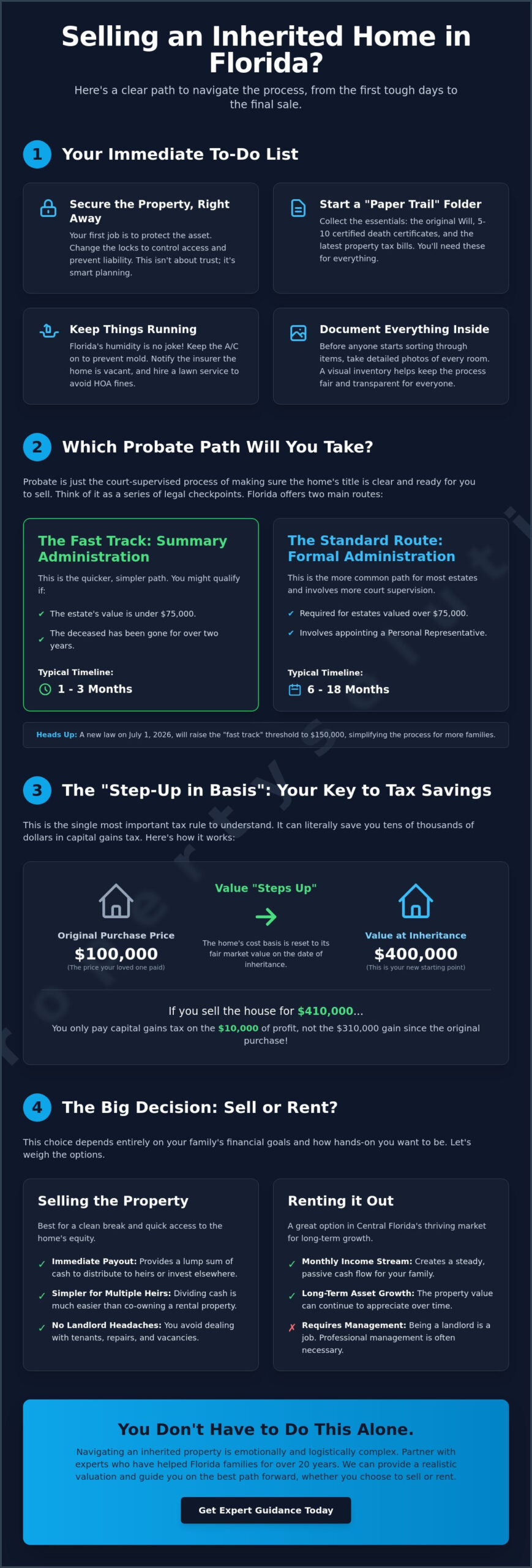
- Secure the property right away by changing the locks and updating the insurance to protect your family’s asset.
- Find out if you qualify for Summary Administration, a faster probate path for estates valued under $75,000.
- Understand the “step-up in basis” rule, which is the secret to minimizing taxes when selling an inherited property in florida.
- Weigh the benefits of a clean sale against the potential for monthly rental income in the thriving Central Florida market.
- Learn how to simplify the transition by partnering with experts who offer both seller representation and professional property management.
First Steps: What to Do Immediately After Inheriting a Florida Home
Inheriting a home usually happens during a period of deep personal loss. It’s easy to feel paralyzed by the sheer volume of tasks ahead, but the very first thing you need to do is breathe. Before you dive into the legal complexities of selling an inherited property in florida, you must protect the physical asset. Change the locks today. This isn’t about a lack of trust; it’s about ensuring that only the people legally responsible for the estate have access during this transitional period. It also protects you from liability if someone enters the property without your knowledge.
Once the house is secure, you’ll need to start a “paper trail” folder. This includes gathering at least five to ten certified copies of the death certificate and the most recent property tax bills. You also need to locate the original Will. In Florida’s legal landscape, the Will determines who is appointed as the Personal Representative. This person is the only one with the legal authority to sign a listing agreement or a closing deed. While Florida doesn’t have a state-level death tax, understanding inheritance tax at the federal level is still a vital part of your financial planning. Knowing who is in charge and having the right documents ready will prevent major delays when you’re ready to move forward.
Securing the Asset in Central Florida
Finding Professional Guidance Early
You don’t have to handle this process alone. While a probate attorney manages the court filings, a real estate agent with specific probate experience handles the property’s market value and physical readiness. Be wary of “we buy houses” flyers that often appear in the mail shortly after a death notice. These investors often offer significantly less than the home’s actual value, counting on your desire for a quick exit. Instead, look for a partner who can give you a realistic valuation and help you weigh all your options. The team at Morgan Property Solutions has spent over 20 years helping families navigate these exact transitions. Having an experienced ally means you can focus on your family’s needs while we manage the logistics of selling an inherited property in florida with the care it deserves.
Navigating Florida Probate: Clearing the Path to a Sale
Think of probate as the legal bridge between the person who passed away and the new owner. It is a court-supervised process that verifies the Will and ensures all debts are paid before you can move forward with selling an inherited property in florida. While the word “probate” often triggers stress, it’s really just a series of checkpoints designed to make sure the title is clean and the transfer of ownership is official. Without this process, you won’t have the legal authority to sign a deed or transfer the keys to a buyer.
Florida offers two main paths for this. If the estate’s non-exempt assets are worth less than $75,000, or if the person has been deceased for more than two years, you may qualify for Summary Administration. This is the “fast track.” It’s helpful to know that a new law is set to increase this threshold to $150,000 on July 1, 2026, which will allow even more families to avoid the longer process. While you’re managing these legal steps, it’s also wise to check the federal estate tax implications for the total estate to ensure you’re prepared for any year-end filings. If you’re feeling stuck on where to start with the property’s status, reading through our landlord resources can help you understand your rights and local requirements during this time.
Types of Florida Probate Explained
Summary Administration is often the goal because it can be wrapped up in just one to three months. However, most larger estates in Central Florida will go through Formal Administration. This is the standard route, usually taking anywhere from six to eighteen months. If the deceased lived in another state but owned a home here, you’ll need Ancillary Probate. This is a secondary Florida-based process that runs alongside the primary probate in their home state to specifically handle the Florida real estate.
Clearing the Title for a Smooth Closing
Before the house hits the market, a title search is essential to identify hidden liens or unpaid property taxes that could stall a sale. You want to resolve these “clouds” on the title early so they don’t surprise you three days before closing. Florida law also provides a “Homestead Advantage,” which protects a primary residence from many general creditors, ensuring more of the sale proceeds stay with the heirs. Title insurance serves as the buyer’s protection against any future claims that might pop up after the sale is finalized. Clearing these hurdles early is the best way to ensure that selling an inherited property in florida stays on track and ends with a successful closing.
The Big Decision: Should You Sell or Rent the Property?
Once you’ve started the journey through Florida’s probate process, the next big question usually hits: what do we actually do with the house? It’s a crossroad that every heir faces. You could sell it for a lump sum or keep it as a continuous source of income. This decision involves “emotional math” just as much as financial logic. Selling an inherited property in florida is often the simplest path for families who want to resolve debts and move forward. However, with Florida’s median home price sitting at $420,000 as of April 2026, you’re holding a valuable asset that could build generational wealth if managed correctly.
The Central Florida market remains incredibly resilient. In areas like Orlando, Tampa, and Lake Nona, we’re seeing strong demand from people relocating to the state. Even with a 4.7-month supply of housing inventory, the rental market is tight. Keeping the home allows you to benefit from long-term appreciation and tax perks like depreciation. On the other hand, selling makes the most sense if you need immediate liquidity to pay off estate expenses or if the heirs live too far away to keep an eye on the place. It’s about finding the balance between a clean break and a long-term investment.
Evaluating Rental Potential in 2026
The Perks of Selling Now
Selling an inherited property in florida right now allows you to tap into high demand in sought-after neighborhoods like Delaney Park or Oviedo. With single-family inventory at 5.4 months, buyers are still actively looking for well-kept homes. Selling also simplifies the inheritance process. It’s much easier to divide cash proceeds among siblings than it is to manage a joint rental business. You’ll also stop the clock on “holding costs” like property taxes, HOA fees, and insurance, which can quickly eat into your inheritance if the home sits empty for too long.
Taxes and Costs: What You’ll Actually Take Home
Beyond taxes, you’ll need to consider the physical state of the home. Many inherited properties are older and might need significant updates to fetch a top-market price. You’ll have to weigh the return on investment for repairs against the ease of selling the home “as-is.” In a balanced market like we’re seeing in 2026, buyers often have more leverage, so making small, high-impact repairs can sometimes prevent the property from sitting on the market too long. If you’re unsure where to put your money, our real estate articles offer deep dives into which upgrades actually add value in the Central Florida area.
Understanding the ‘Step-Up in Basis’
The cost basis of an inherited home is “stepped up” to its fair market value at the date of the owner’s death. This tax rule is a massive advantage because it essentially wipes out the capital gains that accumulated while the previous owner held the property. For example, if your parents bought a home in Oviedo for $100,000 decades ago and it’s worth $500,000 when they pass, your “basis” becomes $500,000. If you sell it shortly after for that same price, you’ll owe zero federal capital gains tax. This is why getting a professional appraisal at the time of inheritance is vital; it provides the IRS with the documentation needed to prove the property’s value at that specific moment.
Florida-Specific Closing Expenses
When the deal is finalized, there are a few standard costs unique to our state. The largest of these is the Documentary Stamp Tax on the deed. In most Florida counties, this is calculated at $0.70 per $100 of the sale price. You’ll also need to handle property tax proration. Since Florida taxes are paid in arrears, the seller is responsible for the taxes from January 1st up until the day of the closing. Finally, you should plan for professional representation. Hiring a full-service firm ensures that your interests are protected and that all the complex paperwork is handled correctly. If you’re ready to see what your property is worth in today’s market, contact Morgan Property Solutions for a professional valuation and expert guidance on selling an inherited property in florida.
How Morgan Property Solutions Simplifies Your Inheritance
Our Dual-Path Strategy
We don’t believe in one-size-fits-all solutions. Our team provides a comprehensive free home valuation alongside a detailed rental analysis. This gives you the full picture before you make a commitment. If the home needs work to reach its full potential, you can tap into our network of vetted contractors to handle repairs without the headache of finding them yourself. This is especially helpful for out-of-state heirs who can’t be here to oversee the lawn crew or the painters. We provide the professional support needed to maximize your financial return, whether you choose to sell or rent.
Start the Conversation Today
You’ve already navigated a lot of emotional and legal ground. The next step shouldn’t feel like a high-pressure sales pitch. We focus on transparency and direct communication, providing you with the clear facts you need to make an informed choice for your family’s future. Our commitment is to provide reliable care throughout your entire journey. Whether you decide to sell the property or transition into residential property management, we’re here to provide the supportive guidance you deserve. Please Contact Morgan Property Solutions to discuss your inherited property options and let us help you move forward with confidence.
Moving Forward with Confidence
Our team brings over 20 years of Central Florida expertise and specialized knowledge in probate real estate to every partnership. As a high-rated property management and sales team, we pride ourselves on being the steady ally you need during these complex moments. You’ve done the hard work of learning the ropes; now it’s time to take the next step toward a stress-free transition. We are here to help you navigate every detail with care and transparency.
Frequently Asked Questions
Do I need probate to sell an inherited house in Florida?
Yes, you generally need to go through probate to clear the title before the sale can be finalized. This court-supervised process ensures the deceased’s debts are settled and the property is legally transferred to the heirs. If the home was in a living trust or held with a “right of survivorship,” you might be able to skip this step. It’s best to have a probate attorney review the deed to confirm your specific situation.
How long does it take to sell an inherited property in Florida?
The timeline varies based on the legal path you take. If you qualify for Summary Administration, the legal part could finish in about one to three months. Formal Administration usually takes six to eighteen months. Once the legal path is clear, you’ll still need to account for the time it takes to find a buyer. In 2026, homes are staying on the market a bit longer as the Florida housing inventory reaches a 4.7-month supply.
Does Florida have an inheritance tax on real estate?
No, Florida does not impose a state-level inheritance or estate tax on real estate. This is a common point of confusion for many families. While the state won’t take a cut, you should still be aware of federal estate tax rules. For 2026, the federal exemption is $15 million per individual, so most estates won’t owe federal taxes either. This makes selling an inherited property in florida much more straightforward from a tax perspective.
Can I sell the house if there are multiple heirs who disagree?
All heirs listed on the title must agree to the sale and sign the closing documents. If one person refuses, you can’t simply outvote them. In cases of a total stalemate, you might have to file a “partition action.” This is a legal process where a judge orders the sale of the home and divides the proceeds. It’s often a last resort because legal fees can quickly eat into your inheritance.
What is a ‘Step-Up in Basis’ and how does it help me?
A “Step-Up in Basis” resets the property’s tax value to its fair market value on the day the owner passed away. This is a huge benefit because you only owe capital gains tax on the profit made after that date. If the house was worth $420,000 when you inherited it and you sell it for $430,000, you only pay taxes on the $10,000 gain rather than the total appreciation since the original purchase years ago.
What happens if the inherited property has a mortgage?
The mortgage doesn’t disappear when the owner passes away. The estate or the heirs must continue making monthly payments to keep the loan current and avoid foreclosure. When you sell the property, the remaining mortgage balance is paid off first from the sale proceeds. If the house is worth less than the loan amount, you’ll need to discuss a short sale with the lender or the probate attorney before moving forward.
Can I sell an inherited home ‘as-is’ in Central Florida?
Yes, selling “as-is” is a very popular option for heirs who don’t want to manage renovations. You simply disclose known issues and the buyer accepts the home in its current state. While this saves time and stress, remember that buyers in the 2026 balanced market will likely ask for price credits if they find major issues during their inspection. It’s a trade-off between a higher price and a faster, simpler exit.
Is it better to rent or sell an inherited home in Orlando?
This depends on whether you want a lump sum or long-term monthly income. Selling an inherited property in florida provides an immediate clean break and cash for the heirs. However, Orlando’s rental market remains strong in neighborhoods like Lake Nona and Dr. Phillips. If the home is in good shape and you aren’t in a rush for the cash, keeping it as a rental can build significant wealth over time. Professional property management can handle the daily landlord duties for you.

Article by
Oliver Overton-Morgan
Oliver Overton-Morgan is a full-time Real Estate Broker since 2003, with years of experience helping thousands of people purchase and sell real estate throughout Central Florida. He holds a Graduate Realtor Institute designation, LCAM, and has held licenses in good standing as a Florida Mortgage Broker and a Notary Public. Oliver immigrated to central Florida in 2001, and within 5 years Oliver built a successful Real Estate brokerage in central Florida, where he recruited over 75 Sales Associates with 25+ million in sales production.