
Imagine standing in the living room of a home you just inherited, feeling the weight of the past while staring at a stack of legal papers you don’t quite understand. You want to honor your loved one’s legacy, but the reality of maintaining a vacant property and managing family expectations is starting to feel like a full-time job. In truth, selling a house in probate florida involves legal hurdles that often feel just as heavy as the emotional ones. You aren’t alone in feeling overwhelmed by court requirements and the pressure to get everything right for your family.
We understand that you need a clear path forward that protects the property value and your peace of mind. It’s completely normal to feel a bit lost, but the process doesn’t have to be a mystery. This guide is here to simplify the journey, especially with the significant changes introduced by Florida’s HB 1337 in July 2026. You’ll learn how to use the new $150,000 summary administration threshold to your advantage and how to navigate a balanced real estate market effectively. We will walk through everything from court approvals to the final closing, giving you a reliable roadmap to maximize your inheritance while keeping the peace with other heirs.
Key Takeaways
- Understand how the 2026 Florida law updates, like the new $150,000 summary administration limit, can significantly speed up your inheritance timeline.
- Learn why selling a house in probate florida is often possible before the court case officially closes, provided you have the right documentation and court approval.
- Discover practical ways to maintain your property’s value from afar, including how to avoid common “vacant home” issues like Florida mold or pool neglect.
- Get a clear strategy for managing family disagreements and creditor claims so the sale stays on track and your family ties stay intact.
- See how expert seller representation helps you navigate court-required valuations to ensure you’re getting the best possible price in the current balanced market.
What Exactly Happens to a Florida Home During Probate?
Probate is essentially the court’s way of making sure a person’s assets are handled fairly after they pass away. In Florida, real estate doesn’t just “belong” to the heirs the moment a loved one dies. The court must oversee the transfer of the title to ensure debts are paid and the right people receive their inheritance. If there is a valid will, the process is called testate. If there isn’t one, it’s intestate, and Florida’s laws step in to decide who the heirs are. To get a better grasp of the broader legal framework, you can explore What Exactly Happens to a Florida Home During Probate? and see how these rules apply generally before diving into our local specifics.
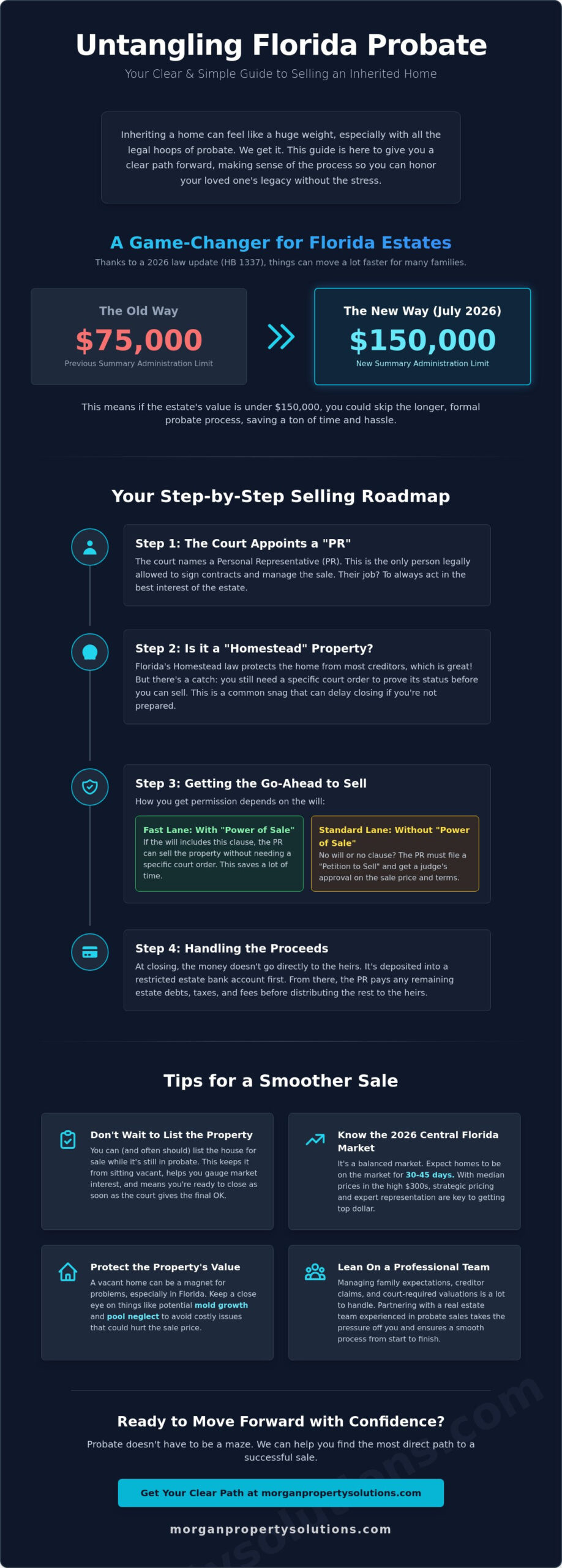
The 2026 Central Florida market is a bit different than the high-stress years we saw recently. It’s moved into a balanced state. From Orlando to Tampa, homes are staying on the market for an average of 30 to 45 days. With median prices in the high $300,000s, you have to be strategic with your timing. Selling a house in probate florida means you’re balancing the court’s legal timeline with a real estate market where buyers have more leverage and options than they used to. Thankfully, new laws like HB 1337, which took effect July 1, 2026, have doubled the summary administration threshold to $150,000, which might help your family avoid the longer formal process if the estate qualifies.
The Role of the Personal Representative
If you’re tasked with selling a house in probate florida, the first thing you’ll realize is that the court is the ultimate supervisor. The judge appoints a Personal Representative, often called a PR, to lead the charge. This person is the only one legally allowed to sign contracts or talk to real estate agents. It’s a fiduciary role, which means you must put the estate’s interests above your own. It can be a lot to handle, especially if you live out of state. Many PRs find that having a professional real estate seller representation team helps take the pressure off. You need a local ally who can keep an eye on the property while you handle the legal filings.
Florida Homestead Laws and Your Sale
Florida treats a person’s primary home differently than other assets. This is known as Homestead status. While it protects the home from being sold to pay off most of the deceased person’s debts, it also requires a specific court order to prove that protection exists. You can’t just sign a deed and walk away. The court has to officially declare the property as Homestead before a title company will let the sale proceed. It’s a common trap for heirs who are in a rush to close. They find a buyer, get an offer, and then realize they’re stuck waiting on a judge’s signature to clear the title. Don’t assume that because you’re the only heir, the house is automatically ready for the market on day one.
Can You Sell a House While It is Still in Florida Probate?
A lot of families worry they’re stuck in a legal waiting room for years before they can even think about finding a buyer. The good news is that you don’t have to wait for the entire case to close to start the process. You can list the property and even sign a sale contract while the court is still reviewing the estate. In fact, many people choose to list early to keep the home from sitting vacant for too long. Selling a house in probate florida is a bit like a relay race. The legal team handles the paperwork, while your real estate partner finds a buyer, and everyone meets at the finish line for the closing.
Listing early also helps you gauge the market demand in real time. In the current balanced market, where buyers are more selective, having your home active on the market allows you to adjust your strategy as the legal process unfolds. You’ll be ready to close the moment the court gives the final green light, rather than starting your search for a buyer at the very end.
Selling With vs. Without a Power of Sale
The speed of your sale often depends on a specific sentence in the will. If the document includes a “Power of Sale” clause, the Personal Representative usually has the authority to sell the home without asking a judge for a specific order. This bypasses a lot of red tape and can save you several weeks. If there is no will, or if that clause was left out, you’ll need to file a “Petition to Sell Real Property.” This tells the judge why the sale is necessary and confirms the price is fair. In Central Florida, specifically in Orange and Osceola counties, court timelines can vary depending on the judge’s schedule. Having a clear understanding of Florida’s official probate process helps you set realistic expectations for your family and your buyer. If you find yourself unsure about the next step, our team at Morgan Property Solutions Inc. is here to offer guidance on the best way to move forward.
Handling the Sale Proceeds
Preparing a Probate Home for the Central Florida Market
Once you’ve cleared the initial legal hurdles, the focus shifts to the physical property. In the 2026 Central Florida market, buyers are more selective than they were a few years ago. Since inventory has improved and homes are sitting for 30 to 45 days on average, your inherited property needs to stand out. Preparing a home for sale while it’s in probate isn’t just about curb appeal; it’s about protecting the estate’s value while meeting specific court requirements. You’re essentially preparing the home for two audiences: the probate judge and the eventual buyer.
Valuation and Appraisal Requirements
A simple Comparative Market Analysis (CMA) from a neighbor’s recent sale usually won’t cut it for the court. Most judges require a formal appraisal to ensure the home is being sold at a fair price, protecting all heirs involved. This is also vital for your tax situation. Florida heirs benefit from a “stepped-up basis,” where the property’s value is reset to its worth on the day the owner passed away. This can save you thousands in capital gains taxes later. When Navigating Heirs, Creditors, and Mortgages, having a professional appraisal provides a solid baseline that keeps everyone on the same page and prevents family disputes over the listing price. We recommend working with agents who have a network of appraisers familiar with these specific probate needs.
Maintenance for Out-of-State Heirs
If you don’t live in Orlando or Tampa, managing a vacant home is a major source of stress. Florida’s humidity is relentless. If the AC fails or is turned off to save money, mold can take over a house in a matter of days. Likewise, a pool that isn’t serviced weekly will turn into a green swamp, which is a massive red flag for buyers and a potential fine from the HOA. This is where property management expertise becomes a lifesaver. Having a local team to handle lawn care, pest control, and regular security checks ensures the home stays in peak condition. When selling a house in probate florida, your goal is to keep the property “market-ready” at all times so you don’t lose a great offer because of a neglected exterior or a musty smell during a showing.
Repairs and Staging with ROI in Mind
You don’t need to do a full kitchen remodel to get a good price in 2026. Focus on high-impact, low-cost fixes that make the home feel safe and clean. Fresh neutral paint, updated light fixtures, and professional carpet cleaning go a long way. Since many probate homes have decades of “lived-in” history, staging is crucial. It’s hard for a modern buyer to see themselves in a house filled with heavy drapes and vintage wallpaper. Removing personal items and thinning out furniture helps the rooms feel larger and brighter. By neutralizing the space, you make it easier for buyers to imagine their own lives there, which often leads to faster offers and a higher final sale price.
Navigating Heirs, Creditors, and Mortgages Without the Stress
Mortgages and Foreclosure Prevention
Mortgages don’t hit the pause button during probate. Even though the owner has passed, the lender still expects monthly payments to be made on time. As of June 1, 2026, with average 30-year fixed mortgage rates in Florida at 6.55%, the cost of holding onto a property can add up quickly. If the estate doesn’t have the liquid cash to keep up, you risk the bank starting foreclosure proceedings. It is vital to notify the lender that the property is in probate as soon as possible. Most banks prefer to work with you on a solution rather than taking the house through a legal battle, especially if they know a sale is already in the works. If the house happens to be worth less than the debt, you might need to look into a short sale. In most cases, however, the equity in the home allows you to simply use the sale proceeds to pay off the mortgage entirely at the closing table, which keeps your credit and the estate’s value intact.
Managing Family Conflict
Disagreements between heirs are incredibly common and can be very painful. One sibling might want to hold out for a higher price, while another needs the money right away to cover their own expenses. This tension can stall a sale for months and lead to a vacant home deteriorating in the Florida heat. This is why having a neutral, professional voice in the room is so helpful. We can provide the hard data to show what a fair market price looks like in the current balanced Central Florida market. If one heir flatly refuses to sell, there are legal avenues, like a partition action, but these are expensive and often drain the estate’s funds. Keeping everyone updated on the timeline and the reality of the market helps lower the temperature. If you need someone to help bridge the gap between family members and handle the heavy lifting, our real estate seller representation services at Morgan Property Solutions Inc. are designed to bring professional guidance and peace of mind to everyone involved.
Dealing With Creditor Claims
Part of the probate process involves publishing a “notice to creditors” in a local newspaper. This gives anyone the deceased person owed money to a window of time to file a claim against the estate. While it feels like a frustrating delay, it’s actually a protection for the heirs. It ensures that once the estate is closed and the money is distributed, no one can come back later and demand money from you personally. You can still move forward with the sale of the home while this clock is ticking; the funds will just stay in the estate account until the creditor period officially ends. This methodical approach ensures that the final payout you receive is yours to keep, free and clear of any lingering legal surprises.
How a Local Real Estate Partner Simplifies the Probate Sale
While a probate attorney is essential for legal filings and court appearances, they usually don’t have the tools to maximize your home’s value on the open market. Their job is to clear the title; our job is to find the right buyer who sees the true potential of the property. Selling a house in probate florida requires a dual approach where the legal paperwork matches a real world marketing strategy. You need a partner who understands the judge’s requirements but also knows how to position a home in the 2026 Central Florida market to get the best possible return for the heirs. We bridge that gap by handling the boots on the ground details that lawyers typically don’t touch.
The Value of 20+ Years of Central Florida Experience
With over two decades of experience, we’ve seen every shift in the Florida market, from the high stress years of the past to the balanced state we’re seeing in June 2026. Whether the property is in Orlando, Tampa, or Miami, we understand the local nuances that drive buyer interest. Experts predict a 3% to 5% annual price increase for much of Florida through the end of the year, which means your inherited home is a valuable asset that deserves professional attention. We also know that heirs often don’t have the energy to vet contractors for last minute repairs. We maintain a network of reliable professionals who can jump in quickly to handle everything from a leaky roof to a neglected lawn. You can learn more about our team and our commitment to helping families through these transitions.
A Reassuring Partnership
Probate often feels like learning a second language full of confusing jargon. We take pride in distilling those complex steps into manageable, everyday actions. You shouldn’t have to stay up at night wondering “what now?” or worrying about a missed court deadline. We act as a steady ally, keeping you informed at every phase and ensuring the real estate side of the estate moves as smoothly as the legal side. Dealing with the complexities of selling a house in probate florida while managing the expectations of multiple heirs is a lot for anyone to handle alone. While you focus on your family and honoring your loved one’s memory, we focus on the logistics of the sale and your final financial return. Our goal is to move you from feeling overwhelmed to feeling confident that the home is sold and the legacy is protected. If you’re ready to move toward a successful closing, our real estate seller representation team is ready to guide you every step of the way.
Moving Forward With Confidence and Clarity
Handling an estate is a journey that requires both legal precision and a smart real estate strategy. By now, you’ve seen how the 2026 updates to Florida’s summary administration laws can help you move faster, and how a balanced market in Orlando or Tampa requires a thoughtful approach to pricing and property care. Selling a house in probate florida doesn’t have to be a source of family tension or endless court delays. It’s about taking the process one step at a time with the right support by your side.
Our team brings over 20 years of Central Florida real estate expertise to every sale. We specialize in the Orlando and Tampa probate markets, offering a unique integration of A+ property management and sales representation. This means we don’t just list the house; we protect it, manage the logistics, and ensure you get the best possible value for your inheritance. We’re here to be your steady ally from the first court filing to the final closing signature.
Let us help you navigate your Florida probate sale with ease. You’ve already done the hard work of honoring your loved one’s legacy. Now, let us handle the details so you can focus on what truly matters most to your family.
Frequently Asked Questions
How long does it take to sell a house in probate in Florida?
The timeline for selling a house in probate florida varies based on the type of administration the court requires. If the estate qualifies for summary administration, which has a threshold of $150,000 as of July 2026, the process can often wrap up in just a few months. Formal administration typically takes six to twelve months. You can often list the home for sale much sooner once the court appoints the Personal Representative, which helps you find a buyer while the legal work continues.
Do I need a lawyer to sell a house in probate in Florida?
In almost every case involving real estate, Florida law requires you to have an attorney. The court needs a licensed lawyer to represent the Personal Representative during formal administration to ensure all legal steps are followed correctly. While it’s an added cost, having a lawyer protects you from personal liability and ensures the title is cleared properly for the eventual buyer. It’s a necessary step to make sure the deed transfer is legally binding.
Who pays the property taxes and mortgage during Florida probate?
The estate itself is responsible for all carrying costs, including property taxes and mortgage payments. The Personal Representative uses the estate’s bank account to cover these bills until the home is sold. If the estate is short on cash, heirs sometimes choose to pay these costs out of pocket to prevent foreclosure or tax liens. They can then be reimbursed from the sale proceeds once the house closes and funds are available in the estate account.
Can I sell the house if the deceased person didn’t leave a will?
Yes, you can sell a property even if the deceased person died “intestate,” which means they didn’t leave a will. The process just follows Florida’s default laws to determine who the legal heirs are. Since there won’t be a “Power of Sale” clause to rely on, the Personal Representative will simply need to get a specific court order to move forward with the sale. It’s a common situation that we help families manage every year.
What is the “Petition to Sell Real Property” in Florida?
A “Petition to Sell Real Property” is a legal document filed with the court asking the judge for permission to sell the home. This is a standard requirement when a will doesn’t explicitly give the Personal Representative the power to sell or when there is no will at all. The petition usually includes the proposed sale price and terms. It ensures the court that the deal is fair to all heirs and that the property is being sold at a reasonable market value.
Do all heirs have to agree to sell the house in Florida?
No, you don’t technically need a unanimous vote from every heir to sell the house, but it certainly makes the process smoother. The Personal Representative holds the legal authority to manage the estate’s assets. If an heir strongly objects, they can file a challenge in court, which might delay the closing. In extreme cases, a judge might require a partition action to force the sale and distribute the proceeds fairly among all beneficiaries.
Can I live in the house while it is in probate?
You can sometimes live in the home, but you’ll need permission from the Personal Representative and potentially the court. If the house is considered a Homestead property, a surviving spouse or minor children may have an immediate right to stay there. If you aren’t the primary heir, you might be expected to pay rent to the estate. This ensures that the interests of all other heirs are protected while the legal process moves forward.
What happens if the house is worth less than the mortgage during probate?
If the mortgage balance is higher than the home’s value, the estate is considered insolvent. In this situation, the heirs won’t receive any money from the sale, but they also aren’t responsible for paying the bank back out of their own pockets. You would likely work with the lender on a short sale to settle the debt. This allows the estate to clear the title and move on without the burden of a property that is underwater.

Article by
Oliver Overton-Morgan
Oliver Overton-Morgan is a full-time Real Estate Broker since 2003, with years of experience helping thousands of people purchase and sell real estate throughout Central Florida. He holds a Graduate Realtor Institute designation, LCAM, and has held licenses in good standing as a Florida Mortgage Broker and a Notary Public. Oliver immigrated to central Florida in 2001, and within 5 years Oliver built a successful Real Estate brokerage in central Florida, where he recruited over 75 Sales Associates with 25+ million in sales production.