
You might be surprised to learn that Florida law doesn’t actually require a seller to fix a single item found during a home inspection. Whether it’s a leaky faucet or an aging HVAC system, the state doesn’t step in to force a repair just because a report says it’s broken. This often leads to a lot of confusion when trying to figure out what repairs are mandatory after a home inspection in florida. While the law stays out of it, your lender and insurance company certainly won’t. If you’re feeling anxious about a deal falling through over a long list of defects, you aren’t alone. It’s completely normal to worry about repair costs or wonder if an older roof will keep you from getting coverage in today’s market.
I’m here to help you clear up that confusion and take the stress out of your closing process. In this guide, you’ll discover exactly which repairs are non-negotiable for lenders, which ones your insurance carrier will demand, and which items you can safely walk away from. We’ll break down the latest 2026 updates, including how new permit laws and condo milestone inspections might affect your sale. By the end, you’ll have a clear roadmap to stay compliant with disclosure laws while keeping as much money in your pocket as possible.
Key Takeaways
- Understand that while Florida law doesn’t force sellers to fix anything, your lender or insurance provider might require specific repairs before they’ll approve the deal.
- Get a clear list of what repairs are mandatory after a home inspection in florida by distinguishing between minor cosmetic issues and major safety hazards.
- Learn the critical differences between “As-Is” and “Standard” contracts so you know exactly when a seller is obligated to pay for general repair items.
- Discover why FHA and VA loans have much stricter habitability standards and which specific defects could cause your financing to fall through.
- Find out how to use professional inspection reports to negotiate better terms and avoid overpaying for repairs during the closing process.
Are Any Repairs Truly Mandatory After a Florida Home Inspection?
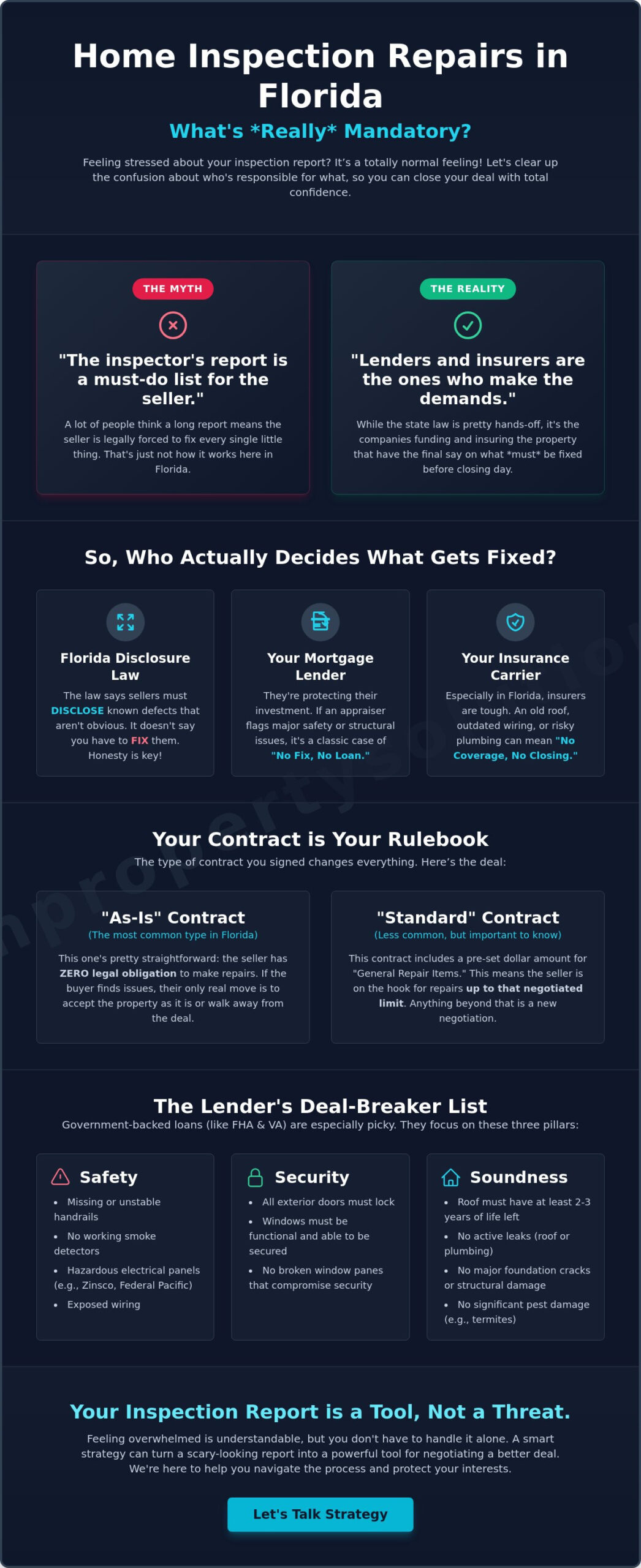
Many buyers and sellers think a home inspector is like a judge who hands down a final verdict. That isn’t how it works. A professional home inspection is simply an expert opinion on the condition of a property at a specific moment in time. The inspector doesn’t have the power to stop a sale or force a seller to pick up a hammer. Instead, the term “mandatory” usually comes from outside forces like your mortgage lender or specific legal requirements. A mandatory repair is any fix required by a lender or law to successfully close the loan and transfer the title.
Whether you’re actually on the hook for these costs depends entirely on the contract you signed. In a standard Florida Realtors/Florida Bar contract, there’s often a pre-negotiated limit for “General Repair Items.” However, if you’re using the more common “As-Is” contract, the seller isn’t legally obligated to fix anything at all. In that scenario, “mandatory” just means the buyer might walk away if you don’t agree to the repair. Understanding what repairs are mandatory after a home inspection in florida helps you separate the emotional requests from the deal-breakers that could actually kill your closing.
The Myth of the “Failed” Inspection
You’ll never see the word “fail” on an official report. Houses don’t pass or fail; they just have conditions. An inspection report can be fifty pages long, which is enough to make anyone’s heart race. Don’t panic over the length. Most of those pages are just descriptions or minor maintenance tips. Your focus should stay on material defects. These are issues that significantly impact the home’s value or safety, rather than a long list of small, cosmetic maintenance items that won’t stop a loan from funding.
Florida Disclosure Laws (Johnson v. Davis)
While you might not be forced to fix an issue, you are legally required to talk about it. Thanks to the landmark Johnson v. Davis case, Florida sellers must disclose any known defects that aren’t easily seen but affect the property’s value. Selling “As-Is” doesn’t give you a pass to hide a cracked foundation or a history of toxic mold. If you know about a problem, you have to disclose it. Failing to do so could lead to a lawsuit long after the moving trucks have left. You can find more guidance on these requirements in our real estate articles.
Lender-Required Repairs: When the Bank Says “No Fix, No Loan”
You might have a signed contract and a willing buyer, but if the bank isn’t happy with the property’s condition, the deal won’t cross the finish line. This is where the concept of What Fixes Are Mandatory After a Home Inspection becomes very real. Mortgage lenders are primarily concerned with protecting their investment. If a home has safety hazards or structural issues, it represents a high risk. While conventional loans are often more flexible, government-backed loans like FHA and VA have strict “Minimum Property Standards” that are non-negotiable.
Sometimes, an appraiser will flag these items during their visit, marking the appraisal “subject to repairs.” When this happens, the loan won’t fund until a licensed professional fixes the issue and the appraiser returns to verify it. If you’re wondering what repairs are mandatory after a home inspection in florida, these lender-driven demands are usually at the top of the list. Sellers often find themselves in a tough spot here; you can either pay for the fix or risk the buyer’s financing falling through entirely. If you’re feeling overwhelmed by these requirements, our team providing Real Estate Seller Representation can help you navigate these negotiations and find the most cost-effective path forward.
FHA and VA “Minimum Property Standards”
- Safety: This includes missing handrails on stairs, non-working smoke detectors, and outdated electrical panels. Specifically, many lenders will reject homes with Federal Pacific or Zinsco panels because they’re known fire hazards.
- Security: All exterior doors and windows must have functional locks to ensure the home is secure.
- Soundness: The roof is a major focus. Most lenders require at least two to three years of remaining life. If the roof is at the end of its cycle, they’ll likely demand a replacement before closing.
The Florida Insurance Hurdle: The “Unspoken” Mandatory Repairs
Standard vs. As-Is Contracts: Understanding Your Repair Obligations
The paperwork you sign at the beginning of your real estate journey dictates your entire repair strategy. When you’re trying to figure out what repairs are mandatory after a home inspection in florida, the very first place you should look isn’t the inspection report. It’s your contract. In Central Florida, most transactions use one of two forms: the “As-Is” Residential Contract or the “Standard” Florida Realtors/Florida Bar (FR/Bar) Contract. Each one handles repairs in a completely different way, and picking the wrong one can lead to expensive surprises at the closing table.
Most sellers in the Orlando area prefer the “As-Is” contract because it’s simpler. Under this agreement, the seller has zero legal obligation to fix anything found during the inspection. However, there’s a catch. The buyer usually has a 15 day window to inspect the property and can cancel for any reason at all. This means that while no repair is technically “mandatory” by the letter of the contract, you might still choose to fix a leaky pipe just to keep the buyer from walking away. It’s a game of leverage rather than a legal mandate. You can find more deep dives into these contract differences in our real estate articles.
The “Standard” contract is much more rigid. It requires the seller to address “General Repair Items” that aren’t in working condition. This is where the distinction between “Working Condition” and “Cosmetic Condition” becomes vital. If a dishwasher doesn’t actually wash dishes, it’s a repair item. If the dishwasher is just scratched or an outdated color, that’s cosmetic, and the seller doesn’t have to do a thing. This contract protects buyers from major functional failures while protecting sellers from being nitpicked over minor wear and tear.
The 1.5% Repair Cap Explained
In a standard contract, the seller’s liability isn’t bottomless. There’s typically a pre-negotiated repair cap, often set at 1.5% of the purchase price. If a home sells for $400,000, the seller is only obligated to pay up to $6,000 for general repairs. If the estimates from licensed contractors come back higher than that, the seller can choose to pay the excess or the buyer can decide to accept the property with the $6,000 credit and handle the rest themselves. It’s a built-in safety net that prevents a single inspection from draining a seller’s entire profit.
Negotiating Credits vs. Physical Repairs
Even when a repair is necessary, you don’t always have to pick up a wrench. Many sellers prefer offering a closing cost credit or a price reduction instead of doing the work themselves. This is often the smartest move. If you hire a contractor to fix a roof and it leaks again two months later, the buyer might come back to you with complaints. By offering a credit, the buyer can choose their own contractor and manage the quality of the work. Just remember that all credits must be approved by the buyer’s lender to ensure they stay within the allowed limits for the specific loan type.
Navigating the Negotiation: A Step-by-Step Guide to Post-Inspection Fixes
Once you have the inspection report in hand, it’s easy to feel overwhelmed by the sheer number of findings. Most reports are dozens of pages long, but you shouldn’t let the volume rattle you. The goal now is to transform that data into a clear plan of action. While we’ve discussed how lenders and insurance companies define what repairs are mandatory after a home inspection in florida, your personal negotiation strategy is what actually keeps the deal moving toward the finish line.
First, you need to review the report and separate “Safety and Structural” issues from “Cosmetic” ones. A cracked tile or a faded wall shouldn’t be on your priority list. Second, get independent quotes from licensed Central Florida contractors rather than relying on the buyer’s estimates. Third, determine your leverage by looking at current Orlando market conditions. If there are five backup offers waiting, you can be much firmer. Fourth, draft a formal Repair Addendum that clearly states what will be fixed, or offer a closing credit to simplify things. Finally, ensure all work is finished and re-inspected well before the closing date. If you need help managing this process, our team at Morgan Property Solutions provides expert Real Estate Seller Representation to ensure you aren’t taken advantage of during negotiations.
Prioritizing the “Big Three”: Roof, Electric, and Plumbing
You should almost always address active leaks or fire hazards immediately. These are the issues that stop insurance companies from writing policies and lenders from funding loans. In Florida, you also have to keep a close eye on the “WDO” or termite report. Termite damage is a common deal-breaker in our humid climate, and most buyers will insist on a clean bill of health before moving forward. If you’re looking for vetted vendors in Winter Park or Lake Nona to handle these specialized tasks, our landlord resources offer a great starting point for finding reliable professionals who understand the local requirements.
When to Stand Your Ground as a Seller
Simplifying Your Sale: How Morgan Property Solutions Manages the Inspection Process
Closing a deal shouldn’t feel like a high-stakes gamble. After learning about what repairs are mandatory after a home inspection in florida, you might feel like there are too many moving parts to track. That’s where we come in. At Morgan Property Solutions, we take a proactive approach to the entire process. Instead of waiting for a buyer’s inspector to find a problem, we often suggest pre-listing inspections. This allows you to handle issues on your own terms and your own budget before the house even hits the market.
We’ve spent over 20 years navigating the Central Florida real estate landscape. This experience means we’ve seen every type of inspection report imaginable. We know how to distinguish a genuine deal-breaker from a minor maintenance item that shouldn’t slow you down. By managing the timeline from the first inspection through the final walk-through, we reduce the psychological friction that often leads to seller anxiety. Our primary goal is to maximize your profit while making sure every legal disclosure is handled correctly. We act as your steady ally, ensuring that a long list of repairs doesn’t derail your hard-earned equity.
Expert Guidance for Sellers and Landlords
Take the Stress Out of Your Next Real Estate Move
You don’t have to navigate these complex repairs alone. If you’re ready to sell, you can get a professional partner by your side to handle the heavy lifting. We invite you to contact us today for a consultation regarding your property’s current condition and market value. Our philosophy is built on distilling these complex real estate hurdles into manageable steps. When you work with us, you aren’t just getting a service provider; you’re gaining a companion who is present throughout every phase of the sale. You can move toward your closing date with total confidence, knowing that every detail has been handled by a seasoned authority.
Take Control of Your Next Real Estate Closing
With over 20 years of Central Florida real estate expertise, we’ve helped countless homeowners in Winter Park, Lake Nona, and Windermere navigate these exact hurdles. As a top-rated Orlando property management and sales firm, we specialize in distilling these complex negotiations into simple, manageable steps. You don’t have to face the stress of a repair addendum alone. Let Morgan Property Solutions guide you through a stress-free home sale today. We’re here to be your steady ally and ensure you close with total peace of mind.
Frequently Asked Questions
Do I have to fix building code violations found during an inspection in Florida?
No, you aren’t legally required to bring an older home up to today’s building codes just to sell it. Most houses in Orlando have at least one or two items that don’t meet current standards. People often ask what repairs are mandatory after a home inspection in florida regarding these code issues, but the law doesn’t force you to modernize the whole house. Unless a local ordinance or your lender demands a fix for safety, these items are usually just another point for negotiation.
Can a buyer walk away after a home inspection if I offer to fix everything?
Yes, they can. Under the common “As-Is” contract used in Florida, a buyer has a right to cancel the deal for any reason during the inspection period. Even if you offer to fix every single item on their list, they can still choose to walk away and get their deposit back. This is why the inspection phase is often the most stressful part of the entire transaction for a seller.
Is a termite (WDO) inspection mandatory for a home sale in Florida?
Florida law doesn’t require a Wood Destroying Organism (WDO) inspection, but your lender probably will. If the buyer is using a VA or FHA loan, a clean termite report is almost always a requirement for funding. In our humid climate, most buyers will insist on this inspection anyway. It’s a smart move to have a clear report ready to avoid any last-minute surprises that could stall your closing at the eleventh hour.
What happens if the inspection finds mold in a Florida home?
Finding mold can quickly change the conversation about what repairs are mandatory after a home inspection in florida. While the law doesn’t force a fix, most lenders will refuse to fund a loan if active mold is present because it’s a health and safety hazard. You’re also legally required to disclose any known mold issues to the buyer. Most sellers find it’s better to remediate the problem professionally to keep the deal alive.
How long does a seller have to respond to a repair request in Florida?
The timeline is strictly governed by the dates you and the buyer agreed to in the contract. Usually, the buyer has a set number of days, often 15, to complete inspections and send a request. Once you receive that request, the negotiation period begins. There isn’t a one-size-fits-all law for response times. You’ll need to follow the specific deadlines outlined in your Repair Addendum to avoid breaching the agreement accidentally.
Can I do the repairs myself or do I need a licensed contractor?
You technically can do them yourself, but it’s rarely a good idea. Most lenders and savvy buyers will demand that repairs be completed by a licensed and insured Florida contractor. They’ll want to see official receipts and sometimes a warranty for the work performed. If you do the work yourself and something fails later, you could be opening yourself up to legal liability that a professional’s insurance would otherwise cover for you.
What is the “Johnson v. Davis” rule and how does it affect my sale?
This rule comes from a famous Florida Supreme Court case that changed how disclosures work. It states that a seller must disclose any known facts that materially affect the value of a residential property and aren’t readily observable by the buyer. Basically, you can’t stay silent about a buried sinkhole or a roof that leaks every time it rains. It applies even if you’re selling the home in “As-Is” condition.
Does an “As-Is” contract protect me from all repair requests?
An “As-Is” contract protects you from being forced to pay for repairs, but it doesn’t stop the buyer from asking for them. It’s a common misconception that this contract shuts down all negotiations. In reality, buyers often use the inspection report to ask for a price credit or a repair anyway. While you have the right to say no to every request, the buyer also has the right to cancel the contract and move on.

Article by
Oliver Overton-Morgan
Oliver Overton-Morgan is a full-time Real Estate Broker since 2003, with years of experience helping thousands of people purchase and sell real estate throughout Central Florida. He holds a Graduate Realtor Institute designation, LCAM, and has held licenses in good standing as a Florida Mortgage Broker and a Notary Public. Oliver immigrated to central Florida in 2001, and within 5 years Oliver built a successful Real Estate brokerage in central Florida, where he recruited over 75 Sales Associates with 25+ million in sales production.