
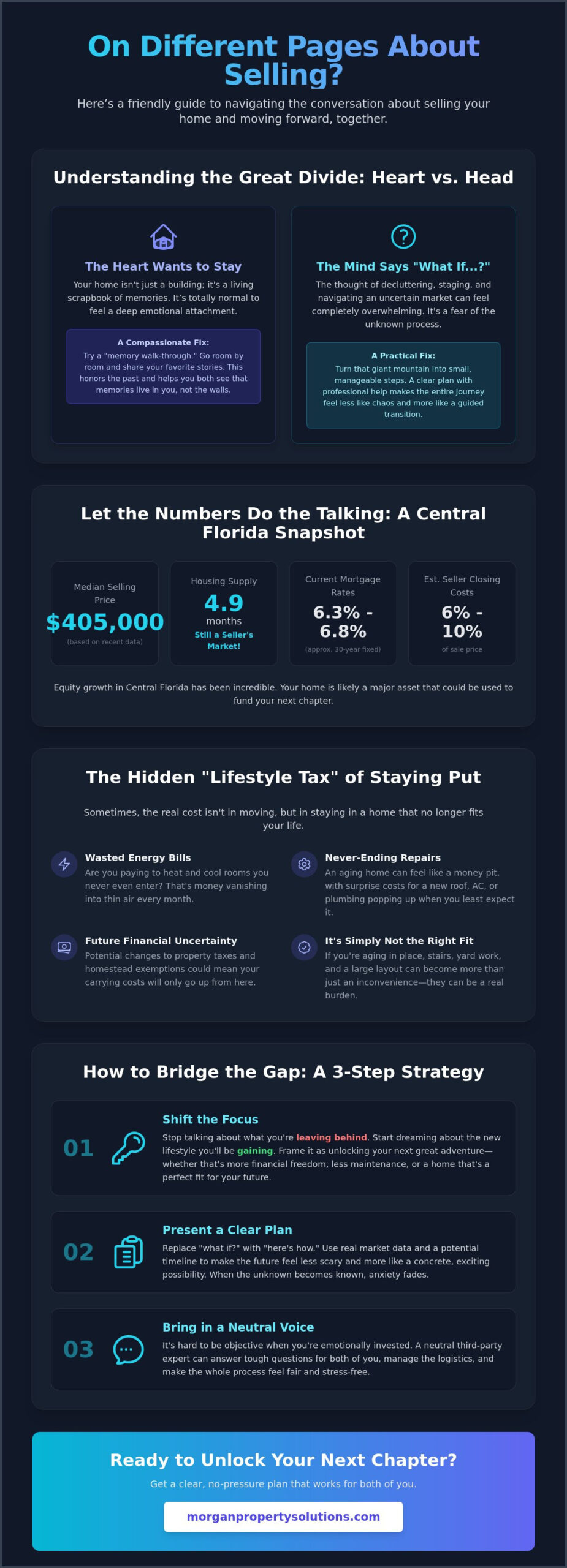
What if the biggest obstacle to your next chapter isn’t the mortgage rate or the housing inventory, but the person sitting across from you at breakfast? It’s incredibly common to feel ready for a change while your partner remains firmly rooted in the past. If you’re feeling stuck in a house that’s too big, too small, or simply too expensive, you’re likely wondering how to convince your spouse it’s time to sell without sparking a major argument. It’s a delicate balance between logic and emotion, especially in a normalizing market like Central Florida where the median price sits around $405,000.
We understand that your home is more than just four walls; it’s where your life happened. However, staying in a property that no longer fits your needs can create a different kind of stress that eventually impacts your relationship. This guide offers a compassionate approach to bridging the gap between your vision and your spouse’s hesitation. We’ll show you how to shift the focus from leaving a house to unlocking a new lifestyle, backed by a clear plan and the financial confidence you need to move forward together. We will walk through how to address their fears, look at the current 4.9 month supply of inventory in Orlando, and create a peaceful path toward your next home.
Key Takeaways
- Identify whether your partner’s hesitation is rooted in deep emotional memories or practical financial worries.
- Use current Central Florida market data to build a logical case for moving while maximizing your home equity.
- Learn how to convince your spouse it’s time to sell by shifting the conversation from what you’re leaving behind to the lifestyle you’re gaining.
- Discover how a neutral third party can help bridge the gap and make the entire transition feel manageable and stress-free.
Understanding Why Your Spouse Is Hesitant to Sell
Selling a house is rarely just a business transaction. It’s an emotional upheaval. If you’re trying to figure out how to convince your spouse it’s time to sell, you have to start by listening. Are they worried about the money, or are they worried about losing the place where your kids took their first steps? Identifying whether the resistance is rooted in deep-seated memories or practical financial anxiety is the first step toward a peaceful resolution.
Home inertia is the psychological comfort of staying in a familiar space despite its drawbacks. It’s the reason many people ignore a cramped kitchen or a three-hour commute for years. Because marriage often involves the co-ownership of property, both partners must feel secure in the decision to move. Dismissing your spouse’s attachment by calling the home “just a house” usually backfires. It signals that you don’t value their feelings, which only makes them dig their heels in deeper. Instead, validate their perspective. Acknowledge that the home has been a sanctuary before you start discussing why it might be time to leave it.
The Power of Emotional Attachment
For many homeowners, the house is a living scrapbook. It represents the height marks on the pantry door and the garden they spent years nurturing. You can acknowledge these memories without letting them anchor you to a property that no longer fits your life. If you’re struggling with how to convince your spouse it’s time to sell, try suggesting a “memory walk-through.” Spend an evening going from room to room, sharing your favorite stories from the years you’ve spent there. This simple act honors the past while helping you both realize that the love and history you’ve built live in your hearts, not the physical walls. It makes the idea of “leaving” feel more like “moving forward.”
Fear of the Selling Process and Market Uncertainty
Sometimes the resistance isn’t about the past at all; it’s about the messy, unpredictable future. The thought of decluttering a decade of family life, hosting open houses, and finding a new home in Central Florida can feel like an impossible burden. Your spouse might be quietly panicking about where you will go next or whether you’ll find a better school district. This fear of the unknown process often disguises itself as a desire to stay put. You can reduce this stress by focusing on the support available to you. Highlighting how a professional partner can manage the logistics of listing and showing the home helps turn a daunting mountain into a series of manageable steps. When the process feels less like a weight and more like a guided transition, the “sell” becomes much easier to swallow.
Presenting the Logical and Financial Case for Central Florida Homeowners
Once you’ve acknowledged the emotional weight of your home, it’s time to look at the cold, hard facts. Numbers have a way of clearing the fog when emotions are high. If you’re wondering how to convince your spouse it’s time to sell, shifting the focus to your financial future is a powerful strategy. It’s not just about moving out of a building. It’s about what that building can do for your retirement, your savings, or your daily peace of mind.
Effective communicating about financial decisions often requires replacing “I think” with “I know.” Instead of guessing what your home is worth, look at the May 2026 data for Greater Orlando. The median selling price reached $405,000, and with 4.9 months of supply, we’re still in a seller’s market. Equity growth in Central Florida has outpaced many other regions over the last five years. This means you’re likely sitting on a significant asset that could be better utilized elsewhere.
Maximizing Profit in Today’s Market
Timing the market in places like Winter Park or Lake Nona isn’t about luck; it’s about understanding inventory. While 30-year mortgage rates are currently between 6.375% and 6.88%, buyer demand remains steady because of continued in-migration to Florida. You’ll also want to account for seller closing costs, which usually range from 6.25% to 10% of the sale price. Waiting another year might seem like the safe choice, but if inventory keeps climbing, your negotiating power could weaken. A professional valuation removes the guesswork. It gives you a concrete number to discuss without the heat of an argument.
The Hidden Costs of Staying Put
Staying in a home that’s too large or aging carries a “lifestyle tax.” Think about the high utility bills for cooling rooms you don’t use or the constant maintenance required for an older roof. There’s also the upcoming vote in November 2026 regarding homestead exemptions. While current laws apply now, the uncertainty of future property taxes is worth considering. If you’re “aging in place” in a home that no longer fits your physical needs, the long-term expenses can be much higher than the cost of moving. Calculating the potential ROI of selling now versus five years from now often makes the transition feel like a smart business move rather than a loss. If you need a clear picture of your property’s potential, exploring professional seller representation can help you map out these financial details.
The Lifestyle Conversation: Painting a Picture of the Future
Spreadsheets and market data are great for the head, but they don’t always reach the heart. If you want to know how to convince your spouse it’s time to sell, you have to talk about the life you’ll lead after the move. It’s time to shift the dialogue. Stop focusing on what you are losing and start talking about what you are gaining. A home is a vessel for your life; if that vessel is too small, too big, or too far away from the things you love, it’s no longer serving you well.
Finding the Right Fit for Your Next Chapter
Starting Small with “Just Looking”
Pressure is the enemy of agreement. Instead of demanding a decision, suggest a low-pressure Saturday morning visiting open houses. This “just looking” approach allows your partner to experience the possibilities without feeling like they’ve already committed to a moving truck. It’s a gentle way to navigate the emotional challenges of selling a home. Use online portals to save listings you both like and track the market together. Keeping the conversation light and exploratory helps your spouse feel in control of the timeline, which is often the most important factor in reaching a peaceful agreement.
Common Objections and How to Compromise
Even when you’ve painted a beautiful picture of the future, you might still run into a wall of “not yet.” This is completely normal. If you are struggling with how to convince your spouse it’s time to sell, look at these objections as requests for more information or more control. It isn’t necessarily a hard “no”; it’s often a “not like this.” Understanding the root of the hesitation allows you to find a middle ground that respects both of your needs.
The most common hurdle is the belief that the market isn’t right. You can counter this with a mix of empathy and current data. Point out that Greater Orlando currently has a 4.9 month supply of homes, which still technically favors sellers. With a median selling price of $405,000 as of May 2026, the market is stable and strategic. Waiting for a “perfect” moment that may never come often leads to missed opportunities in the neighborhood you actually want to move to. If the fear is about the unknown, suggest a “try before you buy” strategy by renting in your target area first to lower the stakes.
The Rental Compromise: Keeping the Asset
Sometimes, the fear isn’t about moving; it’s about losing the security of the asset. If your spouse is terrified of letting go of the property entirely, consider keeping it as a rental. This allows you to move into a home that fits your current lifestyle while maintaining your footprint in the Central Florida market. Professional Orlando property management removes the stress of being a landlord by handling tenant placement, leasing, and maintenance. Professional management protects the property value for a hesitant spouse by ensuring the home is cared for by experts who understand the local market. If you’re considering the rental route as a compromise, exploring Orlando property management services can help you determine if keeping the asset is the right financial move.
Setting a Realistic Timeline
If the speed of the process is the problem, negotiate the “readiness date” instead of the listing date. This gives the hesitant spouse a sense of control over the transition. You might agree to a “Declutter First” phase where you prepare the home to see how it feels without the daily mess. Another smart move is agreeing to a professional home inspection before you list. If the report reveals that expensive repairs are on the horizon, it often makes selling now the more logical and less burdensome choice for both of you.
How a Trusted Partner Simplifies the Transition
Sometimes the most effective way to move past a stalemate is to stop making the conversation about two conflicting opinions. Bringing in an experienced real estate firm provides a neutral third party that can bridge the gap between your desire to move and your partner’s hesitation. When you’re stuck on how to convince your spouse it’s time to sell, an objective valuation and a clear market analysis often do the heavy lifting for you. It shifts the dynamic from a personal argument to a shared strategic decision based on the reality of the current Central Florida market.
At Morgan Property Solutions Inc., we specialize in simplifying these complex life transitions. We don’t just list houses; we help families find the right path forward. Our dual expertise in both real estate seller representation and property management is especially helpful if one of you is still attached to the property as an investment. We provide the data you need to feel confident that your financial future is secure, regardless of which path you choose together. If you’re still navigating how to convince your spouse it’s time to sell, a pressure-free consultation is the best next step to explore your options without any commitment.
Expert Guidance from Valuation to Closing
A successful sale requires more than just a sign in the yard. It requires a customized marketing plan designed to get the top price in a normalizing market. We handle the heavy lifting, from professional photography to managing showings, so you can focus on your family instead of the logistics. Our team is dedicated to removing the psychological friction that often stalls these decisions. You can read more about our approach to see how we prioritize partnership and clear communication throughout the entire process.
Your Ally in Every Phase
Ready to Start Your Next Chapter Together?
Navigating the decision to move is a journey that requires patience and clear communication. You’ve learned that validating your partner’s emotional ties to the home is just as important as showing them the financial benefits of the current Central Florida market. By focusing on the lifestyle you’ll gain rather than what you’re leaving behind, you can turn a stressful debate into an exciting shared goal. If you’re still wondering how to convince your spouse it’s time to sell, remember that you don’t have to navigate this alone.
Bringing in a neutral expert can provide the clarity and confidence needed to move forward. With over 20 years of combined experience in Orlando and its surrounding suburbs, Morgan Property Solutions Inc. offers top-rated local expertise and A+ seller representation. We are here to simplify the process and ensure your financial future is in expert hands. Reach out today to Get a Free Home Valuation and Start the Conversation. Your next great adventure is just one conversation away.
Frequently Asked Questions
How do I start the conversation about selling with my spouse?
Start the conversation by focusing on your shared long-term goals rather than the physical house. Choose a relaxed time to talk, and ask open-ended questions about how your partner feels the current home fits your lives. If you are struggling with how to convince your spouse it’s time to sell, focus on “we” and “our future” to ensure they feel like a partner in the decision rather than someone being pushed into a move.
What if my spouse is worried about the cost of a new home in Orlando?
Reviewing a detailed net sheet that compares your current equity against the down payment for a new property can help alleviate this fear. Many homeowners in Central Florida are surprised by how much their property has appreciated over the last few years. Seeing the actual numbers helps replace financial anxiety with a clear understanding of your buying power. This makes the prospect of a new mortgage feel much more manageable and less like a risk.
Is it better to sell first or buy first in the current Florida market?
Selling first is generally the safer financial move in a normalizing market because it ensures you have the liquid cash ready for your next purchase. This strategy prevents the stress of carrying two mortgages at once if your current home takes longer to close than expected. While buying first is tempting if you find a dream home, selling first provides a clearer budget and stronger negotiating power when you make an offer on your next property.
Can we turn our home into a rental property instead of selling it?
Yes, keeping your home as an investment is a great compromise when you’re figuring out how to convince your spouse it’s time to sell the family asset. This allows you to move into a home that better fits your lifestyle while keeping the original property to build long-term wealth. It’s a practical way to generate passive income and keep a footprint in the Florida real estate market without staying in a house that no longer works for you.
How do we determine the actual value of our home before talking to a realtor?
You can get a realistic idea of your home’s value by looking at the “sold” prices of similar houses in your specific neighborhood from the last 90 days. Focus on properties with the same square footage and similar upgrades. While online estimate tools provide a quick ballpark figure, they often miss local nuances. Researching recent sales gives you a solid foundation for a factual, calm discussion with your spouse before you involve any professionals.
What are the most common reasons spouses disagree on selling?
Disagreements usually happen when one partner is emotionally attached to the memories in the home while the other is focused on practical or financial needs. One person might feel the house is a sanctuary, while the other sees it as a burden of maintenance and high utility bills. Other common friction points include a fear of the moving process itself or uncertainty about where you will live next. Understanding these underlying fears is the key to finding a resolution.
How can a property manager help if we can’t agree on a sale?
A property manager provides a professional rental analysis that shows exactly what your home could earn on the market, offering a “middle ground” option. They take over the daily tasks of finding tenants and handling repairs, which removes the stress of landlording. This helps a hesitant spouse see that moving out doesn’t have to mean losing the home. It turns the property into a hands-off investment that supports your move to a new location.

Article by
Oliver Overton-Morgan
Oliver Overton-Morgan is a full-time Real Estate Broker since 2003, with years of experience helping thousands of people purchase and sell real estate throughout Central Florida. He holds a Graduate Realtor Institute designation, LCAM, and has held licenses in good standing as a Florida Mortgage Broker and a Notary Public. Oliver immigrated to central Florida in 2001, and within 5 years Oliver built a successful Real Estate brokerage in central Florida, where he recruited over 75 Sales Associates with 25+ million in sales production.