
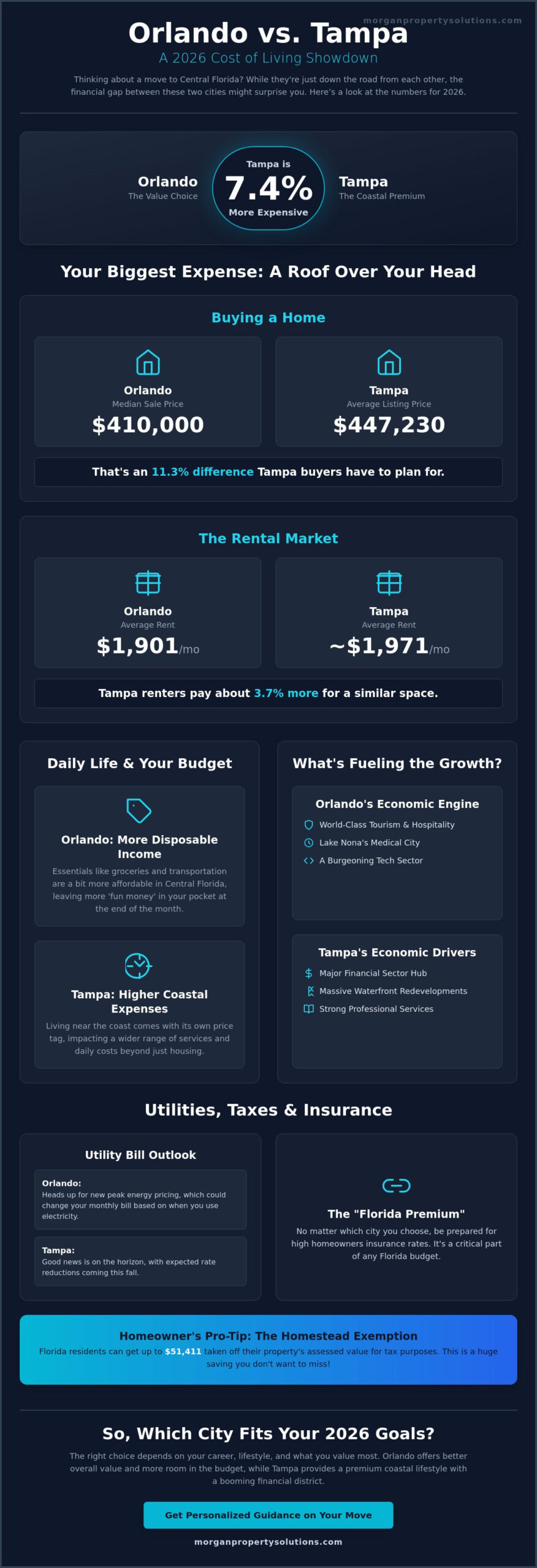
The “coastal premium” of the Gulf Coast might seem like a small price to pay for a sunset, but the financial reality of 2026 shows that the gap between these two cities is wider than you might expect. Many people assume these markets move in lockstep, yet the actual cost of living in orlando vs tampa has diverged in ways that directly impact your monthly budget. With Tampa’s overall expenses currently sitting 7.4% higher than Orlando’s, making the right move requires looking past the surface level prices and into the fine print of local taxes and utility shifts.
It’s completely understandable if you feel a bit of anxiety about skyrocketing insurance rates or the constant climb of rental prices in Florida’s metropolitan areas. We’re here to provide some steady guidance and clear facts to help settle those nerves. You’ll learn exactly how property taxes vary between Orange and Hillsborough counties, including the impact of the $51,411 homestead exemption. We also break down why utility bills are changing this fall and which neighborhoods offer the best return for investors. We have distilled these complex numbers into a simple comparison so you can decide which city truly fits your goals.
Key Takeaways
- Discover why Tampa’s overall expenses currently sit about 7.4% higher than its neighbor and how that affects your daily budget.
- Compare the latest 2026 data on the cost of living in orlando vs tampa to see which city offers the best value for your housing and rental needs.
- Learn how to navigate the “Florida Premium” by understanding property tax exemptions and the latest shifts in homeowners insurance rates.
- Get a clear breakdown of utility changes, including Orlando’s new peak energy pricing and Tampa’s expected rate reductions this fall.
- Identify which city aligns with your 2026 goals, whether you’re looking for family-friendly suburbs or high-yield investment opportunities.
Orlando vs. Tampa: The 2026 Cost of Living Overview
Choosing between the theme park capital and the Gulf Coast’s primary hub used to be a simple choice of lifestyle. Today, it is a complex financial calculation. While these two cities are connected by a 90-mile stretch of asphalt, the cost of living in orlando vs tampa has seen a noticeable split as we move through 2026. Data shows that living in Tampa is now roughly 7.4% more expensive than living in Orlando. This gap isn’t just about the price of a house; it’s reflected in everything from your morning coffee to your monthly electric bill.
The “I-4 Corridor” effect has blurred the lines between these cities as suburbs expand and meet in the middle. This growth has turned the region into a massive economic engine. According to data on Florida metropolitan area populations, both regions are seeing steady influxes of new residents. This constant demand keeps local inflation slightly higher than the national average. It also means that even if you live in a smaller town like Lakeland or Plant City, you are still feeling the price pressure from the major hubs on either side.
The 2026 Price Snapshot: At a Glance
For a comfortable life in 2026, household income requirements have climbed. A direct comparison of the cost of living in orlando vs tampa shows that while Orlando’s average rent sits at $1,901, Tampa renters pay about 3.7% more for similar square footage. Orlando currently holds the edge in disposable income. Since essentials like groceries and transportation are slightly more affordable in Central Florida, residents there often find they have more “fun money” left over at the end of the month. In contrast, Tampa residents often spend a higher percentage of their paycheck on housing and coastal-related expenses.
Economic Drivers: Why Prices Are Shifting
The types of jobs coming to each city are driving these price shifts. Orlando has matured far beyond tourism. The growth of Lake Nona’s Medical City and a burgeoning tech sector have brought high-paying roles that compete for local housing. Tampa’s economy is heavily influenced by its financial sector and massive waterfront redevelopments. These projects attract a different demographic and drive up service costs in the surrounding areas. As these sectors expand, they create a ripple effect. Higher wages for some mean higher prices for everyone else at local restaurants and service providers. If you are considering an investment in the area, our real estate articles offer deeper dives into specific neighborhood trends.
Housing and Real Estate: Buying vs. Renting in 2026
Housing is usually the heaviest weight in any budget. The cost of living in orlando vs tampa is largely defined by what you pay for a roof over your head. In 2026, we are seeing a fascinating split. While the median sale price for a home in Orlando hovers around $410,000, Tampa’s average listing price has climbed to $447,230. That is an 11.3% difference that buyers have to reconcile. It isn’t just about the sticker price, though. Florida residents must also account for Homeowners Association (HOA) fees and Community Development District (CDD) charges. These can add hundreds to a monthly mortgage payment in newer suburban developments.
The Rental Market: Orlando vs. Tampa
If you aren’t ready to buy, the rental market offers a slightly different story. Orlando’s average rent is currently $1,901, while Tampa sits about 3.7% higher. A recent Harvard housing study highlights that many Florida renters are feeling the squeeze of cost-burdened housing, making value-hunting essential. In family-friendly suburbs, a three-bedroom home provides a bit more breathing room for your dollar in Orlando than in coastal Tampa. Trends in Orlando property management have also shifted toward making move-ins easier. Many owners now offer deposit-free renting options. This helps residents keep more cash in their pockets during a transition, which is a major relief when you’re already dealing with moving trucks and utility deposits.
Buying a Home: Inventory and Competition
Investors and families alike are looking toward the outskirts to find better value. In Central Florida, towns like Clermont and Apopka offer a quieter pace and more land for the money compared to Tampa’s outskirts. For those looking to build a portfolio, the cost of living in orlando vs tampa remains a key metric for calculating potential returns. Success in this market depends heavily on who you put in your property. Having strict screening criteria ensures you find reliable residents who will care for your investment long-term. The Price-to-Rent Ratio for Florida investors in 2026 is the median home price divided by the annual median rent, serving as a benchmark to determine if a market favors buyers or renters. If you need help finding the right balance for your next move, our team can provide personalized guidance to simplify your search.
While many real estate costs are recurring, some are strategic one-time investments; for example, if you are setting up a new investment vehicle, you can explore One-time Domain Acquisition Fees to secure a brandable domain name for your business.
Daily Expenses: Groceries, Utilities, and Getting Around
Beyond the mortgage or rent, your daily survival costs shape how your bank account feels by Friday. When you look at the cost of living in orlando vs tampa, the difference in small expenses can surprise you. A quick check of a Forbes cost of living calculator shows that while these cities are close geographically, their utility and transit structures are quite different. These costs are often the ones that catch new residents off guard, especially those moving from out of state.
Groceries are a major part of the weekly budget. Orlando and Tampa both have a heavy Publix presence, which is a Florida staple. If you’re budget-conscious, you’ll find Aldi and Walmart in both markets. However, Tampa’s 7.5% sales tax in Hillsborough County means you’ll pay a bit more for household essentials like paper towels, soap, and cleaning supplies compared to the slightly lower rates often found in parts of Orange County.
Utilities and Connectivity
Keeping your home cool is the biggest recurring expense in Florida. Orlando residents using OUC pay about 17¢/kWh. Starting in the fall of 2026, OUC is introducing “PeakSHIFT” pricing. This model lowers the per-unit cost but adds a fixed monthly charge of $5, $10, or $15 based on when you use the most power. It’s a shift that rewards people who can run their dishwasher or laundry late at night or during off-peak hours.
Tampa Electric (TECO) customers saw a typical bill of $145.58 for 1,000 kWh earlier this year. There is some relief on the way for Bay area residents, though. A temporary storm recovery surcharge is scheduled to be removed on August 1, 2026. This is expected to drop the average monthly bill by nearly $20. For connectivity, both cities offer high-speed fiber in newer developments, though you should budget about $70 to $90 for reliable high-speed internet service.
The Cost of the Commute
The I-4 corridor is the lifeline for both cities, but it comes with a price tag. Orlando commuters often rely on the I-4 Express lanes to bypass heavy congestion. These tolls can easily add $100 a month to a daily commute if you aren’t careful. Orlando does offer the SunRail for north-south travel, which provides a break from the steering wheel for some. Tampa’s public transit is more limited, making a car almost mandatory for most residents.
Car insurance premiums are another factor where Tampa usually takes a bigger bite out of your budget. Higher population density and coastal flood risks in the Bay area generally lead to higher rates than those found in landlocked Orlando. Don’t forget the “time cost” of traffic. Sitting in stop-and-go congestion for an hour each way on I-4 is two hours of your day you can’t get back. This is why many residents are now prioritizing living closer to their specific employment hubs to save both time and money.
The “Florida Premium”: Insurance, Taxes, and Lifestyle
Florida’s lack of a state income tax is a huge draw, but it’s a mistake to think living here is “tax-free.” The state simply collects its revenue in other ways. When evaluating the cost of living in orlando vs tampa, you have to look at the “Florida Premium.” This includes the high cost of protecting your home and the local taxes that fund our growing infrastructure. These expenses are often the most volatile part of a household budget in 2026, and they require careful planning to avoid surprises.
The Insurance Crisis: Orlando vs. Tampa
Homeowners insurance has become the primary budget-breaker for many residents. Orlando properties often see slightly lower premiums because they are landlocked and sit away from the immediate threat of coastal storm surges. Tampa, however, faces a different reality. Even if you aren’t directly on the water, the proximity to the Gulf means higher wind and flood insurance requirements. Many Tampa residents now find flood insurance to be a necessity regardless of their official flood zone. Recent legislative changes in 2026 have focused on attracting more carriers to the state, though it will take time for these shifts to translate into lower monthly bills for the average homeowner.
Taxation and the Bottom Line
Property taxes are another area where the two cities diverge. In Orlando, the median property tax rate is approximately 1.19%, with city millage rates holding steady at 18.1 mills. Tampa’s city millage rate is higher at 19.8428 mills, which can add up quickly on a high-value home. For 2026, all homeowners can benefit from a $51,411 homestead exemption, which was recently adjusted for inflation. Plus, there is a major trend to watch: a proposed constitutional amendment on the November 2026 ballot could increase the homestead exemption to $250,000 for certain levies. If this passes, it would offer massive relief to residents starting in 2027.
Sales tax also plays a role in your daily spending. Hillsborough County, which includes Tampa, has a total sales tax of 7.5%. This is higher than many surrounding areas and affects everything from your new car to your clothes. For investors, these tax nuances are critical for calculating your net operating income. You can find more details on tax-deductible expenses and local regulations in our landlord resources. If you want to maximize your returns while navigating these complex local costs, we suggest you partner with an experienced property manager who understands the Central Florida market inside and out.
Finally, consider the lifestyle costs. Orlando is the world’s playground, and while residents get discounts on theme park passes, those “staycations” still cost money. Tampa offers a different vibe with its proximity to world-class beaches. Beach days are technically free, but you’ll still pay for parking, gas, and coastal dining. Both cities offer a high quality of life, but your weekend habits will definitely dictate which city feels more affordable to you.
Final Verdict: Which City Fits Your 2026 Goals?
Deciding between these two Florida powerhouses isn’t just about finding the lowest price tag. It is about matching your financial reality with your long-term goals. Orlando is often the top choice for families. Suburbs like Winter Garden and Lake Nona offer master-planned safety and high-performing schools that are hard to beat. For young professionals, the choice is tougher. Tampa’s financial district and Ybor City nightlife offer a fast-paced energy, while Orlando’s tech hubs and Thornton Park provide a more balanced, career-focused environment. When you compare the cost of living in orlando vs tampa, Orlando generally offers more breathing room for those starting their careers or raising a family.
For investors, the 2026 market requires a sharp eye on margins. Orlando’s rapid growth in the medical and tech sectors continues to drive intense rental demand. While Tampa sees strong appreciation, the higher insurance premiums and property taxes can sometimes eat into your monthly cash flow. Success in either city depends on your ability to find the right neighborhood and manage your property efficiently. If you want to maximize your ROI, we suggest looking for areas with high job growth and low vacancy rates. Transitioning into these markets can feel overwhelming, but having a steady ally can simplify the entire process.
Decision Framework: Orlando or Tampa?
Neighborhood selection matters more than city selection. A quiet street in Brandon feels very different from a high-rise in Downtown Tampa. Whether you are buying or selling in Central Florida, use this 5-point checklist to guide your move:
- Commute: Are you comfortable with I-4 tolls or do you need the SunRail?
- Insurance: Can your budget handle the “coastal premium” of Tampa?
- Lifestyle: Do you prefer weekend theme parks or Gulf Coast beaches?
- Growth: Is the local neighborhood seeing new infrastructure or business investment?
- Budget: Does your income support the 7.4% higher expenses found in Tampa?
Next Steps for Your Move
If you are ready to take the next step, start with a professional rental analysis. This helps you understand how the cost of living in orlando vs tampa will affect your specific property or future home. At Morgan Property Solutions Inc., we are committed to your long-term success. We offer expert Orlando property management and investment guidance to help you navigate these complex markets with confidence. Our team is here to provide the supportive partnership you need to make your 2026 real estate goals a reality.
Take Control of Your Florida Future
Making sense of the financial landscape in the Sunshine State requires more than just a map. As we have walked through, the cost of living in orlando vs tampa in 2026 reveals a distinct advantage for those prioritizing suburban value and the rapid growth of Central Florida. While Tampa offers undeniable coastal appeal, it currently carries a heavier weight on the monthly budget for essentials and housing. Finding success in either market depends on your ability to stay ahead of shifting utility rates and the local insurance environment. You don’t have to face these transitions alone.
With over 20 years of combined Central Florida experience, our team is ready to act as your steady ally. We provide top-rated residential property management in Orlando, backed by detailed financial reporting and secure owner portals that keep you informed. We focus on distilling complex real estate processes into manageable steps so you can focus on your long-term success. Ready to take the next step? You can simplify your Florida real estate journey with Morgan Property Solutions Inc. and find the guidance you deserve.
Frequently Asked Questions
Is Orlando or Tampa safer for a long-term real estate investment in 2026?
Orlando’s diversified economy and inland position offer a sense of stability that many long-term investors appreciate. While Tampa’s waterfront redevelopments drive high appreciation, Orlando’s tech and medical city growth provides a steady demand for rental housing. Both cities are growing, but Orlando often feels like a safer bet for those looking to avoid the higher insurance costs associated with coastal living.
How much more does it cost to insure a home in Tampa compared to Orlando?
Insuring a home in Tampa typically costs more because of its coastal location and the associated flood risks. Inland Orlando properties are generally shielded from the most severe storm surges, which can lead to lower premiums. You should expect to pay a coastal premium in Tampa, especially in areas where flood insurance is a mandatory requirement for your mortgage.
Are property taxes higher in Orange County or Hillsborough County?
Property taxes are generally higher in Hillsborough County, particularly within the City of Tampa. Tampa’s millage rate sits at 19.8428, while Orlando’s is lower at 18.1 mills. For a new resident, it is important to remember that the median property tax rate in Orlando is around 1.19% of the market value, making it slightly more budget-friendly for homeowners.
Which city has a better job market for tech and healthcare professionals?
Orlando is currently the stronger hub for tech and healthcare professionals. The expansion of Lake Nona’s Medical City and a growing cluster of simulation and software companies have created a high demand for specialized talent. Tampa remains a leader in finance and shipping, but Orlando’s focused investment in high-tech sectors is drawing more professionals to Central Florida.
What is the average monthly utility bill for a 2,000 sq ft home in Central Florida?
A typical residential customer using 1,000 kWh per month will pay around $145 to $170 depending on their provider. For a 2,000 sq ft home, you should budget between $200 and $350 monthly to account for cooling. Orlando’s OUC is introducing peak usage charges in late 2026, while Tampa’s TECO is expected to lower bills slightly after removing a storm surcharge in August.
Can I live in Orlando and commute to Tampa to save money?
While you can commute between the two cities, the 90-mile trip on I-4 is often exhausting and expensive. When you calculate the cost of living in orlando vs tampa, the 7.4% savings in Orlando can quickly disappear. Between high gas prices, daily tolls, and the two hours of traffic, most residents find it better to live closer to their workplace.
How much should I budget for monthly tolls if I live in Orlando?
If you use the I-4 Express lanes daily, you should budget at least $100 per month for tolls. These costs can climb higher if you commute during peak rush hours when dynamic pricing is in effect. It is a good idea to set up a SunPass account to manage these expenses and keep your daily travel as efficient as possible.
Does Tampa or Orlando have better public school options for families?
Both cities offer excellent schools, but Orlando’s newer master-planned communities are often built with education as a central focus. Areas like Winter Garden and Lake Nona are known for their modern facilities and high ratings. Tampa also has strong family-friendly suburbs like FishHawk Ranch, so your choice often depends on which specific neighborhood fits your lifestyle best.

Article by
Oliver Overton-Morgan
Oliver Overton-Morgan is a full-time Real Estate Broker since 2003, with years of experience helping thousands of people purchase and sell real estate throughout Central Florida. He holds a Graduate Realtor Institute designation, LCAM, and has held licenses in good standing as a Florida Mortgage Broker and a Notary Public. Oliver immigrated to central Florida in 2001, and within 5 years Oliver built a successful Real Estate brokerage in central Florida, where he recruited over 75 Sales Associates with 25+ million in sales production.