What if the most profitable move for buying an investment property in Orlando has nothing to do with being close to a roller coaster? Many investors assume that proximity to the parks is the only way to win, but with 2026 mortgage rates sitting between 6.125% and 6.65%, the real strategy lies in understanding the shift toward long-term stability and specific zoning rules. You’re likely looking at Central Florida because you want your money to work for you, not the other way around. It’s completely normal to feel a bit of stress about potential vacancy rates or the confusing differences between short-term and long-term rental laws in Orange County.
We believe that real estate should provide freedom, not a second job. This guide will help you find success in the Orlando rental market, choose the right neighborhoods, and maximize your ROI with a stress-free management strategy. We’ll walk through the current 2026 market trends, explain the latest zoning requirements for different suburbs, and help you find a path to long-term capital appreciation that doesn’t require your constant attention. Whether you are looking for cash flow in Sanford or growth in Winter Garden, we are here to help you make an informed and confident decision.
Key Takeaways
- Orlando isn’t just about theme parks anymore. You’ll see how the expanding healthcare and tech sectors are creating a more stable base of long-term tenants.
- We’ll help you weigh the high yields of short-term rentals against the steady, lower-maintenance cash flow of long-term leases. This is a crucial step when buying an investment property in Orlando.
- You’ll get a clear look at which neighborhoods, from Lake Nona to Winter Garden, currently offer the best balance of appreciation and rental demand.
- Don’t get caught off guard by Florida’s unique tax and insurance rules. We break down what happens to property taxes after a sale and why wind mitigation is your best friend.
- Learn how to step back from the daily stress of landlording by using a professional management strategy that keeps your investment running smoothly.
Why Buying an Investment Property in Orlando Makes Sense in 2026
Orlando’s reputation as a world-class vacation destination is well-earned, but the 2026 investment landscape tells a much broader story. For years, investors focused almost exclusively on the “Disney effect.” Today, the city is a powerhouse of innovation and steady growth. If you are considering buying an investment property in Orlando, you’re entering a market that has matured into a stable, diversified economic hub. Central Florida continues to outpace national population growth averages, and this influx of new residents isn’t just looking for a place to visit; they are looking for a place to live long-term.
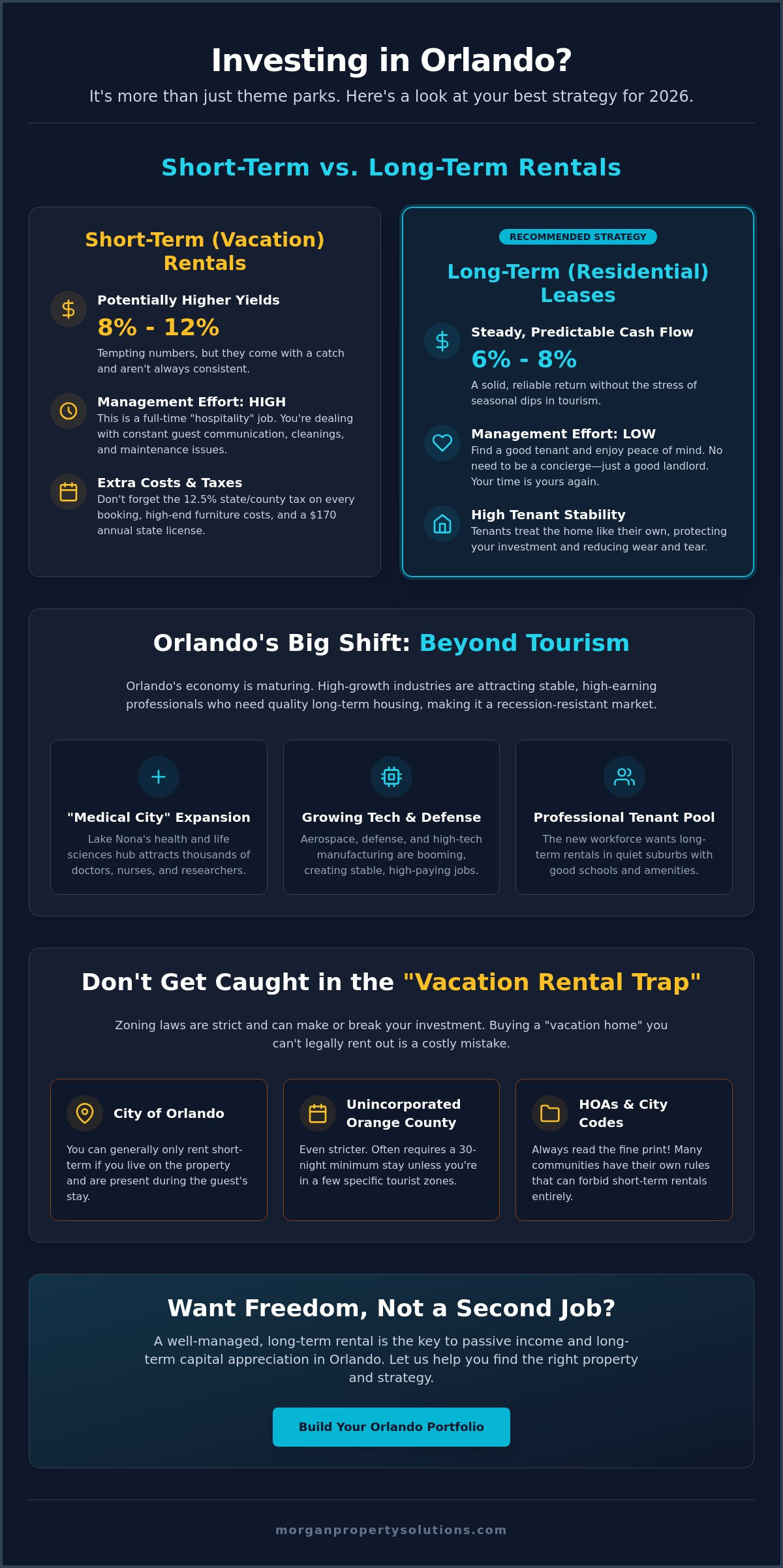
The expansion of Lake Nona’s “Medical City” has been a primary catalyst for this shift. This massive health and life sciences cluster has attracted thousands of high-earning professionals, from specialized surgeons to biotech researchers. This growth is rooted in Orlando’s diverse economy, which now spans far beyond the hospitality sector into aerospace, defense, and high-tech manufacturing. As these industries expand, the tenant demographic is shifting away from seasonal workers toward stable, professional families who value quality housing and community amenities.
The Shift Toward Long-Term Stability
In 2026, we’re seeing a significant move toward residential stability. High-income professionals are increasingly seeking rentals in suburbs like Winter Garden and Windermere, where they can find top-rated schools and a quieter lifestyle. Remote work remains a permanent fixture for many Central Florida residents, which means tenants are willing to pay a premium for larger homes with dedicated office spaces. Orlando’s 2026 economy is recession-resistant because it is built on essential industries like healthcare and defense rather than relying solely on discretionary tourism spending. This makes Orlando property management for long-term rentals a highly attractive path for those seeking predictable monthly income.
To help you navigate these opportunities and build lasting wealth, Passively Rich with Rentals provides expert mentorship and coaching for passive real estate investing.
Tourism Still Matters, But It’s Evolving
While the economy has diversified, tourism remains a vital engine for the region. New attractions and expanded transportation options, like the completed high-speed rail lines, continue to drive demand in secondary rental markets. However, the short-term rental (STR) space has become more nuanced. Investors are now balancing vacation appeal with year-round occupancy strategies to avoid the pitfalls of seasonal fluctuations. Buying an investment property in Orlando in 2026 requires a clear understanding of how these new developments influence specific neighborhoods. Success now depends on matching your property type to the specific needs of the 2026 traveler, who often looks for “workcation” amenities even when visiting the parks.
Choosing Your Strategy: Short-Term vs. Long-Term Rentals
Picking a strategy is the biggest decision you’ll make when buying an investment property in Orlando. Most folks see the 8% to 12% yields from vacation rentals and assume that’s the best path. It’s a tempting number, but it comes with a lot of baggage. You’re dealing with a 12.5% combined state and county tax on every booking, constant cleaning fees, and the stress of managing guests from afar. Long-term rentals might have lower yields, usually between 6% and 8%, but they offer a level of predictability that vacation rentals just can’t match. You aren’t worrying about a slow booking month or a broken dishwasher every Tuesday.
Zoning is another area where things get tricky for those buying an investment property in Orlando. If you’re looking at a home in the City of Orlando, you can generally only rent it out short-term if you actually live there and are present during the stay. Unincorporated parts of Orange County are even stricter, often requiring a 30-night minimum stay unless you’re in very specific zones near the parks. Before you put an offer on a house in Oviedo or Clermont, you have to read the fine print of the HOA and city codes. If you don’t, you might buy a “vacation home” that you aren’t legally allowed to rent out by the night.
The “Vacation Rental” Trap in Central Florida
The “hospitality” side of real estate is a full-time job. Beyond the mortgage, you’re on the hook for high-end furniture and a $170 annual state license from the DBPR. Many investors start with grand visions of vacation rental success—often inspired by the high standards of companies like Northern Michigan Escapes—but eventually pivot to long-term leases because they want their time back. Residential leases don’t require you to be a concierge; they just require you to be a good landlord. We’ve seen many owners find much more peace of mind by switching to traditional year-long agreements.
Maximizing ROI with Residential Leases
Areas like Lake Nona are perfect for residential leases because they attract medical and tech professionals who want to stay for the long haul. When you have a tenant who treats the home like their own, your ROI stays protected. You can check out our landlord resources to see how to handle the legal side of things properly and stay compliant with Florida statutes. If you want to keep your investment truly passive, professional Orlando property management is the best way to handle the day-to-day work while you focus on your next move.
Top Neighborhoods for Orlando Real Estate Investment
Location is everything, but the “best” area depends entirely on whether you want monthly cash flow or long-term equity growth. When you are buying an investment property in Orlando, you’ll find that the city is actually a collection of very different micro-markets. Some neighborhoods are perfect for young professionals, while others are built for families who want to stay for a decade. Understanding these nuances is the key to ensuring your property doesn’t sit vacant.
- Winter Park: This is the “blue chip” choice. With a median sale price of $453,292 and rents around $2,000, it’s an area where investors focus on long-term equity rather than immediate high yields.
- Winter Garden: A stability powerhouse with a median home price of $566,092 and strong rental demand at $2,700 per month.
- Clermont: Offering a slightly lower entry point at $429,741, this area provides a great balance of growth and family-oriented rental demand.
- Apopka and Wedgefield: These are the emerging frontiers. They offer lower entry prices, making them ideal for new investors looking to get into the market before the next wave of appreciation hits.
The Lake Nona Medical City Opportunity
Lake Nona has completely redefined the southeast side of the city. Because it’s home to massive hospitals and research centers, there is a built-in pool of high-earning tenants who need to live nearby. Single-family homes and modern townhomes perform exceptionally well here. Premium tenants in Lake Nona are often willing to pay a higher monthly rate just to avoid a long commute and stay within minutes of the region’s top medical facilities. This creates a reliable environment for Orlando property management strategies focused on professional placement.
Suburban Growth in Clermont and Apopka
Infrastructure improvements have turned Clermont and Apopka from “far away” suburbs into highly desirable residential hubs. In Clermont, families are looking for single-family homes with yards, often driving median rents to $2,450. Apopka offers unique opportunities for “fix and rent” strategies in more established neighborhoods where you can add value through renovations. As the beltways expand, these areas are becoming more accessible to downtown Orlando, which keeps the tenant demand high year-round. Whether you choose a new build or an older home with character, these suburbs are where the 2026 growth is happening. If you aren’t sure which street is the right one, our team at Morgan Property Solutions can help you analyze the specific data for each block.
Essential Due Diligence for Central Florida Investors
Numbers don’t lie, but they can certainly be misleading if you don’t know where to look. When you’re buying an investment property in Orlando, the “sticker price” is only the beginning of the story. You have to look at the long-term carrying costs that are unique to the Sunshine State. Many investors from out of state are surprised by how different the math looks here compared to other markets. Success isn’t just about the purchase price; it’s about understanding the operational reality of owning property in a tropical climate.
Florida’s “Save Our Homes” amendment is a perfect example of a local rule that impacts your bottom line. It’s a great benefit for primary residents because it caps tax assessment increases, but that cap disappears the moment the title changes hands. As an investor, your property tax will be reassessed at the full market value. With Orlando’s median property tax rate currently at 1.19%, your tax bill could jump significantly in the second year of ownership. This is why a professional rental analysis is so much more valuable than a Zillow “Zestimate.” You need to know the true Net Operating Income (NOI) after factoring in management, maintenance, and realistic vacancy rates.
Insurance is another big piece of the puzzle. In 2026, carriers are looking for specific safety features. You’ll want a “wind mitigation” inspection to prove your roof and windows can handle Florida’s storm season. This single report can often save you thousands of dollars in annual premiums. Without it, you might find yourself paying a premium that eats your entire cash flow.
The “Hidden” Costs of Florida Landlording
The Florida humidity is relentless, and your HVAC system bears the brunt of it. Budgeting for regular AC servicing isn’t optional; it’s a requirement to prevent mold and expensive system failures. You also need to account for pest control and lawn care. In this climate, a lawn can turn into a jungle in two weeks, and pests are a year-round battle. If your property is in a community with an HOA, make sure you understand those monthly fees and any restrictions they have on tenants, as these can vary wildly between neighborhoods like Clermont and Oviedo.
Tenant Screening and Protection
Your ROI is only as good as the person living in your home. We recommend using rigorous screening criteria to ensure you’re placing reliable tenants who will care for the property. Dealing with pets can be another hurdle, but tools like PetScreening help you manage these requests legally and safely. To stay competitive and attract a larger pool of qualified applicants, consider offering deposit-free renting options. It lowers the move-in cost for the tenant while still providing the protection you need as an owner. If you want to see how these steps fit into a larger strategy, contact us for a professional property evaluation.
Maximizing Profits Through Professional Management
The closing table is a moment of celebration, but it’s also where the real work begins. Once you’ve finished buying an investment property in Orlando, you transition from being a buyer to being a landlord. Many out-of-state investors start with a DIY mindset to save on costs, but they quickly realize that managing a property from hundreds of miles away is a full-time job. Between coordinating emergency repairs and chasing down late rent, the “passive” part of passive income can disappear fast. We’ve seen many well-intentioned owners burn out because they didn’t have a reliable local partner to handle the daily grind.
Professional Orlando property management is designed to protect your time and your bottom line. It’s a common misconception that management is just an added expense. In reality, a professional team often pays for itself. We have established relationships with local vendors, which means you get fair pricing and high-quality work on every repair. More importantly, we know how to price your rental perfectly to minimize vacancy. A single month of a property sitting empty can cost you more than an entire year of management fees. By keeping the home occupied with qualified tenants, we ensure your cash flow remains steady and predictable.
Reducing Stress and Maximizing ROI
Transparency is the foundation of a good partnership. You shouldn’t have to wonder how your investment is performing. Our owners have access to an online portal where they can view financial reports and property updates 24/7. We also conduct regular inspections to catch small maintenance issues before they turn into expensive disasters. This proactive approach protects the long-term value of your asset. With over 20 years of experience in the Central Florida market, we’ve seen every situation imaginable. That expertise gives you the “peace of mind” factor that is hard to find elsewhere.
Your Partner in Central Florida Real Estate
We don’t just step in after the keys are handed over. Our team can assist you throughout the entire buying process, helping you identify which properties will actually meet your financial goals. Having a single point of contact for both acquisition and management simplifies the entire real estate lifecycle. We help you look past the fresh paint and see the true rental potential of a home. If you’re ready to turn your investment goals into a reality without the stress of being a DIY landlord, we’re here to help. Reach out to us today for a professional consultation and let’s get your Orlando investment journey started on the right foot.
Ready to Build Your Central Florida Portfolio?
The 2026 Orlando market offers incredible potential, but success requires more than just picking a house on a map. You now understand that the real value lies in matching the right neighborhood, like the high-growth corridor of Lake Nona, with a solid long-term rental strategy. We’ve covered why due diligence on Florida-specific taxes and wind mitigation is non-negotiable for your bottom line. Buying an investment property in Orlando is a journey that doesn’t end at the closing table; it’s a long-term commitment to maintaining your asset and keeping your tenants happy.
You don’t have to navigate this process alone. With over 20 years of combined Central Florida real estate experience, our team is here to guide you through both acquisition and residential property management. We provide a comprehensive online portal for transparent financial reporting, so you always know exactly how your portfolio is performing. Maximize your investment returns with Morgan Property Solutions. We are excited to help you turn your real estate goals into a reliable source of passive income and long-term growth.
Frequently Asked Questions
Is Orlando a good place to buy an investment property in 2026?
Orlando remains a top choice in 2026 because the economy isn’t just about tourism anymore. The rise of the medical and tech sectors provides a stable tenant base that keeps demand high year-round. When you’re buying an investment property in Orlando, you’re tapping into a region with population growth that consistently beats the national average, ensuring a steady stream of potential renters.
What is the average rental yield for properties in Central Florida?
Long-term rentals in the Orlando area typically see yields between 6% and 8%. If you’re looking at well-managed short-term rentals in specifically zoned districts, those annual returns can reach 8% to 12% or more. However, those higher yields come with more turnover and higher operating costs, such as the 12.5% combined state and county tourist tax you’ll need to collect and remit.
Do I need a local property manager if I live in Orlando?
While you can manage your own property if you live nearby, many local owners still choose professional help to keep their time free. A manager handles the late-night maintenance calls and ensures you’re following the latest Florida landlord-tenant laws. It’s about turning a part-time job into a truly passive investment that doesn’t eat up your weekends or personal time.
How much are property management fees in Orlando?
Most property management companies in Central Florida charge a monthly percentage of the collected rent, often paired with a flat fee for placing a new tenant. These costs are usually offset by the money you save through lower vacancy rates and better vendor pricing for repairs. It’s an investment in protecting your asset’s long-term value and your own peace of mind.
What are the best suburbs in Orlando for rental properties?
Choosing a suburb depends on your specific financial goals. Lake Nona is excellent for high-income professional tenants, while Winter Garden and Clermont are favorites for families seeking stable, long-term stays. If you’re looking for cash flow, areas like Kissimmee and Sanford often offer more accessible entry prices for new investors compared to the higher-priced “blue chip” neighborhoods.
How do Florida property taxes work for out-of-state investors?
Out-of-state investors should expect to pay the full market rate for property taxes since they don’t qualify for the Florida Homestead Exemption. The median tax rate in Orlando is around 1.19%. It’s also vital to remember that any existing tax caps reset when you buy the home, so your second-year tax bill will likely be higher than what the previous owner was paying.
Can I use a residential property as a short-term rental in Orlando?
Short-term rental rules are very specific and depend on your exact address. Within Orlando city limits, you can only rent short-term if you live on the property and are present during the guest’s stay. In unincorporated Orange County, most residential zones require a 30-night minimum stay, with the exception of specific vacation home districts located near the theme parks.
What should I look for in an Orlando tenant screening process?
A thorough screening process should include a background check, credit history, and verification of employment and previous rental history. When buying an investment property in Orlando, it’s also smart to use a dedicated service for pet screening. This helps you manage animal requests legally while protecting your property from potential damage and ensuring a higher quality of tenant.

Article by
Oliver Overton-Morgan
Oliver Overton-Morgan is a full-time Real Estate Broker since 2003, with years of experience helping thousands of people purchase and sell real estate throughout Central Florida. He holds a Graduate Realtor Institute designation, LCAM, and has held licenses in good standing as a Florida Mortgage Broker and a Notary Public. Oliver immigrated to central Florida in 2001, and within 5 years Oliver built a successful Real Estate brokerage in central Florida, where he recruited over 75 Sales Associates with 25+ million in sales production.