What if the purchase price of your Florida dream home is actually just the entry fee for a series of expenses you never saw coming? It’s a question that keeps many buyers up at night, especially with the unique financial landscape we are seeing in 2026. You want to feel the excitement of a new keys in hand moment, not the anxiety of an empty bank account. We know that navigating the hidden costs of buying a house in florida can feel like learning a new language, especially when you are hit with acronyms like CDD or warnings about tax reassessments.
We believe that homeownership should be a source of stability, not a source of stress. That is why we have put together this guide to help you budget with precision and avoid the “Save Our Homes” tax trap that catches so many new residents. You are going to learn exactly what to expect on closing day and how monthly carrying costs are shifting as the insurance market begins to stabilize. By the end of this read, you will have the clarity you need to buy with confidence and ensure your investment remains a blessing for years to come.
Key Takeaways
- Plan for closing costs between 2% and 5% of your home’s price so you aren’t scrambling for extra cash on moving day.
- Learn how the “Save Our Homes” tax reset works to avoid a major property tax spike during your first full year of ownership.
- Identify the hidden costs of buying a house in florida, including specific climate-related expenses like flood insurance and strict roof age requirements.
- Understand the difference between HOA and CDD fees to accurately calculate your total monthly carrying costs before you sign a contract.
- Discover how expert buyer representation can protect you from properties with pending special assessments or uninsurable maintenance issues.
Beyond the Down Payment: Immediate Closing and Inspection Costs
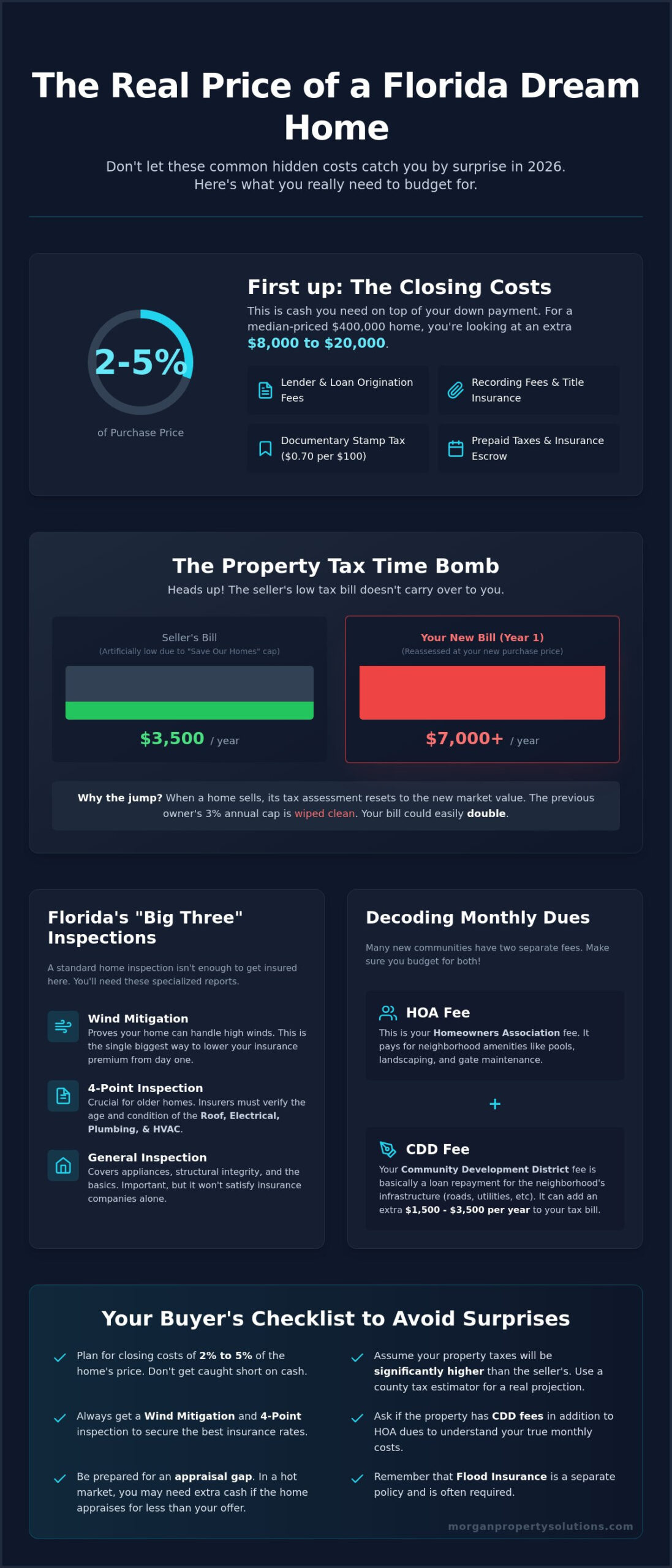
Getting your down payment together is a huge milestone, but it is only the beginning of your financial journey. In 2026, the hidden costs of buying a house in florida often catch buyers off guard because they go well beyond the sticker price. Closing costs in the Sunshine State typically range from 2% to 5% of the purchase price. If you are looking at a median priced home of $400,000, you should expect to need an extra $8,000 to $20,000 just to cross the finish line. These funds cover lender fees, recording fees, and the state’s documentary stamp tax, which is currently $0.70 per $100 of the sale price.
In Central Florida markets like Orlando, it is common for the seller to pay for the owner’s title insurance policy, though this is always up for negotiation. You also need to account for prepaid items. Lenders often require you to put several months of property taxes and homeowners insurance into an escrow account upfront. This is where Florida’s Homestead Exemption becomes a vital piece of the puzzle. While it can save you money later, your initial escrow payments might be based on the previous owner’s capped tax rate, leading to a significant “shortage” surprise once the property is reassessed at the new purchase price.
The “Big Three” Florida Inspections You Can’t Skip
Don’t rely on a standard home inspection alone. While a general inspection tells you if the appliances work, it doesn’t always satisfy insurance companies. You need a Wind Mitigation inspection to prove your home can withstand high winds. This is the primary way to lower your insurance premiums from day one. If you are buying an older home in Winter Park or Apopka, you will also need a 4-Point inspection. This looks specifically at the roof, electrical, plumbing, and HVAC systems. Without these specialized reports, securing a policy in 2026 can be nearly impossible, regardless of how “perfect” the house looks.
Appraisal Gaps and Financing Fees
Financing comes with its own set of smaller hits to your wallet that add up quickly. You will see loan origination fees, credit report charges, and appraisal fees on your final documents. In a competitive market, an appraisal gap is a very real risk. If the bank decides the house is worth less than your offer, you must cover that difference in cash to keep the deal alive. Always ask your lender for a “Loan Estimate” as soon as you apply. It gives you a clear, line-by-line breakdown of these hidden costs of buying a house in florida so you aren’t guessing when you finally reach the closing table.
The Florida Property Tax Surprise: CDDs and Reassessments
One of the biggest shocks for new residents is realizing that the previous owner’s tax bill has almost zero bearing on what they will pay. This is one of the most significant hidden costs of buying a house in florida because it often leads to a massive “tax jump” in your second year of ownership. When a home sells, the property is reassessed at its new market value on the following January 1st. If the previous owners lived there for twenty years, their taxes were likely kept artificially low by state caps. Once you take over, that protection vanishes, and your bill could easily double.
The Save Our Homes cap is a 3% annual limit on assessment increases for residents. However, this only applies after you have established your own homestead. If you close on a home in the middle of the year, you’ll likely pay a prorated version of the seller’s capped tax rate for those remaining months. Don’t let this lower number fool you into a false sense of security. By the time the next tax cycle rolls around in 2026, the county will apply the current millage rates to your full purchase price. Filing for your Homestead Exemption the moment you move in is the only way to start building your own tax protections for the future.
What is a CDD Fee and Why Is It on My Tax Bill?
In newer, master-planned communities like Lake Nona or Clermont, you’ll often see a Community Development District (CDD) fee attached to your tax bill. This isn’t a tax in the traditional sense, but a way for developers to finance neighborhood infrastructure like roads, utilities, and streetlights. These fees typically range from $1,500 to $3,500 per year. They are split into two parts: a “bond” portion that eventually gets paid off and an “operations” portion that covers ongoing maintenance. These are separate from your HOA dues, so you must account for both in your monthly budget.
Estimating Your Post-Purchase Tax Bill
To avoid sticker shock, stop looking at the historical taxes listed on real estate websites. Instead, use official county tools to look up property tax reassessments for new buyers. These estimators allow you to plug in your purchase price and see a realistic projection of your future bill. Remember that out-of-state investors pay more than primary residents because they don’t qualify for the same exemptions. If you are planning to rent out your new purchase, our team at Morgan Property Solutions can help you calculate how these tax changes impact your potential rental yield and overall investment strategy.
Protecting Your Investment: Insurance and Climate-Related Costs
Once you have navigated the closing table, the reality of maintaining a home in the subtropics begins to set in. One of the most persistent hidden costs of buying a house in florida is the insurance premium. While the market is showing signs of stabilization in 2026 thanks to recent legislative reforms, Florida still has the highest premiums in the country. Some homeowners see annual bills around $8,458, though others in less risky zones might find rates closer to $3,815. It’s a wide range that depends heavily on your home’s age and specific location.
The “Roof Age” rule is a major factor many buyers overlook. In Florida, if your roof is over 15 years old, many private insurers will refuse to cover the property entirely. You might be forced into a policy with Citizens Property Insurance, the state-backed insurer of last resort. Even though Citizens approved an average rate decrease of 8.7% for renewals starting in spring 2026, it’s often still more expensive than a well-maintained home on the private market. You also have to consider sinkholes. While standard policies cover “catastrophic ground cover collapse,” actual sinkhole coverage is usually an optional, and often expensive, add-on.
The Rising Cost of Hazard Coverage
Don’t assume you’re safe just because you’re inland. Even in areas like Windermere, flood zones exist around the many lakes and chains. Standard homeowners insurance doesn’t cover rising water. You’ll need a separate NFIP or private flood policy, which averages between $894 and $1,363 per year. There’s usually a 30-day waiting period for these policies to take effect, so don’t wait until a storm is in the Gulf to buy one.
Pest Control and Termite Bonds
In the Central Florida humidity, pest control is a utility, not a luxury. You have to budget for both subterranean and drywood termite protection. Most local lenders require a clear “Wood Destroying Organism” report before they’ll fund your loan. Maintaining a termite bond, which is essentially a service agreement and warranty against future infestations, is a standard expense. When combined with monthly pest control to keep ants and roaches at bay, you should budget for an ongoing cost that protects your equity from the ground up.
Community Living: HOA Fees and Neighborhood Maintenance
Central Florida is often described as the land of the HOA. With about 45% of homes in the state sitting within managed communities, you are likely to encounter these associations during your search. While these groups maintain the aesthetic of your neighborhood, they represent one of the most significant hidden costs of buying a house in florida. For a single-family home, you might see monthly dues between $150 and $400. If you are looking at a condo, those fees can jump to $900 or more because they often include building insurance and exterior maintenance.
The real danger to your budget isn’t the monthly fee, but the “Special Assessment.” This happens when the association doesn’t have enough in its reserves to cover a major project, like a new community roof or a pool resurfacing. In 2026, many condo associations are passing these costs onto owners to comply with new state laws requiring fully funded reserves for structural integrity. These one-time bills can reach into the thousands of dollars. Before you buy, you should always review the association’s financial health and meeting minutes to see if a major assessment is on the horizon.
HOA vs. CDD: A Quick Comparison for Buyers
While we discussed the tax implications of CDDs earlier, it is vital to understand the structural difference. An HOA is a private entity run by a board of residents that can change its rules and fees annually. A CDD is a local government unit. While HOA fees cover things like your gate guard or clubhouse, CDD fees pay for the actual pipes under the street and the streetlights above them. You can usually find both listed in the MLS summary, but you should verify the exact totals with the title company before you sign.
Utility Setup and Hidden Connection Fees
Setting up your home in 2026 involves more than just a quick phone call. In areas like Clermont, you might find some homes on septic systems while others use city-tap sewer lines. This changes your monthly bill and your long-term maintenance costs. You also need to budget for irrigation. Your water bill can spike significantly during the dry Florida summer if you are trying to keep a lush lawn alive. Most utility providers, such as Duke Energy or OUC, require initial deposits for new accounts, which can add a few hundred dollars to your first month’s expenses.
If you are purchasing a property with the intent to rent it out, you must also consider how HOA rules impact your ROI. Many associations have strict caps on the number of rentals allowed or require a lengthy approval process for new tenants. If you want to ensure your investment remains profitable despite these hidden costs of buying a house in florida, our experts at Morgan Property Solutions can help you navigate association restrictions and maximize your rental returns.
Smart Buying: How Professional Guidance Saves You Money
Buying a home is one of the most emotional purchases you’ll ever make, but in Florida, you have to lead with your head. A local Central Florida Realtor is your first line of defense against overpaying or walking into a financial trap. They know which neighborhoods in Winter Garden are prone to specific drainage issues and which builders in Lake Nona have the best reputations for energy efficiency. By identifying the hidden costs of buying a house in florida during the showing phase, they help you avoid properties that look perfect on the surface but hide expensive maintenance issues or uninsurable roofs.
When you transition from being a buyer to an owner, your focus shifts to asset preservation. If you are an investor, this transition is even more critical for your bottom line. This is where residential property management adds significant value. A professional manager doesn’t just collect rent; they protect your ROI by handling the “hidden” expenses of tenant turnover and preventative maintenance. They ensure your property remains a performing asset rather than a drain on your bank account, allowing you to enjoy the benefits of ownership without the daily headaches.
The Long-Term View: Maintenance vs. Management
A common rule of thumb is to budget at least 1% of the home’s value annually for what we call “survivor” maintenance. This covers the inevitable things that wear out, like AC units struggling in the 95-degree heat or water heaters nearing the end of their life cycle. Research for 2026 suggests the average annual cost of owning and maintaining a single-family home in the U.S. is estimated to be $21,400. That’s a big number, but professional management helps reduce the friction of these costs through vetted vendor relationships and regular inspections. You can explore our landlord resources for a deeper dive into these carrying costs.
Your Next Steps in Central Florida
Your journey should start with a clear financial picture. Get a pre-approval that accounts for the 2026 millage rates and insurance premiums we have discussed. Don’t settle for a generic estimate; you need numbers that reflect the hidden costs of buying a house in florida specifically. Work with a partner who knows the local neighborhoods from Winter Garden to Lake Nona. At Morgan Property Solutions, we pride ourselves on simplifying this complex process and acting as your steady ally. Contact us today to start your stress-free home search and move forward with total confidence.
Move Forward with Clarity and Confidence
Preparing for the hidden costs of buying a house in florida doesn’t have to be a solo mission that leaves you feeling anxious. By understanding the tax reassessment reset and budgeting for specific inspections, you’re already ahead of the curve. Accounting for CDD fees and the unique insurance environment ensures that your first year of ownership is defined by peace of mind rather than financial surprises. You now have the clarity needed to build a budget that supports your long-term success. It’s about buying with your head as much as your heart.
With over 20 years of Central Florida real estate experience and specialized expertise in Orlando property management, our team provides the professional, client-focused guidance you deserve. We take pride in simplifying complex transitions so you can focus on the excitement of your new home. Your Florida dream is well within reach. With the right preparation, you’ll turn that key knowing your investment is secure. Start your stress-free home search with Morgan Property Solutions and let us help you close with total confidence.
Frequently Asked Questions
Is title insurance required in Florida and who pays for it?
Title insurance is not mandated by Florida law, but your mortgage lender will almost certainly require a lender’s policy to protect their interest in the property. For the owner’s policy, custom dictates that the seller usually pays in Central Florida, though this is entirely negotiable during the offer stage. Having this coverage protects you from historical ownership disputes or liens that were not discovered during the initial title search.
How much should I budget for a home inspection in Orlando?
You should budget between $400 and $700 for a comprehensive set of inspections in the Orlando area. This total typically includes the general home inspection plus the Florida-specific Wind Mitigation and 4-Point inspections required by most insurance companies. Investing in these reports early helps you identify the hidden costs of buying a house in florida before you are fully committed to the purchase.
Will my property taxes go up after I buy a house in Florida?
Yes, your property taxes will likely increase significantly the year after you purchase your home. Florida’s “Save Our Homes” cap resets upon a sale, which means the property is reassessed at its current market value on January 1st following the transaction. If the previous owner lived there for a long time, their tax bill was kept artificially low, and your new bill will reflect the full purchase price.
What is the difference between an HOA and a CDD fee?
The main difference is that an HOA is a private association while a CDD is a local government entity that appears directly on your property tax bill. HOA fees generally cover neighborhood amenities and landscaping maintenance for common areas. CDD fees are used to pay back bonds that funded the community’s initial infrastructure, like roads and main utility lines, and they are usually fixed for 20 to 30 years.
Do I really need flood insurance if I am not near the ocean?
You should absolutely consider flood insurance even if you are miles away from the coast. Central Florida is prone to heavy tropical rains that can cause localized flooding in areas not designated as high-risk zones. Standard homeowners insurance does not cover rising water damage. With average annual premiums between $894 and $1,363, it’s a relatively small price to pay for protection against a common Florida reality.
What are the typical closing costs for a buyer in Central Florida?
Typical closing costs for a buyer in Central Florida range from 2% to 5% of the home’s purchase price. For a $400,000 home, you should have between $8,000 and $20,000 ready in addition to your down payment. These costs cover your loan origination fees, appraisal, title insurance, and the state’s documentary stamp tax. Your lender will provide a specific Loan Estimate early in the process to help you plan.
How much does a termite bond cost in Florida?
An initial termite bond in Florida usually costs between $500 and $1,500, with annual renewal fees ranging from $200 to $500. This bond is essentially a service agreement that includes regular inspections and a guarantee for treatment if termites are found. Maintaining this bond is a standard way to manage the hidden costs of buying a house in florida, as it protects your home’s structural integrity from the ground up.
Can I lower my Florida homeowners insurance premiums?
You can lower your premiums by performing a Wind Mitigation inspection to document “home hardening” features like hurricane straps or impact-resistant windows. Installing a new roof is often the most effective way to see a major price drop, as older roofs trigger higher rates. You might also check with the state-backed insurer, Citizens, which approved an average rate decrease of 8.7% for renewals beginning in spring 2026.

Article by
Oliver Overton-Morgan
Oliver Overton-Morgan is a full-time Real Estate Broker since 2003, with years of experience helping thousands of people purchase and sell real estate throughout Central Florida. He holds a Graduate Realtor Institute designation, LCAM, and has held licenses in good standing as a Florida Mortgage Broker and a Notary Public. Oliver immigrated to central Florida in 2001, and within 5 years Oliver built a successful Real Estate brokerage in central Florida, where he recruited over 75 Sales Associates with 25+ million in sales production.