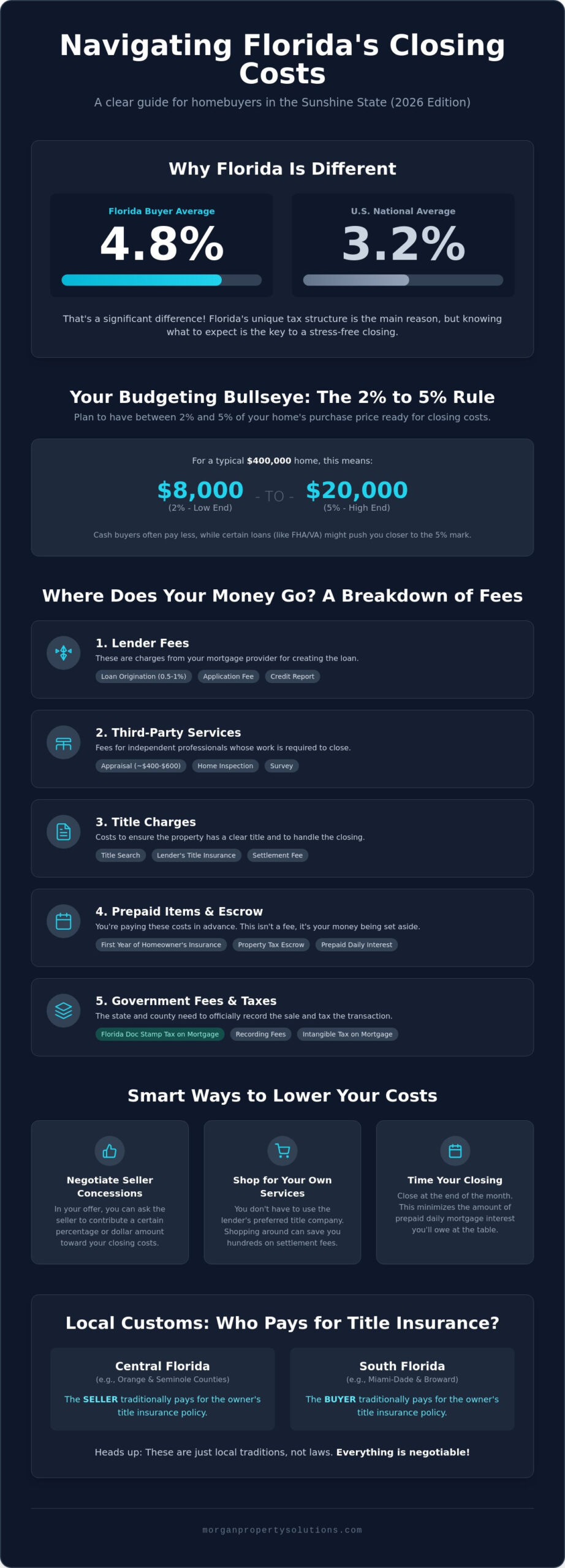
Did you know that the average closing costs for buyer in florida sit at roughly 4.8 percent of the home’s price, while the rest of the country averages just 3.2 percent? That’s a big gap that can catch even the most prepared person off guard. We know how stressful it is to worry about unexpected fees or confusing state taxes when you’re so close to getting your keys. It’s completely natural to want a little more clarity before you sign those final papers.
We’re here to help you build a predictable budget so you can move into your new home with total peace of mind. This guide offers a straightforward look at exactly what you’ll owe at the table in 2026, including those unique Florida mortgage taxes and lender fees. We’ll also show you how to spot negotiable items so you don’t pay a penny more than necessary. From the first line item to the final signature, we’ve got you covered and want to ensure your transition is as smooth as possible.
Key Takeaways
- Learn why you should budget between 2% and 5% of your home’s purchase price to cover the total closing costs for buyer in florida.
- Identify the specific state-mandated taxes that are unique to the Sunshine State so you can build a truly predictable budget.
- Discover how to lower your out-of-pocket expenses by effectively negotiating seller concessions and shopping for your own title services.
- Feel prepared for a stress-free transition with a clear checklist of what to bring to the table and how to handle your final walkthrough.
What Exactly Are Closing Costs in the Sunshine State?
Think of closing costs as the final hurdle before you cross the finish line of homeownership. While your down payment is the big chunk of change you have likely been saving for years, these fees represent the administrative, legal, and tax-related costs required to actually transfer the property into your name. If you are asking yourself, What are closing costs? precisely, they are a bundle of charges from your lender, the state of Florida, and third-party service providers like appraisers and title companies.
Florida stands out from other states because of its specific tax structure. We don’t have a state income tax, so the government collects revenue through other means, including unique taxes on real estate transactions and mortgage notes. This often makes the closing costs for buyer in florida slightly higher than the national average, but being prepared means you won’t face any heart-sinking surprises when the settlement statement arrives.
The 2% to 5% Rule of Thumb
In the current 2026 market, most buyers should budget between 2% and 5% of the home’s purchase price for these expenses. For a typical Orlando home priced at $400,000, that means having between $8,000 and $20,000 ready at the closing table. Several factors influence where you fall on that spectrum. If you are using a low down payment loan like an FHA or VA mortgage, your costs might lean toward the 5% mark due to upfront mortgage insurance premiums or funding fees. Conversely, cash buyers often dodge nearly half of these common fees because they skip the lender charges and mortgage-related state taxes entirely.
Who Pays What? Florida Customs
One detail that often surprises people is how much “who pays what” depends on the specific county. In Central Florida counties like Orange and Seminole, it is a long-standing tradition for the seller to pay for the owner’s title insurance policy. However, if you were to look further south in Miami-Dade or Broward, the buyer is usually the one who picks up that tab.
It is vital to remember that these are just local customs, not set-in-stone laws. In a shifting market, everything is technically negotiable. We often help clients through Real Estate Buyer Representation to structure offers where the seller contributes to the buyer’s costs, regardless of what the local “tradition” might be. Understanding these regional quirks gives you a significant edge when it is time to make an offer.
The Florida Buyer’s Expense Checklist
When you receive your first Loan Estimate, the long list of numbers can feel a bit overwhelming. It’s helpful to think of these as a simple checklist of professionals who need to be paid for their part in your home purchase. Understanding the closing costs for buyer in florida starts with categorizing these fees into groups so you can see exactly where your money is going.
Most of these costs fall into five main buckets:
- Lender Fees: This includes the loan origination fee (usually 0.5 percent to 1 percent of the loan), application fees, and the cost of pulling your credit report.
- Third-Party Services: These are fees for people like appraisers and inspectors who don’t work directly for the bank.
- Title Charges: You’ll pay for a title search to ensure the home is free of liens, along with settlement fees to the title company and your own title insurance policy.
- Prepaid Items: This covers your first year of homeowners insurance and initial deposits for your property tax escrow account.
- Government Fees: The county charges small fees to officially record your new deed and mortgage in public records, along with state-specific items like Florida’s documentary stamp tax on the mortgage note.
Lender vs. Third-Party Fees
Some lender fees are fixed, but others are what we call “junk fees.” Look closely for vague terms like “processing” or “administrative” charges. While an appraisal fee is a non-negotiable cost that usually runs between $400 and $600, you often have the right to shop for your own title company. Choosing a title service yourself rather than using the lender’s preferred partner can sometimes save you a few hundred dollars on settlement fees. If you’re feeling unsure about these details, browsing our real estate articles can provide more context on the local Orlando market.
The Hidden Power of Prepaids
It’s important to distinguish between “fees” and “prepaids.” Fees are gone once you pay them, but prepaids are actually your money; you’re just paying it in advance. This includes setting up your escrow account for future taxes and insurance. The day of the month you close also matters. If you close on the 30th, you’ll only owe one day of prepaid interest. Close on the 1st, and you’ll have to pay for the entire month upfront. Timing your closing carefully is a simple way to keep your “cash to close” lower on the big day.
The “Florida Only” Taxes You Need to Know
Florida is famous for having no state income tax. It’s a huge perk for residents, but the state still needs to fund its operations. They do this by taxing the “indebtedness,” or the money you borrow to buy a home. This is the primary reason why closing costs for buyer in florida often seem steeper than what your friends in neighboring states might have paid. These taxes are calculated strictly based on your loan amount rather than the home’s purchase price. If you happen to be paying cash for your property, you can skip this section entirely since there is no mortgage to tax.
Understanding these costs ahead of time helps remove the “sticker shock” that often happens when buyers see their final settlement statement. These aren’t junk fees from a bank; they are state-mandated requirements that every financed buyer must meet. While they add to your total cash to close, they are simply part of the landscape here in the Sunshine State. Learning how to lower your closing costs in other areas is the best way to offset these fixed state expenses.
Doc Stamps on the Mortgage
The Documentary Stamp Tax on Notes is a state tax that applies to any written obligation to pay money. In your case, that’s your mortgage. The current rate is $0.35 per $100 of the mortgage amount. There is absolutely no wiggle room or negotiation possible with this fee. You should also know that while you pay this tax on the loan, the seller is usually responsible for a different version of this tax on the deed itself. In most of Florida, that deed tax is $0.70 per $100 of the total sale price, though it can vary in Miami-Dade county.
The Non-Recurring Intangible Tax
Next is the non-recurring intangible tax. This is a one-time tax on the value of the mortgage lien. The rate is set at 2 mills, which is a technical way of saying $0.002 for every dollar of the mortgage. To put it simply, you’ll owe $2.00 for every $1,000 you borrow. Because this tax only applies to the portion of the home you are financing, increasing your down payment is one way to reduce this specific tax bill.
Let’s look at a quick example to show the impact. If you take out a $300,000 mortgage to buy a home in Orlando, the intangible tax will be exactly $600. When you add the $1,050 you’ll owe for the documentary stamp tax on that same loan, you’re looking at $1,650 in state taxes alone. These costs are a standard part of the process, and we focus on providing Real Estate Buyer Representation to help you navigate these requirements without any stress.
How to Lower Your Closing Costs in Central Florida
You aren’t stuck with every fee you see on that initial estimate. While the state taxes we discussed earlier are set in stone, many other parts of the closing costs for buyer in florida are surprisingly flexible. Being a savvy buyer means knowing which levers to pull to keep more cash in your pocket. From shopping for your own service providers to timing your move-in date, you have more control over the final number than you might think.
One of the easiest ways to save is by shopping for your own title insurance and settlement services. Your lender will suggest a company, but you aren’t required to use them. Comparing just two or three local title companies can often reveal a difference of several hundred dollars in administrative fees. Additionally, try to schedule your closing for the very end of the month. Since you pay “prepaid interest” from the day you close until the first of the next month, closing on the 30th instead of the 5th can save you weeks of interest payments upfront.
Negotiating Seller Credits
In the Central Florida market, it’s common to ask the seller to chip in. These are called seller concessions or credits. Depending on your loan, there are limits on how much they can help. FHA loans allow the seller to pay up to 6 percent of the purchase price toward your costs, while VA loans allow up to 4 percent. Conventional loans are a bit more varied, usually allowing between 3 percent and 9 percent depending on your down payment. If an inspection reveals a few minor issues, asking for a closing cost credit is often better for a cash-strapped buyer than asking for a price reduction. A $5,000 credit keeps $5,000 in your bank account today, whereas a $5,000 price drop only lowers your monthly mortgage payment by a tiny amount.
The “No-Closing-Cost” Mortgage Trap
You’ll often see lenders advertising “no-closing-cost” mortgages. It sounds like a dream, but there is always a trade-off. In these cases, the lender usually pays your costs in exchange for a higher interest rate, or they roll the fees into your total loan balance. This can be a smart move if you’re short on cash and plan to refinance or sell the home in a few years. However, if this is your “forever home,” that slightly higher interest rate will cost you thousands more over the life of the loan. It’s vital to run the numbers to see if paying the cash upfront is the better long-term investment. If you want an expert to help you weigh these options, our team provides dedicated Real Estate Buyer Representation to ensure you’re making the most financial sense of your purchase.
From Closing Day to Property Management
The final few days before your closing date are often a whirlwind of paperwork and logistics. After you have spent weeks calculating the closing costs for buyer in florida and negotiating with your lender, the finish line is finally in sight. Before you sit down at the table, you’ll need to complete your final walkthrough. This is your last chance to ensure the home is in the exact condition you agreed upon, with all repairs finished and no new issues present. Once that is done, make sure you have your government-issued ID and your certified funds ready. Most title companies prefer a wire transfer, so you will want to initiate that early to avoid any last-minute bank delays.
For many, the closing table is the end of a long journey, but for investors, it is actually just the beginning. Buying a property is a big win, but making it profitable is the real goal. We often see buyers get so focused on the closing costs for buyer in florida that they forget to plan for what happens once the keys are in hand. This is where having a steady ally makes all the difference in your long-term success and peace of mind.
Closing on an Investment Property
If you are investing in rental properties, your budget needs to extend beyond just the purchase price and closing fees. You should factor in your initial maintenance reserves and ongoing management expenses from day one. A smooth transition from buyer to landlord is critical for your cash flow. Our team at Morgan Property Solutions Inc. specializes in bridging this gap. By utilizing our Orlando property management services, you can move directly from the closing table to tenant placement without the usual stress of self-management. We handle the heavy lifting so your investment starts working for you immediately.
Your Central Florida Real Estate Allies
With over 20 years of experience in the local market, we have seen almost every closing day scenario imaginable. Whether you are buying a family home in Lake Nona or an investment unit in Winter Park, having a local partner helps you avoid those last-minute surprises that can derail a deal. We pride ourselves on being more than just a service provider; Morgan Property Solutions Inc. is your long-term partner in real estate. If you want to keep learning about the local market trends, we invite you to explore our library of real estate articles for more local tips. We are here to support you through every phase of your property journey, from that first calculation to years of successful ownership.
Step Into Your New Florida Home With Confidence
Buying a home is a massive life event, and we want you to feel empowered when you finally reach that table. By now, you have a better grasp of the 2 percent to 5 percent range and those unique state taxes we covered earlier. Remember that while some fees are fixed, your ability to negotiate seller credits and shop for title services can significantly impact the final closing costs for buyer in florida. You don’t have to tackle these complex financial details on your own.
With over 20 years of Central Florida real estate expertise, we specialize in making these transitions simple and stress-free. Whether you are looking in Orlando, Lake Nona, or Winter Park, our A+ rated team is here to provide the specialized local knowledge you need to succeed. Let Morgan Property Solutions Inc. help you navigate your next Central Florida home purchase. We are committed to your long-term success and can’t wait to help you settle into your new home or investment property. You’ve done the planning; now it’s time to enjoy the results.
Common Questions About Florida Closing Costs
Is title insurance required for buyers in Florida?
If you are taking out a mortgage, your lender will absolutely require a lender’s title insurance policy to protect their interest in the property. While the owner’s title insurance policy is technically optional for you as the buyer, it is a vital safeguard for your investment. In many Central Florida counties, the seller actually pays for this policy, so it’s a huge benefit you should always confirm in your contract.
Can I roll my closing costs into my mortgage in Florida?
You cannot simply add your closing costs on top of the loan amount for a purchase like you might with a refinance. However, you can negotiate seller concessions where the seller pays those costs for you. This allows you to keep your cash in the bank, effectively wrapping the closing costs for buyer in florida into the total deal structure through the purchase price.
What is the average closing cost for a buyer in Orlando?
Buyers in the Orlando area should typically budget between 2 percent and 5 percent of the home’s purchase price. Based on a median home price of approximately $400,000 in 2026, this means you should expect to pay between $8,000 and $20,000 at the closing table. These figures include state taxes, lender fees, and prepaid items like insurance and property tax escrows.
Do buyers pay for the appraisal at closing or upfront?
Most lenders require you to pay for the appraisal upfront at the time it is ordered. This fee generally ranges from $400 to $600 and is paid directly to the appraisal management company. Even though you pay it early, you’ll still see it listed on your final Closing Disclosure marked as “Paid Outside of Closing” or POC to ensure the accounting is accurate.
What happens if my closing costs are higher than the Loan Estimate?
Federal law protects you from significant “bait and switch” tactics regarding your fees. Certain costs, like lender origination fees, have a zero percent tolerance, meaning they cannot increase at all. Other third-party fees can only increase by a maximum of 10 percent. If your lender exceeds these limits, they are usually required to provide a credit to make up the difference at the closing table.
Are closing costs tax-deductible in Florida?
Most closing costs are not immediately deductible on your annual tax return. Instead, items like title insurance and recording fees are added to your “cost basis,” which can reduce your capital gains taxes when you eventually sell the home. The main exceptions are mortgage “points” paid to lower your interest rate and your pro-rated share of property taxes, which may be deductible in the year you buy.
How much cash should I bring to closing if I am buying with cash?
Cash buyers enjoy much lower closing costs because they avoid all lender fees and state-mandated mortgage taxes. You should typically prepare to pay between 1 percent and 2 percent of the purchase price. This covers your title search, settlement fees, and any pro-rated property taxes or HOA dues. It’s a significantly simpler and cheaper process without a bank involved.
What is a “Section L” credit on a Closing Disclosure?
Section L on your Closing Disclosure is where you’ll find “Other Credits,” which include money coming from the seller or lender to help cover your expenses. If you negotiated for the seller to pay a specific amount toward your closing costs for buyer in florida, that credit will appear here. It’s a key area to check to ensure all your negotiated credits are being applied correctly to reduce your final cash to close.

Article by
Oliver Overton-Morgan
Oliver Overton-Morgan is a full-time Real Estate Broker since 2003, with years of experience helping thousands of people purchase and sell real estate throughout Central Florida. He holds a Graduate Realtor Institute designation, LCAM, and has held licenses in good standing as a Florida Mortgage Broker and a Notary Public. Oliver immigrated to central Florida in 2001, and within 5 years Oliver built a successful Real Estate brokerage in central Florida, where he recruited over 75 Sales Associates with 25+ million in sales production.