
Did you know that missing a single 30-day deadline to claim a security deposit could lead to a costly legal battle that wipes out your yearly profit? Staying on top of florida landlord tenant law is often the difference between a thriving rental portfolio and a stressful liability. Many investors in the Orlando area feel a sense of dread when it comes to the fine print of Florida Statutes Chapter 83. It’s perfectly normal to worry about accidentally violating a statute or mishandling a complex eviction. You’ve worked hard to build your investment, and you shouldn’t have to risk it all on a simple paperwork error.
In this 2026 guide, we’ll help you master the legal essentials to protect your assets and build better relationships with your tenants. You will learn how to handle deposits with confidence, understand new rules regarding fraudulent entry, and comply with the latest flood disclosure requirements. We’ll also explore how professional management in Central Florida can serve as your best defense against legal traps. Let’s look at the specific steps you can take to lower your risk and keep your properties running smoothly.
Key Takeaways
- Understand why Florida Statutes Chapter 83 serves as the final authority on rental agreements, even if your written lease says something different.
- Learn the exact steps for storing security deposits and the critical 30-day window for providing initial notices to your tenants.
- Identify your mandatory maintenance duties under the Warranty of Habitability to ensure your property remains legally compliant and safe.
- Master the specific timelines and procedures for serving 3-day and 7-day notices under florida landlord tenant law to handle lease violations correctly.
- Discover how professional property management in Orlando can automate your legal documentation and provide a layer of protection for your rental portfolio.
Navigating the Florida Residential Landlord Tenant Act in 2026
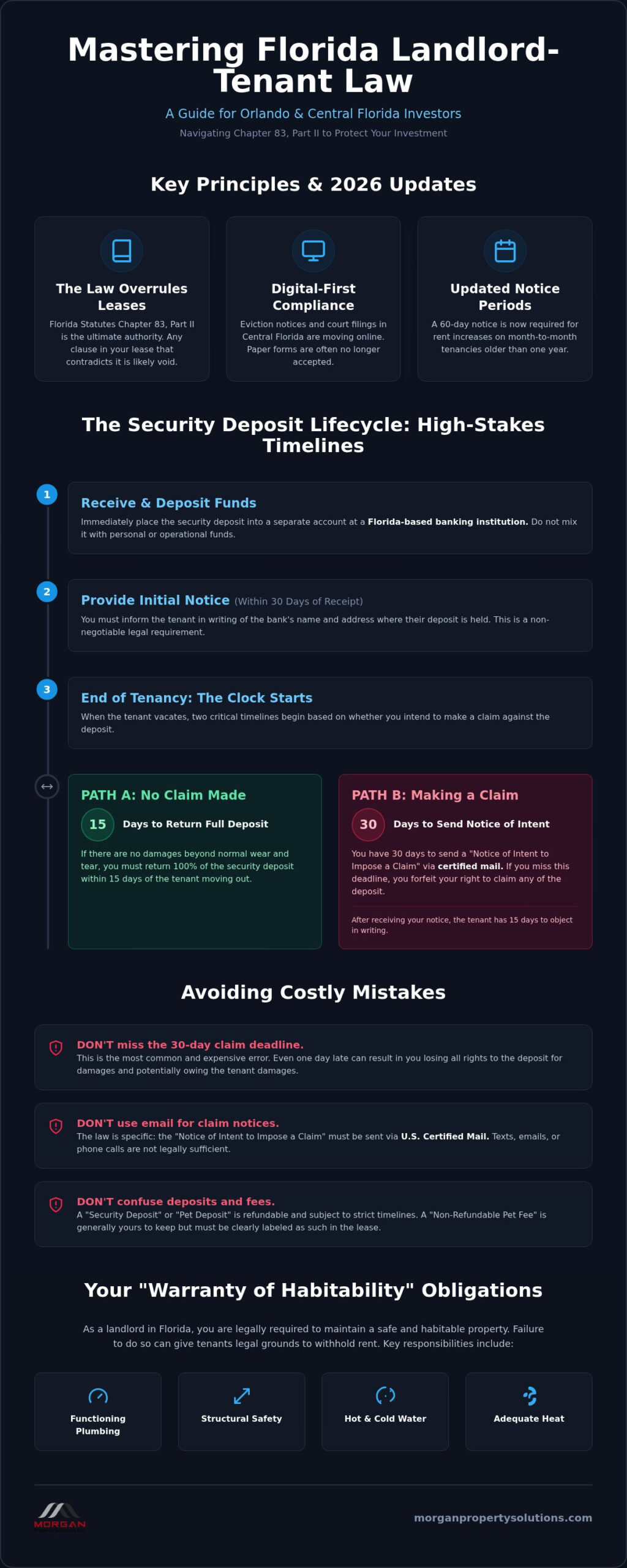
Florida Statutes Chapter 83, Part II is the foundation of every rental relationship in the Sunshine State. Think of it as the ultimate rulebook that governs how you interact with your tenants. Whether you’re renting out a single-family home in Windermere or a condo in Baldwin Park, this statute defines your rights and responsibilities. One mistake many owners make is assuming their lease agreement can say whatever they want. In reality, state law always overrides your lease. If a clause in your contract contradicts the statute, a judge will likely toss it out during a dispute.
Another core concept you need to understand is “peaceful possession.” This means that once a tenant moves in, they have a legal right to occupy the property without constant or unreasonable interference from you. While you own the dirt and the bricks, the tenant “owns” the right to live there peacefully during the lease term. Understanding this balance is vital for anyone working within florida landlord tenant law. While oral agreements are technically legal for tenancies under a year, they are incredibly risky in 2026. Without a written record, proving the terms of the deal in an Orlando courtroom becomes almost impossible. A clear, written contract protects both parties and sets the stage for a professional relationship.
Why Landlords Need to Know the Act
Having a firm grip on the law is your best defense against “tenant-friendly” rulings. When a dispute reaches a judge, they look for strict compliance with Chapter 83. If you’ve followed the rules, you’re in a position of strength. For many owners, this knowledge helps maintain high professional standards across their Orlando rentals. It’s about more than just avoiding lawsuits; it’s about building a reputation as a fair and reliable provider. You can find more detailed breakdowns in our landlord resources to help you stay ahead of potential issues.
Key 2026 Legislative Updates
The legal landscape in Florida is constantly shifting. As of July 1, 2025, landlords and tenants can officially agree to send and receive legally required notices via email, provided it’s in writing. Additionally, the new flood disclosure requirements that took effect in late 2025 mean you must provide specific written warnings before a lease is even signed. In October 2026, House Bill 1293 will also make it easier to remove people who use forged documents to gain entry. Keeping your rental portfolio updated with these changes is essential for long-term success in Central Florida. Regular policy reviews ensure you don’t get caught off guard by these evolving standards.
Security Deposits: The Landlord’s Guide to Timelines and Notices
Handling security deposits is often the most stressful part of being a landlord. If you don’t follow the florida landlord tenant law exactly, you could end up paying the tenant’s legal fees and forfeiting your right to the funds. The process starts as soon as you receive the money. According to the Florida Residential Landlord Tenant Act, you must store these funds in a Florida-based banking institution. You can choose an interest-bearing or non-interest-bearing account, but you must provide the tenant with an “Initial Notice” within 30 days of receiving the money. This notice must state the name and address of the bank and whether the funds are being held separately or commingled with other security deposits.
Once a tenant vacates the property, the clock starts ticking again. If you intend to return the full deposit, you have exactly 15 days to send it back. However, if the property has damage beyond normal wear and tear, you have 30 days to send a “Notice of Intent to Impose Claim” via certified mail. If you miss this 30-day window by even a single day, you legally forfeit your right to keep any portion of the deposit, even if the damage is extensive. After the tenant receives your notice, they have 15 days to object in writing. If they don’t object, you can deduct the specified amount and return the remaining balance within 30 days of the original notice date.
Common Deposit Traps to Avoid
The biggest trap for Central Florida owners is relying on informal communication. A text message or email is not a substitute for a legal notice sent by certified mail. If a case goes to court, judges look for that specific proof of delivery. To protect yourself, always take high-resolution photos and videos during move-in and move-out inspections. This documentation is your only real evidence if a tenant challenges your claim. If managing these high-stakes timelines feels overwhelming, partnering with an Orlando property management expert can ensure you never miss a deadline.
Managing Advance Rent and Deposits
It’s vital to distinguish between a security deposit and last month’s rent. While both are collected upfront, last month’s rent is strictly for rent, whereas the security deposit covers potential damages. You should also be clear about pet fees. Non-refundable pet fees are common in Orlando, but if you label it as a “pet deposit,” it must be treated with the same refundable rules as the main security deposit. For more tools on how to structure your agreements, check out our landlord resources to stay compliant.
Who Fixes What? Maintenance Duties Under Florida Law
Maintaining a rental property is more than just keeping the lawn mown; it’s a legal obligation that ensures your investment remains viable. Under florida landlord tenant law, every landlord provides an implied “Warranty of Habitability.” This means you must keep the dwelling in a condition that is fit for humans to live in. Essential services are the baseline here. You are legally required to provide functioning plumbing, heat during the winter months, running hot water, and a structurally sound roof and walls. If a major system fails, you can’t simply wait until it’s convenient to fix it.
Privacy is another area where the law is very specific. In Florida, you must give your tenant at least 12 hours of notice before entering the unit for repairs or inspections. This notice should be for a reasonable time, usually between 7:30 a.m. and 8:00 p.m. Of course, emergencies change the rules. If a pipe bursts or there’s a fire, you can enter immediately to protect the property. For a more human-centric look at these rights, the Landlord/Tenant Law in Florida guide provides excellent context for both parties. Understanding these nuances of florida landlord tenant law keeps your relationship with your tenant professional and your liability low.
The Landlord’s Core Responsibilities
Beyond the big systems, you’re responsible for extermination, functioning locks, and safe common areas. In our local climate, screens are a big deal. Florida law specifically requires that screens be in good repair at the start of a lease. If a tenant sends you a “7-Day Notice to Cure” regarding a maintenance failure, take it seriously. Ignoring this notice gives the tenant the legal right to withhold rent or even terminate the lease. This is where professional Orlando property management becomes invaluable, as we handle these requests before they turn into legal threats.
Tenant Maintenance Obligations
Tenants have a role to play too. They must keep the premises clean and sanitary and use all facilities and appliances reasonably. The law forbids them from destroying, defacing, or damaging any part of the property. When the lease ends, you’ll need to distinguish between “normal wear and tear” and actual damage. Faded paint or worn carpet is usually wear and tear. A hole in the drywall or a broken window is damage. Clear documentation during inspections helps avoid these arguments during the security deposit stage we discussed earlier.
Handling Lease Violations and the Florida Eviction Process
Eviction is a word no landlord wants to hear, but it’s a tool you must know how to use correctly. Under florida landlord tenant law, the process is strictly procedural. If you miss a single step, you might have to start the entire process over again. The most common starting point is the 3-Day Notice for Non-Payment. When you count these three days, you must exclude the day you served the notice, weekends, and legal holidays. In 2026, this notice must also include a clear, itemized breakdown of exactly what the tenant owes and direct them to the Florida Courts website for information on their rights.
For other lease violations, like unauthorized pets or excessive noise, you’ll use a 7-Day Notice. There are two types: a “Notice to Cure” for fixable issues and a “Notice to Terminate” for repeated violations or serious intentional damage. According to 2026 standards, you must cite the specific lease clause that has been violated. If the tenant doesn’t fix the problem or the violation is unfixable, you can then file for eviction in court. After a judge rules in your favor, they’ll issue a Writ of Possession. This is the only legal way to regain control of your property, as it authorizes the sheriff to physically remove the tenant and their belongings.
Avoiding ‘Self-Help’ Evictions
It’s tempting to take matters into your own hands when a tenant refuses to leave, but “self-help” evictions are a massive legal risk. You cannot change the locks, remove doors, or shut off utilities to force someone out. Doing so can lead to heavy fines and lawsuits that far outweigh any unpaid rent. Professional documentation is your best defense. If you’re feeling the pressure of a non-compliant tenant, our Orlando property management services provide the buffer you need to stay legal and calm. You can find more details on these specific steps in our landlord resources.
Terminating a Lease Early
Sometimes a lease needs to end before the agreed date. Military members have specific protections under florida landlord tenant law, allowing them to terminate with a 30-day notice if they receive deployment or station change orders. For other tenants, breaking a lease without a legal reason can be complicated. This is why every Florida lease should include a liquidated damages or early termination clause. This clause usually limits the tenant’s liability to two months’ rent, providing you with financial certainty while allowing the tenant a clean break. Handling these transitions with a clear plan prevents the stress of unexpected vacancies and protects your rental income.
How Professional Management Simplifies Legal Compliance in Orlando
Managing a rental property in Central Florida is a demanding job that requires constant vigilance. As we’ve explored, the nuances of florida landlord tenant law are complex and leave very little room for error. One small mistake with a timeline or a missing word in a notice can result in a judge ruling against you. That’s why many investors view professional management as the ultimate insurance policy for their portfolio. At Morgan Property Solutions Inc., we don’t just collect rent; we act as your legal buffer. We’ve spent over 20 years perfecting our systems to automate the high-stakes timelines of Florida Statutes Chapter 83. From the security deposit notices discussed earlier to 3-day non-payment filings, we ensure every step is handled with precision.
Beyond just following the rules, professional management is a strategic financial move. Most owners don’t realize that management fees are typically a deductible business expense. This means you’re getting expert legal protection and operational support that essentially pays for itself by helping you avoid the astronomical costs of a botched eviction or a security deposit lawsuit. We handle the stress of lease enforcement and tenant screening so you can focus on the big picture of your investment. By distilling these complex legal requirements into a seamless, manageable process, we protect your time and your bottom line.
Expertise You Can Trust
We see ourselves as your steady ally in the ever-changing Orlando rental market. Our team brings a deep understanding of how local ordinances in Orange and Seminole counties might layer over state laws. When you choose professional Orlando property management, you’re gaining the “procedural ease” that comes from two decades of local experience. We’ve seen almost every scenario imaginable, which allows us to navigate potential legal traps before they ever become a problem for you.
The Peace of Mind Guarantee
Imagine never having to worry about a 3:00 AM emergency maintenance call or a confrontational legal conversation again. We take over the paperwork and the tenant interactions, ensuring your property stays profitable and compliant year-round. Our methodical approach to management means you’ll always have the documentation you need if a dispute ever arises. Don’t let a simple legal oversight or a missed deadline ruin your investment success. You’ve worked hard to build your rental portfolio; let Morgan Property Solutions Inc. handle the complexities of florida landlord tenant law so you can enjoy the rewards of being an owner without the stress.
Protecting Your Investment for the Long Haul
Owning rental property in Central Florida is a rewarding way to build wealth, but it’s clear that the legal landscape is more demanding than ever. Mastering florida landlord tenant law requires constant attention to detail, especially when handling high-stakes security deposit timelines and strict maintenance obligations. By staying proactive and documenting every step of your process, you protect your assets from unnecessary risk and keep your tenant relationships on solid ground.
You don’t have to navigate these complex regulations alone. With over 20 years of experience in the Orlando market, we specialize in professional legal compliance tracking and maximized ROI for our clients. We take the weight of statutory notices and maintenance requests off your shoulders so you can focus on the big picture of your portfolio. Simplify Your Rental Compliance with Orlando Property Management today and gain the peace of mind you deserve. Your success as an investor is our top priority, and we’re here to support you through every phase of your journey.
Frequently Asked Questions
Can a Florida landlord enter without notice in an emergency?
Yes, you can legally enter a rental unit without notice if there is a genuine emergency. Situations like a major water leak, fire, or any event that threatens the immediate safety or structural integrity of the property qualify. While 12 hours of notice is usually required for standard repairs, the law prioritizes protecting the premises during a crisis. This is a vital part of protecting your investment in the Orlando area.
How many days does a landlord have to return a security deposit in Florida?
You have exactly 15 days to return a security deposit in full if you do not intend to make a claim. If you do plan to keep a portion for damages, you must send a “Notice of Intent to Impose Claim” via certified mail within 30 days. Missing these strict windows is a common mistake that can lead to legal trouble under florida landlord tenant law, potentially forcing you to pay the tenant’s legal fees.
Is a written lease required for a rental in Florida?
No, a written lease isn’t strictly required for tenancies lasting less than one year, but relying on oral agreements is very risky. Oral leases are difficult to prove in court and often lead to costly misunderstandings. Having a professional, written contract is the best way to maintain a professional relationship with your tenants and ensures everyone understands their duties. Most Central Florida owners find that written leases provide much better protection.
What is the 3-day notice for non-payment of rent?
A 3-day notice is a formal demand for unpaid rent that gives the tenant three business days to pay or vacate. When you calculate this period, you must exclude the date of service, weekends, and legal holidays. In 2026, these notices must be itemized and include specific language about tenant rights to be legally enforceable in local courts. It’s the first step in the formal eviction process if rent isn’t paid.
Can a tenant withhold rent for repairs in Florida?
A tenant can only withhold rent if they have provided you with a written 7-day notice and the property has a serious habitability issue that you failed to fix. They cannot simply stop paying because of minor inconveniences. If they follow the proper legal steps and the issue is significant, they may withhold rent until the repair is made. This situation is rare when properties are overseen by professional management.
What is the 7-day notice to cure in Florida?
This notice is used for lease violations that a tenant has the opportunity to fix, such as an unauthorized pet or noise complaints. It gives the tenant seven days to correct the behavior. If the same violation happens again within a 12-month period, you can move toward terminating the lease without giving them another chance to fix it. This process helps maintain high standards for your rental units.
Does Florida law allow for a grace period on rent payments?
Florida law does not mandate a grace period for rent payments. Unless your specific lease agreement says otherwise, rent is due on the date stated in the contract. Many Orlando property managers include a small grace period as a courtesy to tenants, but it’s not a legal requirement under florida landlord tenant law. You are legally entitled to charge late fees the very next day if your lease allows it.
How do I legally handle mail from a previous tenant in Florida?
You should never open or throw away mail addressed to a former tenant, as this is a federal offense. The best practice is to write “Return to Sender” or “No Longer at This Address” on the envelope and put it back in the mailbox. This keeps you in compliance with postal regulations while preventing clutter at your property. It’s a simple step that maintains professional standards and respects the privacy of former residents.

Article by
Oliver Overton-Morgan
Oliver Overton-Morgan is a full-time Real Estate Broker since 2003, with years of experience helping thousands of people purchase and sell real estate throughout Central Florida. He holds a Graduate Realtor Institute designation, LCAM, and has held licenses in good standing as a Florida Mortgage Broker and a Notary Public. Oliver immigrated to central Florida in 2001, and within 5 years Oliver built a successful Real Estate brokerage in central Florida, where he recruited over 75 Sales Associates with 25+ million in sales production.