
What if the biggest threat to your home’s equity isn’t the market price, but the “invisible” fees waiting for you at the closing table? It’s common for the total cost to sell a house in Florida to average around 16.62% of the sale price, which can feel like a shock if you aren’t prepared for it. We understand the frustration of feeling “nickel and dimed” by Documentary Stamp Taxes or wondering if those pre-listing repairs will actually pay off. You want to walk away from your sale knowing you squeezed every bit of value out of your investment.
This guide will show you every fee, tax, and hidden expense involved in a 2026 sale so you can calculate your net profit with confidence. Drawing on our 20 years of experience in Orlando property management and real estate, we’ll help you look at your home through a professional lens to minimize costs. We’ll walk through a line-item breakdown of closing costs, explain the latest commission trends, and share strategies to keep more money in your pocket. You’re about to get the clarity you need to move forward with your Central Florida home sale without any expensive surprises.
Key Takeaways
- Learn why the “16% Rule” is a vital benchmark for Florida sellers and how 2026 market shifts are changing the way we handle concessions.
- Get a clear breakdown of the cost to sell a house in Florida, including specific taxes and title insurance fees that vary by county.
- Leverage a property manager’s eye for detail to identify which strategic repairs are non-negotiable for attracting competitive offers in Orlando.
- Understand how the 2026 commission structure works and why partnering with an experienced local expert helps minimize expenses while maximizing sale price.
- Discover how to use a Seller Net Sheet to accurately project your walk-away profit after commissions, mortgage payoffs, and local fees.
The Big Picture: What is the Average Cost to Sell a House in Florida?
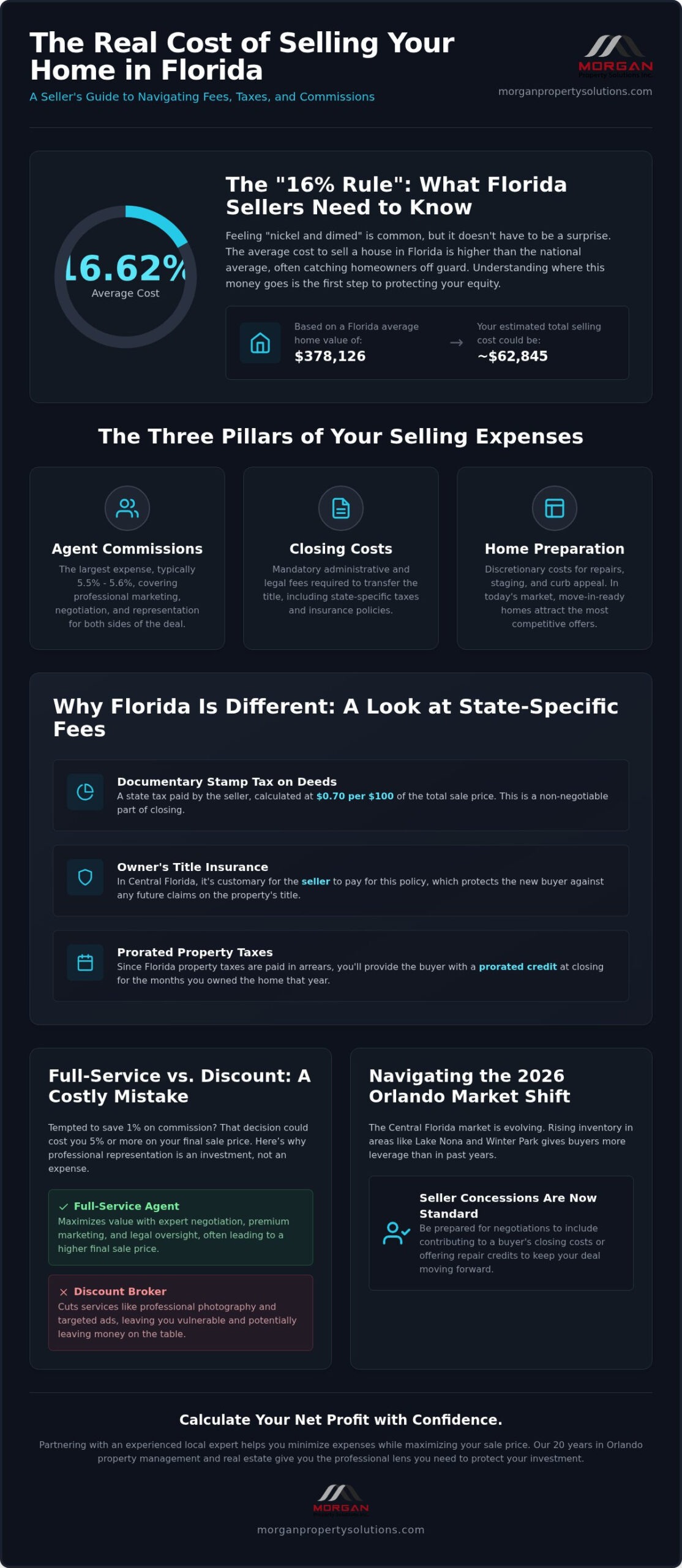
Selling a home in the Sunshine State involves more than just a handshake and a “For Sale” sign. Many homeowners are surprised to learn that the average cost to sell a house in Florida is approximately 16.62% of the total sale price. For a home valued at the state average of $378,126, that translates to roughly $62,845 in various expenses. This “16% Rule” often catches people off guard because it sits higher than the national average. Understanding this breakdown helps you plan your next move with confidence.
In 2026, we are seeing a distinct shift across Central Florida. Inventory has risen in popular areas like Lake Nona and Winter Park, which gives buyers more leverage than they had in previous years. Because of this, seller concessions have become a standard part of negotiations. You might find yourself contributing to a buyer’s closing costs or offering repair credits to keep a deal moving forward. Our team at Morgan Property Solutions Inc. has spent over 20 years watching these cycles; we know that staying ahead of these trends is the best way to protect your equity.
You will face two main categories of expenses: mandatory and discretionary. Mandatory costs include state taxes and title fees that are non-negotiable requirements of the transaction. Discretionary costs involve things like staging, professional photography, or elective repairs. While it’s tempting to skip the “optional” stuff, move-in-ready homes are currently commanding much higher interest in the Central Florida market. The “Seller Net” is the final amount you receive after all liens, commissions, and taxes are settled.
The Three Pillars of Selling Expenses
Most of your expenses fall into three buckets. Agent commissions are the largest, typically covering professional representation and marketing for both sides of the deal. Closing costs include the administrative and legal fees required to transfer the title. Finally, home preparation covers everything from basic curb appeal to major system repairs. Balancing these three pillars is essential to avoid being “nickel and dimed” during the process.
Why Florida Costs Differ from Other States
Florida has a few unique financial quirks that impact your bottom line. The Documentary Stamp Tax on deeds is a state tax paid by the seller, usually calculated at $0.70 per $100 of the sale price. In Central Florida, it’s also customary for the seller to pay for the owner’s title insurance policy, which isn’t the case in every state. Additionally, since property taxes are paid in arrears, you’ll provide the buyer with a prorated credit at the closing table for the months you owned the home that year.
Real Estate Agent Commissions: Evaluating the Value of Expertise
When you sit down to calculate the total cost to sell a house in Florida, real estate commissions usually represent the largest single expense. On average, you can expect a total commission between 5.5% and 5.6% of the sale price. This fee is typically split between the listing agent, who markets your home, and the buyer’s agent, who brings a qualified purchaser to the table. While the 2024 NAR settlement changed how buyer agent commissions are communicated, offering a competitive rate remains a vital strategy in 2026 to ensure your home gets the attention it deserves from the most active buyers in Orlando.
It’s tempting to look for the “cheapest” agent to save a few thousand dollars, but this often leads to lost equity in the long run. A discount broker might save you 1% on the commission, but if they lack the marketing budget or negotiation skills to drive up the sale price, you could end up leaving 5% or more on the table. At Morgan Property Solutions Inc., we use our 20 years of local experience to position your home as a premium listing. We focus on securing top-tier offers quickly, which often saves you more in holding costs than you’d ever save by cutting commission corners.
Full-Service vs. Discount Brokers
Cutting commissions often means cutting services. Discount brokers frequently skip high-end professional photography, targeted social media ads, and comprehensive legal oversight. This leaves you vulnerable to the “FSBO trap,” where sellers try to go it alone and often fail to reach the closing table. Understanding how to choose the best real estate agent to sell your house in Central Florida is about finding a partner who protects your interests from the first showing to the final signature.
The ROI of Professional Representation
Expert negotiation is where a full-service agent truly earns their keep. We handle the complexities of the Florida “As-Is” contract, ensuring you don’t get stuck with unfair repair demands. A professional also ensures all your paperwork is flawless, including the calculations for Florida’s documentary stamp tax, so there are no surprises at closing. Plus, our background in Orlando property management gives us a unique eye for detail; we can spot potential inspection red flags before they become deal-breakers. If you’re ready to see how a strategic approach can boost your bottom line, take a look about our team and our proven results.
Navigating Florida Closing Costs: Taxes, Title, and Legal Fees
Once you move past the big-ticket commission items, you enter the procedural maze of closing day. While commissions are the most visible expense, the technical fees and taxes required to transfer a deed can still take a significant bite out of your equity. Excluding commissions, the average seller closing costs in Florida typically range from 2% to 4% of the final sale price. Understanding these line items early in the process prevents the “sticker shock” that many sellers face when they see their final settlement statement.
One of the largest non-commission expenses you’ll face is the Documentary Stamp Tax. This is a state-mandated excise tax on the transfer of real estate. In the vast majority of the state, including the cost to sell a house in Florida throughout the Orlando metro, this tax is calculated at $0.70 for every $100 of the sale price. It’s a non-negotiable fee collected at the moment of closing to legally record the new deed with the county. Florida deed taxes are among the highest in the South, making accurate calculation vital for your financial planning.
Documentary Stamp Taxes in Central Florida
In Orange, Seminole, and Lake Counties, the $0.70 rate remains the standard for 2026. If you’re selling a home for $400,000, you can expect to pay $2,800 just for this single tax. Unlike some other states where these costs might be split, Florida custom dictates that the seller covers this expense. Because this is tied directly to the sale price, any successful negotiation that increases your home’s value will also slightly increase this tax liability.
Title Fees and Administrative Charges
The title company acts as a neutral third party to ensure the property’s “chain of ownership” is clear. In Central Florida, it’s customary for the seller to pay for the owner’s title insurance policy. This policy protects the buyer from any future claims against the property that might have originated during your ownership. You’ll also encounter smaller administrative charges like recording fees and lien searches, which ensure there are no outstanding utility bills or contractor debts attached to the home.
If your home is located in a managed community, such as those in Lake Nona or Winter Garden, don’t forget the HOA estoppel fee. This fee, usually between $250 and $300, is charged by the association to certify that your dues are paid in full. Finally, remember that Florida property taxes are paid in arrears. At the closing table, you’ll provide a prorated credit to the buyer for the portion of the year you lived in the home. Since tax bills aren’t mailed until November, this calculation is based on the previous year’s assessment. Having a partner with deep roots in Orlando property management and sales ensures these tiny details are handled correctly, so you don’t owe money back after the keys have changed hands.
Preparing Your Central Florida Home for a Top-Dollar Sale
We’ve discussed the taxes and commissions, but the total cost to sell a house in Florida also includes the capital you invest to make your home shine. In 2026, Central Florida buyers are looking for a turnkey experience. They want to move in without a long list of projects. Investing in the right areas now helps you avoid massive price drops during the inspection phase later.
Strategic repairs are your best defense against a deal falling through. In our Orlando climate, a roof near the end of its life or an aging HVAC system can make it nearly impossible for a buyer to get homeowners insurance. We often suggest a pre-listing inspection to catch these “red flags” early. It’s much cheaper to fix a leak or service an AC unit on your own schedule than to pay for a buyer’s emergency repairs at the last minute.
Curb appeal is another non-negotiable. Because of our local humidity, mold and mildew can quickly dull a home’s exterior. A professional pressure washing and fresh mulch are simple ways to boost interest. While staging costs vary, homes in neighborhoods like Winter Garden or Apopka generally net a much higher return when they aren’t left empty.
Local Market Expectations: Orlando and Lake Nona
Buyers in high-end communities like Windermere or Lake Nona expect premium finishes. If your home hasn’t been updated in a decade, simple changes like new light fixtures or a neutral coat of paint go a long way. The “fresh paint rule” is consistently the highest ROI project for any seller. If you’ve been renting your property, check out our Landlord Resources for tips on maintaining value before you list.
Managing the Transition: Moving and Storage
Budgeting for your move is just as vital as budgeting for repairs. Moving a three-bedroom home in Central Florida can be a significant expense, and timing is key to avoiding double mortgage payments. This is where our expertise in residential property management and sales provides a unique advantage. We help you coordinate the transition smoothly. If you want a partner who handles every detail, contact Morgan Property Solutions Inc. today to start your customized sale strategy.
Calculating Your Net Proceeds: The Seller Net Sheet
After reviewing the commissions, taxes, and prep work, it’s time to focus on the only number that truly matters: your walk-away profit. We find that the best way to eliminate anxiety is to create a realistic Seller Net Sheet before your home ever hits the market. This document acts as a financial roadmap, distilling every potential cost to sell a house in Florida into a single, clear bottom line. While online calculators offer a rough estimate, they often miss the specific nuances of Orlando utility prorations or local HOA requirements that we handle every day.
Your net sheet isn’t just about the sale price. It must account for your specific financial obligations. This includes your remaining mortgage balance and any outstanding Home Equity Lines of Credit (HELOC). You should also leave a small “buffer” for buyer repair credits, which have become more common in the 2026 Central Florida market. Finally, consider the federal tax implications. While Florida doesn’t have a state capital gains tax, you’ll want to verify if your profit exceeds the IRS exclusion limits of $250,000 for individuals or $500,000 for married couples.
Step-by-Step Profit Calculation
To get an accurate picture, start with a conservative likely sale price based on recent neighborhood data. From there, subtract the total transaction costs, which usually sit between 8% and 10% when you combine commissions and the closing fees we discussed earlier. Finally, deduct your mortgage payoff and any planned repair investments. This simple subtraction gives you a dependable estimate of the cash you’ll actually have in hand at the end of the day.
Is Selling Always the Best Option?
Sometimes, the numbers on a net sheet don’t align with your long-term goals. If the current market value doesn’t provide the equity you need for your next move, it’s worth considering a “Plan B.” Instead of selling at a loss or a break-even point, you could pivot and keep the home as a high-yield investment. Our expertise in property management allows us to help you transition from a frustrated seller to a successful landlord without the stress of daily tenant issues.
Turning your home into a rental can build wealth while you wait for the next market upswing. If you’re curious about how this fits into your broader financial picture, our sibling guide on Investing in Rental Properties: The 2026 Guide to Central Florida Success provides a deep dive into local rental trends. Whether you decide to sell for top dollar or build a rental portfolio, we’re here to provide the steady guidance you need through every phase of your real estate journey.
Take the Next Step with Confidence
Selling a home is a major life transition, but it doesn’t have to be an overwhelming one. We have walked through the various fees and taxes that make up the total cost to sell a house in Florida, but the most important thing to remember is that you have options. Whether you’re aiming for a top-dollar sale or considering keeping your home as a rental, having a clear plan is what protects your equity. You now have the tools to look past the list price and focus on the profit that actually lands in your pocket.
At Morgan Property Solutions Inc., we bring over 20 years of Central Florida real estate expertise to the table. Our team provides full-service support from the initial listing to the final closing, using our deep knowledge of both sales and professional property management to give you a unique edge. We’re here to simplify the procedural maze and act as your steady ally throughout the entire journey. We believe that clarity leads to confidence, and we are committed to your long-term success.
If you’re ready to see the numbers for your specific property, Get a Free Home Valuation and Net Proceeds Estimate today. Let’s work together to make your next move in the Orlando market a success.
Frequently Asked Questions
How much are closing costs for a seller in Florida?
Sellers can generally expect to pay between 2% and 4% of the home’s final sale price in closing costs. This percentage does not include real estate commissions, which are a separate expense. These costs cover items like the state deed tax, title insurance, and various administrative fees required to finalize the transaction. On a home sold at the state average of $378,126, these costs typically amount to about $12,400.
Who pays for title insurance in Florida, the buyer or the seller?
In Central Florida counties such as Orange, Seminole, and Lake, it’s customary for the seller to pay for the owner’s title insurance policy. This practice varies by region; for example, in Sarasota or Miami-Dade, the buyer often covers this cost. Since this is a negotiable item, your agent can help you decide how to structure your offer based on current local market trends in 2026.
What is the Documentary Stamp Tax on a Florida home sale?
The Documentary Stamp Tax is a state excise tax charged on the transfer of a real estate deed. In most counties, the rate is $0.70 for every $100 of the sale price. This tax is a mandatory part of the cost to sell a house in Florida and is collected at the closing table. If you sell a home for $500,000, your specific tax liability for this item would be $3,500.
Do I need a real estate attorney to sell my house in Florida?
Florida law does not strictly require you to hire a real estate attorney for a residential sale. Most transactions are handled efficiently by title companies that manage the escrow and closing process. However, some sellers choose to hire an attorney for extra legal protection if the sale involves complex title issues or unique contract disputes. We often see investors use attorneys to ensure their interests are fully shielded.
How can I avoid paying capital gains tax on my Florida home sale?
You can typically avoid federal capital gains tax if the home was your primary residence for at least two of the last five years. The IRS allows you to exclude up to $250,000 in profit for single filers or $500,000 for married couples filing jointly. Since Florida has no state capital gains tax, you only need to focus on these federal thresholds. Always consult a tax professional for your specific situation.
What is the average realtor commission in Orlando for 2026?
The average total commission in the Orlando area currently ranges between 5.5% and 5.6% of the sale price. This fee is usually shared between the listing agent and the buyer’s agent. While commissions are negotiable, offering a competitive rate helps attract the most qualified buyers and their agents. This professional representation often nets a higher sale price that outweighs the commission cost itself.
Are there hidden fees when selling a home in an HOA community?
Selling in an HOA community often involves an estoppel fee, which typically ranges from $250 to $300. This fee covers the administrative cost for the association to provide a letter certifying that your dues are paid in full. Some communities also charge a transfer fee or require you to pay any outstanding special assessments at closing. It is a good idea to check your specific association’s bylaws early.
Can I sell my Florida house ‘As-Is’ to save on repair costs?
Yes, selling ‘As-Is’ is very common in Central Florida, but it doesn’t mean you can hide known property defects. You are still legally required to disclose any major issues that aren’t readily visible. While this saves you from making repairs upfront, buyers in 2026 often request price reductions or repair credits during the inspection period. Our property management team often finds that small, strategic fixes prevent these larger credits later.

Article by
Oliver Overton-Morgan
Oliver Overton-Morgan is a full-time Real Estate Broker since 2003, with years of experience helping thousands of people purchase and sell real estate throughout Central Florida. He holds a Graduate Realtor Institute designation, LCAM, and has held licenses in good standing as a Florida Mortgage Broker and a Notary Public. Oliver immigrated to central Florida in 2001, and within 5 years Oliver built a successful Real Estate brokerage in central Florida, where he recruited over 75 Sales Associates with 25+ million in sales production.