
In the state of Florida, missing a security deposit deadline by just twenty-four hours isn’t just a minor mistake. It’s a legal trap that could force you to hand over the entire deposit plus your tenant’s attorney fees, regardless of how much damage they left behind. We understand that managing a rental in Orlando comes with plenty of pressure, especially when you’re trying to distinguish between simple wear and tear and actual property damage. It’s completely normal to feel anxious about the strict requirements of florida landlord tenant law security deposit regulations, but you don’t have to handle it alone.
This guide is designed to help you master the strict 2026 statutory timelines so you can protect your investment and keep your ROI high. We’ll show you how to make your process bulletproof by following FL Statute 83.49 to the letter. You’ll learn exactly how to document damages, meet every certified mail deadline, and utilize professional property management strategies to ensure you stay in full compliance while maintaining your peace of mind.
Key Takeaways
- Learn why Florida Statute 83.49 is your essential rulebook for protecting your rental income and avoiding legal pitfalls.
- Master the strict timelines of florida landlord tenant law security deposit requirements, including the 15-day return rule and the 30-day window for claims.
- Understand the three legal ways to hold a deposit and the mandatory disclosure you must provide to tenants within their first 30 days.
- Distinguish between normal wear and tear and actual damage to ensure your deductions stand up in a Central Florida court.
- See how professional Orlando property management uses meticulous inspections to remove the stress of move-out disputes and protect your ROI.
Understanding Florida Statute 83.49: The Landlord’s Rulebook
If you’re managing property in Orlando, you’ve likely heard of Florida Statute 83.49. Think of this as the absolute rulebook for every dollar you collect from a tenant beyond their monthly rent. This specific piece of florida landlord tenant law security deposit regulation matters more in 2026 than ever before because the courts have become incredibly strict about procedural errors. The core philosophy is simple: that money belongs to the tenant. You’re just holding it in trust. To keep any portion of it, you must prove through specific documentation that damages occurred beyond normal wear and tear.
The court system often leans in favor of tenants in these disputes. Why? Because the law is designed to protect the party with less perceived power. This creates a “strict liability” trap. If you miss a notice deadline by even one day, your intent or the quality of your property doesn’t matter. You’ll likely lose the right to the deposit and could be on the hook for the tenant’s attorney fees. It’s a high-stakes game where being “mostly right” isn’t good enough. As a steady ally for local investors, we’ve seen how a single paperwork error can wipe out an entire year of rental profit.
The Different Types of Deposits in Florida
When setting up a lease in Central Florida, it’s vital to distinguish between different funds. Security deposits are for physical damages, while advance rent is specifically for future housing costs. Mixing these up in your accounting can lead to legal headaches. You also need to be clear about pet deposits. In Orlando rentals, these can be non-refundable fees or refundable deposits, but they must be clearly labeled in the lease. Finally, holding deposits are often used to secure a unit before a lease is signed. If the tenant backs out, whether you can keep that money depends entirely on your written agreement.
Why 2026 is a Critical Year for Compliance
As we move through 2026, compliance has become more complex due to digital payment platforms. While Zelle and Venmo are convenient, they can create confusion regarding the exact date of “receipt” for legal notice windows. We’ve seen a rise in litigation across Orange and Seminole counties where tenants challenge these digital timelines. To simplify things, many landlords are moving toward deposit-free renting. This modern approach removes the burden of holding large sums of cash and significantly reduces the risk of a lawsuit. Understanding the broader framework of Landlord-tenant law is the first step toward becoming a successful, stress-free investor.
Collecting and Holding the Deposit: The First 30 Days
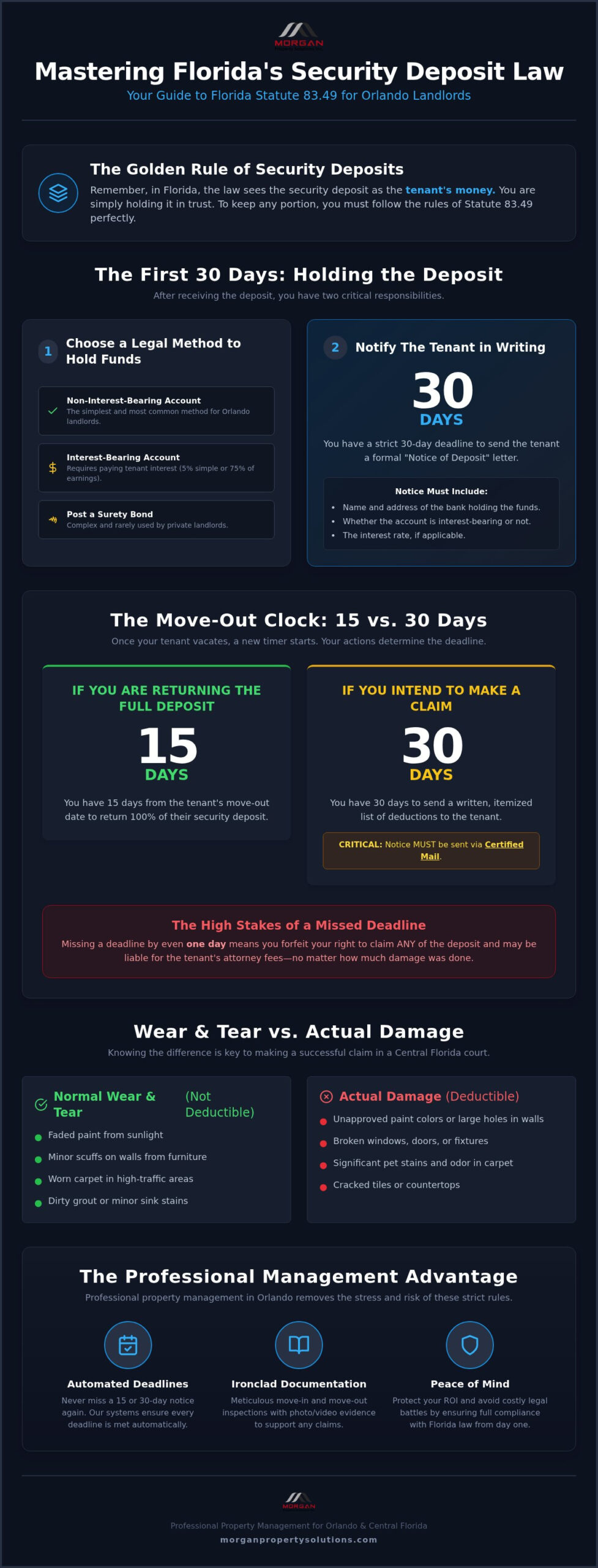
In Florida, you can’t just stick a security deposit in your personal savings account and call it a day. According to Florida Statute 83.49, you have three specific ways to hold these funds. You can use a separate non-interest-bearing account in a Florida bank, a separate interest-bearing account in a Florida bank, or post a surety bond with the local circuit court. Most private landlords in Orlando avoid the bond because it’s complicated. The biggest mistake we see is commingling. If you mix the tenant’s deposit with your personal funds or your business operating budget, you’ve technically violated the law before the lease even starts.
Once you’ve received the funds, you have exactly 30 days to notify your tenant in writing about where their money is sitting. This isn’t just a courtesy; it’s a mandatory disclosure under florida landlord tenant law security deposit rules. Your letter must include the name and address of the bank and whether the funds are earning interest. Failing to send this notice doesn’t necessarily mean you lose the deposit immediately, but it puts you on shaky legal ground if a dispute arises later.
Interest-Bearing vs. Non-Interest-Bearing Accounts
If you choose an interest-bearing account, you’re taking on a significant administrative burden. You must pay the tenant either 75% of the annualized average interest rate or 5% simple interest per year. In the current market, the interest earned is usually tiny compared to the headache of calculating and distributing those funds. That’s why the vast majority of our clients prefer a non-interest-bearing escrow account. It’s simpler, cleaner, and keeps your records easy to manage. Keeping your accounting transparent is the best way to maintain trust with your tenants from day one.
The “Notice of Deposit” Letter
The “Notice of Deposit” is a formal document that must be delivered to the tenant within that initial 30-day window. You can deliver this notice personally or through the mail. However, sending it via certified mail provides a vital paper trail that can protect you in an Orange County court. Many DIY landlords find this deadline easy to miss during the chaos of a move-in. Professional Orlando property management teams automate this entire process. We ensure the notice is sent immediately so you never have to worry about a technical violation. If you’re feeling overwhelmed by these timelines, our landlord resources offer a great starting point for staying organized.
The Move-Out Timeline: The 15 vs. 30 Day Dance
When a tenant hands over the keys to their Orlando rental, a legal stopwatch starts ticking immediately. Under florida landlord tenant law security deposit regulations, you have two primary deadlines to remember. If the home is in perfect condition and you don’t intend to keep any of the money, you must return the full deposit within 15 days. However, if there are damages that require a deduction, you have exactly 30 days from the date the tenant vacates to send a written notice of your intent to impose a claim. It’s a tight window, and there is no “grace period” for being busy or out of town.
Missing this 30-day window is a critical error. If the notice isn’t sent on time, you forfeit your right to keep any part of the deposit, even if the tenant caused significant damage. To protect yourself, you must send this notice via certified mail to the tenant’s last known address. This provides the court-admissible proof you’ll need if the situation escalates. For a deeper look at your rights and responsibilities during this phase, the Florida Bar Landlord/Tenant Guide offers an excellent summary of how these timelines function in practice.
Drafting the Notice of Intent to Impose Claim
Your notice isn’t just a casual letter; it must include specific language required by Florida Statute 83.49. You should state: “This is a notice of my intention to impose a claim for damages in the amount of $____ upon your security deposit, due to ____.” Be precise when itemizing. Writing “general cleaning” is often viewed as too vague by judges. Instead, list specific issues like “professional steam cleaning for pet stains in the master bedroom.” Once the tenant receives this notice, they have 15 days to object in writing. If they don’t object, you can deduct the amount and return the remainder.
Managing Tenant Disputes and Objections
Disputes can get emotional quickly, especially when money is on the line. If a tenant objects to your claim or refuses to sign for the certified mail, don’t panic. The law still requires them to provide a written objection within their 15-day window to preserve their rights. We often find that an informal resolution, such as a calm phone call to explain the repair costs with photos as evidence, can prevent a trip to small claims court. If the conversation becomes too heated, involving a professional Orlando property manager can help. We act as a neutral third party, using our 20+ years of experience to handle the “emotional” side of the dispute while keeping everything strictly by the book.
Deductions: Normal Wear and Tear vs. Property Damage
Understanding the difference between damage and wear is the most common point of conflict in florida landlord tenant law security deposit disputes. In Orlando, “normal wear and tear” refers to the expected decline in a property’s condition due to everyday living. It’s the difference between a carpet that looks walked on and a carpet that has a giant red wine stain. As a landlord, you’re responsible for the cost of refreshing the home for the next tenant, while the outgoing tenant is responsible for any actual destruction they caused.
You also have to consider the “useful life” of your property’s components. If your tenant moves out and the 10-year-old carpet is worn down, you can’t legally charge them for a full replacement. Most courts follow guidelines that suggest carpet has a life of about five to seven years. Charging a tenant for the full cost of replacing an item that was already at the end of its life is a quick way to lose a case in an Orange County court. It’s about being fair and methodical with your math.
Your best defense is a “bulletproof” move-in and move-out inspection. In 2026, high-resolution photos and 4K videos are your most valuable assets. They provide undeniable proof of the property’s state before and after the lease. We always recommend taking hundreds of photos of every corner, including inside drawers and under sinks. This level of detail makes it very difficult for a tenant to successfully object to a valid claim.
Common Valid Deductions in Orlando Rentals
Pet damage is a frequent issue in Central Florida. While a few stray hairs are wear and tear, urine stains on the subfloor or chewed baseboards are definitely damage. We also see valid claims for large holes from wall-mounted TVs, broken windows, or unauthorized “upgrades” like painting a room a dark color without permission. If a home is left in a state of excessive filth that requires a professional deep clean beyond a basic “broom clean” standard, that’s a legitimate deduction from the deposit.
Pitfalls: What You CANNOT Deduct
Be careful with the effects of the Florida sun. Faded paint or sun-damaged blinds are usually considered wear and tear in our region. Minor scuffs on baseboards or traffic patterns on the carpet are also just part of doing business as a landlord. You can’t deduct for routine AC maintenance or repairing an appliance that simply stopped working due to age. These are ownership costs, not tenant damages. If you want to ensure your investment is protected by experts who know these distinctions inside and out, consider our Orlando property management services to handle the heavy lifting for you.
How Professional Management Eliminates Security Deposit Stress
Managing a rental property in Central Florida involves navigating a field of legal landmines. One of the most dangerous traps in florida landlord tenant law security deposit regulations is the “losing party pays” clause. If a judge decides you incorrectly withheld a deposit, you don’t just lose that money. You’re often ordered to pay the tenant’s attorney fees, which can easily reach thousands of dollars. This risk alone makes DIY property management a high-stakes gamble for many Orlando investors.
By partnering with a professional, you’re investing in a legal shield. We act as a neutral third party, removing the emotion from move-out negotiations. When a tenant sees that a professional firm is handling the claim with data-backed evidence, they’re much less likely to pursue a frivolous lawsuit. This mediation saves you time, stress, and potentially a very expensive day in court. It’s about protecting your ROI by ensuring every step of the process is bulletproof.
The Morgan Property Solutions Advantage
With over 20 years of experience in the Orlando market, we’ve refined our process to make compliance simple. We utilize detailed inspections that capture the home’s condition with precision. This documentation is uploaded to our secure online portal, giving you 24/7 visibility into your portfolio. You can also access our library of landlord resources to stay informed about shifting regulations. We handle everything from the initial certified mail notice to the final fund distribution, so you don’t have to worry about a single deadline.
Getting Started with Stress-Free Management
Whether you own a single-family home in Lake Nona or a high-value estate in Winter Park, your assets deserve professional oversight. Transitioning your current portfolio to our care is a seamless process. We’ll review your existing leases, verify your security deposit holding methods, and ensure your next move-out follows every letter of the law. Our goal is to serve as your steady ally throughout your investment journey. Don’t wait until you’re facing a legal dispute to seek help. Reach out to us today for a free consultation and see how we can turn your rental property into a truly passive source of income.
Securing Your Investment and Your Peace of Mind
Managing a rental property in Central Florida shouldn’t feel like a constant legal battle. By mastering the strict timelines and documentation requirements of florida landlord tenant law security deposit regulations, you can transform your investment into a stable asset. Remember that the difference between a profitable year and a costly legal dispute often comes down to a single certified letter or a well-documented move-out inspection.
At Morgan Property Solutions, we’ve spent more than 20 years helping Orlando landlords navigate these complexities. Our A+ rated property management systems are built around total compliance with FL Statute 83.49, ensuring your interests are always protected. You don’t have to handle the stress of move-out disputes or escrow account management alone. We are here to act as your steady ally and expert guide throughout every phase of your professional journey.
Protect your investment with professional Orlando property management today. We look forward to helping you achieve the long-term success and financial returns you deserve.
Frequently Asked Questions
How long does a landlord have to return a security deposit in Florida?
You have exactly 15 days to return the full security deposit if you aren’t making a claim. If you intend to keep any portion for damages, you must send a written notice of your claim within 30 days. These deadlines are strictly enforced under Florida Statute 83.49. Missing these dates by even 24 hours can lead to a total forfeiture of your right to the funds, even if legitimate damage exists.
Can a Florida landlord deduct for professional cleaning?
You can deduct for professional cleaning only if the property is left in a condition that exceeds normal wear and tear. Florida law generally expects a tenant to return the unit in “broom clean” condition. If there is excessive filth, trash left behind, or deep stains that require specialized services, you may have a valid claim. We recommend keeping detailed receipts and photos to justify these specific costs if a tenant objects.
What happens if a landlord doesn’t send the 30-day notice?
Failing to send the required 30-day notice means you forfeit your right to impose a claim on the security deposit. Even if the tenant caused significant damage to your Orlando rental, you must return the full amount. However, you still have the right to file a separate lawsuit for damages in small claims court. Most landlords find this process much more expensive and stressful than simply meeting the initial statutory deadline.
Does a security deposit have to be in a separate bank account in Florida?
Yes, the funds must be held in a separate account within a Florida banking institution. You cannot mix these funds with your personal money or business operating accounts. This is a core requirement of fortida landlord tenant law security deposit regulations. You have the choice between a non-interest-bearing account, an interest-bearing account, or posting a surety bond. Most Central Florida investors choose non-interest-bearing accounts to avoid the administrative burden.
Can a tenant use a security deposit as their last month’s rent in Florida?
No, a tenant cannot use the security deposit as their last month’s rent unless your lease agreement explicitly permits it. The deposit is specifically reserved to cover damages or unpaid rent after the tenant vacates. If a tenant attempts to skip their final payment, you should treat it as a standard late rent issue. We often see this confusion among DIY landlords, but sticking to your lease terms is essential for protection.
What is considered “normal wear and tear” in a Florida rental property?
Normal wear and tear is the natural deterioration that occurs from everyday use. In our local market, this includes things like faded paint from the Florida sun, minor scuffs on baseboards, or light traffic patterns on carpets. These are ownership costs you shouldn’t deduct from a tenant. Actual damage, such as large holes in drywall, broken appliances due to misuse, or pet urine stains, are valid reasons to impose a claim.
Are Florida landlords required to pay interest on security deposits?
You aren’t required to place the deposit in an interest-bearing account, but if you do, you must pay the tenant. Specifically, you must return 75% of the annualized average interest rate or 5% simple interest per year. Because of this requirement, many Orlando property owners prefer non-interest-bearing escrow accounts. It simplifies your accounting and removes the need for annual interest calculations, making your management process much more manageable and less prone to errors.
Can a landlord keep the deposit if the tenant breaks the lease early?
You can deduct for unpaid rent or damages if a tenant breaks their lease early, but you must still follow the 30-day notice process. Many Florida leases include a liquidated damages clause that allows you to collect up to two months’ rent for an early termination. However, you cannot simply keep the security deposit as a penalty. You must itemize the specific financial losses incurred and follow the statutory timeline to remain compliant.

Article by
Oliver Overton-Morgan
Oliver Overton-Morgan is a full-time Real Estate Broker since 2003, with years of experience helping thousands of people purchase and sell real estate throughout Central Florida. He holds a Graduate Realtor Institute designation, LCAM, and has held licenses in good standing as a Florida Mortgage Broker and a Notary Public. Oliver immigrated to central Florida in 2001, and within 5 years Oliver built a successful Real Estate brokerage in central Florida, where he recruited over 75 Sales Associates with 25+ million in sales production.