
What if your Orlando home could pay for your next move while building wealth on autopilot, all without the midnight phone calls about a broken AC? It’s a compelling goal, but many homeowners get stuck wondering exactly how to rent out my house in orlando without ending up with a legal disaster or a trashed living room. You want the steady passive income that comes with Central Florida real estate, but the stress of managing a property from another city or keeping up with changing state laws can feel like a second full-time job.
We know that handing over the keys to your most valuable asset is a big step, and you deserve to feel completely secure in that decision. This 2026 guide is here to simplify the process by providing a clear, local roadmap for success. You’ll learn how to stay compliant with Florida’s latest regulations, screen for reliable tenants, and protect your property’s long-term appreciation. We’ll also show you how professional management can remove the psychological friction of landlording, turning your house into a stress-free engine for financial growth.
Key Takeaways
- Evaluate the 2026 Orlando rental market to determine if long-term appreciation makes renting more profitable than selling.
- Navigate essential legal requirements for how to rent out my house in orlando, such as updating your status with the Orange County Property Appraiser.
- Prepare your home to meet “rent-ready” standards with specific tips for Florida-friendly landscaping and landlord-specific insurance.
- Implement a professional screening and marketing process to attract reliable tenants who will treat your property with respect.
- Decide between DIY management and professional property management to ensure your investment remains a truly passive income stream.
Deciding to Rent Out Your Orlando Home: Is It the Right Move?
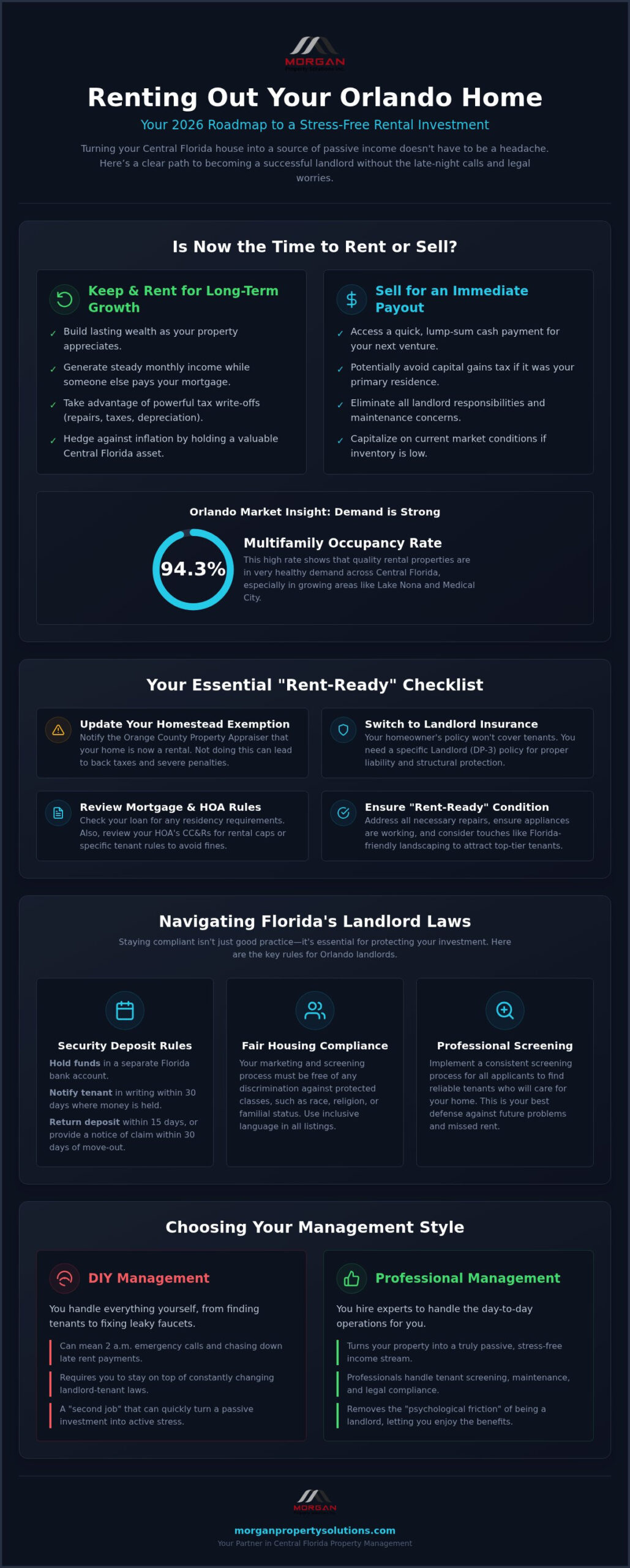
Transitioning from a homeowner to a landlord is a significant lifestyle shift. It involves more than just putting a sign in the yard. It is a strategic choice to hold onto a piece of the Central Florida dream. Many owners start researching how to rent out my house in orlando because they are moving for work or family but aren’t ready to say goodbye to their neighborhood. Keeping your home as a rental property is one of the best ways to hedge against inflation. While you are settling into a new city like Tampa or Miami, your Orlando asset continues to build equity and generate a monthly check.
Being a landlord is a professional role that requires patience and a thick skin. You have to be ready for the reality of property maintenance, which never seems to happen at a convenient time. A broken pipe at 2 a.m. is a classic landlord trope for a reason. Understanding the basics of Landlord-tenant law is essential before you sign your first lease. If the thought of middle-of-the-night emergencies or chasing down late rent makes you anxious, that’s completely normal. Many successful owners use professional property management to handle these details. It allows them to stay in the driver’s seat of their investment without the daily friction of being the point of contact for every minor issue.
Renting vs. Selling in Central Florida
In neighborhoods like Winter Garden and Apopka, inventory levels remain a key factor in your decision. Selling might offer a quick cash payout, and if the home was your primary residence, you might benefit from capital gains tax exclusions. However, renting offers long-term tax advantages that a sale can’t match. You can often write off property taxes, repairs, and even the depreciation of the building itself. It is a choice between an immediate profit and building a legacy of wealth. If your home is in a high-demand area, the long-term growth typically outweighs the one-time gain of a sale.
The Long-Term ROI of an Orlando Investment
Orlando remains a top-tier market for residential real estate in 2026. Major developments in Lake Nona and the continued growth of Medical City provide a stable base of high-quality tenants who value proximity to work. Even with a slight cooling in rent prices recently, the 94.3% multifamily occupancy rate shows that demand is still very healthy. For a deeper dive into the numbers, check out our resource on Investing in Rental Properties: The 2026 Guide. Holding onto your Orlando asset ensures you don’t miss out on the next wave of regional growth while someone else pays down your mortgage.
Navigating Florida Legal and Tax Requirements
Understanding how to rent out my house in orlando requires a deep dive into local and state regulations to avoid expensive mistakes. One of the most common pitfalls for new landlords is the “Homestead Exemption trap.” If you are currently receiving a tax break on your primary residence, you must notify the Orange County Property Appraiser once the home becomes a rental. According to Florida Statute 196.061, renting your entire dwelling constitutes an abandonment of that homestead for tax purposes. Failing to report this change can lead to significant back taxes and hefty penalties that could wipe out your first year of rental profit.
Your financial protection also depends on having the right insurance coverage. A standard homeowners policy usually won’t cover a property that is occupied by tenants. You need to switch to a Landlord Insurance policy, often referred to as a DP-3 policy. This covers the structure and provides liability protection specifically for rental scenarios. Before you list the property, review a professional checklist for turning your home into a rental to ensure you haven’t missed any financial steps. You should also check your mortgage agreement. Most conventional loans require you to live in the home as a primary residence for at least 12 months before turning it into a rental.
Florida Landlord-Tenant Law Essentials
Florida has strict rules regarding security deposits. You must hold these funds in a Florida-based bank account and notify the tenant in writing where the money is being kept within 30 days of receipt. When the lease ends, you have 15 days to return the deposit or 30 days to give notice of a claim. Staying compliant with Fair Housing laws is also vital; your marketing must never include language that could be seen as discriminatory based on familial status or other protected classes. For a deeper look at these rules, see our Florida Landlord Tenant Law: The 2026 Guide.
HOA and Municipality Compliance
If your home is in a community like Wedgefield or Clermont, your Homeowners Association (HOA) likely has specific rental rules. Some neighborhoods have rental caps that limit the percentage of homes that can be leased at any one time. Always review your Covenants, Conditions, and Restrictions (CC&Rs) for these details. We recommend using a lease addendum that explicitly states the tenant must follow all HOA rules, making them responsible for any fines incurred. If the complexity of these regulations feels overwhelming, partnering with an expert in Orlando property management can help ensure you never miss a compliance deadline.
Preparing Your House for the Orlando Rental Market
Once you have the legal groundwork settled, it’s time to focus on the physical property. Preparing your home for a tenant requires a different mindset than preparing it for a buyer. You want the property to be “rent-ready,” which means it is safe, spotless, and every system works perfectly. If you are wondering how to rent out my house in orlando successfully, start with the basics. Test every smoke detector, service the HVAC unit, and ensure all windows lock securely. Meeting the safety standards found in Florida’s official landlord and tenant laws is your first priority as a new landlord.
Curb appeal is just as important for rentals as it is for sales. In the Central Florida heat, landscaping can be a challenge. We recommend using drought-tolerant plants and fresh mulch to keep the exterior looking sharp without requiring excessive water. Inside, focus on refreshes that offer high durability. Neutral paint colors make the space feel larger and cleaner, while luxury vinyl plank flooring handles the wear and tear of daily life far better than carpet. These small investments help your listing stand out in a competitive market like 2026 Orlando.
High-ROI Upgrades for 2026
Smart home features are no longer just for luxury listings. Many Orlando tenants now look for keyless entry and smart thermostats as standard features. Keyless locks are particularly helpful for owners because they eliminate the need to re-key the house between every tenant. Energy efficiency is another major selling point. Since cooling costs are a significant part of a Florida budget, a home that stays cool efficiently will attract higher-quality applicants. Always perform a detailed move-in inspection with photos to document the home’s condition before the first lease begins.
Determining Your Rental Rate
Pricing your home correctly is a balancing act. If you set the rent too high, you risk expensive vacancy months where you are paying the mortgage out of your own pocket. If you price it too low, you’re missing out on vital passive income. To find the sweet spot, look at a comparative market analysis for your specific neighborhood. A home in Winter Park or Windermere will have different price drivers than one in a newer suburban development. For a professional look at your home’s potential, you can request a rental analysis on our Orlando property management page.
Finding and Screening High-Quality Tenants
Finding the right tenant is the most critical step in learning how to rent out my house in orlando. You are looking for someone who will treat your home with the same care you do. It starts with high-quality marketing to attract the right pool of applicants. Professional photography is a must; cell phone photos simply don’t cut it in the 2026 market. You should list your property on major platforms like Zillow and the MLS, but don’t overlook social media. Since over half of the people searching for Orlando rentals are coming from out of town, providing a high-definition video tour can help you secure a great tenant before they even step foot in Florida.
Once the applications roll in, you need a rigorous system to separate the best candidates from the rest. We recommend a multi-layered approach that includes credit, criminal, and eviction history. Verifying income is non-negotiable. A standard benchmark is the 3x rent-to-income ratio, which ensures the tenant can comfortably afford the monthly payments. You also need to verify employment directly with their employer. Don’t forget about pets. Being pet-friendly opens your home to more applicants, but you should use a professional service to mitigate risks and verify animal behavior and vaccination records.
Effective Rental Marketing
Your listing description should do more than list the number of bedrooms. It should sell the Orlando lifestyle. Highlight the proximity to local favorites like the restaurants in Winter Park or the parks in Lake Nona. If you want to see what a professional standard looks like, you can review the Morgan Property Solutions screening criteria. This transparent approach helps set expectations early and discourages unqualified applicants from applying in the first place. It saves you time and ensures you only spend your energy on the most promising leads.
The Lease Agreement and Move-In
A handshake deal is a recipe for disaster in Florida. You need a comprehensive written lease that clearly defines maintenance responsibilities and late fee structures. This document protects both you and the tenant. To handle the liability of four-legged residents, we utilize PetScreening to ensure every animal is properly vetted. This adds a layer of security and professional oversight to your rental agreement. If you’d rather skip the stress of showings and background checks, our Orlando property management team can handle the entire tenant placement process for you.
Managing Your Orlando Rental: DIY vs. Professional Management
Many owners who research how to rent out my house in orlando initially plan to handle every detail themselves. It seems straightforward until the first major repair happens. Being an “accidental landlord” means you’re essentially the first point of contact for every property emergency. When an AC unit fails in the middle of a July heatwave, your tenant expects a solution immediately. If you live in another city or have a busy career, managing these emergencies is a massive source of stress that can quickly drain the joy out of your investment.
Managing the tenant relationship is another hurdle. Collecting rent on time and enforcing lease terms requires a firm but professional touch. If you’re still figuring out how to rent out my house in orlando while working a full-time job, these tasks can become overwhelming. It’s easy to let things slide when a tenant has a convincing story, but those delays can impact your mortgage payments. You also have to consider the value of your own time. If you spend five hours a week chasing paperwork or coordinating repairs, self-management isn’t actually “free.” It’s a second job that takes you away from your family and your primary career.
When to Hire an Orlando Property Manager
You might be ready for professional help if you’ve noticed late rent payments becoming a habit or if legal notices from your HOA are piling up. A professional Orlando Property Management firm acts as a vital buffer between you and your tenant. This professional distance ensures that the lease is followed strictly while keeping your relationship with the tenant positive. Streamlined systems for accounting and maintenance coordination mean you can finally stop worrying about the “what ifs.”
The Morgan Property Solutions Advantage
At Morgan Property Solutions, we focus on making your investment as passive as possible. We provide total transparency through our Online Owner Portal, which offers 24/7 financial reporting so you can check your investment’s performance at your convenience. Our goal is to maximize your profit by keeping vacancy rates low and reducing the high costs of tenant turnover. We bring 20+ years of experience to the table to ensure your home is cared for properly. If you want to simplify your transition, reach out to our Orlando property management team today to discuss your goals.
Your Next Steps to Orlando Rental Success
Renting out your home in 2026 is a smart way to build long-term wealth, but it requires a methodical approach. You’ve learned about the importance of legal compliance, from notifying the property appraiser to handling security deposits correctly. You also know that finding the right tenant through rigorous screening is the foundation of a stress-free experience. These steps ensure your property remains a profitable asset rather than a source of anxiety.
If the details of how to rent out my house in orlando still feel a bit daunting, you don’t have to navigate this journey alone. With over 20 years of Central Florida expertise, our A+ rated team understands the specific nuances of the Winter Park and Lake Nona markets. We are here to act as your steady ally, protecting your asset while you focus on your next chapter. We simplify the complex parts so you can enjoy the benefits of property appreciation and passive income.
Ready to see what your property could earn in today’s market? Get a Free Rental Analysis from Morgan Property Solutions today. Taking this first step is the best way to turn your house into a reliable income stream with total confidence.
Frequently Asked Questions
Can I rent out my house in Orlando if I still have a mortgage?
Yes, you can rent out a home with an existing mortgage, but you must ensure you’ve met the occupancy requirements of your loan. Most conventional mortgages require the owner to live in the property as a primary residence for at least 12 months. If you decide to move out sooner, it’s best to check with your lender to avoid any technical defaults on your original loan agreement.
What happens to my Florida Homestead Exemption if I rent out my home?
You will lose your Florida Homestead Exemption if you rent out your entire property for a long-term lease. Florida law considers this an abandonment of the homestead for tax purposes. It’s vital to notify the Orange County Property Appraiser of this change in status. Failing to do so can lead to significant penalties and back taxes that could wipe out your rental profits for the year.
Do I need a special business license to be a landlord in Orlando?
In the city of Orlando and Orange County, you generally don’t need a specific “landlord license” for a single-family home. However, some local municipalities or Homeowners Associations may require a rental registration or a local business tax receipt. Checking these small local rules is a key part of learning how to rent out my house in orlando without facing unexpected fines or legal delays from your community.
How much can I realistically rent my house for in Lake Nona or Winter Park?
Rental rates in Lake Nona and Winter Park are typically higher than the Orlando average of $2,374 for a single-family house. These areas are highly desirable due to top-rated schools and proximity to major employment hubs like Medical City. To get an accurate figure, we recommend a professional comparative market analysis. This looks at similar homes within a one-mile radius to account for your specific upgrades and local neighborhood amenities.
Should I allow pets in my Orlando rental property?
Allowing pets is usually a smart move because it significantly expands your pool of potential applicants. Since many Orlando renters have animals, a “no pets” policy can lead to longer vacancy periods. To protect your investment, we recommend using a professional screening service to verify the animal’s history and health records. This approach allows you to be pet-friendly while minimizing the risk of property damage or liability issues.
What is the most common mistake first-time landlords make in Florida?
The most common mistake is failing to conduct a thorough, professional background check on every adult applicant. Relying on a “gut feeling” or a handshake deal often leads to tenants who don’t pay rent or damage the home. Another frequent error is using a generic lease found online that doesn’t account for specific Florida statutes. Professional property management helps avoid these pitfalls by implementing standardized, legally vetted screening and leasing processes.
How do I handle a tenant who stops paying rent in Orlando?
If a tenant stops paying rent, you must follow the formal legal eviction process exactly as outlined by Florida law. You cannot change the locks or turn off utilities to force them out, as these “self-help” evictions are strictly illegal. The process typically begins with a formal 3-day notice to pay or quit. If they still don’t pay, you will need to file a lawsuit in the county court.
Is landlord insurance more expensive than regular homeowners insurance?
Landlord insurance is generally more expensive than a standard homeowners policy because rental properties carry higher liability risks. When you are figuring out how to rent out my house in orlando, you must factor in the cost of a DP-3 policy. This specialized coverage is essential for protecting the structure and providing liability defense if a guest is injured on the property. It ensures you aren’t left with a denied claim.

Article by
Oliver Overton-Morgan
Oliver Overton-Morgan is a full-time Real Estate Broker since 2003, with years of experience helping thousands of people purchase and sell real estate throughout Central Florida. He holds a Graduate Realtor Institute designation, LCAM, and has held licenses in good standing as a Florida Mortgage Broker and a Notary Public. Oliver immigrated to central Florida in 2001, and within 5 years Oliver built a successful Real Estate brokerage in central Florida, where he recruited over 75 Sales Associates with 25+ million in sales production.