
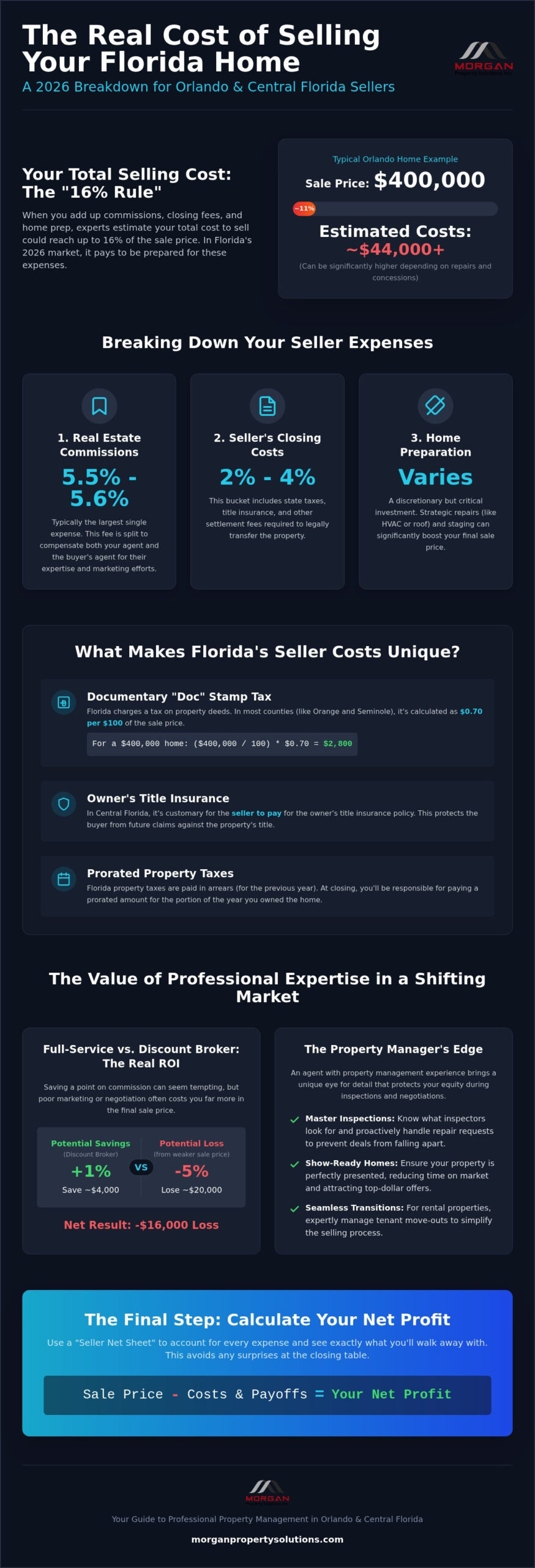
Did you know that the total cost to sell a house in Florida can sometimes reach nearly 11% of your final sale price? For a $400,000 home in Orlando, that means you might see over $40,000 disappear into commissions, taxes, and settlement fees before you ever receive your check. It’s a significant amount that often catches sellers by surprise. We know how frustrating it feels to worry about being “nickel and dimed” at the closing table or wondering if those pre-sale repairs will actually pay off.
This guide is here to replace that confusion with total clarity. We’ll walk you through every fee, tax, and hidden expense you’ll face in 2026 so you can calculate your exact net profit with confidence. You’ll get a line-item look at everything from Documentary Stamp Taxes to title insurance. We will also share how a professional property management eye for detail can help you minimize expenses while maximizing your home’s value. From Winter Park to Lake Nona, we’re here to simplify the process and ensure you keep as much of your equity as possible.
Key Takeaways
- Learn how to calculate the total cost to sell a house in Florida by understanding the “16% Rule” and how current 2026 market shifts impact your bottom line.
- Demystify the procedural maze of closing costs, including how to accurately estimate Florida’s Documentary Stamp Taxes and Title Insurance fees.
- Discover why the standard 5-6% commission is structured the way it is and how choosing the right expert can actually protect your home’s equity.
- Use a property manager’s eye for detail to identify which strategic repairs, like HVAC or roofing, are essential for a top-dollar sale in the Orlando market.
- Master the Seller Net Sheet to account for mortgage payoffs and hidden expenses, ensuring you walk away from the closing table with no financial surprises.
The Big Picture: What is the Average Cost to Sell a House in Florida?
Selling a home in the Sunshine State involves more than just a handshake and a “Sold” sign. When you look at the total cost to sell a house in Florida, many experts point to the “16% Rule.” This means that after you factor in commissions, closing fees, and home preparation, you might spend up to 16% of the sale price. While some national averages hover lower, Florida’s specific tax structure and market demands in 2026 often push these numbers higher. Your Seller Net is the final amount you pocket after all liens, commissions, and taxes are settled.
Inventory has surged across Central Florida recently, especially in markets like Orlando and Sarasota. This shift means buyers have more leverage than they did a few years ago. You might find yourself offering concessions, such as paying for a buyer’s home warranty or covering a portion of their understanding closing costs. These aren’t mandatory, but they are becoming essential to close deals in a competitive landscape. Being prepared for these requests helps you stay calm and confident during negotiations.
The Three Pillars of Selling Expenses
To keep the process manageable, we categorize these expenses into three main buckets. First, you have real estate commissions, which typically range from 5.5% to 5.6% to cover professional representation and marketing. Second, there are closing costs, which usually fall between 2% and 4% for the seller. Finally, there is home preparation. While discretionary, investing in repairs or staging is often the difference between a house that sits and one that sells for top dollar.
Why Florida Costs Differ from Other States
Florida has a few unique quirks that impact your bottom line. The biggest one is the Documentary Stamp Tax. In most counties, like Orange and Seminole, you’ll pay $0.70 for every $100 of the sale price. Title insurance is another factor. In Central Florida, it’s customary for the seller to pay for the owner’s policy, which can cost thousands depending on your home’s value. You also have to account for property tax cycles. Since Florida taxes are paid in arrears, you’ll owe a prorated amount for the portion of the year you owned the home.
If you’re selling a rental property, having a team that understands Orlando property management can be a lifesaver. They can help manage tenant transitions and ensure the home is show-ready, which directly impacts your cost to sell a house in Florida by reducing time on the market. This specialized knowledge helps turn a complex transition into a smooth, successful sale.
Real Estate Agent Commissions: Evaluating the Value of Expertise
When you calculate the total cost to sell a house in Florida, the real estate commission is usually the largest line item. In 2026, the average commission rate in Florida continues to hover between 5.5% and 5.6%. This fee is typically split between the listing agent, who handles your marketing and negotiations, and the buyer’s agent, who brings a qualified purchaser to the table. While these rates are always negotiable, many sellers find that offering a competitive buyer’s agent commission is still the most effective way to attract a large pool of buyers in a crowded Central Florida market.
Choosing the “cheapest” agent might feel like a win for your wallet initially, but it often leads to lost equity. A discount broker might save you 1% on the commission, yet if their lack of marketing reach or poor negotiation skills results in a 5% lower sale price, you’ve actually lost money. At Morgan Property Solutions, we use a full-service approach to ensure your home stands out. We focus on securing top-tier offers quickly so you don’t end up chasing the market while your carrying costs mount.
Full-Service vs. Discount Brokers
Cutting corners on professional representation often means losing out on vital legal protections and high-end marketing. Many sellers fall into the “FSBO” (For Sale By Owner) trap, thinking they’ll save thousands. However, only a tiny fraction of Florida sellers succeed alone. Without an expert to guide you through the procedural maze, including complex items like Florida’s documentary stamp tax, the risk of a deal falling through is high. It’s much safer to learn how to choose the best real estate agent to sell your house in Central Florida to protect your investment.
The ROI of Professional Representation
Expert negotiation can easily offset the entire cost of the commission. Florida’s “As-Is” contract is standard, but it’s full of potential pitfalls during the inspection period. We bring a unique perspective to the table by utilizing our Orlando property management insights. We know exactly what inspectors look for and how to handle repair requests without blowing up the deal. This level of detail-oriented care provides peace of mind that a discount service simply can’t match. If you want to see how a professional partner simplifies the cost to sell a house in Florida, we’re ready to help you maximize your final net profit.
Navigating Florida Closing Costs: Taxes, Title, and Legal Fees
Once you’ve accounted for commissions, you need to look at the administrative side of the transaction. The cost to sell a house in Florida includes several state-mandated taxes and customary fees that can surprise an unprepared seller. These aren’t just small nuisance charges; they often total thousands of dollars. Understanding these line items helps you avoid that “nickel and dimed” feeling at the closing table. Our goal is to make sure you walk into your closing with your eyes wide open.
Documentary Stamp Taxes in Central Florida
The single largest closing tax you’ll face is the Documentary Stamp Tax. In Orange, Seminole, and Lake counties, the state charges $0.70 for every $100 of the sale price. For a $450,000 home, this amounts to $3,150. This tax is collected by the title company at the moment of closing and sent directly to the Florida Department of Revenue. Florida deed taxes are among the highest in the South, making accurate calculation vital. It’s a non-negotiable expense that scales directly with your home’s value.
Title Fees and Administrative Charges
Title insurance is another significant expense to track. While everything is negotiable, it’s standard practice in Central Florida for the seller to pay for the owner’s title insurance policy. This policy protects the new buyer’s ownership rights. You’ll also likely pay for a title search and a municipal lien search to prove the property is clear of debts. If your home is in a community with an HOA, like Lake Nona or Winter Garden, don’t forget about estoppel fees. These are charged by the association to confirm your standing and can range from $250 to $500 per association. These fees cover the administrative work the HOA does to provide your account status to the title company.
Finally, you have to account for prorated property taxes. Because Florida taxes are paid in arrears, you’ll owe the buyer a credit for the portion of the year you lived in the house. Even if you just paid your bill in November, you’ll still owe for the months leading up to your closing date the following year. This is where an expert in Orlando property management adds value. We track these details meticulously to ensure your final net sheet is accurate. Recording fees, which usually average around $70 in Florida, are the final small step in making the sale official with the county. By grouping these costs together, the “procedural maze” becomes much easier to navigate.
Preparing Your Central Florida Home for a Top-Dollar Sale
While taxes and commissions are largely fixed, your preparation budget is where you have the most control over your final net profit. When calculating the total cost to sell a house in Florida, many homeowners overlook the impact of strategic repairs. In our humid climate, a roof older than 15 years or an aging HVAC system can be a deal-breaker. Florida insurance companies have become incredibly strict lately. If a buyer can’t get affordable coverage because of your roof’s age, your pool of potential offers will shrink instantly. Spending money on these big-ticket items upfront often prevents massive price drops during the inspection period.
Curb appeal is another essential investment, especially in the Orlando area where tropical growth and humidity are constant. A simple pressure washing of the driveway and siding can remove months of mildew buildup in a single afternoon. Pair this with fresh mulch and trimmed palms to create a strong first impression. We also recommend a pre-listing inspection. This allows you to fix small leaks or electrical issues on your own schedule rather than under the high-pressure clock of a closing deadline.
Local Market Expectations: Orlando and Lake Nona
Buyers in high-end neighborhoods like Windermere and Lake Nona expect a high level of finish. If your home has dated light fixtures or worn carpet, it will likely sit on the market longer than its modernized neighbors. The “fresh paint” rule remains the highest ROI project you can undertake. A neutral palette makes rooms feel larger and cleaner, which is vital for photography. If you have been renting your property out, you can find helpful tips in our Landlord Resources for maintaining property value before a transition to the sales market.
Managing the Transition: Moving and Storage
The logistical cost to sell a house in Florida also includes the physical move. Moving a standard 3-bedroom home in Central Florida involves careful timing to avoid double mortgage payments or expensive storage fees. Staging your home with professional furniture can net a higher return by helping buyers visualize the lifestyle, but it does add to your monthly carrying costs. Working with a firm that understands both residential property management and sales gives you a unique advantage. We know how to coordinate move-outs and repairs simultaneously to keep your timeline tight. If you are ready to get your home show-ready, you can schedule a consultation with our team to prioritize the right projects.
Calculating Your Net Proceeds: The Seller Net Sheet
After looking at all the individual fees, it’s time to bring everything together. Creating a Seller Net Sheet is the best way to visualize your bottom line before your home even hits the market. It’s not just about the big numbers. It’s about the small deductions that can change your final check. When you calculate the total cost to sell a house in Florida, you want to be conservative so you aren’t disappointed on closing day. We believe that transparency is the best way to reduce the anxiety of a move.
Step-by-Step Profit Calculation
To get a clear picture, start with a realistic sale price based on recent neighborhood comps. From there, subtract about 8% to 10% for the combined total of agent commissions and closing costs we’ve discussed. Next, you must deduct your remaining mortgage balance and any outstanding HELOCs. Don’t forget to set aside a buffer for repair credits that might arise during inspections. Finally, consider your tax situation. If you’ve lived in the home as your primary residence for two of the last five years, you might avoid Capital Gains Tax on a large portion of your profit. However, it’s always smart to consult a tax professional to see exactly what you’ll owe the IRS after the sale.
Is Selling Always the Best Option?
Sometimes, the final number on your net sheet doesn’t align with your financial goals. If the market is too crowded or your equity isn’t where you want it to be, you don’t have to force a sale at a loss. This is where having a “Plan B” becomes vital. Instead of selling, you might find that keeping the home as a rental property is the smarter long-term move. Professional property management can turn a potentially frustrating sale into a high-yield investment that builds wealth while you wait for better market conditions.
We often help Central Florida homeowners transition from frustrated sellers to successful landlords. Our team understands how to optimize rental rates in neighborhoods like Baldwin Park or Hunters Creek to ensure your carrying costs are covered. If you want to explore this path, our guide on Investing in Rental Properties: The 2026 Guide to Central Florida Success provides a deep dive into local market trends. Whether you decide to sell or rent, our goal is to ensure you navigate the cost to sell a house in Florida with total confidence in your final decision.
Take Control of Your Florida Home Sale
Selling your home is a major transition, but it doesn’t have to be a stressful one. By understanding the cost to sell a house in Florida, you’ve already taken the most important step toward protecting your equity. You now have a clear roadmap for navigating closing costs and choosing the right strategic repairs to maximize your final net profit. Whether you decide to list your home or pivot to a rental strategy, having an experienced ally makes all the difference in the Orlando market.
At Morgan Property Solutions, we bring over 20 years of Central Florida real estate expertise to every transaction. Our team provides full-service support from the initial listing to the final closing table, combining deep sales knowledge with professional property management insights. We’re here to simplify the procedural maze and ensure you move forward with confidence. If you’re ready to see the real numbers for your property, Get a Free Home Valuation and Net Proceeds Estimate today. We look forward to helping you achieve a successful and profitable sale.
Frequently Asked Questions
How much are closing costs for a seller in Florida?
Closing costs for sellers generally range from 2% to 4% of the sale price, excluding real estate commissions. These costs cover items like documentary stamps, title insurance, and recording fees. On a $400,000 home, expect about $13,120 in these specific administrative expenses. The total cost to sell a house in Florida usually ends up between 7% and 9% once you factor in professional representation.
Who pays for title insurance in Florida, the buyer or the seller?
In Central Florida counties like Orange and Seminole, it’s customary for the seller to pay for the owner’s title insurance policy. This policy protects the buyer’s future ownership interest in the property. While the state sets these rates based on the home’s value, the responsibility for payment is technically negotiable. We’ll help you navigate these contract details to ensure the local customs in Orlando or Winter Park are followed.
What is the Documentary Stamp Tax on a Florida home sale?
This is a transfer tax paid to the state when your deed is recorded. For most of Florida, the rate is $0.70 per $100 of the sale price. If you sell a home in Orlando for $500,000, the tax will be $3,500. It’s a non-negotiable expense that the seller almost always covers. We calculate this early in the process so you can accurately estimate your final net proceeds.
Do I need a real estate attorney to sell my house in Florida?
Florida doesn’t legally require a real estate attorney to close a residential sale. Most transactions are managed by title companies who handle the escrow, title search, and deed recording. However, if your sale involves complex probate issues or a difficult tenant situation, a legal review might be helpful. While we don’t provide legal services, our property management experience helps us identify when a situation requires specialized attention.
How can I avoid paying capital gains tax on my Florida home sale?
Most sellers qualify for the Section 121 exclusion if the home was their primary residence for at least two of the last five years. You can likely exclude up to $250,000 in profit if single, or $500,000 if married. This is a significant way to lower the total cost to sell a house in Florida. If the property was a rental, you might consider a 1031 exchange to defer those taxes.
What is the average realtor commission in Orlando for 2026?
The average commission rate in the Orlando market currently ranges from 5.5% to 5.6%. This fee is typically split between the listing agent and the buyer’s agent. While these rates are negotiable, offering a competitive commission ensures your home gets maximum exposure from other local agents. We focus on providing full-service representation that justifies this investment by securing higher offers and smoother closings for our clients in Windermere and beyond.
Are there hidden fees when selling a home in an HOA community?
Yes, sellers in communities like Lake Nona or Winter Garden often face HOA-specific fees. The most common is the estoppel fee, which covers the cost of the association certifying your account status. These typically range from $250 to $500. Some communities also charge capital contribution fees or transfer fees. We’ll review your specific HOA documents early to ensure these costs are accurately accounted for in your final net sheet.
Can I sell my Florida house ‘As-Is’ to save on repair costs?
You can certainly list a home “As-Is,” but this doesn’t mean the buyer won’t ask for credits. In 2026, many buyers in Apopka or Clermont still use the inspection period to negotiate for major issues like roof leaks or failing HVAC systems. While you aren’t obligated to fix them, a buyer might walk away if the home isn’t insurable. We help you decide which repairs are truly essential to protect your sale price.

Article by
Oliver Overton-Morgan
Oliver Overton-Morgan is a full-time Real Estate Broker since 2003, with years of experience helping thousands of people purchase and sell real estate throughout Central Florida. He holds a Graduate Realtor Institute designation, LCAM, and has held licenses in good standing as a Florida Mortgage Broker and a Notary Public. Oliver immigrated to central Florida in 2001, and within 5 years Oliver built a successful Real Estate brokerage in central Florida, where he recruited over 75 Sales Associates with 25+ million in sales production.