
Imagine sitting down for a quiet dinner in Orlando when your phone buzzes with an urgent, emotional text from a tenant. They claim their neighbor is making their life a living hell, and suddenly, you are expected to play judge and jury. It is a high-stakes situation that can leave even the most experienced property owners feeling overwhelmed. When it comes to handling tenant-on-tenant harassment, Florida laws require a delicate balance of decisive action and strict legal compliance.
We understand the anxiety that comes with managing aggressive personalities and the fear of being sued for constructive eviction. You want a peaceful, low-turnover environment, but the line between a petty neighbor spat and actual harassment often feels blurry. It is frustrating to feel like your investment is at risk because of someone else’s behavior. The good news is that when you partner with Morgan Property Solutions Inc., you don’t have to manage these complex transitions alone.
This guide provides the exact steps to resolve these conflicts professionally while protecting yourself from liability and Fair Housing complaints. We will walk through the specific documentation needed and how to properly use tools like the Seven-Day Notice to Cure. By the end, you will have a clear, step-by-step process to restore order and keep your Central Florida rental business running smoothly.
Key Takeaways
- Identify the legal boundary between common neighbor spats and actionable harassment under Florida’s “Quiet Enjoyment” standards.
- Master a documented 5-step process for handling tenant-on-tenant harassment florida to resolve disputes with confidence and clarity.
- Shield your rental business from liability by understanding how the Fair Housing Act and Florida Statutes apply to tenant conduct.
- Learn to effectively use the “Seven-Day Notice to Cure” to provide a professional path toward resolution before considering eviction.
- See how rigorous tenant screening and clear lease language can help you maintain a low-turnover, peaceful environment in Central Florida.
What Qualifies as Tenant-on-Tenant Harassment in Florida?
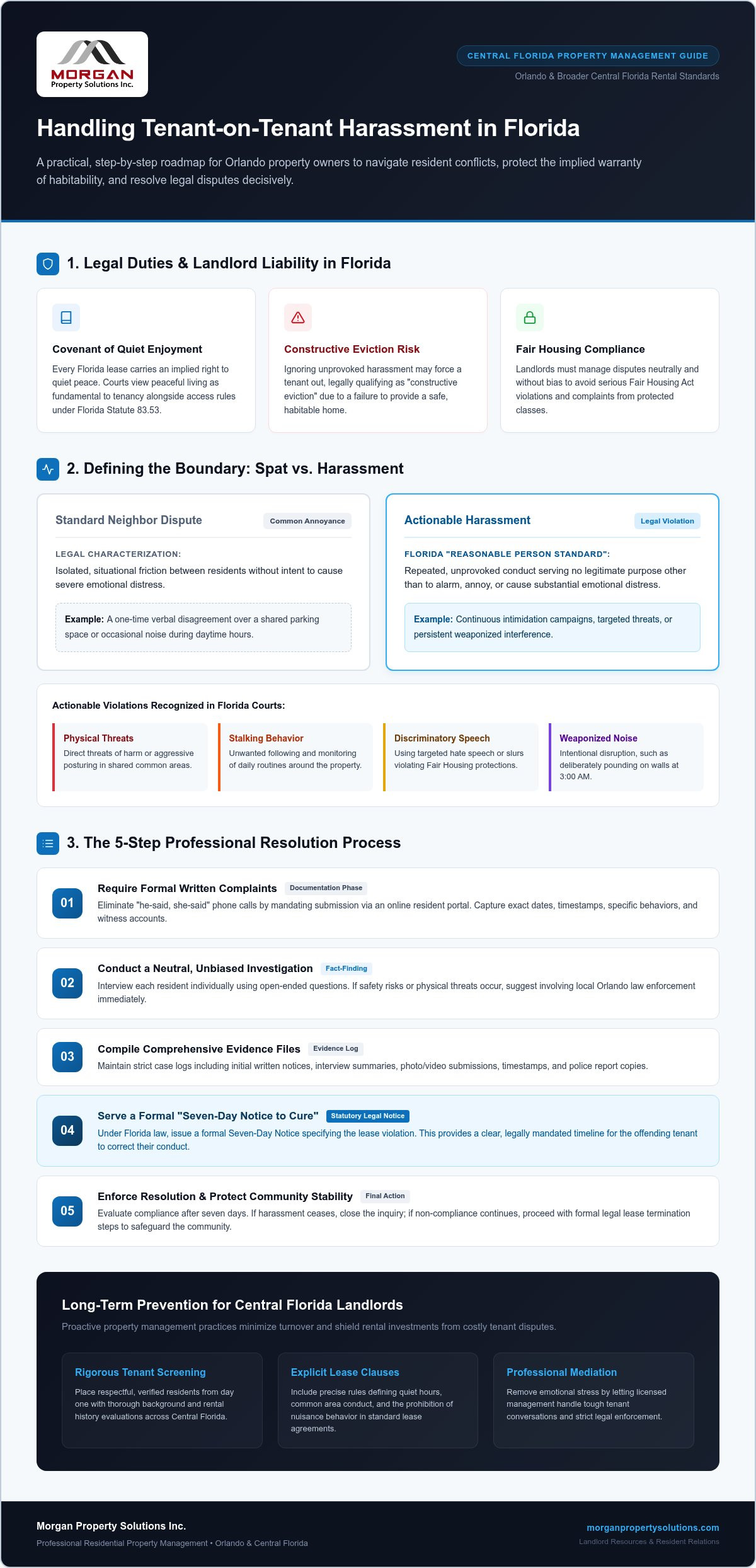
Managing rental properties in Orlando involves more than just property maintenance; it requires active community management. You might think a dispute between two neighbors is their problem alone, but in the eyes of Florida law, you have a duty to ensure every resident can live in peace. Successfully handling tenant-on-tenant harassment florida starts with identifying exactly what crosses the line from an annoyance into a legal violation. It’s about protecting your investment and your reputation as a responsible landlord.
The Right to Quiet Enjoyment
Every lease in Florida carries an implied “covenant of quiet enjoyment.” While Florida Statute 83.53 specifically outlines how a landlord can access a unit, courts often view a tenant’s right to peace as a core part of their residency. If one tenant’s behavior makes it impossible for another to live comfortably, and you fail to step in, you could be seen as breaching the implied warranty of habitability. This is a common reason landlords face legal action in Central Florida. Residents expect their homes to be a sanctuary, and your role as a steady ally is to protect that peace.
Harassment vs. Standard Neighbor Disputes
Distinguishing between a “neighbor spat” and actual harassment is essential for your protection. Courts generally look at the frequency and severity of the behavior. A one-time argument over a parking spot is a dispute; a daily campaign of intimidation is harassment. To help clarify this, the legal definition of harassment typically involves repeated, unprovoked conduct that serves no legitimate purpose other than to alarm or annoy. In Florida courts, judges use the “reasonable person standard,” which defines harassment as conduct that would cause a reasonable person to suffer substantial emotional distress.
Common examples of actionable harassment include:
- Direct physical threats or aggressive posturing in common areas.
- Stalking or unwanted following around the property.
- Using discriminatory slurs or targeted hate speech.
- Using noise as a weapon, such as intentionally pounding on walls at 3:00 AM.
Ignoring these complaints is a high-risk move. If a tenant feels they have no choice but to move out because you refused to address the harassment, they may file a claim for “constructive eviction.” This means you essentially forced them out by failing to provide a safe living environment. To avoid these headaches, many owners rely on rigorous tenant screening provided by experts like Morgan Property Solutions Inc. to ensure they’re placing respectful individuals in their communities from the start. Taking the “dirty work” of mediation off your plate is exactly why professional management is so valuable in the Orlando market.
A 5-Step Process for Handling Tenant Complaints
When you receive a complaint about one resident bothering another, your first instinct might be to jump in and fix it immediately. However, a rushed response can often lead to more complications. Successfully handling tenant-on-tenant harassment florida requires a methodical, calm approach that prioritizes facts over emotions. By following a structured process, you protect your investment while showing your residents that you take their peace of mind seriously.
The Power of the Written Complaint
In the world of property management, “he-said, she-said” phone calls are a landlord’s worst enemy. Emotional conversations are difficult to track and even harder to prove if a dispute escalates. This is why you should require all complaints to be submitted in writing through a formal portal. A written record forces the tenant to slow down and provide specific details, such as dates, times, and exact descriptions of the behavior. If you’re looking for templates or guidance on how to set up these systems, our Landlord Resources section offers helpful tools for effective documentation.
Investigating Without Taking Sides
Once you have a written complaint, your role shifts to that of a neutral investigator. It is vital to remain objective. If you appear to favor one party, you risk a claim of bias or even a violation of your Fair Housing Act obligations. Interview both parties separately and speak with any witnesses or neighbors who might have seen what happened. Ask open-ended questions like, “Can you describe the interaction in your own words?” rather than leading questions. If a situation involves physical threats or illegal activity, don’t hesitate to suggest that the tenants contact local Orlando law enforcement to file a report. Safety always comes first.
The remaining steps in the process ensure the issue is resolved legally and permanently:
- Step 3: Document everything. Keep a file with the original complaint, your notes from interviews, any photos or videos provided, and copies of police reports.
- Step 4: Issue a formal Notice to Cure. If your investigation confirms a lease violation, issue a Seven-Day Notice to Cure under Florida Statute 83.56. This gives the offending tenant a clear window to fix their behavior.
- Step 5: Follow up. Check back with the complaining tenant after a week to ensure the harassment has stopped. Consistency here shows you are a proactive and caring manager.
Managing these high-stress interactions can be exhausting for any property owner. Many landlords find that partnering with professional Orlando property management is the best way to ensure these disputes are handled with expert care and legal precision.
Navigating the Fair Housing Act and Florida Statutes
While many landlords view a dispute as a simple lease violation, federal and state laws elevate these situations to a matter of serious liability. Understanding the legal framework is essential when handling tenant-on-tenant harassment florida cases. It isn’t just about managing personalities; it’s about adhering to strict Fair Housing Act protections that shield residents from discrimination and intimidation. Compliance is your best defense against costly litigation.
The HUD Harassment Rule Explained
In 2016, the U.S. Department of Housing and Urban Development (HUD) clarified that landlords can be held responsible for tenant-on-tenant harassment if they knew, or should have known, about the behavior and failed to take prompt action. Your “power to intervene” is the standard the government uses to judge your liability. If you have the authority to issue a warning or a notice but choose to look the other way, you are essentially allowing a hostile environment to persist. For a deeper look at your responsibilities, our Florida Landlord Tenant Law Guide provides clear guidance on maintaining compliance with state and federal mandates.
When Harassment Becomes a Fair Housing Violation
Harassment based on race, religion, color, sex, national origin, familial status, or disability is a high-risk scenario. These incidents often fall into the category of “Hostile Environment” harassment. This occurs when unwelcome conduct is so severe or pervasive that it interferes with a person’s ability to use and enjoy their home. These cases are particularly dangerous for property owners because they can bypass local Orlando courts and move directly to the federal level, where penalties are significantly steeper. You must treat every complaint with the same level of seriousness to ensure you aren’t accused of selective enforcement.
Florida law provides a specific tool for addressing these issues: the Seven-Day Notice to Cure. Under Florida Statute 83.56, you can formally notify a tenant that their behavior violates the lease and give them seven days to correct it. If the harassment is repeated or particularly severe, this notice serves as the first legal step toward a termination of the rental agreement. Implementing a zero-tolerance policy for discriminatory harassment is the best way to protect your community. It sends a clear message that your Orlando rental investment is a safe space for everyone, and it establishes a documented history of consistent rule enforcement.
Resolution Strategies: Mediation vs. Eviction
Successfully handling tenant-on-tenant harassment florida requires knowing when to extend an olive branch and when to draw a hard line. Not every conflict necessitates a trip to the courthouse; in fact, many disputes can be resolved through structured communication. Your goal as a property owner is to restore peace while protecting your rental income and long-term investment. Choosing the right resolution strategy depends on the severity of the behavior and the willingness of the parties to change.
Mediation: A Reassuring First Step
Sometimes, tenants simply need a neutral space to voice their frustrations. Mediation involves sitting down with both parties and a neutral third party to find a middle ground. This approach is often much faster and significantly cheaper than the formal Florida eviction process. During these sessions, you can draft a “Behavior Agreement” as an addendum to the lease. This document clearly outlines what conduct is expected moving forward and the specific consequences if those rules are broken. It’s a professional way to give someone a chance to fix their behavior while creating a paper trail for future enforcement.
If mediation isn’t appropriate, Florida law provides two primary paths for formal notices:
- The Seven-Day Notice to Cure: This is used for “curable” offenses, like loud music or minor verbal spats. It gives the tenant one week to stop the behavior or face lease termination.
- The Seven-Day Notice of Non-Compliance with No Opportunity to Cure: This is reserved for severe issues, such as physical violence, intentional property damage, or repeated harassment after a previous warning. It informs the tenant that their lease is terminating in seven days, and they must vacate.
Moving Toward Eviction
There are times when eviction is the only way to protect the rest of your community. If a tenant’s actions create a genuine safety risk or involve criminal activity, you must act decisively. Having an ironclad lease agreement is your best defense in these cases. Your lease should specifically define harassment and conduct violations as grounds for immediate termination. Without clear language, a judge may be hesitant to grant an eviction based on neighbor testimony alone.
While the legal process moves forward, don’t forget to communicate with the victimized tenant. Let them know you are taking their safety seriously and keep them updated on the steps you’re taking. This reassurance often prevents good tenants from breaking their lease out of fear. If you’re feeling overwhelmed by the legal complexities of these disputes, our team at Orlando property management can step in as your steady ally to handle the heavy lifting of tenant relations and enforcement.
How Professional Property Management Prevents Harassment
While resolving disputes is necessary, the most successful investors focus on prevention. Creating a peaceful community doesn’t happen by accident; it’s the result of deliberate systems and expert oversight. When you partner with a professional, handling tenant-on-tenant harassment florida becomes less about reactive crisis management and more about maintaining a standard of excellence. It starts long before a tenant ever receives their keys.
Screening for Success
A peaceful rental environment is built on a foundation of quality residents. Our tenant screening process goes far beyond simple credit checks. We look for a history of stable residency and positive neighbor relations. By verifying rental history with previous landlords, we can identify red flags like past behavioral complaints or noise violations that a standard background check might miss. We apply the same level of detail seen in our Pet Screening process to every applicant to ensure they’re a good fit for your community. Identifying aggressive personalities at the application stage is the most effective way to protect your investment and your other tenants.
Clear lease language also plays a vital role. A professional lease shouldn’t be vague about conduct. It should explicitly define expectations for neighborly behavior and the consequences for harassment. When residents know the rules from day one, they’re much less likely to push boundaries. If a problem does arise, having these terms in writing makes enforcement straightforward and legally sound.
The Peace of Mind Partnership
One of the biggest challenges for independent landlords is the personal nature of tenant disputes. It’s hard to stay objective when you’re the one receiving late-night phone calls or angry texts. A property manager acts as a vital buffer, removing the emotional element from the equation. We handle the uncomfortable conversations, conduct the neutral investigations, and issue the necessary notices so you don’t have to. This third-party distance often de-escalates tension much faster than a direct confrontation between a landlord and a tenant.
In Central Florida’s competitive market, professional documentation is your best defense during a Fair Housing audit. We maintain meticulous records of every complaint and resolution through our online portal, ensuring you stay compliant with both state and federal laws. At Morgan Property Solutions, we pride ourselves on being the steady ally you need to navigate these complex transitions. Learn how we simplify Orlando property management and help you maintain a low-turnover, stress-free rental environment.
Protecting Your Rental Community and Your Investment
Managing a rental property in Central Florida shouldn’t feel like being a full-time referee. By establishing a clear, documented process for handling tenant-on-tenant harassment florida, you move from reactive stress to proactive control. Your duty to provide quiet enjoyment is balanced by your power to intervene through mediation or the Seven-Day Notice to Cure. When you prioritize thorough documentation and neutral investigations, you shield yourself from liability while maintaining a high-quality living environment for your residents.
If the thought of managing aggressive personalities or navigating complex Fair Housing rules feels overwhelming, you don’t have to go it alone. With over 20 years of combined experience in Central Florida and specialized knowledge of Florida Landlord-Tenant Law, we are here to act as your steady ally. We handle the difficult conversations and the detailed documentation required to keep your business compliant and peaceful. Let Morgan Property Solutions handle the stress of tenant management so you can focus on growing your portfolio. You’ve worked hard to build your investment; let’s work together to protect it.
Frequently Asked Questions
Can I evict a tenant for harassing another tenant in Florida?
Yes, you can evict a tenant if their behavior violates the lease agreement or Florida Statutes. Most cases start with a Seven-Day Notice to Cure. This gives the offender a chance to stop the behavior. If they continue harassing their neighbor after the cure period, you can move forward with a formal eviction in an Orlando court. It is a necessary step to protect your community’s peace and your long-term investment.
Am I liable if one tenant stalks another on my property?
You may be held liable under the 2016 HUD rules if you knew or should have known about the stalking and failed to intervene. Florida landlords have a duty to ensure quiet enjoyment for all residents. If a victim reports stalking and you take no action, you could face a lawsuit for constructive eviction or Fair Housing violations. Using a professional Orlando property manager helps ensure every complaint is documented and addressed promptly.
What should I do if a tenant files a police report against another tenant?
First, request a copy of the official police report for your records. This provides neutral, third-party documentation of the incident. You should then conduct your own internal investigation to see if the behavior violates specific terms in your lease. If the report involves violence or threats, it might qualify as a non-curable violation. In Winter Park or Lake Nona, having this paperwork is vital if you eventually need to defend an eviction case.
Does Florida law require me to provide a safe environment for tenants?
Yes, Florida law includes an implied warranty of habitability. This means you must provide a living environment that is safe and fit for human residency. While this often refers to physical repairs, courts also apply it to a tenant’s right to peace. If you allow a dangerous or harassing situation to persist, you are failing to meet your legal obligations. Consistent enforcement of community rules is the best way to maintain safety in Central Florida rentals.
Can a tenant break their lease in Florida due to harassment from a neighbor?
A tenant may be able to break their lease without penalty if they can prove constructive eviction. This happens when a landlord’s failure to address harassment makes the property uninhabitable or deprives the tenant of their right to quiet enjoyment. To avoid this, you must show that you took reasonable steps to resolve the conflict. Professional property management in Orlando focuses on documenting these efforts to prevent good tenants from feeling forced to move out.
How do I write a 7-day notice to cure for harassment?
A Seven-Day Notice to Cure must be in writing and specifically reference Florida Statute 83.56. You need to clearly describe the harassing behavior and cite the specific lease clause being violated. Tell the tenant exactly what they must stop doing to remain in compliance. If you are in Clermont or Oviedo, it’s helpful to use a professional portal for delivery. This ensures you have a clear record that the notice was received and the cure period began.
What is the difference between a curable and non-curable lease violation?
A curable violation is an issue the tenant can fix, such as loud music or minor verbal arguments. You must give them seven days to stop. A non-curable violation involves severe actions like physical violence, intentional property damage, or a second instance of the same harassment within 12 months. Non-curable offenses allow you to terminate the lease immediately. Correctly identifying these is essential for handling tenant-on-tenant harassment florida effectively while protecting your community.
Should I involve a lawyer for every tenant-on-tenant dispute?
You don’t always need a lawyer for minor spats, but having professional guidance is wise for actual harassment. A property manager with over 20 years of experience can handle the mediation and documentation for you. If a dispute escalates to an eviction or a Fair Housing complaint, you should consult a legal professional. Our team at Morgan Property Solutions specializes in expert tenant relations to help you avoid the need for expensive legal battles in Central Florida.

Article by
Oliver Overton-Morgan
Oliver Overton-Morgan is a full-time Real Estate Broker since 2003, with years of experience helping thousands of people purchase and sell real estate throughout Central Florida. He holds a Graduate Realtor Institute designation, LCAM, and has held licenses in good standing as a Florida Mortgage Broker and a Notary Public. Oliver immigrated to central Florida in 2001, and within 5 years Oliver built a successful Real Estate brokerage in central Florida, where he recruited over 75 Sales Associates with 25+ million in sales production.