
What if the belongings left behind aren’t legally yours to move or discard yet? Unpaid rent alone doesn’t mean a landlord can remove a tenant’s possessions. This landlord guide to florida’s abandoned property statute explains why confirming that the tenancy has ended and the tenant has vacated matters before you act.
It’s understandable to want to clear the unit and prepare it for the next renter. But unclear notice or timing requirements, or a dispute about what was left behind, can make a rushed decision costly. A careful, documented process helps you move forward with a clearer picture of the facts.
Here, you’ll learn about the Florida statutory framework, what to consider before treating belongings as abandoned, and how to approach notices, deadlines, and documentation. You’ll also learn when case-specific legal guidance may be appropriate. For Orlando and Central Florida landlords, professional property management can help keep rental records organized, with services such as attorney-written leases and detailed inspection reports containing hundreds of photos. Legal questions about a particular situation remain matters for a qualified attorney.
Key Takeaways
- Use this landlord guide to florida’s abandoned property statute to understand why an apparently vacant unit doesn’t establish that a tenant’s belongings can be treated as abandoned.
- Distinguish surrender, abandonment, and lawful recovery of possession before deciding what to do with items left behind.
- Check Florida’s current rules for notice methods, required details, deadlines, and how property may be handled.
- Create a clear record of the situation and your actions to help reduce the risk of disputes about belongings or access.
- Learn how residential property management in Orlando and Central Florida can support organized rental operations and documentation.
Florida’s abandoned property statute: what landlords need to identify first
A tenant appears to have moved out, but furniture, boxes, or other belongings remain in the rental. It’s tempting to treat the unit as empty and start clearing it. Pause first. The items are personal property, and their presence alone doesn’t establish that the tenancy ended, that the tenant surrendered possession, or that you can dispose of them.
This landlord guide to florida’s abandoned property statute starts with a practical distinction: the legal status of the tenancy and the status of the belongings are related, but they aren’t the same question. Before acting, establish what happened, review the rental agreement, and identify which statutory process may apply. If the facts are disputed or unclear, seek case-specific legal guidance.
What does Florida law mean by abandoned tenant property?
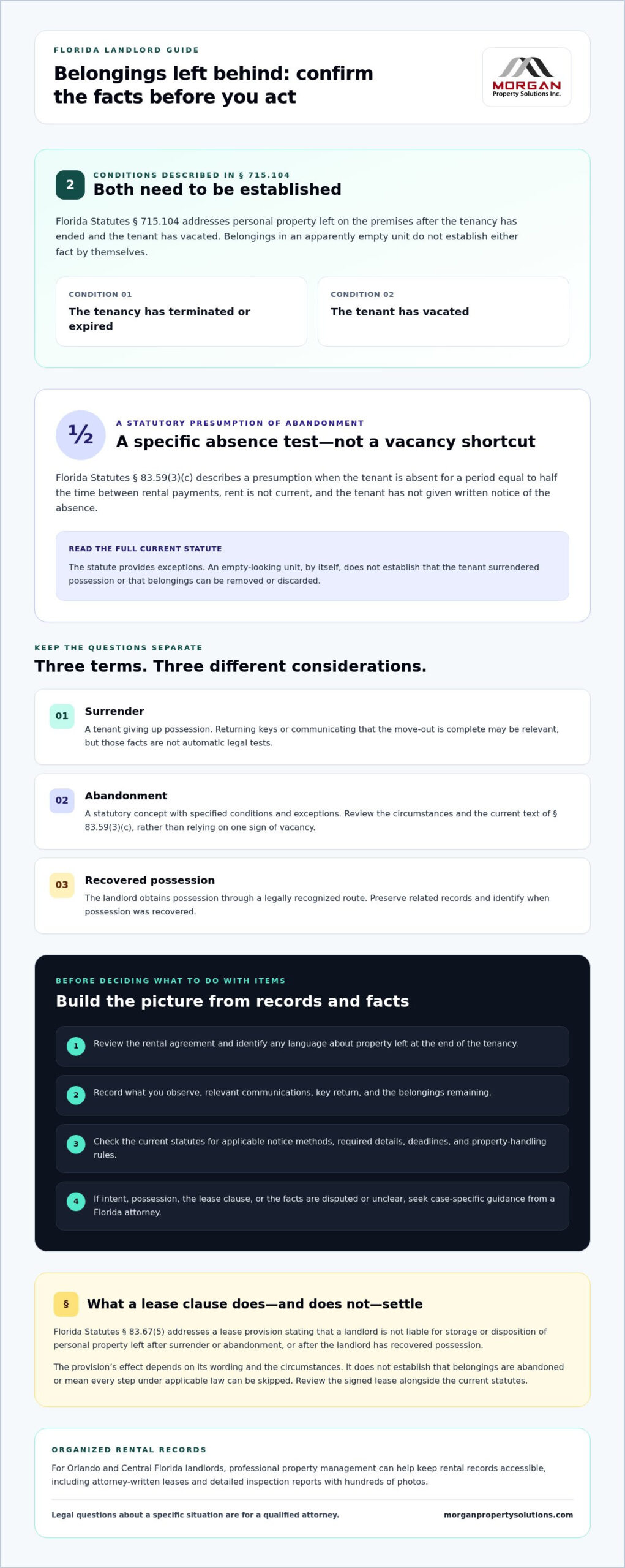
Florida Statutes § 715.104 addresses personal property left on the premises after a tenancy has terminated or expired and the tenant has vacated. In short, it concerns belongings that remain after both events, not simply items a landlord finds in a unit that seems quiet or unused. The statute sets out a process for dealing with that property; it isn’t permission to skip applicable notice requirements.
That distinction matters in real situations. A few boxes in a closet could be belongings the tenant intends to retrieve, or items left after a completed move-out. A landlord’s assumption doesn’t resolve which explanation is correct. The lease may also affect the analysis, including whether it contains language about property left at the end of the tenancy. Review the agreement alongside the facts and the current text of Florida Statutes § 715.104. How a lease clause applies to a specific situation is a legal question.
Is abandoned property the same as an abandoned rental unit?
No. Personal property left behind concerns belongings. Abandonment of the rental unit concerns whether the tenant has stopped occupying or possessing the premises. Florida Statutes § 83.59(3)(c) describes a presumption of abandonment when the tenant is absent for a period equal to half the time between rental payments, rent is not current, and the tenant hasn’t given written notice of the absence. The statute also provides exceptions, so review its full current text rather than relying on one sign of vacancy.
For example, an empty-looking unit doesn’t by itself establish that the tenant surrendered possession. Review the lease and available communications, and document what you observe. Move-out evidence may help clarify the situation, but no single assumed indicator replaces a careful review of the circumstances. Keep the two questions separate: has possession been lawfully recovered, and what process applies to belongings remaining afterward? Answering both before acting keeps the next steps grounded in facts rather than guesswork.
When Florida landlords may treat belongings as abandoned
The facts that end a tenancy and the rules for handling belongings left behind need separate assessment. Florida law addresses both possession of the rental and personal property remaining after a tenant leaves, but “surrender,” “abandonment,” and “recovered possession” aren’t interchangeable shortcuts. This landlord guide to florida’s abandoned property statute begins with the specific event that ended the tenant’s right to occupy, then considers which property rules apply.
How do surrender, abandonment, and recovered possession differ?
Surrender generally describes a tenant giving up possession, often shown by actions such as returning keys or communicating that the move-out is complete. Those facts can be relevant, but they aren’t automatic legal tests. Abandonment has a statutory context: Florida Statutes § 83.59(3)(c) provides a presumption when specified conditions are met, subject to the statute’s exceptions. Recovered possession refers to the landlord obtaining possession through a legally recognized route. Pause if the tenant’s intent, the move-out, or the status of possession is disputed.
Use these situations as prompts for fact-checking, not as conclusions:
Tenant returns keys and confirms the move-out. Document the communication, key return, and items remaining. Review the lease and confirm what process applies to the belongings.
Unit appears empty, but the tenant hasn’t responded. Record observations and communications. Don’t rely on vacancy alone; review the statutory conditions and any relevant exception.
Possession followed a court process. Preserve the related records and identify when possession was recovered. Ask a Florida attorney how that timeline affects the handling of property.
What role can the rental agreement play?
Florida Statutes § 83.67(5) addresses a lease provision stating that the landlord isn’t liable for storage or disposition of personal property left after a tenant has surrendered or abandoned the premises, or after the landlord has recovered possession. The provision’s effect depends on its wording and the circumstances. It doesn’t justify assuming that belongings are abandoned or that every step under applicable law can be skipped.
Pull the signed lease and identify the exact clause before acting. Compare it with the current statutes governing possession and disposition of personal property, including Chapter 715. If the clause is missing, unclear, or appears to conflict with the facts, pause and seek case-specific legal guidance. Attorney-written leases and orderly records support broader rental operations, but applying a lease provision to a dispute is a legal question.
For landlords in Orlando and Central Florida, organized property management helps keep leases and rental records accessible as situations develop. Orlando property management support can help maintain a consistent approach to rental operations. Legal questions about a particular tenant or lease clause should be directed to a qualified attorney.
Florida abandoned-property notices and handling: what to verify
Once you’ve established that the tenancy has ended and possession has been resolved, treat the belongings as a separate, documented matter. Don’t jump from finding property to moving or discarding it. Florida’s notice and disposition rules depend on the circumstances, the lease, and the applicable statutory provisions. Review the current law before choosing a delivery method or setting a deadline.
For a landlord guide to florida’s abandoned property statute, the practical sequence is to create a reliable record, verify the notice procedure, and then follow the applicable steps for securing, storing, and disposing of the property.
What should a landlord document before taking action?
Make a dated record of what remains and where it is. Take photographs that show both individual items and their location in the unit. Keep the signed lease, move-out communications, key-return details, possession-related records, and copies of notices together. These records help establish what you observed and when, especially if the tenant later disputes the contents or condition of the belongings.
Use this workflow, verifying each legal requirement against the current statutory text before proceeding:
- Record the condition. Note the date, location, and items observed. Photograph the property before handling it, and retain relevant communications and lease documents.
- Check the governing rules. Review Florida Statutes §§ 715.104-715.109, any applicable provisions of Chapter 83, and the signed lease. Confirm whether a lease clause or statutory exception affects the process.
- Verify the notice. Under Florida Statutes § 715.105, written notice must give the former tenant at least 10 days to reclaim property if personally delivered, or at least 15 days if sent by first-class mail. Check the current statute for the required notice contents, permitted delivery method, how the deadline is calculated, and any applicable exceptions.
- Secure and store only as required. Before moving items, verify what the law and lease require for handling and storage. If you incur storage costs or plan to require payment before returning property, confirm the statutory basis and applicable limits.
- Determine the lawful disposition. Check Florida Statutes § 715.109 for the applicable process, including the rules tied to the property’s reasonably believed total value. Don’t treat an estimate as permission to dispose of items before completing required steps.
Notice requirement: Florida Statutes § 715.105 requires written notice giving a former tenant at least 10 days to reclaim property when notice is personally delivered, or at least 15 days when it is sent by first-class mail.
Keep the notice and proof of delivery with the rest of the file. If ownership is disputed, the tenant contests the facts, or you’re unsure how a lease provision applies, pause before removing, disposing of, or claiming the belongings. A Florida attorney can provide guidance based on the specific circumstances. Consistent records are also part of organized rental operations, a focus of Orlando property management.
Common abandoned-property mistakes Florida landlords can prevent
A unit can look empty while important questions remain unanswered. Treating a tenant’s apparent absence as permission to clear the property can lead to avoidable disagreements about what was left, when it was removed, and whether the required process was followed. A careful pause gives you time to check the facts and keep your actions grounded in the lease and current law.
Can a landlord throw away belongings immediately?
Not solely because the rental appears vacant. Florida’s rules for personal property left after a tenancy are addressed in Chapter 715, including the notice and disposition provisions in §§ 715.104-715.109. The applicable process depends on the circumstances, any relevant lease language, and whether possession has been resolved. Check the current statutory text before moving, discarding, or claiming belongings. If ownership or the tenant’s departure is disputed, seek case-specific legal guidance.
Small shortcuts can make a later account harder to verify. A landlord who relies on memory may not be able to explain which items were present or their condition. A notice sent without checking its required contents or delivery method can also leave uncertainty about whether the process was followed. These are reasons to improve the record, not assumptions about what a court would decide.
Mistake: Treating an empty-looking unit as proof that the tenant surrendered possession.
Safer practice: Record observable facts, communications, and possession-related events separately from conclusions about the tenant’s intentions.
Mistake: Moving or disposing of items before checking the governing process.
Safer practice: Review the current statutes and signed lease first, and note which provisions you relied on.
Mistake: Recreating a timeline from memory after the fact.
Safer practice: Keep dated notes, photographs, copies of communications, and relevant delivery records together.
Mistake: Treating a lease clause as a substitute for statutory review.
Safer practice: Read the exact signed language and verify how it applies alongside current law.
How can landlords reduce confusion and preserve a clear record?
Use one written checklist for communications, photographs, lease review, possession records, and statutory checks. Label each entry with its date and source. For instance, write “keys returned by tenant” if that happened, rather than “tenant abandoned unit” unless that legal conclusion has been properly assessed. Separating observations from interpretations makes the file easier to follow.
Abandoned belongings may raise questions alongside other landlord-tenant obligations. For broader context, consult the Florida landlord resources and review the law that applies to your specific facts. For rental owners seeking more organized property operations, explore residential property management with Morgan Property Solutions Inc.
A practical next step for Orlando-area rental property owners
When belongings remain, slow the decision down and follow a clear path: establish what happened, confirm the tenant’s possession status, review the signed lease, and check the current statutory requirements that apply. Keep dated records of your observations and communications. Don’t turn an assumption about the tenant’s intentions into a decision to move or dispose of property.
This landlord guide to florida’s abandoned property statute can help organize the questions, but it can’t resolve every fact-specific legal issue. If the tenant disputes the move-out, ownership of an item is unclear, or the lease language raises questions, pause irreversible action and seek advice from a Florida attorney who can review the circumstances.
When can professional property management help landlords?
Even when a particular belongings issue needs legal review, consistent rental operations can make it easier to locate records and understand the property’s history. Organized inspections, dated reports, and orderly lease files support a clearer picture of a rental’s condition over time. Morgan Property Solutions Inc. provides residential property management for owners in Orlando and Central Florida.
Management includes attorney-written Florida leases. A lease is an important part of the rental record, but its wording doesn’t replace checking current law or getting legal advice about a specific dispute. For owners who want ongoing support with broader rental operations, explore Orlando property management and how it can fit into managing a rental property.
What should landlords do if the situation is disputed?
Keep the property and the record intact while you clarify the facts. Preserve communications, the signed lease, photographs, and any records related to how possession ended. Then verify the current statutory requirements that apply. If the tenant contests the timeline, claims belongings, or challenges the notice process, ask a qualified Florida attorney for advice tailored to those details before taking an irreversible step.
A steady process helps separate what you know from what you suspect. For owners, that means managing the immediate question carefully while keeping the rest of the rental operation organized. If ongoing oversight would make rental ownership simpler, Morgan Property Solutions Inc. offers residential management across Orlando, Winter Park, Lake Nona, Clermont, Oveido, Windermere, Winter Garden, Apopka, Wedgefield, and Hunters Creek. Explore professional property management for your broader rental needs.
Build a steadier process for your next rental transition
Use what you’ve learned to create a simple routine before another move-out occurs. Decide where lease documents, tenant communications, inspection records, and notices will be kept, so you can find the right information without piecing it together later. A consistent system can make each transition easier to manage while leaving room to handle unusual situations on their own facts.
This landlord guide to florida’s abandoned property statute is a starting point for better-informed decisions, not a substitute for legal advice tailored to a particular dispute. If a tenant contests what happened or who owns the belongings, get case-specific guidance before taking an irreversible step.
For broader support with rental ownership, explore professional property management for your rental. Contact Morgan Property Solutions Inc. to discuss professional management for your Central Florida rental property.
Frequently Asked Questions
What is Florida’s abandoned property statute?
Florida’s rules for personal property left by former tenants are found primarily in Chapter 715, the Florida Disposition of Personal Property Landlord and Tenant Act. Related provisions in Chapter 83 address possession of residential rental premises, including a statutory presumption of abandonment in certain circumstances. Which rules apply depends on how the tenancy ended, the facts surrounding the belongings, and the lease. This landlord guide to florida’s abandoned property statute provides general information, not legal advice.
Can a landlord throw away a tenant’s belongings in Florida?
Not just because the unit looks vacant. Before disposing of belongings, assess how possession ended, what the signed lease says, and whether the notice and disposition requirements in Chapter 715 apply. For example, a tenant’s message saying they’ll return for a large item could change how you understand the situation. Record the communication and pause before taking irreversible action if the facts or ownership are disputed.
How long must a Florida landlord keep abandoned property?
There isn’t one timeframe that should be applied without checking the circumstances and current statute. Florida Statutes § 715.105 sets minimum reclaim periods for the notice it covers: at least 10 days after personal delivery or at least 15 days after first-class mail. Those are notice periods, not a universal storage rule. Verify the delivery method, notice requirements, applicable exceptions, and disposition rules before setting a final date.
What happens if a tenant leaves belongings after moving out?
First, create a dated record of what remains and the unit’s condition. For instance, note whether furniture is in the living room or boxes are in a closet, and preserve relevant move-out messages. Then review the signed lease and confirm which statutory process applies before moving or disposing of anything. If the former tenant asks to retrieve a particular item, keep that request with the property records and verify the next step.
Does Florida law require landlords to notify tenants about property left behind?
Florida Statutes § 715.105 provides for written notice to the former tenant in the process it governs. The reclaim period must be at least 10 days when notice is personally delivered or at least 15 days when sent by first-class mail. The statute addresses notice content as well as timing, so use its current text to verify what to include and which method fits the situation.
Does a lease determine what happens to abandoned property in Florida?
A lease can matter, but it doesn’t erase the need to follow applicable Florida law. Florida Statutes § 83.67(5) addresses certain lease language about a landlord’s liability for storing or disposing of personal property after surrender, abandonment, or recovery of possession. Review the exact signed clause alongside Chapter 715. If its effect is unclear or the tenant challenges its application, get legal advice based on the specific facts.
Is abandoned personal property the same as an abandoned rental unit?
No. Personal property means a tenant’s belongings; abandonment of a rental unit concerns the tenant’s absence or possession status. Under Florida Statutes § 83.59(3)(c), a presumption of abandonment applies when specified conditions are met, subject to statutory exceptions. A couch left behind doesn’t by itself establish that the unit was abandoned, just as an apparently vacant unit doesn’t automatically resolve who owns the remaining items.

Article by
Oliver Overton-Morgan
Oliver Overton-Morgan is a full-time Real Estate Broker since 2003, with years of experience helping thousands of people purchase and sell real estate throughout Central Florida. He holds a Graduate Realtor Institute designation, LCAM, and has held licenses in good standing as a Florida Mortgage Broker and a Notary Public. Oliver immigrated to central Florida in 2001, and within 5 years Oliver built a successful Real Estate brokerage in central Florida, where he recruited over 75 Sales Associates with 25+ million in sales production.