
Could choosing the wrong place to hold a security deposit turn a routine rental task into an avoidable dispute? If you’re reviewing florida landlord security deposit account requirements, start by choosing a lawful holding method and setting up a reliable process for notices and records. Account separation, interest, and deadlines can feel like a lot to track. A consistent workflow makes those responsibilities easier to manage.
This 2026 guide explains Florida’s three holding options: a separate non-interest-bearing account, a separate interest-bearing account, or a surety bond. You’ll learn how to compare the options, what to record when funds move, how tenant notices and interest fit into deposit handling, and which return or claim deadlines to track. We’ll also cover practical recordkeeping steps that help distinguish deposit funds from operating money. For Central Florida landlords, professional property management can connect deposit administration with bookkeeping and owner reporting. Use this overview as a starting point, then review the current statute or seek qualified legal advice about a specific situation.
Key Takeaways
- Understand the florida landlord security deposit account requirements and compare the lawful ways to hold residential deposits.
- Learn how account and bond arrangements differ, including how interest and tenant notices fit into the process.
- Build a repeatable workflow for recording deposits, account movements, and applicable interest calculations.
- Keep deposit administration organized with clear records, and know when to review the current statute or seek qualified legal advice.
- See how reconciled escrow handling and owner reporting can fit into professional residential property management in Central Florida.
Florida Landlord Security Deposit Account Requirements: What Must You Do?
Florida law governs how residential security deposits must be held. Under Florida Statutes section 83.49, landlords must follow rules for handling covered security deposits and advance rent, including applicable account and tenant-notice requirements. Start by identifying what each payment is for. Then confirm how the current statute applies before deciding where the funds belong.
The phrase florida landlord security deposit account requirements can sound like a narrow banking question, but it involves more than choosing an account. A sound process begins with classifying payments correctly, keeping tenant funds separate from personal and operating money, and following the statute’s specific requirements. This section offers general information, not legal advice. Read the current text of section 83.49 or consult qualified legal counsel about a particular lease or payment.
Which Florida rentals and payments does the rule cover?
Section 83.49 addresses security deposits and advance rent connected with residential rental agreements. Its definition of a security deposit includes money held by a landlord on behalf of a tenant, including money that secures performance of the rental agreement or payment for damage to the premises. Advance rent is a different category: it is collected for rent due in a future rental period, rather than held as security.
That distinction matters when recording a payment. For example, money collected to cover rent in a later month serves a different purpose from money held to secure a tenant’s obligations. A lease label can help document the parties’ intent, but the payment’s purpose and handling matter too. Don’t assume a label alone determines its legal character. Check section 83.49 and its exceptions against the current statutory text, especially when a payment doesn’t fit neatly into one category.
Residential landlord-tenant rules form part of the broader landlord-tenant law framework, but the Florida statute is the relevant source for state requirements. Keep the focus here on residential rentals, and don’t automatically apply these rules to unrelated property arrangements.
What does it mean to hold a deposit separately?
In practical terms, separation means tenant deposit funds aren’t mixed with a landlord’s personal money or ordinary operating funds. That separation helps create a clear record of what was received and where it went. Bookkeeping labels or a separate line in a ledger can support organized records, but they don’t replace any account arrangement required by statute.
A security-deposit holding account is an account used to hold tenant security-deposit funds apart from the landlord’s personal and operating money, in a manner that meets Florida’s statutory requirements. Treat that as a practical description, not a substitute for checking the permitted holding methods and notice duties in current law. Those details determine how to set up the account and what steps to take next.
Florida Security Deposit Account Options: Compare the Lawful Methods
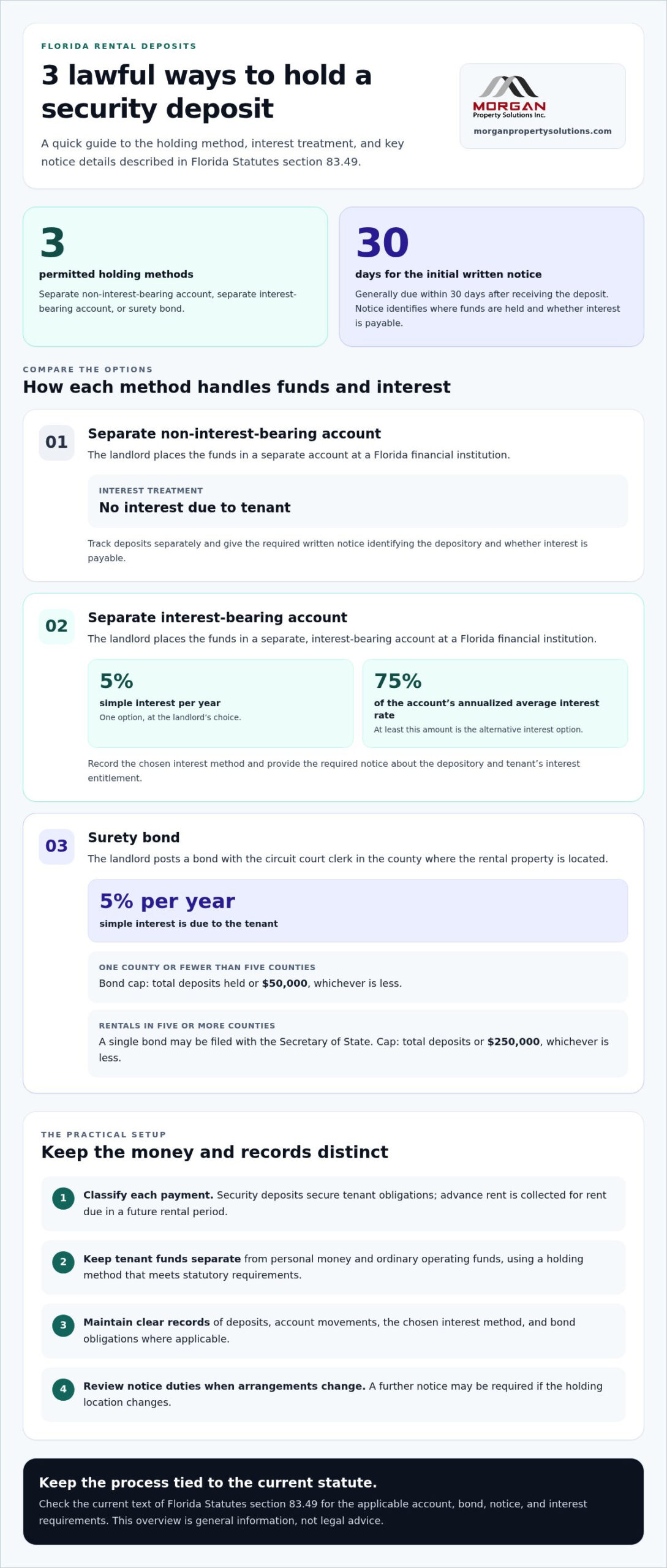
Florida law provides three ways to hold residential security deposits: a separate non-interest-bearing account, a separate interest-bearing account, or a surety bond. The right fit depends on how you plan to administer the funds, but convenience doesn’t replace statutory duties. The florida landlord security deposit account requirements also connect each method to specific interest and tenant-notice rules.
How do the statutory account methods differ?
Here’s a practical comparison of the methods described in Florida Statutes section 83.49. Check the current statutory text before setting up an arrangement, particularly if you manage rentals in multiple counties or plan to change where funds are held.
| Method | Who holds the funds | Interest treatment | Notice and administration |
|---|---|---|---|
| Separate non-interest-bearing account | The landlord deposits funds in a separate account at a Florida financial institution. | No interest is due to the tenant under this method. | Track deposits separately and provide the required written notice identifying the depository and whether interest is payable. |
| Separate interest-bearing account | The landlord deposits funds in a separate, interest-bearing account at a Florida financial institution. | At the landlord’s option, pay the tenant either 5% simple interest per year or at least 75% of the account’s annualized average interest rate. | Record the chosen interest method and provide the required notice about the depository and interest entitlement. |
| Surety bond | The landlord posts a bond with the clerk of the circuit court in the county where the rental property is located. A landlord renting in five or more counties may use a single bond filed with the Secretary of State. | The tenant is entitled to 5% simple interest per year. | The bond amount is capped at the total deposits held or $50,000, whichever is less. For the multi-county option, the cap is the total deposits or $250,000, whichever is less. Verify the current statutory conditions. |
For each method, the initial written notice is generally due within 30 days after receiving the deposit. It identifies where the funds are held and whether the tenant is entitled to interest. If the holding location changes, a further notice may be required. The Florida Bar’s Rights and Duties of Tenants and Landlords in Florida provides additional background, while section 83.49 sets out the statutory details.
How should a landlord choose an account arrangement?
Start with the records you can maintain consistently. If you manage several rentals, consider whether your process can distinguish each tenant’s deposit, reconcile account balances, and document interest calculations or bond obligations. A clear ledger and regular reconciliation make discrepancies easier to spot, but bookkeeping alone doesn’t satisfy the requirement to use a permitted holding method.
Compare the administration each option requires with the statutory duties attached to it. For Central Florida owners who want deposit handling organized alongside broader rental operations, residential property management can bring escrow administration and owner bookkeeping into a consistent process.
Interest, Tenant Notices, and Deposit Transfers: Where Landlords Need Precision
Account disclosures and move-out notices serve different purposes. The first tells a tenant where a deposit is held and whether it earns interest. A later notice addresses a landlord’s claim against the deposit after the tenancy ends. Keeping these steps distinct helps prevent an account update from being confused with a deduction dispute.
What must a landlord disclose about the deposit account?
Under Florida Statutes section 83.49, a landlord generally must notify the tenant in writing within 30 days after receiving a security deposit. The notice must identify the name and address of the depository where the deposit is held and state whether the tenant is entitled to interest. The notice may be included in the lease. Keep a copy of the disclosure and a record of when it was provided.
This is an account disclosure, not a move-out decision. It doesn’t explain potential deductions or give notice that the landlord intends to keep some of the deposit. If the landlord later makes a claim, the statute sets a separate process and deadline, including written notice by certified mail within 30 days after the tenant vacates. A tenant who receives that claim notice has 15 days to object in writing. Check the current statutory text for the exact requirements and language before sending notices.
What changes when a deposit earns interest or moves?
Interest depends on the holding method. For an interest-bearing account, Florida law allows the landlord to choose between paying 5% simple interest per year or at least 75% of the account’s annualized average interest rate. A surety bond carries a 5% simple-interest obligation, while a non-interest-bearing account doesn’t require interest payments. Record the method selected for each deposit, the period covered by any calculation, and how interest is paid or credited. Confirm the current statute before relying on a rate or calculation.
If the depository or holding location changes, Florida law generally requires written notice to the tenant within 30 days after the change. Moving funds doesn’t end the landlord’s responsibilities. Keep a record of the date, amount, source account, destination, reason for the movement, and related tenant notice. Reconcile the old and new balances to preserve a traceable account history for each deposit.
- Save the original receipt and account disclosure with the tenant’s file.
- Record transfers promptly, including dates and amounts.
- Keep interest calculations and payment records tied to the applicable tenant and holding method.
- Store move-out claim notices separately from routine account disclosures.
A consistent document routine makes account changes easier to explain and review. For broader landlord-tenant information and practical rental resources, visit the Florida landlord resources page. This overview is general information, not legal advice. Because the florida landlord security deposit account requirements depend on the chosen method and current statutory wording, consult section 83.49 or qualified legal counsel when a specific situation raises questions.
A Practical Florida Landlord Workflow for Receiving and Reconciling Deposits
A repeatable process helps keep each deposit traceable from the day it arrives through move-out. Use this workflow as an administrative guide, then verify current requirements in Florida Statutes section 83.49. The florida landlord security deposit account requirements apply to specific holding methods, notices, and deadlines, so distinguish those legal duties from your internal bookkeeping steps.
- Record the payment when received. Note the date, amount, tenant, rental property, payment method, and purpose of the payment. Classify it as a security deposit, advance rent, or another charge based on its purpose and the lease, rather than relying only on a shorthand label.
- Apply the selected lawful holding method. Deposit the funds according to the method you’ve chosen under current law. Keep the confirmation or other transaction record with the tenant’s file. Don’t use a ledger entry as a substitute for placing funds in the required account or arranging the applicable bond.
- Send and retain the required disclosure. Track the statutory deadline for the initial written notice and keep a copy with the date and delivery record. If the depository or holding location changes, document the transfer and the related tenant notification.
- Update the tenant-level ledger. Record the amount held, the account or method, any movements, and applicable interest calculations. Tie each entry to the property and tenant so that a combined account balance can still be understood at the individual-deposit level.
- Reconcile routinely. Compare the ledger’s total deposit liability with account statements and transaction records. Investigate unexplained differences promptly, document any correction, and preserve supporting records before closing the reporting period.
- Handle move-out separately. If no claim is intended, Florida law generally requires returning the deposit within 15 days after the tenant vacates. If making a claim, the landlord generally must send written notice by certified mail within 30 days after vacancy. The tenant has 15 days after receiving the claim notice to object in writing. Verify current statutory language and deadlines before acting.
What records should landlords keep for each deposit?
Maintain one organized file or ledger for each tenant and property. Keep the receipt, lease payment classification, disclosure notices, account statements, transfer records, and any interest calculation together. Regular reconciliation helps catch a missing transaction or mismatch early. If a balance doesn’t agree, trace the entries and document the resolution rather than carrying an unexplained difference into the next reporting period.
How can professional management simplify deposit administration?
Morgan Property Solutions holds security deposits in a reconciled escrow account and provides bookkeeping and online owner statements. These services connect deposit records with broader rental reporting, while deposit refunds are processed according to Florida law. For related owner guidance, explore the landlord resources.
For Central Florida owners who want deposit administration included in a broader rental-management process, explore residential property management with Morgan Property Solutions.
How Morgan Property Solutions Handles Security Deposits for Central Florida Owners
Security-deposit administration is one part of managing a rental property’s finances. Morgan Property Solutions Inc. holds deposits in a reconciled escrow account and processes deposit refunds according to Florida law. For owners, deposit handling connects with the broader work of organizing rental income, expenses, and financial records.
Reconciliation helps keep account records aligned with the funds being held. Clear documentation makes it easier to follow deposit activity, review owner reporting, and understand what is happening during a tenant transition. This supports organized administration, but it doesn’t remove the need to follow applicable law or review current statutory requirements for a particular situation.
What does escrow handling mean for a rental property owner?
In practical terms, escrow handling means security-deposit funds are tracked and reconciled against the relevant financial records. That gives owners a clearer view of deposit activity without blending it into routine rent or expense reporting. Morgan Property Solutions Inc. also provides bookkeeping and online owner statements as part of its financial services, bringing key rental information into an organized reporting process.
Good records matter at each stage. An owner should be able to understand which tenant and property a deposit relates to, how it appears in the financial records, and how activity is reflected in reporting. Reconciliation helps identify differences that may need attention. It is an administrative safeguard, not a substitute for following the applicable rules on holding funds, giving notices, or handling refunds and claims.
When might a landlord consider professional deposit administration?
Professional management can help when an owner is balancing records across multiple properties, handling tenant changes, or keeping up with recurring financial reporting. Each rental can generate separate payment records and deposit activity. A consistent process keeps that information organized and easier to review, rather than leaving the owner to piece it together later.
For Central Florida owners, security-deposit handling can fit within a broader residential property-management relationship. Alongside escrow administration, Morgan Property Solutions Inc. provides rent collection, bookkeeping, and online statements. The aim is to make routine property finances more manageable while keeping deposit records connected to the relevant rental activity.
The florida landlord security deposit account requirements matter whether an owner manages a property independently or works with a professional manager. Management can organize administration and reporting, but it isn’t legal advice and doesn’t replace the need to follow current law. Morgan Property Solutions Inc. serves owners in Orlando, Winter Park, Lake Nona, Clermont, Oveido, Windermere, Winter Garden, Apopka, Wedgefield, and Hunters Creek. If you own a rental in Orlando and want support with the wider management process, explore Orlando property management support.
Put a Consistent Deposit Process in Place
A dependable deposit process starts with clear ownership of each task. Decide who records incoming funds, tracks account activity, prepares tenant notices, and reviews deadlines. Then make those steps part of your regular rental-property workflow, rather than revisiting them only when a tenancy ends. If a situation raises legal questions, consult the current Florida statute or qualified legal counsel.
For landlords, the florida landlord security deposit account requirements are easier to manage when deposit administration fits into the property’s overall workflow. Professional management can bring day-to-day rental operations and financial oversight into a more organized routine, leaving you more room to focus on your property goals.
Ready to simplify the management of your Orlando rental? Explore Orlando property management support with Morgan Property Solutions.
Frequently Asked Questions
Can a Florida landlord keep a tenant’s security deposit in a personal account?
Don’t assume a personal account is acceptable. Florida Statutes section 83.49 sets specific rules for holding residential deposits, including a separate-account option and a surety-bond option. Keep deposit funds distinct from personal money, rent receipts, and ordinary operating funds, and classify each payment by its purpose. The florida landlord security deposit account requirements depend in part on the holding method, so review the current statute or get qualified legal advice for your situation.
Does a Florida landlord have to put a security deposit in an interest-bearing account?
No. Florida law provides more than one permitted holding method, and not every method handles interest the same way. For example, the interest obligation differs depending on whether the landlord uses an interest-bearing account or a surety bond. Before choosing, check the current text of section 83.49 for the applicable calculation and tenant entitlement. Record your selected method and retain the related account and interest records so the handling is clear later.
What notice must a Florida landlord give about a security deposit account?
A landlord generally must give the tenant written information about where the deposit is held and whether interest is payable. Under section 83.49, the initial notice is generally due within 30 days of receiving the deposit. Keep a copy with the tenant’s file and document delivery. This account disclosure is separate from a later notice of a claim against the deposit after move-out, which follows its own statutory process.
Can a Florida landlord use a security deposit before the tenant moves out?
A landlord shouldn’t treat a security deposit as ordinary cash for rental expenses. It’s held subject to the lease and Florida law, so don’t use it as a substitute for rent income or funds for routine costs. Advance rent is a different payment category, based on its purpose and timing. If a proposed transfer or use raises questions, review the current statutory conditions and lease, or seek qualified legal advice before acting.
What happens if a Florida landlord does not follow security deposit account rules?
Failing to meet statutory duties can lead to a dispute or other legal and financial consequences, but the result depends on the facts and current law. In a lawsuit over entitlement to a deposit, Florida law provides for the prevailing party to recover court costs and reasonable attorney’s fees. Keep clear records of receipts, notices, and account activity, and consult the current statute or qualified legal counsel if a dispute arises.
Does a Florida landlord need a separate account for every rental property?
Don’t assume the law requires a different account for each property. The key is to use a holding arrangement that complies with current statutory requirements and maintain records that identify each tenant’s deposit. For example, an owner with rentals in Winter Park and Clermont can use a property-level ledger to connect each payment and account movement to the right tenancy. Regular reconciliation helps flag discrepancies for review.
Are security deposit account rules different for landlords in Orlando?
Florida’s state law governs residential security deposits in Orlando; don’t assume a separate city account rule applies. The same state requirements are relevant to rentals in Lake Nona, Oviedo, Windermere, Winter Garden, Apopka, Wedgefield, and Hunters Creek. Local management practices may affect how records are organized, but they don’t replace statutory duties. For an unusual lease arrangement or a specific dispute, check current state law and seek qualified legal guidance.

Article by
Oliver Overton-Morgan
Oliver Overton-Morgan is a full-time Real Estate Broker since 2003, with years of experience helping thousands of people purchase and sell real estate throughout Central Florida. He holds a Graduate Realtor Institute designation, LCAM, and has held licenses in good standing as a Florida Mortgage Broker and a Notary Public. Oliver immigrated to central Florida in 2001, and within 5 years Oliver built a successful Real Estate brokerage in central Florida, where he recruited over 75 Sales Associates with 25+ million in sales production.