To understand how to avoid being a slumlord in Florida, keep the rental safe, address repair problems, and follow the rules for notices and deposits. According to the Florida Legislature, a tenant may terminate a rental agreement if a landlord materially fails to meet the requirements of section 83.51(1) and does not correct the issue within seven days after receiving written notice. Clear records of the property’s condition and repair work help you manage these responsibilities.
It’s easy to focus on rent and overlook the daily steps that protect your property and your relationship with tenants. Florida’s landlord rules cover repair complaints, rent withholding, and security deposits. A consistent process helps prevent avoidable disputes.
This guide explains landlords’ maintenance responsibilities, how to respond to habitability concerns, how deposit deadlines work, and how to document inspections and repairs. It also outlines key Florida rules to keep in mind when managing a rental.
Key Takeaways
- Respond to repair requests promptly and keep a written record of the issue, your response, and the work completed.
- Understand how a tenant’s written notice can affect the timeline for addressing a serious housing or lease violation.
- Track security-deposit deadlines carefully: Florida sets different timelines for returning a deposit and notifying a tenant of a claim.
- Use the legal eviction process rather than changing locks or otherwise blocking a tenant’s access, and avoid retaliation over repair complaints.
- Give reasonable notice before inspections and compare move-in and move-out records to document property condition and potential damage.
1. Landlord maintenance and repair responsibilities
If you’re learning how to avoid being a slumlord in Florida, start with a dependable repair process. Landlords must keep rental housing safe, meet applicable housing-code requirements, and make reasonable repairs when needed. These responsibilities continue throughout the tenancy, not just before move-in. A small roof leak, for example, can damage walls or flooring. Address it promptly, record the work, and keep the tenant informed.
Florida’s landlord-tenant law is summarized in Chapter 83, Part II, Florida Statutes. Under Florida Statutes section 83.51(1), a landlord has responsibilities for maintaining the rental property. A tenant may terminate the rental agreement if the landlord materially fails to comply with Florida Statutes section 83.51(1) within 7 days after receiving the tenant’s written notice, according to the Florida Legislature. Record when a notice arrives, identify the reported issue, and arrange reasonable corrective work.
Pay particular attention to essential services and building systems. Florida landlords must ensure rental properties have functioning plumbing, hot water, heating, and air conditioning to be habitable. When a tenant reports a plumbing failure, record the report, assess the problem, and track repairs through completion. In Central Florida’s humid climate, prompt attention to leaks can also help limit moisture-related damage, such as mold, rot, or structural deterioration.
What Florida building, housing, fire, and property maintenance codes apply to landlords? Florida’s Chapter 83, Part II, addresses landlord-tenant responsibilities, while landlords must also meet applicable housing-code requirements. Building, fire, and property-maintenance rules can depend on the property’s local jurisdiction. Identify applicable requirements and keep inspection records and correction documents in the property file.
What are the penalties and legal risks for Florida landlords who neglect repairs or violate tenant rights? If a material violation remains uncorrected within the statutory period, a tenant’s written notice may lead to termination. Neglected repairs can also prompt disputes over habitability, lease compliance, and the landlord’s response. To avoid being a slumlord in Florida, respond to complaints without retaliation, document each repair step, and keep invoices or work orders.
A practical maintenance routine makes these duties easier to manage. Keep a dated log of tenant reports, inspection observations, repair appointments, and completed work. For example, note when a tenant reports a leaking sink, what the inspection found, and when the repair was finished. Before entering to make repairs, provide 24 hours’ notice and visit at a reasonable time. These records help show how concerns were handled and make recurring problems easier to spot.
2. Tenant rent withholding for habitability issues
A tenant who reports a serious housing problem needs a clear response, not silence or a rent dispute. Florida tenants may give a landlord 7 days to make reasonable efforts to correct listed rental-property violations before choosing to withhold rent or terminate the lease. The written notice should identify the problem, such as a failed plumbing fixture or a housing-code concern. Record its delivery date, the specific issue, and each repair step taken.
Florida law does not make every repair complaint an automatic right to stop paying rent. The notice and the landlord’s response matter. If a landlord fails to fix a material housing-code or lease violation within 7 days after receiving written notice, a tenant may terminate the rental agreement, according to the Florida Legislature. Take the deadline seriously: arrange an inspection, communicate the repair plan, and keep work orders or other records showing reasonable efforts to correct the violation.
If a tenant says they plan to withhold rent, respond to the underlying repair issue first. Keep rent communications separate from maintenance records, and avoid treating a habitability complaint as a routine payment dispute. If the matter reaches court and rent is deposited in its registry, the administrative fee is 3% of the first $500 and 1½% of any amount above $500. This fee applies to the court registry deposit process, not as a fee the landlord should add to the tenant’s rent.
Not every tenant notice concerns a landlord’s failure to make repairs. When a tenant violates a lease, a landlord may issue a warning or send a notice to cure or quit, depending on the violation. Document the lease term involved, the conduct observed, and any communication about correcting it. Keep your response consistent and focused on the issue. Consider repair complaints on their own merits, without retaliation or interference with the tenant’s peaceful possession.
Good records also help when a tenancy ends. Keep a timeline of written repair requests, inspection findings, vendor work, and messages about completion. At move-out, note unresolved maintenance issues and distinguish them from damage or lease concerns. Plan cleaning, touch-ups, and marketing in advance to reduce avoidable turnover delays. A vacancy gives you time to finish repairs and prepare the home for its next resident, while a complete file clarifies what work remains and why.
3. Florida security deposit return and withholding procedures
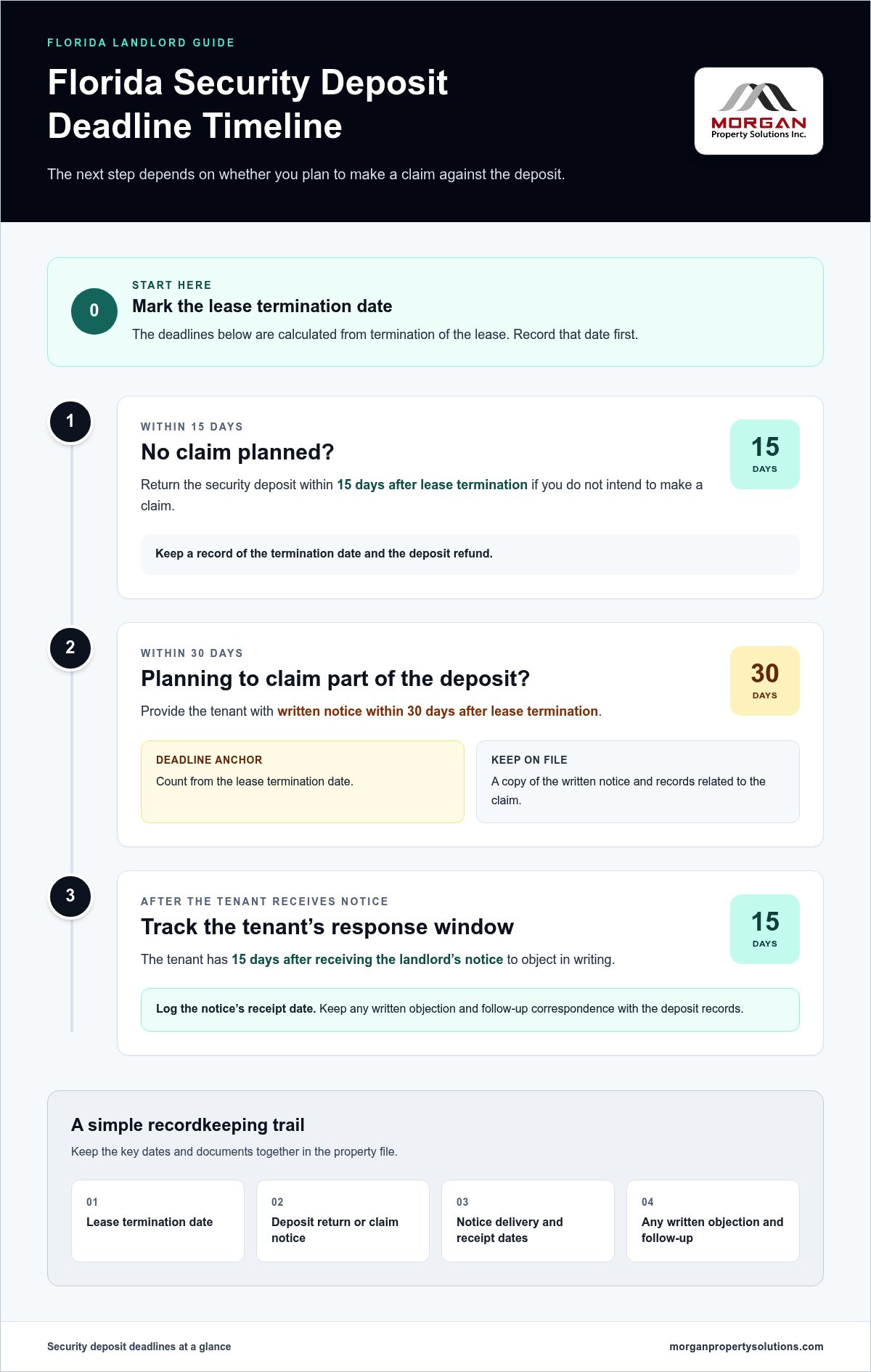
Florida’s security-deposit deadlines depend on whether the landlord plans to make a claim. If no claim is intended, return the deposit within 15 days after termination of the lease. If claiming part of the deposit, provide the tenant written notice within 30 days after termination of the lease. Record the termination date, calculate each deadline from it, and keep a copy of the notice or refund record.
A claim notice starts a separate response period for the tenant. The tenant has 15 days after receiving the landlord’s notice to object in writing. Keep track of when the notice was received, along with any written objection and follow-up. For example, if a tenant disputes a proposed deduction, preserve the correspondence and the records that explain the claim. A clear paper trail helps both landlord and tenant understand what was proposed and when.
Missing the claim-notice deadline has a direct consequence. A Florida landlord who fails to send the required written notice within 30 days forfeits the right to claim the deposit. Don’t wait until the final day to prepare a notice. Set a reminder as soon as the lease ends, confirm the tenant’s forwarding details, and organize relevant property records promptly. A dated timeline can help prevent a deadline from slipping during turnover.
Florida tenants may be entitled to damages of up to three times the security deposit, plus attorney fees, if a landlord fails to return the deposit or provide written notice. Accurate dates and complete records are therefore important. Keep proof of the refund or claim notice, along with the lease and move-out documentation. If a tenant disputes the accounting, respond using those records rather than relying on memory or informal conversations.
Handle rent and security-deposit matters separately. A tenant who plans to withhold rent over a dispute should not be treated as if the deposit automatically covers unpaid rent. Keep separate records for rent payments and deposit activity, and document each transaction. This makes the account easier to explain and prevents confusion about whether a deposit was returned, claimed, or applied.
Florida Statutes Section 83.491 addresses a landlord’s nonrefundable fee in place of a security deposit. Because that arrangement is different from holding a refundable deposit, identify the arrangement clearly in the rental paperwork and maintain records that match it. For a traditional deposit, use a simple closeout sequence: note the lease termination date, assess the account, send any required written claim notice within 30 days, or return the deposit within 15 days when making no claim. File the documents together for a consistent record.
4. What are the new rules for landlords in Florida?
Florida eviction rules require formal notices and court procedures. Landlords cannot change the locks or otherwise deny tenants access to their rental unit. Complaints about repairs or reports to a local housing authority also cannot trigger retaliation. Keep repair concerns separate from lease enforcement, communicate respectfully, and use the legal process when a tenancy issue requires action.
For unpaid rent, a landlord must give the tenant three days, excluding weekends and legal holidays, to pay or vacate before beginning legal action. A curable lease violation generally gives the tenant seven days after written notice to correct the issue before eviction proceedings can begin. For a violation that cannot be corrected, the tenant must receive seven days to surrender the premises. Repeated similar conduct within 12 months may allow termination without another chance to cure.
If the tenant doesn’t leave after notice, the landlord must file a complaint with the local court to seek possession. After a final judgment, the landlord can request a writ of possession, which authorizes the sheriff to remove the tenant and belongings. Once the writ is issued, the sheriff notifies the tenant that removal will take place in 24 hours. A landlord must not replace these court steps with a lockout.
What are Florida rules for rent increases, late fees, and lease terms? Landlords must follow any rent-increase amount or percentage stated in the lease; a lease lasting one year or more cannot have an increase until it expires. Florida permits yearly, quarterly, monthly, or weekly rental terms. State late-fee terms clearly in the written agreement so payment expectations are understandable.
What fair housing laws and anti-discrimination rules apply to Florida landlords? The Fair Housing Act protects people from discrimination when renting a house or apartment. Apply rental policies consistently during advertising, screening, and lease enforcement. For example, use the same written screening standards for every applicant rather than changing requirements based on personal characteristics.
How do landlord requirements differ across Florida cities and counties, such as Orlando, Winter Park, and Lake Nona? State landlord-tenant rules provide a statewide baseline, while local building, housing, fire, or property-maintenance requirements may depend on the property’s jurisdiction. Identify the city and county for each rental, then keep applicable permits, inspection records, and correction documents in its property file.
Before sending a notice, match it to the issue, lease term, and required timeline. Florida Statutes section 83.505 permits email delivery of required notices when the landlord and tenant sign an addendum agreeing to email notices and provide valid email addresses. A residential landlord must also provide a flood disclosure to prospective tenants before or when signing a rental agreement for at least one year, beginning October 1, 2025. Keep the disclosure with the signed lease documents.
5. Inspecting and documenting rental property conditions
A useful inspection record starts with a consistent routine. Before move-in, walk through each room and note the condition of walls, floors, fixtures, appliances, and utilities. Take dated photos showing the full area and close-ups of existing damage. Give the tenant a copy of the condition record and invite them to note anything you missed. This creates a clearer starting point for both parties.
During the tenancy, use periodic walk-throughs to catch small problems before they spread. A slow drain, water stain, or pest activity can signal a repair that needs attention. Give the tenant reasonable notice before entering, and plan visits at a reasonable time. Although notifying tenants a few days ahead can help them prepare, keep the required notice period in mind. Record the visit date, areas observed, and any follow-up.
At move-out, compare the final inspection with the original condition report. Separate ordinary wear from specific damage, and support each concern with dated photos or written notes. For example, record whether a broken cabinet hinge appears in the move-in photos or first appears in the move-out inspection. This comparison helps explain the property’s condition and supports deposit accounting. Don’t rely on memory or a single undated photograph.
What are Florida landlord requirements for rental licenses, inspections, and local permits? Requirements can depend on the property’s location and planned work. Identify applicable local requirements before renting or renovating, then keep inspection results, permits, and related approvals in the property file.
Good due diligence begins before a rental is occupied or acquired. Review available records for the roof, plumbing, electrical systems, appliances, and utility service. For repair work, keep the contractor’s scope, invoices, completion notes, and inspection documents together. File insurance policy records with the property documents and note renewal dates to keep coverage information organized. These steps create a practical record of the home’s condition and maintenance history.
What records, insurance, contractors, and property management practices help Florida landlords stay compliant? Keep the rental agreement, inspection reports, tenant notices, repair records, contractor documents, utility information, and insurance papers in one organized file. A property manager can coordinate inspections, track maintenance requests, and preserve records; explore Orlando property management for help managing rental details.
Morgan Property Solutions: Residential Property Management
Morgan Property Solutions Inc. offers Residential Property Management for owners who want support overseeing their rental properties. If repair follow-up, tenant communication, records, or property upkeep are becoming difficult to manage, professional management can help organize the process and reduce day-to-day stress. Owners planning a real estate transition can also explore Real Estate Seller Representation or Real Estate Buyer Representation. For help managing a rental, visit Morgan Property Solutions Inc..
Build a More Manageable Rental Business
Knowing how to avoid being a slumlord in Florida is a starting point. The next step is choosing a practical approach to rental ownership that fits your time, priorities, and plans for the property. A clear direction can make it easier to move forward with confidence.
If you’d like to discuss your next step, contact Morgan Property Solutions Inc. for a helpful conversation about your real estate plans.
Frequently Asked Questions
What are the new rules for landlords in Florida?
Recent Florida requirements include a flood disclosure for prospective tenants signing residential rental agreements for at least one year, effective October 1, 2025. Required notices may be delivered by email when both parties sign an addendum agreeing to email notices and provide valid email addresses. Landlords also cannot lock tenants out or retaliate over repair complaints. For an Orlando rental, keep the signed notice addendum and any required disclosure with the lease file.
What is considered tenant harassment in Florida?
Repeated unwanted contact, threatening messages, or visits that disregard required notice can make landlord-tenant communication feel coercive. Keep contact focused on tenancy matters, use the agreed communication channel, and respect the tenant’s peaceful possession. Florida landlords cannot retaliate against tenants for repair or housing-authority complaints, and they cannot block access by changing locks. For a repair visit, provide the required notice and record the reason and timing.
What are Florida landlords legally required to maintain in rental properties?
Florida landlords must provide safe housing that meets applicable housing-code requirements and make reasonable repairs when needed. Essential services include functioning plumbing, hot water, heating, and air conditioning. If a tenant reports a leaking pipe affecting a bathroom, for example, record the report, assess the source, and arrange corrective work. Keep maintenance records tied to the property so recurring issues, such as repeated plumbing failures, are easier to identify and address.
What are Florida landlord responsibilities for mold, pests, plumbing, heat, and air conditioning?
Landlords must maintain functioning plumbing, hot water, heating, and air conditioning, and address reasonable repair needs. A leak can create moisture that contributes to mold, so investigate water stains or damp areas instead of treating them as cosmetic issues. Periodic walk-throughs can also reveal pest activity early. Record the tenant’s report, inspection observations, and repair follow-up, including whether a plumbing leak or pest source was corrected.
What are Florida’s security deposit handling, notice, and return requirements?
If no deposit claim is planned, return the security deposit within 15 days after lease termination. If claiming part of it, send written notice within 30 days after termination; the tenant has 15 days after receiving that notice to object in writing. Keep the lease, move-out condition records, notice, and refund documentation together. A landlord who misses the required claim-notice deadline forfeits the right to claim the deposit.
What are Florida eviction procedures and required notices for nonpayment or lease violations?
For unpaid rent, provide a three-day notice, excluding weekends and legal holidays, to pay or vacate before beginning legal action. For a curable lease violation, written notice generally gives the tenant seven days to correct it. If the tenant remains, seek possession through the court rather than attempting a lockout. When a notice is mailed under Florida’s Landlord and Tenant Act, add five days to the compliance period, excluding weekends and legal holidays.
How often should Florida landlords inspect and maintain rental properties, and what should inspections cover?
Use periodic walk-throughs during the tenancy and compare move-in and move-out condition records; Florida’s guidance calls for reasonable notice of at least 24 hours before an inspection. Check visible plumbing, leaks, signs of pests, and the condition of fixtures and surfaces. Photograph concerns, date the notes, and track resulting work. In Orlando and surrounding Central Florida communities, paying attention to moisture and leaks can help identify problems before they worsen.
What are Florida landlord requirements for rental licenses, inspections, and local permits?
Before an inspection or repair visit, give at least 24 hours’ notice and enter at a reasonable time. The material does not provide requirements for rental licenses or local permits.

Article by
Oliver Overton-Morgan
Oliver Overton-Morgan is a full-time Real Estate Broker since 2003, with years of experience helping thousands of people purchase and sell real estate throughout Central Florida. He holds a Graduate Realtor Institute designation, LCAM, and has held licenses in good standing as a Florida Mortgage Broker and a Notary Public. Oliver immigrated to central Florida in 2001, and within 5 years Oliver built a successful Real Estate brokerage in central Florida, where he recruited over 75 Sales Associates with 25+ million in sales production.