
To handle neighbor complaints about tenants in Florida, document each report, inspect the property when needed, and address noise or other lease concerns directly with the tenant. For severe nuisances involving suspected illegal activity or health hazards, contact local code enforcement or law enforcement, as appropriate.
It’s understandable to want to act quickly when a neighbor reports repeated disturbances, but a clear record helps you respond fairly and consistently. This guide explains what to document, how to assess a complaint and inspect the property, how to address noise, and when an issue may call for outside enforcement. You’ll also learn how to distinguish a recurring problem from an isolated disturbance and choose a practical next step.
Key Takeaways
- Keep a clear record of each complaint, including when it occurred and how it affected nearby residents.
- Use a property inspection when needed to understand the concern and assess what is happening on site.
- For noise complaints, distinguish a one-time event from a repeated disturbance and consider local noise rules.
- Address tenant conduct through the lease and reserve code enforcement or law enforcement for issues that warrant outside intervention.
- Recognize that complaints can involve more than noise, including property upkeep, trees, and trash.
Documenting complaints and inspecting properties
After a noise or nuisance complaint, record the report, check the details, inspect the property when appropriate, and address any lease concern consistently. Keep the complainant’s account separate from your conclusions until you have heard relevant perspectives.
-
Record Complaint Details
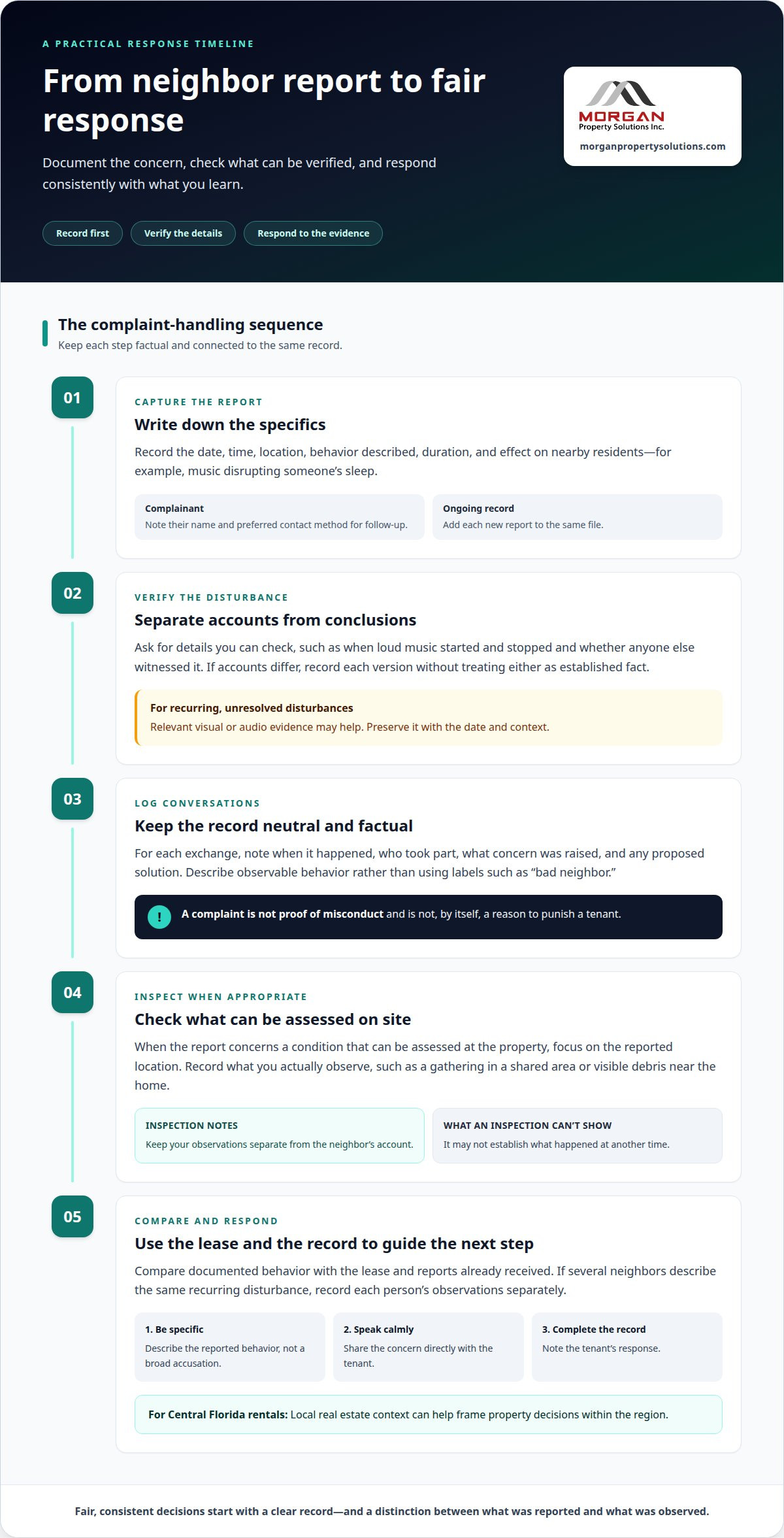
Start a written record as soon as a neighbor reports a disturbance. Note the date, time, location, behavior described, duration, and effect, such as music disrupting a nearby resident’s sleep. Record the complainant’s name and preferred contact method for follow-up. Separate direct observations from assumptions, and add each new report to the same file.
-
Verify Complaints and Disturbances
Check what can be verified before deciding what happened. Ask the complainant for specifics, such as when loud music started and stopped and whether anyone else witnessed it. If accounts differ, record each version without treating either as established fact. For recurring disturbances that remain unresolved, relevant visual or audio evidence may help; preserve it with the date and context.
-
Document Disputes and Neighbor Behavior
Keep a record of conversations about the problem as well as the original complaint. Note when each exchange occurred, who took part, what concern was raised, and any proposed solution. Describe observable behavior rather than using labels such as “bad neighbor.” Keep notes factual and consistent, even if the dispute becomes tense. A complaint is not proof of misconduct or a reason by itself to punish a tenant.
- Arrange an inspection when the report concerns something that can be assessed at the property. Focus on the reported location and condition, and record what you actually observe, such as a gathering in a shared area or visible debris near the home. Keep your inspection notes separate from the neighbor’s account. An inspection adds context, but may not establish what happened at another time.
- Compare the documented behavior with the lease and the reports already received. If several neighbors describe the same recurring disturbance, their accounts can help clarify its scale; record each person’s observations separately. Share the concern with the tenant calmly, describe the specific behavior reported, and note their response. For owners managing Central Florida rentals, local real estate context can help frame property decisions within the region.
Contacting code enforcement or law enforcement
Escalate when documented behavior raises a public-rule, safety, or repeated lease concern. Match the next step to the issue: lease terms, local code, an HOA rule, or an immediate report of suspected illegal activity.
For a tenant nuisance violation, a Florida landlord may use a seven-day notice to cure or a seven-day termination notice. These are distinct options. Match the notice to the violation and follow the applicable process.
- If the reported behavior appears to violate the lease, review the relevant terms and send a written warning. Describe the conduct, such as repeated disruptive gatherings, and identify the lease provision. Keep a copy with the complaint record and note when it was delivered. If the behavior continues, assess whether a seven-day notice to cure or termination notice applies. A warning is not either notice.
- Direct a local code complaint to the issue the municipality can assess, such as a property condition or health hazard. Provide the location, dates, and specific observations, rather than broad claims about a tenant’s character. Florida code enforcement boards may impose initial-violation fines often ranging from $100 to $250 per day, and up to $500 per day for repeat violations. A complaint can create a written record and may lead to a formal warning.
- Contact law enforcement when a report involves suspected illegal activity or an immediate safety concern. Give the responding agency concrete details, including the location, what was observed, and when it occurred. Don’t use police as a substitute for addressing an ordinary lease dispute. Florida Statute §823.01 defines a public nuisance as conduct that annoys the community, injures public health, or corrupts public morals; that definition does not make every neighbor disagreement a police matter.
- Check the community’s governing documents before treating a report as an HOA violation. Noise, parking, or property appearance may fall under association rules, but document the specific rule and reported conduct. Under Florida Statute §720.305, an HOA may enforce governing documents through fines, suspension of common-area privileges, and legal action. After a proper hearing, Florida HOAs may impose fines of up to $100 per violation or $1,000 in aggregate for continuing violations.
- Keep enforcement consistent: record the complaint, the rule involved, each notice, and the tenant’s response. A clear timeline helps distinguish repeated activity from an isolated event and supports a measured next step. Keeping complaint records, notices, and tenant responses together also supports the organized recordkeeping described in these landlord resources.
What About Noise Complaints Specifically?
Before deciding how to respond to a noise report, compare it with the lease and local ordinance. Take reasonable steps when a reported nuisance affects neighbors rather than dismissing a repeated disturbance.
-
Check Local Noise Ordinances
Identify the city or county rule that applies to the rental property. Florida handles noise regulation locally, and quiet hours vary by municipality. Many local ordinances use quiet hours starting at 10:00 or 11:00 PM and ending at 7:00 AM. Don’t treat those times as a statewide schedule. Check the rule’s definition of a violation and whether it covers amplified music, parties, or barking.
-
Review Noise and Quiet Enjoyment Clauses
Check the lease for terms about noise, shared spaces, and peaceful enjoyment. Some agreements require tenants not to disturb neighbors’ peaceful enjoyment, while landlords promise tenants peaceful enjoyment of their rental home. These terms can clarify expectations on both sides. If the lease prohibits disruptive conduct, identify the specific behavior and provision instead of relying on a general accusation.
-
Address Noise Complaints and Quiet Hours
Compare the reported time with both the lease and local ordinance. A lease might set quiet hours from 10 PM to 8 AM on weekdays, or 11 PM to 9 AM on weekends. Those are examples, not universal Florida rules. A party outside listed quiet hours may still create a repeated disturbance, so consider its frequency and effect rather than treating the clock as the only factor.
- Distinguish a one-time gathering from a recurring pattern. A graduation party may be an isolated event; loud music several nights in a row may indicate an ongoing problem. Ask whether the noise continued, where it was heard, and whether it disrupted a neighbor’s use of their home. Describe the reported conduct and relevant lease term clearly to the tenant.
- Address barking pets under the applicable lease terms and local rules. For example, clarify whether the report concerns brief barking when a dog is outside or repeated barking that interrupts rest. Ask for concrete details, then discuss steps that could reduce the disturbance. A pet’s presence alone does not prove a violation; focus on documented behavior and its effect.
- Respond consistently to complaints about tenant conduct. A landlord may take action when a tenant disturbs a neighbor’s peaceful enjoyment and may face liability in some circumstances for failing to take reasonable steps to stop a reported nuisance. Apply the lease to the specific behavior, keep the response measured, and assess whether the issue is isolated or recurring.
What Qualifies as a Legal Nuisance in Florida?
A complaint alone does not establish a legal nuisance. Assess the reported conduct, its effect on the property, and whether it meets Florida’s nuisance standards.
-
Identify Common Tenant Nuisance Complaints
Classify complaints by the conduct described, such as repeated loud music, trash piles, or an unkempt lawn. Noise and neglected property conditions may raise lease or community-rule concerns, but each situation needs an individual assessment. Distinguish a one-time gathering from ongoing behavior, and a reported condition from a proven violation. This keeps decisions grounded in the rental and its circumstances.
-
Assess Florida Nuisance Standards
Compare the reported behavior with the relevant legal standard before calling it a nuisance. Florida Statute §823.01 defines a public nuisance as conduct that annoys the community, injures public health, or corrupts public morals. A neighbor’s frustration alone does not establish that standard. Consider the conduct, its reach, and its effects rather than relying only on the complaint’s wording.
-
Consider Private Nuisance Claims
For a private nuisance claim, assess whether the conduct substantially and unreasonably interferes with another person’s use of property. Repeated activity that affects a neighbor’s ability to use their home may raise a different concern from an isolated disagreement. Focus on the interference and its practical effects. If a claim is being considered, consult a Florida attorney about the specific situation.
- Evaluate the available accounts before drawing conclusions. Frequent reports of car-horn honking, foul language, obscene gestures, or spitting toward a home do not automatically establish a nuisance under Florida law. Consider the pattern, context, and effect on the affected property. Offensive behavior and a legally actionable nuisance are not interchangeable.
- Apply the same careful review to tenants and neighbors. Tenants are typically liable for nuisances they cause, while landlords may also face liability in certain circumstances. Base the response on documented conduct and applicable lease terms. Do not assume a tenant caused a problem simply because the rental is nearby.
- Give the tenant an opportunity to respond to a specific allegation before deciding what action fits. Explain the reported behavior, identify the relevant lease term or rule, and listen to the tenant’s account. Disagreement about the facts may call for further assessment, not an immediate conclusion. Focus on conduct and its effect, not personal conflict between neighbors.
Common neighbor complaints
Noise is a common concern, but complaints may also involve shared spaces or property upkeep. To handle neighbor complaints about tenants in Florida, first sort each report by the behavior described. Then choose a response that addresses the specific issue without escalating a manageable dispute.
- Group noise reports by pattern and location. Loud music, late gatherings, and repeated disruptions in a shared hallway may call for different conversations. Ask whether the issue happened once or keeps recurring, and whether it affects one neighbor or several. A graduation party, for example, differs from repeated loud music. Respond to the details rather than assuming every gathering requires the same action.
- For lawn and landscaping concerns, identify the specific condition. A neighbor might report an uncut lawn, an overgrown hedge, or branches extending across a boundary. Check whether the concern falls under the tenant’s upkeep responsibilities, an owner-managed area, or a shared space. Clear responsibility matters: a tenant cannot reasonably address a task outside their control. Identify who is responsible before promising a remedy.
- Break trash complaints down by the issue: bags left beside a rental, overflowing bins, and debris in a shared area may have different causes. Ask where the waste appeared and whether it blocks access or creates an ongoing concern. If relevant, explain the expected disposal routine to the tenant. A specific request, such as moving bags to the proper storage area, is more actionable than a broad accusation of being untidy.
- Keep related concerns separate rather than combining them into one allegation. A neighbor may report a barking dog and noise from visitors, but each behavior needs its own facts and response. Clarify whether barking is brief when the dog goes outside or continues repeatedly. For visitor-related reports, identify the conduct, such as loud conversation in a shared entrance. Addressing each issue clearly can help resolve disputes without damaging neighbor relationships.
- Choose a proportionate response before discussing consequences. Start with a calm, specific conversation when the report concerns a correctable behavior, such as leaving trash outside overnight. If the issue continues, review the lease and community rules, then follow the applicable process. Do not jump from a single complaint to eviction; focus first on the reported conduct and how to correct it.
- Keep the outcome practical for both the rental and surrounding homes. For a recurring lawn concern, clarify who maintains the area and what action is expected. For persistent noise, address the particular behavior and relevant rule. Knowing how to handle neighbor complaints about tenants in Florida also means considering each report separately, rather than treating the whole relationship as a single conflict; these landlord resources can support owners as they address rental concerns.
Morgan Property Solutions Inc.: Tenant Placement and Leasing
Morgan Property Solutions Inc. provides Tenant Placement and Leasing for owners preparing to rent a residential property. If neighbor concerns point to a need for clearer expectations before a new tenancy, tenant placement may be a useful next step. For ongoing rental and tenant support, Residential Property Management is also available.
Leasing and property management support different stages of ownership. Tenant placement helps bring a tenant into the rental; property management supports owners throughout the tenancy. Choose the service that matches your current need, whether you are preparing to lease or managing an occupied property.
Contact Morgan Property Solutions Inc. to discuss Tenant Placement and Leasing or Residential Property Management for your property.
Set a Clear Standard for Your Rental
Each complaint is also an opportunity to strengthen how you manage a rental. Clear lease expectations, consistent communication, and a measured response help tenants understand their responsibilities before a small concern becomes a recurring dispute. Keep these standards in mind as you plan future leasing and property decisions.
A thoughtful approach to how to handle neighbor complaints about tenants in Florida can support a better experience for residents and owners. For ongoing rental oversight, Morgan Property Solutions Inc. provides Residential Property Management. The company also offers Real Estate Seller Representation and Real Estate Buyer Representation for owners considering a change in their property plans.
Choose the support that fits your next decision. Contact Morgan Property Solutions Inc. to discuss your real estate needs, and move forward with a clearer plan.
Frequently Asked Questions
What Are Your Options Before Taking Legal Action?
Try a direct, respectful conversation and a practical solution before escalating a manageable dispute. Neighbors might discuss moving a gathering indoors or clarifying use of a shared space. If that does not resolve the concern, raise it with the landlord and keep the discussion focused on specific conduct. For property-line disagreements, clarify the boundary before using shared facilities or installing a fence.
What Florida laws govern landlord duties to address tenant disturbances and nuisance behavior?
Florida Statute §823.01 defines a public nuisance as conduct that annoys the community, injures public health, or corrupts public morals. A private nuisance claim focuses on substantial and unreasonable interference with another person’s use of property. These standards address different issues. A landlord may also face liability for failing to take reasonable steps after learning of a nuisance affecting tenants or neighboring properties.
How should a Florida landlord document and investigate a neighbor complaint about a tenant?
Record the complainant’s account, the specific conduct, when it occurred, and its effect. Then seek separate accounts from other neighbors who witnessed the disturbance; multiple perspectives can help establish its scope. If the issue continues, preserve relevant visual or audio evidence with its context. Invite the tenant to respond, keeping their account separate from the original complaint.
Can a Florida landlord issue a lease violation notice or evict a tenant for repeated noise complaints?
A landlord may address repeated noise that violates the lease, but a complaint alone does not establish a violation or justify eviction. For a tenant nuisance violation, Florida landlords may use a seven-day notice to cure or a seven-day termination notice. Choose the option that fits the applicable notice process. Keep the reported behavior and relevant lease provision clear in any communication.
Can a Florida landlord enter a rental unit to investigate a neighbor complaint, and what notice is required?
Arrange access with the tenant and follow the lease and applicable entry and notice requirements. A neighbor’s complaint does not replace proper arrangements for entry. Explain the inspection’s purpose, such as checking a condition reported inside the rental, and coordinate a suitable time. Keep the inspection focused on the concern and follow the required process.
When should neighbors contact local police or code enforcement about a Florida tenant disturbance?
Contact law enforcement about suspected illegal activity or an immediate safety concern. Report property conditions or health hazards to local code enforcement when appropriate. Suspected illegal activity calls for a different response than recurring loud conversation. Give the agency the location and specific observed conduct. For an ordinary disagreement, neighbors can raise the concern with the landlord first.
Do Florida cities or counties have local noise ordinances that affect landlord responses to tenant complaints?
Yes. Florida noise regulation is handled locally, so the applicable city or county ordinance matters. Local quiet hours typically begin at 10:00 or 11:00 PM and end at 7:00 AM, but rules vary by location. Check the rule’s definition of prohibited noise before deciding whether reported behavior violates it. A lease may set its own quiet hours, so compare both sources.

Article by
Oliver Overton-Morgan
Oliver Overton-Morgan is a full-time Real Estate Broker since 2003, with years of experience helping thousands of people purchase and sell real estate throughout Central Florida. He holds a Graduate Realtor Institute designation, LCAM, and has held licenses in good standing as a Florida Mortgage Broker and a Notary Public. Oliver immigrated to central Florida in 2001, and within 5 years Oliver built a successful Real Estate brokerage in central Florida, where he recruited over 75 Sales Associates with 25+ million in sales production.