The best townhouse match isn’t necessarily the one closest to you. It’s the one whose location, layout, outdoor space, and ownership costs fit your plans. If you want to buy a townhouse near me, compare nearby listings by bedrooms, bathrooms, square footage, lot details, and whether the property is part of an HOA.
Photos and asking prices are easy to focus on, but ownership details can shape your everyday experience just as much. HOA fees, shared responsibilities, and ownership structure affect how a property fits your budget and expectations. Compare nearby listings, assess space and location, and review HOA documents carefully to narrow your choices and decide which homes are worth exploring further.
Key Takeaways
- Compare nearby listings by neighborhood as well as asking price to see how location changes your options.
- Use bedroom and bathroom counts to assess whether a townhouse’s layout fits your household and plans.
- Look beyond interior space: square footage and lot details help you understand how the property may work for everyday living.
- Review ownership structure and HOA details to understand the responsibilities and recurring costs tied to a home.
- Bring these comparisons together to narrow your shortlist and focus on the properties that suit your priorities.
Nearby cities with townhouse listings
Townhouse options depend on current listings across Orlando and nearby Central Florida communities. Compare locations, property types, and ownership details to identify which areas suit your search.
Nearby City Townhouse Listings
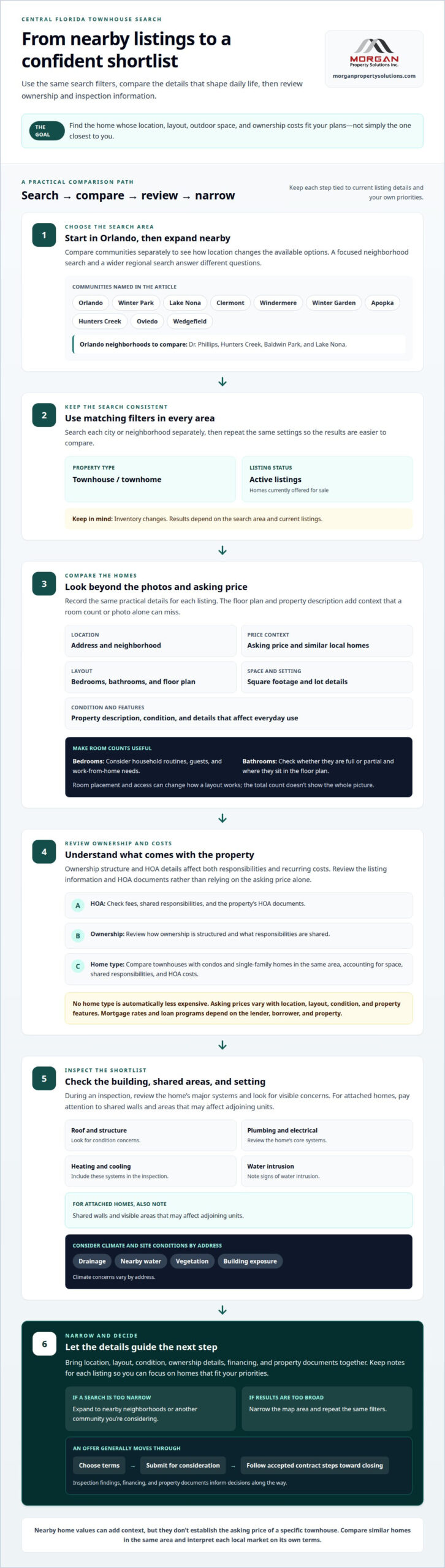
Start your search in Orlando, then include nearby places such as Clermont, Winter Garden, and Apopka. You can also compare Winter Park, Windermere, and Lake Nona. Use the same filters in each area, including townhouse or townhome as the property type and active status for homes currently offered for sale. Inventory changes, so results depend on your search area and current listings.
Neighborhood Townhome Listings
Within Orlando, compare neighborhoods such as Dr. Phillips, Hunters Creek, Baldwin Park, and Lake Nona. Review each listing’s location, access to your preferred destinations, and ownership details. Nearby communities can offer different settings and property options, so pair a map search with specific neighborhood names and consistent filters.
Listing Prices and Home Sizes
Asking prices vary with location, layout, condition, and property features. Compare townhouses with condos and single-family homes in the same area, accounting for differences in space, shared responsibilities, and HOA costs. No home type is automatically less expensive. Mortgage rates and loan programs depend on the lender, borrower, and property, so compare terms that fit your circumstances.
To find townhouses for sale nearby, search Orlando and nearby communities, then filter by townhouse type and active listing status. Review each home’s floor plan, property description, and ownership information. During an inspection, pay attention to the roof, structure, plumbing, electrical systems, heating and cooling, and signs of water intrusion. For attached homes, note shared walls and visible areas that may affect adjoining units.
Making an offer generally involves choosing terms, submitting them for consideration, and following the accepted contract steps toward closing. Inspection findings, financing, and property documents inform decisions along the way. First-time buyer assistance varies by location and program eligibility, including buyer and property criteria. Climate concerns also vary by address; consider drainage, nearby water, vegetation, and the building’s exposure when comparing homes.
Neighborhood and nearby-market browsing
Compare townhouse listings across Orlando and nearby Central Florida communities using the same filters. This makes it easier to see how location affects the available choices and which neighborhoods fit your priorities.
Nearby Cities and Neighborhoods
Begin with Orlando, then expand to Winter Park, Lake Nona, Clermont, Windermere, and Winter Garden. You can also include Apopka, Wedgefield, Hunters Creek, and Oviedo. Search each city or community separately with the same property-type and listing-status settings. This helps distinguish a wider regional search from a focused neighborhood comparison.
Nearby Neighborhood Options
Within Orlando, compare areas such as Dr. Phillips, Hunters Creek, Lake Nona, and Baldwin Park. Shortlist neighborhoods that match your preferred location, then review the available townhome listings in each. Listing details can change, so use current results and check each property’s address, status, and description.
Nearby home values provide context, but they don’t establish the asking price of an individual townhouse. Compare similar homes in the same area, considering condition, size, layout, and ownership details. First choose your preferred Central Florida communities, then apply consistent filters and compare the resulting listings side by side.
A mortgage decision depends on the property and the buyer’s financing terms. A home’s value alone doesn’t determine affordability. Review the listing information and available documents, including standard operating procedures or a consumer protection notice where applicable. Phrases such as “deemed reliable” don’t replace examining the details of a particular home.
To keep comparisons manageable, note each listing’s location, asking price, layout, and ownership details. If a Winter Park search returns few suitable options, broaden it to nearby Orlando neighborhoods or another community you’re considering. If results are too broad, narrow the map area and repeat the same filters. This helps you compare local options consistently without treating nearby markets as identical.
For help organizing a Central Florida home search, explore real estate buyer resources.
Separate from Central Florida communities, average home values are listed for several places in New York. These figures offer a regional reference, not Orlando-area values or townhouse asking prices.
As with any broad home-value figure, an average doesn’t describe the condition, layout, ownership details, or asking price of a specific property. Keep these New York figures separate from a Central Florida shortlist, and use location-specific listing information to compare homes. Apply a consistent approach across markets, but interpret results in their own local context rather than blending them into a single comparison.
Bedrooms and bathrooms
Bedroom and bathroom counts help narrow a Central Florida townhouse search, but the floor plan shows how those rooms work together. Compare the listed counts with your household’s routines, privacy needs, and plans for guests or work-from-home space.
In Orlando, Lake Nona, Dr. Phillips, Hunters Creek, Winter Park, and nearby communities, use bedroom filters to create a practical shortlist. Then look beyond the total. A room near the main living area may suit guests or an office, while a more private placement may better fit household members with different schedules.
Bathrooms also affect everyday convenience. Note whether a listing shows full or partial bathrooms and where they are located. A home with bathrooms on different floors may work differently from one with them grouped together. Listing descriptions and floor plans help clarify these details; room count alone doesn’t show access or flow.
- Bedrooms: Consider how each room could serve your household, guests, or work needs.
- Bathrooms: Review the type and location of each bathroom in the floor plan.
- Room access: Notice whether bedrooms and bathrooms connect conveniently to shared living spaces.
- Flexibility: Consider whether the layout can accommodate changing household routines.
For example, when comparing a two-bedroom layout with a three-bedroom one, weigh more than the extra room. Consider how the additional space affects privacy, storage, and shared areas. Also compare bathroom placement with your morning and evening routines rather than assuming that a higher count automatically means a better fit.
For each Orlando-area listing, record the bedroom and bathroom counts, room placement, and intended use for each space. Apply the same criteria to homes in Winter Park, Lake Nona, or Hunters Creek. A consistent approach helps distinguish a layout that meets your needs from one that only looks suitable in a brief listing description.
Before deciding, compare listing details with the floor plan and note questions about how rooms are described. Counts provide a useful first filter, while layout and access show how well the home may support your everyday life.
Square footage and lot size
Square footage describes interior area, while lot size refers to the land associated with a property. Compare these as separate details when reviewing Orlando-area townhouse listings. Interior measurements don’t tell you how much outdoor space a home has, and a lot figure doesn’t explain how usable the rooms feel. Review the listing description and any available floor plan together.
Central Florida listings show why measurements need context. An Orlando property at 13325 Old Dock Road is listed with 2,680 square feet, while a listing at 1314 Hialeah Drive shows 1,200 square feet. These examples provide local size context, not a townhouse size range. Confirm the property type and use each listing’s own measurements when comparing townhomes.
Start with the interior layout. A floor plan shows how rooms, stairs, storage, and shared living areas use the listed square footage. Two properties with similar measurements may feel quite different if one has more hallways or less flexible room space. For an Orlando-area search, compare the stated area with the plan instead of treating the largest number as the best fit.
- Interior area: Compare the listed square footage with the floor plan and room arrangement.
- Lot details: Review the listing’s description of any yard, patio, or other outdoor area.
- Shared spaces: Identify areas described as common or shared rather than private.
- Daily use: Consider how storage, stairs, and living areas fit your routine.
Review lot size separately. In Orlando, Winter Park, or Lake Nona, look for a stated lot measurement and descriptions of outdoor areas. A patio or yard label doesn’t establish its dimensions or whether the space is private. Compare the property description with available plans or survey documents to understand boundaries and how the space relates to the home.
Compare each townhouse side by side. Record interior square footage, lot information, floor-plan features, and whether outdoor areas are described as private or shared. A kitchen island may provide useful workspace, while an outdoor area offers a different kind of space. Neither detail replaces checking the complete layout and lot information.
Measurements are one part of evaluating an Orlando-area townhouse. Compare them with the layout, outdoor-space details, and property description to understand how each home may work for you. If a listing provides limited measurement details, use the available floor plan and stated property features to compare carefully, without assuming similar figures mean similar living space.
Townhouse ownership and HOA information
In Orlando and nearby Central Florida communities, townhouse ownership details vary by property. Review the listing and available association documents to understand what the owner controls and which areas involve shared responsibilities. These details clarify the practical side of ownership beyond the property description.
For a townhouse in Winter Park, Lake Nona, or Hunters Creek, look for the HOA fee amount and billing schedule. Read the association documents to see which services and shared-area expenses the fee covers. Don’t assume homes in nearby communities have the same fee schedule or included services.
Ownership documents can also explain how outdoor areas, parking, and access spaces are treated. Compare the listing with available HOA rules and maintenance information. A fee amount alone doesn’t explain the association’s responsibilities or yours. Look for clear descriptions of who maintains shared spaces and which areas are private.
- Ownership: Identify private and shared areas in the property documents.
- HOA fee: Note the stated amount, billing schedule, and covered services.
- Maintenance: Review responsibilities for the home and shared areas.
- Restrictions: Read rules that may affect parking, renovations, or outdoor-space use.
As a buyer, pay attention to how the association describes its finances and rules. Review the budget, reserve information, meeting minutes, and notices about planned work or proposed assessments. These records can show how the association handles shared expenses and future maintenance. Review documents for the specific Orlando-area property rather than drawing conclusions from another community’s HOA.
Keep a side-by-side record of each home’s ownership structure, fee schedule, covered services, and restrictions. This makes it easier to compare Orlando townhouses with options in Clermont, Windermere, or Winter Garden. If a document uses unfamiliar terms, note the passage and ask for clarification during your purchase process.
For support as you consider a Central Florida townhouse, explore real estate buyer resources.
Treat that figure as information about that listing, not as a guide to fees for townhouses in Orlando or nearby communities. Association charges and responsibilities are specific to each property, so compare the documents for the home you’re considering rather than relying on an example from elsewhere.
For each property, check that the fee amount and billing schedule in the listing match the association materials. Look for an explanation of covered services and shared expenses, along with any separate charges or proposed assessments described in the available records. Check how the documents distinguish private areas from shared spaces and who is responsible for maintenance. If a rule or fee description is unclear, note the relevant passage and request clarification during your purchase process. Keeping these details together helps you compare homes, especially when their fees appear similar but included services or maintenance arrangements differ. The documents, rather than the fee alone, provide context about the owner’s responsibilities and the association’s role. Use the same review approach for every property so your comparison reflects its own terms and available information.
Morgan Property Solutions
Morgan Property Solutions Inc. can help you turn townhouse comparisons into a clear next step. Through Real Estate Buyer Representation, the team supports buyers as they assess listings, locations, layouts, and ownership details. If you’re comparing homes in Orlando or Central Florida, the guidance can help you focus on the features and responsibilities that matter to you.
For owners planning to rent out a property, Residential Property Management and Tenant Placement and Leasing can support the next stage. Reach out when you’re ready to discuss buying, selling, or managing a residential property and want help understanding your options.
Contact Morgan Property Solutions Inc. to discuss your townhouse plans.
Take the Next Step Toward Your Townhouse
If you’re ready to buy a townhouse near me, turn your shortlist into a clear plan. Decide which homes are worth a closer look and what questions to ask before moving forward. A focused next step can make the process more manageable.
Morgan Property Solutions offers Real Estate Seller Representation for owners preparing to sell, as well as support for buyers and residential property owners. Whether you’re moving toward a purchase or planning a change in ownership, real estate guidance can help you approach the decision with greater clarity.
There’s no need to have every detail settled before starting a conversation. Share what you’re hoping to accomplish and where you are in the process. Contact Morgan Property Solutions to discuss your next step. Your townhouse search can move forward at a pace that feels right for you.
Frequently Asked Questions
What is the median townhouse price in my area?
There isn’t one median price that applies across nearby markets. The figure depends on the city or neighborhood and whether the comparison uses asking prices or completed sales. For a useful local benchmark, define your search area, then compare townhouses within that area and bedroom range. A broad citywide median can hide meaningful differences between nearby neighborhoods.
Which nearby neighborhoods have townhouses for sale?
For Central Florida searches, consider Orlando neighborhoods and nearby communities such as Lake Nona, Dr. Phillips, Hunters Creek, Winter Park, Clermont, Winter Garden, Apopka, and Wedgefield. Search each area separately and filter for townhouse or townhome listings. Listing status can change, so focus on properties currently presented as available rather than relying on older search results.
What are the average HOA fees for local townhouses?
HOA fees vary by community, so a single average may not reflect the home you’re considering. The amount can depend on shared maintenance, amenities, insurance arrangements, and other association responsibilities. Compare fees after noting their billing schedule and what they cover. A lower fee may include fewer services, while a higher fee may reflect more shared responsibilities.
What property taxes and other ownership costs apply to townhouses in my area?
Property taxes depend on the home’s location and local assessment details. When budgeting for a townhouse, also account for HOA dues, utilities, insurance, routine maintenance, and costs tied to shared spaces. These expenses vary by property and ownership arrangement. Compare recurring costs, not just the asking price, to understand how each townhouse may fit your budget.
What townhouse HOA rules, fees, and financial records should buyers review?
Review the association’s current rules, fee schedule, budget, reserve information, and recent meeting minutes. Look for planned repairs, changes to shared services, or discussions of additional assessments. Check restrictions that could affect pets, parking, renovations, or use of outdoor areas. Comparing these documents with the listing helps clarify the community’s financial picture and the responsibilities attached to ownership.
What are the steps to make an offer and close on a townhouse?
Choose your offer terms and submit them for consideration. If accepted, follow the contract steps toward closing, using inspection findings, financing, and property documents to inform your decisions.

Article by
Oliver Overton-Morgan
Oliver Overton-Morgan is a full-time Real Estate Broker since 2003, with years of experience helping thousands of people purchase and sell real estate throughout Central Florida. He holds a Graduate Realtor Institute designation, LCAM, and has held licenses in good standing as a Florida Mortgage Broker and a Notary Public. Oliver immigrated to central Florida in 2001, and within 5 years Oliver built a successful Real Estate brokerage in central Florida, where he recruited over 75 Sales Associates with 25+ million in sales production.