
What if responding to an unauthorized occupant isn’t an automatic yes or no? If a tenant has an unauthorized occupant in Florida, start by reviewing the lease and determining whether the person is a short-term guest or has moved into the rental. Florida has no statewide occupancy cap for rental housing, so the lease and the circumstances matter.
It’s understandable to want a clear rule for when a guest becomes an occupant. The Florida Residential Landlord and Tenant Act doesn’t set a specific number of guest days, but leases commonly require written approval after 7 consecutive nights or 14 days in a six-month period. For a lease violation, a notice may give the tenant 7 days to remedy it or face lease termination, according to the Florida Legislature.
This guide explains how to assess the situation, handle rent, distinguish guests from occupants, give the tenant an opportunity to address a violation, and consider occupancy limits. The decision to approve someone should reflect the lease, the rental’s occupancy restrictions, and the person’s application, not a single guest-night threshold.
Key Takeaways
- Assess whether the person is a short-term guest or has begun living in the rental by looking at the circumstances, not just the label used.
- Avoid accepting rent from an unauthorized occupant: under Florida Statute 83.56(5)(a), accepting rent with knowledge of a violation waives the landlord’s right to terminate for that noncompliance.
- Use the lease’s occupancy terms and a fair, consistent screening process to guide an approval decision.
- Keep communication with the named tenant clear and professional, and document notices and key conversations.
- Professional tenant placement and leasing support can help owners set clear expectations for future residents from the start.
Should You Authorize the Unauthorized Occupant?
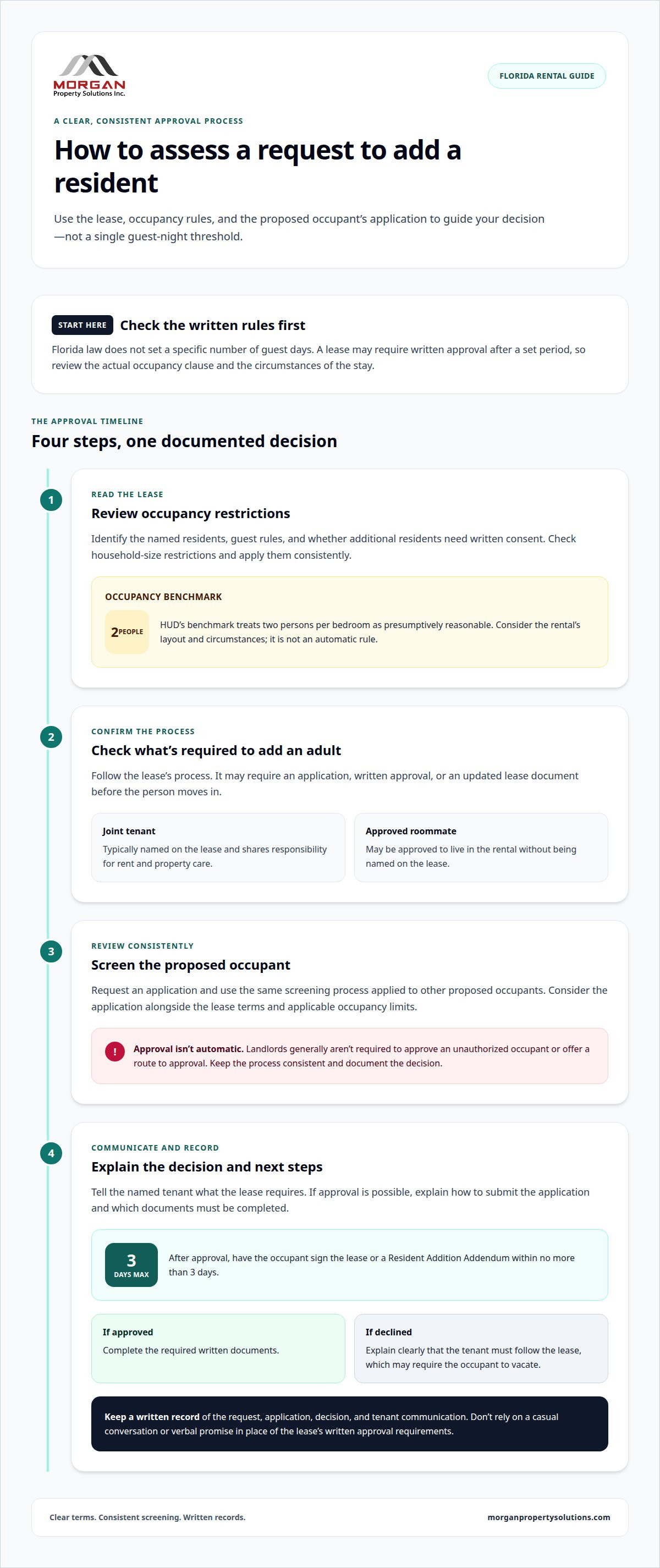
Decide whether approval is consistent with the lease, the rental’s occupancy limits, and the proposed occupant’s application. Follow a consistent process, then clearly communicate the decision and next steps to the named tenant.
-
Review Lease Occupancy Restrictions
Read the lease’s occupancy clause before discussing approval. Identify the named residents, the rules for guests, and whether additional residents need written consent. Check any household-size restrictions and apply them consistently. HUD’s occupancy benchmark treats two persons per bedroom as presumptively reasonable, but consider the rental’s layout and circumstances rather than treating the benchmark as an automatic rule.
-
Check Rules for Adding Adults
Follow the lease’s process for any adult who will live in the rental. It may require an application, written approval, or an updated lease document before the person moves in. Distinguish a joint tenant, who is typically named on the lease and shares responsibility for rent and property care, from an approved roommate who may not be named on the lease.
-
Screen the Proposed Occupant
Request an application and review it before deciding whether to approve the person. Use the same screening process applied to other proposed occupants, along with the lease terms and applicable occupancy limits. Approval isn’t automatic: landlords generally aren’t required to approve an unauthorized occupant or offer a route to approval. Keep the process consistent and document the decision.
- Tell the named tenant what the lease requires and what will happen next. If approval is possible, explain how to submit the application and which documents must be completed. Once approved, have the occupant sign the lease or a Resident Addition Addendum within no more than 3 days after approval. If you decline, communicate that decision clearly and explain that the tenant must follow the lease, which may require the occupant to vacate.
Keep a written record of the request, application, decision, and communication with the tenant. Clear records help distinguish an approved household change from an unresolved lease violation. Don’t rely on a casual conversation or verbal promise instead of the lease’s written approval requirements.
Accepting rent from an unauthorized occupant
- Route rent payments through the resident named on the lease. Florida Statute 83.56(5)(a) says accepting rent with knowledge of a violation waives the landlord’s right to terminate for that noncompliance. So, if you know an occupant lacks approval, don’t accept rent directly from that person while deciding how to address the lease violation. Record who offered the payment, when it was offered, and how you responded.
- Keep the payment process consistent during a cure period. A tenant may be working to resolve an unauthorized-occupancy issue, but accepting rent from the occupant during that period can affect enforcement. Direct rent questions to the named tenant and retain payment records and communications. If the occupant offers money, don’t silently apply it to rent. Document the circumstances and handle the payment in keeping with the lease and notice already given.
- Record utility contributions separately from rent. For example, note whether the named tenant paid the utility bill or another household member reimbursed them. Record the payment’s stated purpose and keep the related receipt or message. A utility contribution may provide context, but it doesn’t by itself establish whether someone is an authorized occupant. Don’t label a payment as rent unless it was intended to cover rent.
- Keep communication clear and in writing. Tell the named tenant where to pay rent and explain that payments from an unauthorized occupant won’t count as approval to live in the rental. Don’t use utility access or payment arrangements as a substitute for resolving the lease issue. Track dates, amounts, payer names, and any refund or payment instructions so the record shows how each offer was handled.
For a practical recordkeeping routine, keep payment notes with your other landlord resources. Consistent records can help you distinguish rent from utility reimbursements and keep the next step clear during a cure period.
What qualifies as an unauthorized occupant versus a guest
Assess the person’s living arrangement, permission, and connection to the lease. A brief visit differs from someone who has made the rental their home.
-
Distinguish Guests from Tenants
Compare the person’s role with the lease and the circumstances of their stay. A guest is generally invited for a short visit, while a tenant has signed the rental agreement and is responsible for rent and its terms. Consider whether the person contributes to rent, receives mail there, or appears to live in the unit. No single detail determines every case.
Florida’s Residential Landlord and Tenant Act doesn’t set a specific number of guest days. A lease may set approval thresholds, but these are lease rules, not a statewide statutory definition. Subletting with the landlord’s consent differs from occupying the rental without the landlord’s approval or knowledge. If a tenant has an unauthorized occupant in Florida, assess the full circumstances rather than relying on one sign, such as a package delivered by mail.
-
Assess Occupant Rights and Tenancy
Determine whether the person was allowed to stay temporarily or has established residency. Florida Statutes section 82.035 generally addresses a transient occupant who was initially allowed to stay temporarily but later refuses to leave. It is a limited procedure, not a shortcut for removing every person whose name isn’t on the lease. A missing written agreement alone doesn’t establish that its conditions are met.
An unauthorized occupant may have rights depending on the circumstances, and a person may establish residency even without a written lease. If a tenant has an unauthorized occupant in Florida and that person establishes residency, Florida eviction proceedings are governed by Chapter 83. The process involves the applicable notice and court proceedings; don’t assume a specific timeline from the person’s lack of a lease.
Build a factual record before taking action. Preserve the signed lease, written guest or occupancy communications, payment records, and dated notes about observed residence. Where appropriate, photographs can document occupancy conditions. Record who communicated with the tenant, what was said, and when. These details can help show whether the person was visiting or living there. If the distinction affects an eviction or a proposed use of section 82.035, get legal advice from a qualified attorney before proceeding.
Allowing the tenant to remedy the violation
A Florida tenant can ask the landlord in writing to approve the occupant and submit an application, or resolve the violation by having that person leave. According to the Florida Legislature, a landlord’s notice may require the tenant to remedy the violation within 7 days, or the lease may be terminated.
- Read the notice promptly and note its deadline and required action. Determine whether it allows approval as a possible remedy or requires the occupant to leave. If the notice is unclear, ask the landlord in writing what would resolve the stated violation. Keep a copy of the notice and response, noting when each was received.
- Submit a written approval request if you want the occupant to remain. Include the person’s name and explain that you’re requesting an addition to the household. Provide the application and any lease documents the landlord requires. A request alone doesn’t make the occupant approved, so continue following the notice while the request is being considered.
- Complete the screening steps within the time allowed. If the landlord requests an application, return it promptly and provide the information needed for review. The prior section’s lease process calls for returning an unauthorized occupant’s application within no more than 3 days. Keep a dated copy. If the application is denied, the landlord may serve a new Seven Day Notice of Noncompliance with Opportunity to Cure.
- Confirm the outcome in writing before treating the issue as resolved. If approval is granted, complete the required lease addition or Resident Addition Addendum within no more than 3 days after approval. If the occupant must leave, communicate the move-out plan and confirm when the person has vacated. Don’t assume that a pending application pauses the notice deadline or changes its terms.
- Keep a clear record of each step. Save the notice, application, delivery confirmation, landlord communications, decision, and any signed lease addition. If the tenant doesn’t resolve the violation within the stated period, the lease may be terminated and further enforcement may follow. Use the written notice and lease terms to guide the next action rather than relying on an informal conversation.
Florida rental occupancy limits
Florida has no statewide occupancy cap for rental housing. To assess a possible breach, compare the lease terms with the household’s size, the unit’s layout, and any applicable program or property requirements.
- Start with the lease’s occupancy terms. Note the approved residents, any rules for guests becoming occupants, and how the agreement handles household changes. A lease may require approval, but assess a possible breach against the actual clause and circumstances, not an assumed statewide headcount limit.
- Use HUD’s Keating Memo benchmark as a starting point, not an automatic cap. It treats two persons per bedroom as presumptively reasonable for occupancy. For example, four people in a two-bedroom rental generally align with that benchmark. Consider the unit’s layout and relevant circumstances alongside the number of bedrooms.
- Apply occupancy terms consistently and account for fair housing protections. Familial status is protected under the federal and Florida Fair Housing Acts, so don’t treat a household as violating the lease solely because children are present. Assess the stated occupancy rule and circumstances using the same approach for every household.
- Check whether the rental is subject to additional program or property requirements. Unauthorized occupancy in federally subsidized housing may implicate Section 42 of the Internal Revenue Code. Condominiums and mobile homes may also involve property-specific documents or program terms. Don’t assume one general rental rule answers every situation; review the requirements that apply to that property.
- Document the basis for a suspected occupancy breach before acting. Record the relevant lease clause, approved household, observed facts, and how the property’s requirements apply. For example, compare the number of residents with the approved household and the unit’s bedroom count, then consider the HUD benchmark without treating it as a fixed legal maximum.
- For a rental in Orlando or elsewhere in Central Florida, keep the decision tied to its lease and applicable occupancy requirements. Get help reviewing rental occupancy requirements as part of a careful property-management process.
Morgan Property Solutions: Tenant Placement and Leasing
Morgan Property Solutions Inc. provides tenant placement and leasing for owners preparing to rent a residential property or set expectations for a new tenancy. Clear lease terms and consistent communication can establish expectations about approved residents before move-in. If an occupant issue has raised questions about your rental process, professional leasing support can help organize the next steps without treating every guest as a lease violation.
Tenant placement is most useful before a tenancy begins or when preparing for a new leasing cycle. It can help owners establish a consistent process for resident applications, approval requirements, and lease documentation. For a dispute involving an existing occupant, the signed lease and circumstances still guide decisions. Leasing services don’t replace legal advice or decide a court matter.
- Set expectations before move-in. Tenant placement and leasing help owners address household requirements during the leasing process. Clear terms can explain who is approved to live in the home, how a tenant can request an additional occupant, and why written approval matters. Consistent expectations give residents a clear process to follow instead of leaving them to rely on informal conversations.
- Bring structure to placement. Documented application and lease-completion processes help keep resident changes organized. For example, when an adult household member is proposed, the owner can follow the established application and approval steps before adding that person to the lease. This helps distinguish an approved resident from someone whose status remains unresolved.
- Consider ongoing management needs. Owners who want support beyond filling a vacancy can explore residential property management. Professional management can help coordinate leasing and property responsibilities as part of the rental’s day-to-day operation. The right next step depends on whether you need help preparing for a new tenant, managing an active rental, or reviewing your process after an occupant concern.
For owners in Orlando and Central Florida, Morgan Property Solutions Inc. provides tenant placement and leasing. Bring details about the rental and the questions you want to address, such as how new residents are handled or how lease expectations are communicated. This helps focus the conversation on your property and the support you need.
Contact Morgan Property Solutions Inc. to discuss your tenant placement and leasing needs.
Build a steadier plan for your property
An occupant concern can also be an opportunity to strengthen your approach to managing the rental. A clear, repeatable process for resident changes can support consistent decisions and communication as your property needs evolve.
If a tenant has an unauthorized occupant in Florida, consider what support would help you manage the property beyond the immediate issue. Morgan Property Solutions Inc. offers residential property management, as well as real estate buyer and seller representation. These services can support different stages of owning and managing residential property, whether you’re refining your rental process or considering another real estate move.
Choose a next step that fits your goals and gives you a clearer path forward. Explore your options with Morgan Property Solutions Inc., and take the next step with confidence.
Frequently Asked Questions
Can someone live with a tenant in Florida without being on the lease?
Yes, if the landlord permits the arrangement and the lease allows it. A lease may require written approval before another adult moves in, even when the named tenant remains responsible for rent. For example, a friend visiting temporarily is different from someone moving in without approval. Florida law doesn’t set a specific number of guest days, so the lease and circumstances matter.
How do you serve a 7-day notice to cure in Florida?
Give the tenant a written notice that describes the lease violation and the action needed to remedy it. The tenant’s 7-day period begins upon receipt of the notice. If the landlord mails a 7-day notice instead of hand-delivering it, add 5 days to the notice period. Keep a copy of the notice and a record of how and when it was delivered.
How many people can legally live in a rental in Florida?
Florida has no statewide occupancy cap for rental housing. HUD’s Keating Memo treats two persons per bedroom as presumptively reasonable, not as a universal legal maximum. A two-bedroom rental with four residents, for example, generally aligns with that benchmark. The lease, unit layout, applicable housing requirements, and fair housing protections also matter when evaluating occupancy.
Occupancy limits: what can a Florida landlord enforce?
A landlord can apply occupancy restrictions in the lease if they’re applied consistently and in accordance with fair housing protections. Review the specific clause, approved household, and applicable rental requirements before treating someone’s presence as a breach. Don’t rely on headcount alone: HUD’s bedroom benchmark guides an assessment of reasonableness, but it isn’t a statewide occupancy cap.
What Is the Difference Between Unlawful Detainer and Sections 82.035 and 82.036?
Unlawful detainer is a court action, while Florida Statutes sections 82.035 and 82.036 describe limited statutory procedures. Section 82.035 addresses a transient occupant who was initially allowed to stay temporarily but refuses to leave; it requires no presuit notice before an unlawful detainer action. Section 82.036 provides another limited removal route for certain unauthorized occupants, but it cannot be used against current or former tenants under an owner-authorized rental agreement.
When Is Ejectment Required?
Ejectment may be relevant when the dispute concerns a person’s claimed right to possess property, rather than a tenant’s breach of a rental agreement. The facts matter, including whether the owner authorized a rental arrangement and whether the person claims a right to remain. Section 82.036 is unavailable in some situations, including when the person is a current or former tenant under an owner-authorized agreement.
When Is a Florida Unlawful Detainer Action Appropriate?
Section 82.035 addresses a transient occupant who was initially allowed to stay temporarily but later refuses to leave. No presuit notice is required before filing an unlawful detainer action against a qualifying transient occupant. After receiving the required affidavit, a law-enforcement officer may direct that person to surrender possession. This route is distinct from a lease-based eviction when someone has established residency.
What counts as an unauthorized occupant under Florida law and a residential lease?
An unauthorized occupant is generally someone living in a rental without the landlord’s approval when the lease requires it. For example, an adult relative who moves in without required consent may raise an occupancy issue, while a permitted short visit may not. The lease terms and the person’s actual living arrangement help distinguish the situations. Florida law doesn’t set a specific number of guest days.

Article by
Oliver Overton-Morgan
Oliver Overton-Morgan is a full-time Real Estate Broker since 2003, with years of experience helping thousands of people purchase and sell real estate throughout Central Florida. He holds a Graduate Realtor Institute designation, LCAM, and has held licenses in good standing as a Florida Mortgage Broker and a Notary Public. Oliver immigrated to central Florida in 2001, and within 5 years Oliver built a successful Real Estate brokerage in central Florida, where he recruited over 75 Sales Associates with 25+ million in sales production.