
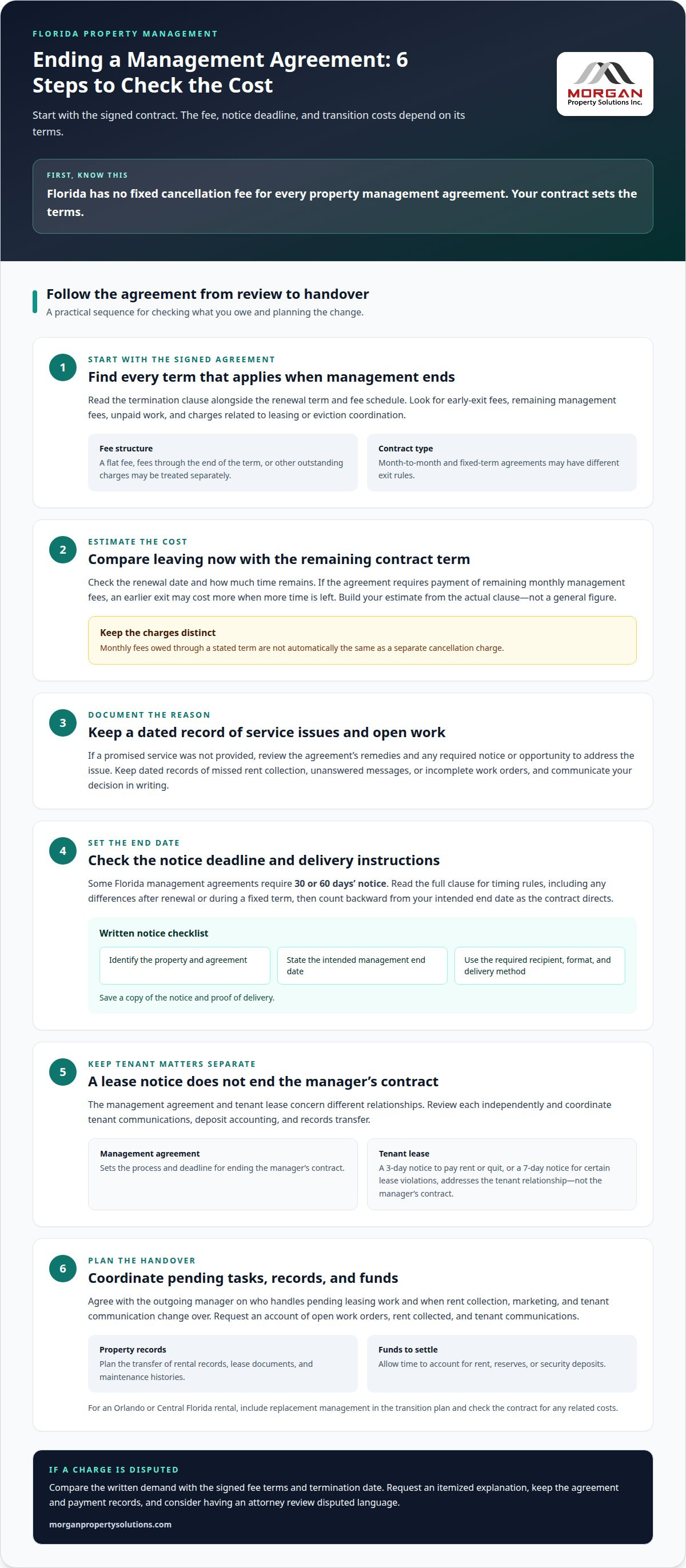
Could the biggest expense of ending your property management agreement come after the termination fee? The cost to break a property management agreement in Florida has no fixed cancellation fee; any charge depends on your contract. Some agreements also require 30 or 60 days’ notice, which can affect when you can switch managers and what you pay during the transition.
It’s understandable to want a clear number before making a change. The cost to break a property management agreement in Florida depends on the contract’s early-termination terms, the timing of your exit, unpaid fees, and the cost of arranging replacement management.
This guide explains how to review the fee and notice clauses, weigh the contract’s end date against leaving sooner, and plan for a change in management without overlooking transition costs. You’ll also see what to consider when lining up a new manager in Orlando or elsewhere in Central Florida.
Key Takeaways
- Read the termination clause for fees, notice deadlines, and any management charges that may continue through the end of the agreement.
- Send cancellation notice in the form and by the method your contract requires, and keep a copy for your records.
- Keep management-agreement notice periods separate from eviction notices; they apply to different relationships and situations.
- Compare the cost of leaving early with the remaining contract term before deciding when to end the management relationship.
- Plan for the transition to substitute management, including any contract terms that address related costs and the transfer of property records.
Reviewing termination terms in the management agreement
Start with the signed agreement. Identify its rules for termination, unpaid work, tenant records, and security deposits. These terms shape the steps to take before changing managers.
Florida does not set one cancellation fee for every property management agreement. Your cost depends on the contract type, termination clause, and time remaining. The agreement may charge a fee or require payment of management fees through the remaining term. During a manager change, rental records, lease documents, and maintenance histories must be handed over. The former manager may also need time to settle funds, including rent, reserves, or security deposits.
-
Inspect Early Termination Fee Terms
Find the termination clause and note whether it sets a flat fee, requires payment of remaining management fees, or applies only to early exits. Check whether unpaid work orders, completed maintenance, or other outstanding charges are treated separately.
-
Compare Costs by Contract Type and Remaining Term
Compare the agreement’s fee structure with its renewal date and remaining term. A month-to-month arrangement may have different exit rules from a fixed-term contract, which could require fees through its end date. If the contract charges remaining monthly management fees, leaving early may cost more when more time remains. Base your estimate on the actual clause, not a general figure.
- Document why you want to end management. If the company has not provided a promised service, review the agreement’s remedies and any required notice or opportunity to address the issue. Keep dated records of missed rent collection, unanswered messages, or incomplete work orders. Follow the contract’s termination process and communicate your decision in writing.
- Separate the management agreement from the tenant’s lease. A landlord’s action to end a tenant’s lease for a material breach concerns the rental relationship; it does not automatically cancel the manager’s contract. Review the lease and management agreement independently, then coordinate any tenant communication, deposit accounting, and records transfer. For an Orlando rental, Orlando property management is a relevant local service context.
Required notice period and written cancellation notice
Use the management agreement to find the notice deadline, required format, and delivery method. Keep this notice separate from any notice relating to a tenant’s lease.
-
Check the Required Notice Period
Locate the termination clause and identify the required notice period before choosing an end date. Some Florida management agreements require 30 or 60 days’ notice, while a fair early-termination clause generally allows 30 to 60 days. Read the full clause for any different timing after renewal or during a fixed term. Count backward from the intended end date using the contract’s stated method.
-
Prepare Written Cancellation Notice
Draft written notice identifying the property, agreement, and intended management end date. State that you are terminating under the relevant clause. Follow the delivery instructions exactly, then save a copy and proof of delivery. If the contract names a recipient or address, use those details rather than relying only on a conversation with the manager.
- Plan notice around active leasing work. If a tenant application or renewal is underway, explain how you want pending tasks handled before the end date. Request a written account of open work orders, rent collected, and tenant communications. An attorney can review the contract or draft a notice if the deadline or termination language is disputed.
- Keep management-agreement notice distinct from Florida eviction notices. A 3-day notice to pay rent or quit concerns a tenant’s nonpayment, while a 7-day notice may address a curable lease violation or an incurable one. Those tenant notices do not set the deadline for ending the manager’s contract. Confusing the two can disrupt rental operations, so label each notice by the relationship and purpose it addresses.
- Coordinate the transition date with the outgoing manager so rent collection, marketing, and tenant communication remain clear. Record who will handle each pending leasing task and where rental records should go. For practical landlord resources, use guidance that relates to the property-owner responsibilities involved in a management change.
Reviewing the cancellation policy in the management agreement
Before signing, read the cancellation clause alongside every fee schedule and renewal term. To dispute a termination charge, compare it with the signed contract, request an itemized explanation in writing, and document any discrepancy. An attorney can review disputed terms and help draft a letter.
-
Review Fee Clauses
Mark each clause that could apply when management ends, including early termination, renewal, unpaid work, and charges for leasing or eviction coordination. Check whether the contract explains how each charge is calculated and when it is due. Monthly fees owed through a stated term differ from a separate cancellation charge, so do not treat them as interchangeable.
-
Dispute an Excessive Termination Fee
Compare the manager’s written demand with the fee language and termination date in your contract. Request an itemized explanation that identifies the clause, calculation, and any unpaid work orders behind the charge. Keep the agreement, invoices, messages, and payment records together. If the amount still conflicts with the contract, an attorney can review the documents and draft a written dispute.
- Before signing, note why you might want to leave, such as a sale, a change in service, or a management issue. Find the clause covering that situation. Check whether termination requires notice, applies only after renewal, or changes what you owe during a fixed term. A clear written explanation is easier to assess than a broad label such as “early cancellation fee.”
- Read exceptions and exclusions in the same section as the headline policy. A satisfaction refund policy advertised for 60-90 days may include thresholds, notice requirements, or exclusions in the agreement. Confirm how those conditions interact with termination, rather than assuming the policy cancels every charge. Save the signed version and any written explanation of the terms.
- Ask an attorney to review the management contract if its fee formula is unclear, the manager’s demand conflicts with the clause, or the dispute involves a material breach. Share the signed agreement, cancellation notice, work-order history, and fee statement. An attorney can assess the wording and prepare a letter. A disagreement over the charge alone does not establish what the contract requires.
- Keep the cancellation fee separate from other account items. An unpaid repair work order, for example, may be a different charge from the fee for ending management. Ask that each amount be tied to a contract term or completed work. This helps identify duplicate charges or calculations that do not match the agreement.
Deciding whether to wait until the contract term ends
Compare the agreement’s early-exit terms with the management fees and services remaining through its end date. The right timing depends on the contract, the rental property, and the effect on income.
- Write down the contract end date, renewal terms, and every charge that applies to early termination. Compare these with the cost of continuing until expiration. If the agreement requires remaining monthly management fees, include them in your early-exit estimate rather than looking only at a separate cancellation charge.
- Assess what the landlord receives for each remaining month. Consider whether rent collection, maintenance coordination, tenant communication, or leasing work is still being completed. If a manager is reliably handling an active residential lease, staying until the term ends may preserve continuity. If important work remains unresolved, continuing may offer less value.
- Estimate transition needs before choosing an end date. A vacant property may need leasing support, while an occupied rental needs clear tenant communication and an orderly records handoff. Include any contract charges for outstanding work orders in your comparison, but do not assume those invoices are part of the termination fee.
- Consider how timing may affect rental income. If changing managers interrupts rent collection or delays marketing a vacant home, weigh that risk alongside the contract charges. An owner preparing to sell may want to coordinate termination with the sale process. An owner keeping the property may prioritize uninterrupted management.
- Use a side-by-side comparison before deciding. List the early-termination charge, remaining management fees, unpaid work, and transition tasks in one column. In the other, list the fees and services that continue until expiration. Consider the practical cost of maintaining a strained manager relationship, while separating documented contract charges from possible operational effects.
- Choose a date that fits both the contract and the property’s needs. If waiting avoids a fee but leaves a serious service problem unresolved, weigh that against an earlier change. If early termination creates a larger contractual cost, consider whether a written plan with the current manager can protect rental operations through the end date.
Damages for substitute property-management services
A new management company’s fees can add to transition expenses, but they are separate from charges under the old agreement. To assess a claim for damages, connect the amount requested to the contract, the alleged failure, and supporting records.
- Separate the former manager’s charges from the replacement company’s invoice. List an early-termination charge, an unpaid repair work order, and the new company’s management services as distinct items. This prevents the rental property’s overall transition cost from being treated as one amount automatically owed under the old contract.
- Read the old agreement for terms covering breach, remedies, early termination, and continuing fees. If the management company failed to provide a promised service, match that specific obligation with dated emails, account statements, or maintenance records. A documented service gap gives you a clearer basis for discussing the issue than general dissatisfaction.
- Build a timeline showing when the service problem occurred, when you notified the manager, and when replacement services began. Record a missed maintenance response, your written complaint, and the date a new manager arranged the repair. Keep invoices and work-order notes together so each expense can be tied to the rental property and its timing.
- Distinguish necessary replacement work from a change in service preferences. If the former company stopped handling an existing maintenance task, the replacement cost and work details may help explain the transition expense. If you chose a different management package or added services, keep those charges separate from amounts connected to the former company’s performance.
- Request an itemized accounting before agreeing that replacement-service expenses are damages. Compare each amount with the old contract, the new company’s invoice, and records showing the work performed. An attorney can assess whether the agreement and evidence support a claim or response, especially if the parties disagree about breach or the calculation.
- Keep the handoff focused on uninterrupted property operations. Give the incoming manager the lease, tenant contacts, open work orders, and relevant maintenance history, while recording which company handled each task. If you need a new management arrangement for a Central Florida rental, explore property management options that fit the property’s needs.
Morgan Property Solutions
Morgan Property Solutions Inc. can help you plan the property’s next step after you review your management agreement. The right direction depends on whether you plan to keep renting, find a tenant, buy another home, or sell.
If you’re keeping the property, Residential Property Management may suit your ongoing needs. An owner ending one management relationship, for example, may want professional management for an occupied rental. If the rental is vacant, Tenant Placement and Leasing can help with finding and leasing to a tenant. These services support property operations, not interpretation of disputed termination language.
If you decide to sell, Real Estate Seller Representation may be relevant as you prepare to list the property rather than continue renting it. If you’re buying another residential property, Real Estate Buyer Representation may fit that part of your plans. Consider which direction best matches your goals.
Before moving forward, organize the details that shape your decision: the agreement’s end date, any written cancellation notice, current occupancy, and open maintenance work. A landlord with an occupied rental may need to plan how management will continue during the handoff. An owner preparing to sell may focus instead on the sale timeline. These details can help clarify which real estate service fits your situation.
Keep legal and operational questions separate. An attorney can review the management contract or advise on a disputed termination charge. Morgan Property Solutions Inc. offers residential real estate services for your next property decision, including management, leasing, buying, and selling. Start with the outcome you want for the property, then choose the next step.
If you’re weighing your next step for a Central Florida rental or residential property, contact Morgan Property Solutions Inc. to discuss your real estate needs.
Choose the next step that fits your property
Your management agreement is one part of a larger decision about the property. Consider what you want the home to do next: support rental income, move toward a sale, or become part of a new purchase plan. That goal can help you prioritize as the management relationship ends.
The cost to break a property management agreement in Florida is easier to weigh alongside your plans for the property, rather than as an isolated charge. If you plan to keep renting, focus on continuity for tenants and property operations. If your plans have changed, coordinate the transition with your next real estate move. Morgan Property Solutions Inc. can help you consider your options without pressure to decide everything at once.
When you’re ready to talk through what comes next, contact Morgan Property Solutions Inc. A clear next step can make this transition feel more manageable.
Frequently Asked Questions
What does it cost to terminate a property management agreement in Florida?
The cost to break a property management agreement in Florida depends on its termination clause and remaining term. Separate any cancellation charge from earned management fees and unpaid work to get a clearer estimate. An open repair invoice, for example, may be a separate account item rather than part of the termination fee.
What termination fees are allowed by Florida property management contracts?
There is no single fixed cancellation fee for every Florida property management contract. The written agreement explains which charges may apply, such as an early-exit fee or fees tied to the remaining term. Review the signed contract and any referenced schedules together. If an invoice includes a charge that appears inconsistent with those terms, request an itemized explanation before paying or disputing it.
How much notice is required to cancel a Florida property management agreement?
The required notice period comes from the management agreement. Some Florida contracts require 30 or 60 days’ notice, but the applicable clause controls your cancellation date. For example, a notice sent by email may not meet the contract’s delivery instructions if it requires another method. Use the specified recipient and delivery process, then save a dated copy so you can track the notice period.
Can a Florida property manager charge fees after the owner terminates the agreement?
A manager may seek fees that the contract says remain due after notice, including charges for services already performed or amounts tied to the contract term. Termination does not automatically settle the property’s account. Request a final statement separating collected rent, management charges, open work orders, and funds held for the owner or tenant. Compare each item with the agreement and completed services.
Are early termination fees enforceable under Florida law?
Whether an early-termination fee is enforceable depends on the contract language and circumstances. The fee’s label alone does not answer that question. Review how the agreement describes the charge, when it applies, and how it is calculated. If the amount seems inconsistent with the signed terms, keep the contract and related statements. A Florida attorney can assess the documents and explain potential options.
What steps should a Florida landlord take to terminate a property management agreement?
Identify the agreement’s end date, termination clause, notice method, and any charges that may remain due. Then prepare written notice identifying the property and intended termination date, and deliver it as the contract requires. Keep proof of delivery. Before the handoff, request a status list covering tenant communications, rent activity, open maintenance, and property records so the next manager can continue operations.
Can a Florida property owner terminate a management agreement for breach or poor performance without a fee?
Not automatically. The management agreement may explain what counts as a failure to perform, what notice or opportunity to remedy it is required, and which remedies may apply. Document specific problems, such as an incomplete work order or missed reporting, with dated records. Compare those facts with the contract before ending the relationship. An attorney can help assess whether the agreement provides grounds to dispute a fee.

Article by
Oliver Overton-Morgan
Oliver Overton-Morgan is a full-time Real Estate Broker since 2003, with years of experience helping thousands of people purchase and sell real estate throughout Central Florida. He holds a Graduate Realtor Institute designation, LCAM, and has held licenses in good standing as a Florida Mortgage Broker and a Notary Public. Oliver immigrated to central Florida in 2001, and within 5 years Oliver built a successful Real Estate brokerage in central Florida, where he recruited over 75 Sales Associates with 25+ million in sales production.