The lowest management fee isn’t always the best fit. Questions to ask before switching property managers should cover the full service, not just the monthly charge: what’s included, how the agreement ends, and how the manager handles residents and daily operations.
It makes sense to want clear terms and dependable care before handing over your property. A focused conversation can help you assess whether a prospective manager’s experience fits your rental and what to expect during the transition.
Use this checklist to discuss fees, agreement terms, property experience, resident communication, maintenance, and the transition plan. You’ll have a clearer basis for choosing a manager whose approach suits your priorities.
Key Takeaways
- Compare the full fee plan, including what each management charge covers and which services may cost extra.
- Understand the contract’s renewal, cancellation, and notice terms before you begin a management change.
- Look for experience with properties and owner priorities similar to yours, not just general industry experience.
- Ask how resident updates and maintenance requests are handled so service can continue through the transition.
- Clarify who will manage each handoff task and how unresolved items will be tracked.
Communicating with residents and maintaining services
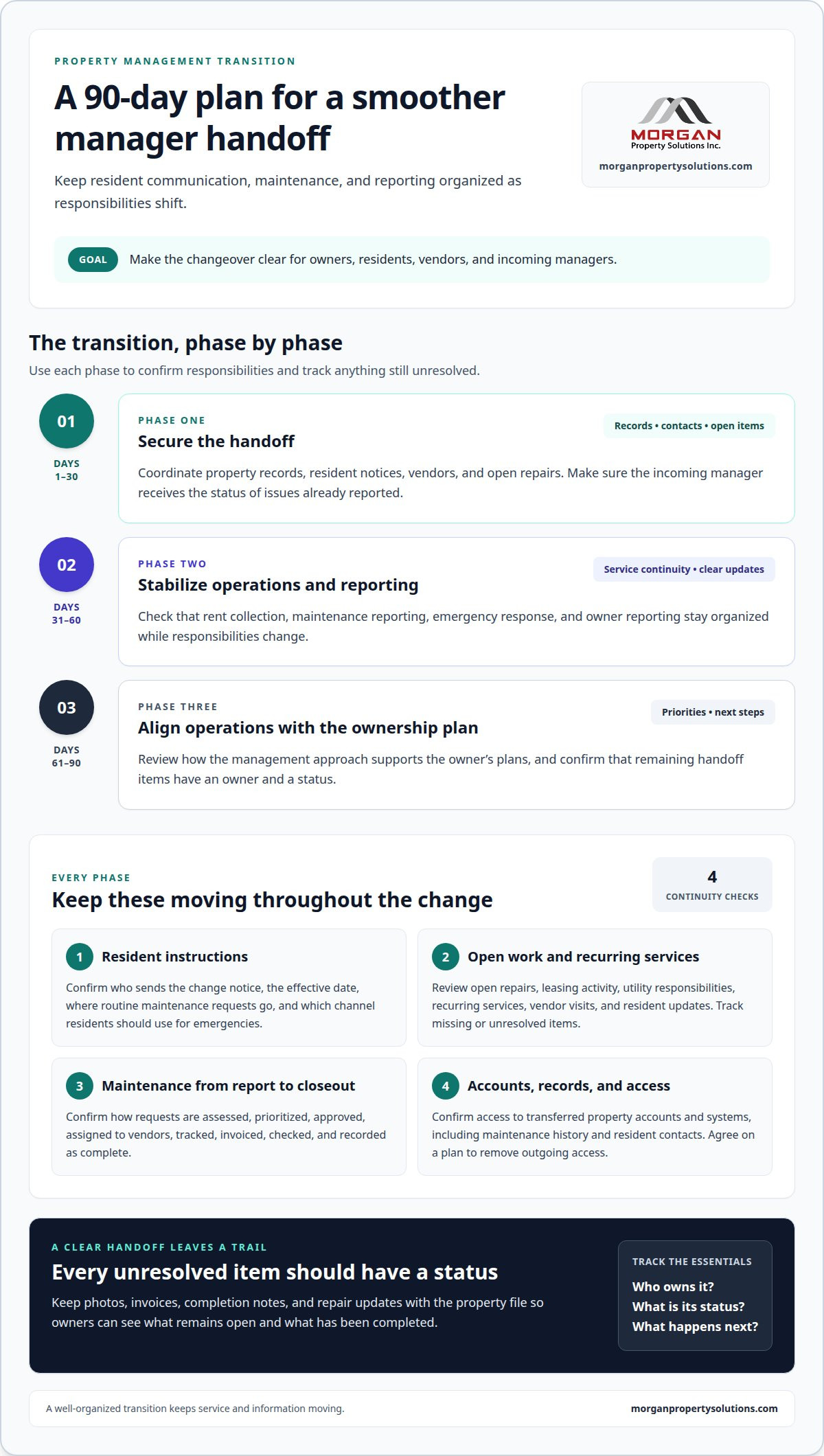
A well-organized transition coordinates records, resident notices, vendors, and open repairs. The handoff should keep rent collection, maintenance reporting, and emergency response organized while responsibilities shift between managers.
Start with the resident communication plan. Ask who will send the change notice, which contact details residents should use, and how urgent requests will be handled. The notice should identify the effective date, explain where residents submit routine maintenance requests, and specify the channel for emergencies. If a resident has already reported a leak, for example, the incoming manager needs the report and its status before residents receive new instructions.
Maintenance should follow a documented process from the first report to completion. Ask how the manager assesses each request, determines urgency, obtains approval, assigns a vendor, tracks the repair, reviews the invoice, checks the work, and records completion. This sequence helps owners see whether a repair remains open, whether a vendor has been dispatched, and how the issue may affect the property and residents.
- Approval policy: Ask which repairs need owner approval and how exceptions are handled.
- Vendor selection: Clarify how vendors are assigned and how service quality is reviewed.
- Repair charges: Ask whether invoices show labor, materials, and any separate management charge.
- Work records: Confirm that photos, invoices, and completion notes stay with the property file.
- Emergency coverage: Identify the contact path for urgent issues during the handoff.
These questions also clarify maintenance costs beyond the headline management fee. Repair charges can depend on the work, materials, labor, and urgency. Ask how vendor markups or maintenance fees appear in owner statements and whether the agreement explains them. A clear invoice trail helps distinguish the vendor’s charge from any separate management charge.
Technology matters when accounts and records change hands. Confirm that incoming users can access transferred property accounts and systems, including maintenance histories and resident contact records. Agree on a plan to remove outgoing access. This can prevent confusion when residents use an existing portal or a vendor needs details of earlier repairs.
Use a phased transition plan to maintain service: the first 30 days secure the handoff, days 31 to 60 stabilize operations and reporting, and days 61 to 90 align operations with the ownership plan. Confirm recurring services, open work, leasing activity, utility responsibilities, and resident updates during each phase. Track missing or unresolved items so repairs, turnover tasks, and vendor visits don’t disappear between managers.
What questions should I ask a property manager before hiring?
Ask questions that reflect your property, reporting needs, and ownership plans. The manager’s answers should explain who handles each task, what information owners receive, and how decisions move from request to completion.
Licensing and insurance requirements depend on the manager’s duties and location. For an Orlando rental, ask which Florida license applies to the work, who holds it, and what insurance coverage protects the management operation and property.
Tailor the conversation to your property. For a single-family rental, ask how the management company handles leasing, resident updates, and work orders. For a property with several units, ask how it tracks separate leases, deposits, repairs, and shared services. If you may sell the property or change how it is used, discuss how management decisions can support that timing.
Financial reporting deserves specific answers. Property managers should provide owners with monthly statements, and bank accounts should be reconciled monthly, with someone other than the preparer reviewing them. Ask what each report includes, when it arrives, and how the manager explains a charge that looks different from the prior month.
- Report contents: Ask whether statements show rent collected, expenses, deposits, unpaid balances, and property-level notes.
- Payment schedule: Ask what steps occur between rent collection, expense payment, and owner disbursement.
- Financial review: Ask who reviews reconciliations and how discrepancies are resolved.
- Owner access: Clarify how owners view statements, receipts, work orders, and account updates.
- Communication: Agree on the best channel for routine questions and decisions needing your approval.
A sample owner report can make the answers easier to assess. Check whether it separates income from expenses and links repair charges to specific invoices or work orders. A completed work order can also show what the manager records, such as the reported issue, assigned vendor, work completed, and closeout notes.
Ask how often the manager provides updates beyond the owner statement. An owner planning a renovation, for example, may need timely updates on access, vendor scheduling, and invoices. An owner focused on rental income may prioritize clear explanations of vacancies, expenses, and payment timing. The reporting rhythm should fit the decisions you expect to make.
Before choosing a management company, send two or three practical questions in advance, such as a request for a sample report and fee schedule. Then use the meeting to discuss your property’s specific needs. Owners considering Orlando property management can use these reporting questions to understand how professional oversight may fit their priorities.
Comparing managers’ experience with similar properties
A management agreement can cover leasing, rent collection, resident communication, maintenance coordination, and owner reporting. The written scope should show which services are included, which involve separate charges, and who handles each task.
Experience matters most when it matches your rental property. Ask about examples involving similar features, such as a single-family home, condominium, or small multifamily building. Then ask what the manager handled, what challenges arose, and how the work was documented. Specific examples reveal more than a general claim of “extensive experience.”
Use the same prompts for each management company. Ask how it handles tenant placement, leasing, renewals, resident concerns, and owner updates. A useful answer names the process and records involved. For example, a manager discussing leasing should explain how listing activity, inquiries, tours, applications, and lease status are tracked.
- Property fit: Ask which comparable properties the manager currently oversees and what makes them similar.
- Actual responsibilities: Request a clear example of a challenge handled from first report through resolution.
- Response process: Ask who responds to residents and owners, and how unresolved issues are escalated.
- Service boundaries: Match each promised service to a specific contract term or reporting item.
For rental pricing, ask how the manager evaluates comparable properties and adjusts recommendations. A sound review considers local listings, property condition, lease terms, and current leasing activity. The manager should explain how lead volume, tours, comparable rentals, and days on market inform pricing decisions. Vacant-unit rents should be reviewed weekly or more often, using those signals to assess whether the asking rent fits current demand.
Look for answers that connect evidence to action. “We know the market” offers little detail; an explanation of comparable rentals and the next pricing review gives you something concrete to assess. Ask how the manager will report actual leasing activity and what might prompt a change in strategy.
Compare total cost alongside the service, not as a fee alone. Use each written fee plan to identify included work, separate charges, leasing services, and any costs tied to turnover. Then weigh those items against the support your property needs. A lower stated management fee may not mean a lower total cost if key services are billed separately.
Finally, request references from owners who have worked with the manager for more than two years, plus an owner who experienced a difficult period. Ask how the manager communicated during that period and whether the agreed services matched actual performance. Their specific examples can help you judge whether the manager’s experience fits your property and priorities.
Management fees and contract disclosures
Compare written fee plans alongside each management agreement. A useful plan separates the recurring management charge from leasing work, inspections, maintenance coordination, and other billable services. Ask which tasks are included, which incur separate charges, and how each charge appears in owner statements. This makes it easier to compare companies by service scope, not just headline fee. Include questions about what each charge covers and how exclusions are documented.
How much notice is required to terminate a property management agreement? Contracts often set cancellation notice periods of 30 to 60 days. The signed agreement determines the applicable deadline, delivery method, renewal terms, and any cancellation charges.
Read your current agreement before giving notice. Identify its start and end dates, automatic renewal language, termination procedure, and handoff responsibilities. Check whether fees apply if a tenant buys the property or you sell it. If you plan a real estate sale, clarify how any such term interacts with the listing process and management relationship.
- Fee schedule: Request a written plan showing management fees, exclusions, and charges for separate services.
- Renewal terms: Note whether the agreement renews automatically and what action stops renewal.
- Exit obligations: Identify required notice, outstanding charges, open work orders, and file-transfer duties.
- Inspection scope: Clarify whether inspections are included, how findings are recorded, and how follow-up work is handled.
- Sale or purchase terms: Look for provisions addressing a tenant purchase or owner sale.
Ask how tenant security deposits, rent, and property records will transfer to the new manager. The transition should reconcile each balance and match deposits, rent receipts, owner funds, and ledgers to supporting records. Assign responsibility for transferring leases, resident details, inspection reports, keys, open work orders, vendor information, and current leasing activity.
Ask for a transition accounting that shows the balance carried forward for each property. For example, you should be able to connect a deposit ledger entry with the corresponding lease and account record. The rent roll should also match occupancy and lease terms, giving the incoming manager an accurate starting picture.
Before notice goes out, confirm the successor manager and agree on the transfer sequence. Set dates for account access, record delivery, resident updates, and responsibility for pending payments. Keep a written list of missing or unresolved items, such as an unmatched deposit or incomplete repair invoice. These practical questions are especially important when the handoff involves several open tasks.
Finally, compare the exit terms with the incoming agreement. Confirm the new start date, which services begin immediately, and how the first owner statement will reflect transferred balances. Clear dates and reconciled records help prevent confusion over rent, deposits, or continuing contracts.
Property manager experience and time in business
Time in business offers useful context, but it doesn’t show how a manager handles your property. A manager with a long history may lack experience with your property type, while a newer firm may bring relevant hands-on expertise. One market recommendation is to look for a manager with at least 10 years in business. Treat that as a starting point, then ask for examples that connect experience to your rental’s needs.
During the interview, distinguish the company’s history from the assigned manager’s background. Ask who will oversee your account, how long they’ve managed rentals, and which decisions they handle directly. If the property has frequent turnover, ask how the manager organizes leasing activity and tracks open tasks between residents. A clear answer names the person responsible and describes their process.
Ask for a practical example, not just a list of property types. For instance, ask how the manager handled a vacancy, difficult repair, or resident concern at a similar rental. Then ask what happened, how the owner was updated, and what records documented the result. Specific details help you assess whether that experience applies to your situation.
Use the same interview prompts with each candidate, then compare the substance of their answers:
- Role clarity: Who will manage the property, and who steps in when that person is unavailable?
- Relevant experience: Which property types and operating challenges match your rental?
- Process: How does the manager track leasing, resident requests, and outstanding decisions?
- Planning: What would the first 90 days focus on, and how would progress be reported?
The first 90 days can reveal whether an experienced manager has a structured approach. Ask what they would review first, such as current leases, property condition, resident concerns, or operating records. Then ask how they would prioritize those findings and share recommendations. A useful plan connects each review to an action, an owner decision, or a follow-up update.
For a rental in Orlando, ask how the manager’s experience applies to local properties and responsibilities. You can also ask which licenses or professional credentials relate to the work and who on the team holds them. A direct answer helps distinguish relevant qualifications from a general claim of experience.
Finally, ask how the manager would organize a smooth termination and handoff if the relationship ends. A clear answer explains how records, resident matters, and open responsibilities are prepared for transfer. Choose based on relevant experience, clear accountability, and an understandable plan, not tenure alone.
Ready to discuss your property’s management needs? Talk with a property management team about the experience and support that fit your rental.
Morgan Property Solutions: Orlando Property Manager
Morgan Property Solutions Inc. provides residential property management for owners who want professional support with day-to-day rental operations. If you’re considering a management change, the questions here can help clarify your priorities, from resident communication to fee terms and transition planning.
Morgan Property Solutions Inc. says it assists clients in managing residential properties. Its real estate services also include buyer and seller representation, useful when your plans involve purchasing or selling a home.
If you’re ready to discuss management for your property, contact Morgan Property Solutions Inc.
Make Your Next Management Decision With Confidence
A management change can help align daily property decisions with your longer-term plans. Before moving forward, decide what a successful working relationship looks like: clear owner updates, dependable follow-through, and an approach that fits how you want your property handled.
Questions to ask before switching property managers can turn those priorities into a practical decision. Guide the conversation with what matters to you, then look for a manager whose communication and working style help you stay informed without adding complexity to your role as an owner.
You don’t need to have every detail settled before starting that conversation. A straightforward discussion about your property and goals can help you understand whether the next step feels right. For support with residential property management in Orlando, contact Morgan Property Solutions to talk through your needs.
Choose the path that gives you clarity and room to focus on what matters next. A thoughtful transition starts with a conversation, and you can take that step when you’re ready.
Frequently Asked Questions
Can I cancel a property management contract if I’m unhappy?
Yes, if the agreement allows termination under the circumstances and process it describes. Read the cancellation clause before acting, including notice requirements, renewal dates, delivery method, and any remaining charges. For example, an agreement may require written notice to a named contact rather than a phone call. Keep a copy of your notice and delivery record, and coordinate the effective date with the incoming manager.
Do you charge for an additional fee for maintenance?
Maintenance charges depend on the agreement and the work performed. Check whether the management fee includes coordination or whether a separate management charge, vendor markup, or repair cost may apply. A clear invoice distinguishes the vendor’s bill from any management charge. Ask how a plumbing repair invoice would appear in your owner statement, including any coordination charge and supporting documentation.
Do you have a policy about landlords contacting the tenants?
Owner-resident communication should follow an agreed contact plan, with a clear point person for routine matters and urgent concerns. Ask which topics the manager handles directly and when you should contact a resident. A question about a lease term, for example, may need a different path from an update about a planned property improvement. Set expectations in writing to avoid conflicting instructions or duplicate responses.
Do you provide a copy of the lease to the owner, and if so, when?
Owners should receive and retain the fully signed lease and any later amendments. Ask how final documents are delivered, where they remain available, and whether renewal paperwork is added to the same file. If a renewal changes the rent or lease dates, for example, your records should include both the original lease and signed renewal. This helps keep management, accounting, and future sale records consistent.
How much do property managers charge, and what fees should owners compare?
There is no single fee for every management agreement. Compare the full written fee plan, including recurring management charges, tenant placement, lease renewals, inspections, maintenance coordination, and termination-related charges. Note which services are excluded, too. One proposal may include a task that another bills separately. Comparing the complete scope and charges helps you assess expected costs against the services your property needs.
What are the contract term, renewal, and cancellation rules for property management agreements?
The signed agreement sets the term, renewal process, and cancellation procedure. Look for the initial term, whether renewal happens automatically, how notice must be delivered, and when termination takes effect. Check for charges tied to early cancellation, a tenant’s purchase, or an owner’s sale. For example, mark the renewal date and required notice method on your calendar so the agreement’s timeline doesn’t catch you by surprise.
Who handles maintenance, emergencies, vendor selection, and repair approvals?
The agreement should identify who receives maintenance requests, selects vendors, approves repairs, and communicates updates. Ask how urgent issues are routed and what happens if you cannot be reached. A routine appliance issue may follow a different approval path from a problem that threatens the property. Clarify how vendor invoices and completed work are documented, so responsibilities and costs remain clear.
How does the manager screen tenants, collect rent, and handle late payments or evictions?
Ask the manager to explain its screening criteria, application review, rent collection process, and communication steps for overdue payments. Clarify what updates you receive and how decisions are recorded. Ask how the manager documents an incomplete application or missed payment, and what follows under the management agreement. Also clarify which responsibilities remain yours if a tenant matter escalates toward eviction.

Article by
Oliver Overton-Morgan
Oliver Overton-Morgan is a full-time Real Estate Broker since 2003, with years of experience helping thousands of people purchase and sell real estate throughout Central Florida. He holds a Graduate Realtor Institute designation, LCAM, and has held licenses in good standing as a Florida Mortgage Broker and a Notary Public. Oliver immigrated to central Florida in 2001, and within 5 years Oliver built a successful Real Estate brokerage in central Florida, where he recruited over 75 Sales Associates with 25+ million in sales production.