
Can you sell a deceased parent’s Winter Park home without going through full probate? Sometimes, but the answer depends on how the property is owned and who has legal authority to sign. In Florida, summary administration may be available for an estate valued under $75,000 or when the person who died has been deceased for more than two years. That makes selling a parent’s home in Winter Park from out of state a process to begin with the estate’s legal status, not just the property’s listing.
When you’re managing a home and coordinating with family from another state, a clear plan helps. This guide explains what affects probate, who may authorize a sale, and how to coordinate the property, disclosures, paperwork, and closing remotely. You’ll also learn how local real estate support can help with pricing, preparation, and showings, so you can understand the steps without making every decision in person.
Key Takeaways
- Confirm how the home is titled and who has legal authority to approve the sale before moving ahead.
- Understand which disclosures and tax considerations may apply to an inherited property.
- Coordinate local property preparation, pricing, and showings without managing every detail in person.
- Plan for remote document signing and closing, while keeping estate paperwork organized.
- Agree on one main point of contact among heirs to keep decisions and communication moving.
What Disclosures Are Required When Selling Inherited Property Remotely?
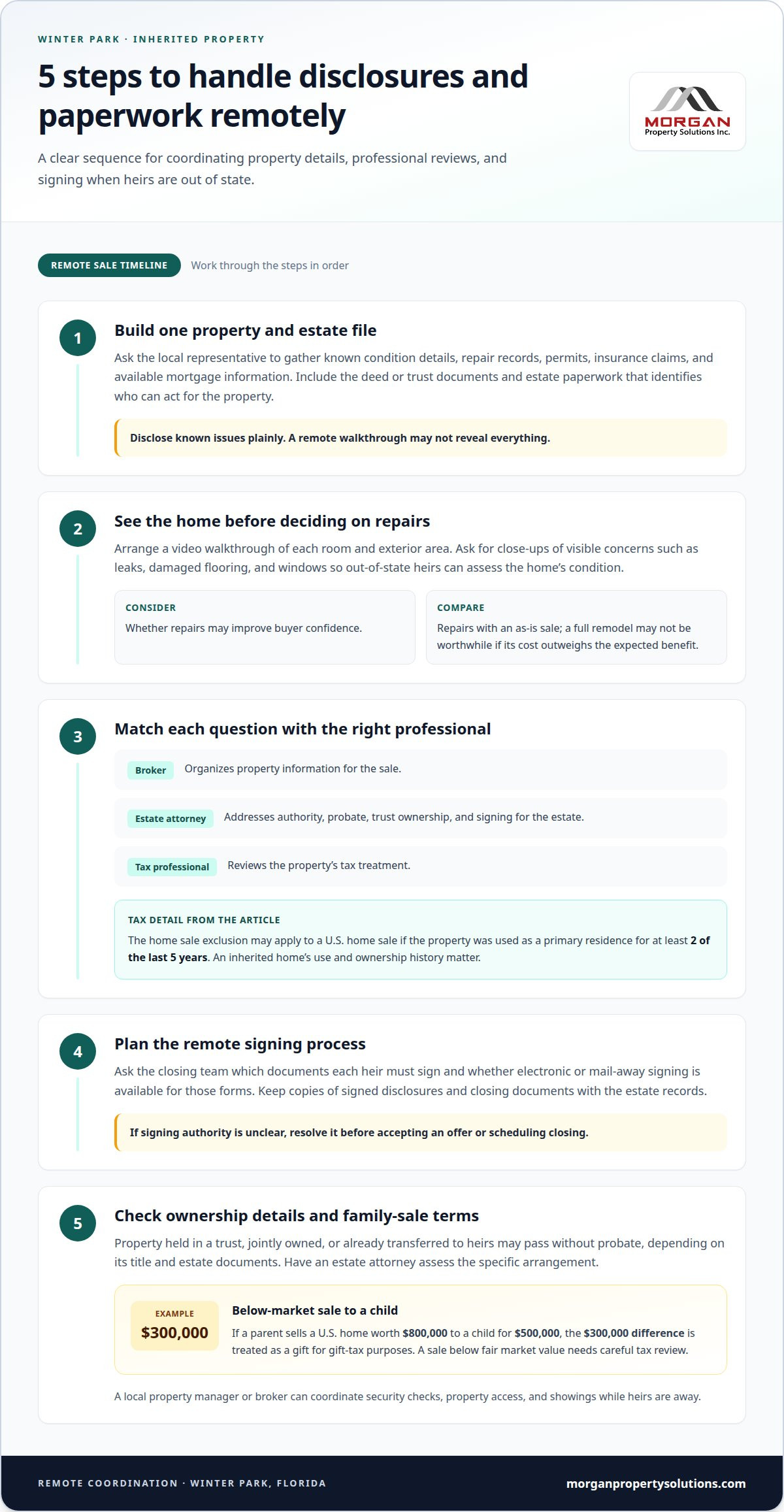
- Build a clear property and estate file. Ask the local representative to organize known condition details, repair records, permits, insurance claims, and available mortgage information. Include the deed or trust documents and estate paperwork identifying who can act for the property. These records help the people preparing sale documents describe the home accurately and address prospective buyers’ questions. Disclose known issues plainly rather than relying on a remote walkthrough to reveal everything.
- Arrange a video walkthrough before deciding on repairs. A local real estate professional can show each room, exterior area, and visible concern by video, giving out-of-state heirs a practical view of the home. Ask for close-ups of leaks, damaged flooring, windows, and other apparent problems. Then consider whether repairs may improve buyer confidence or whether an as-is sale better suits the home’s condition. A full remodel may not be worthwhile if the cost outweighs the expected benefit.
- Coordinate disclosures and documents with the right professionals. Have the broker organize property information for the sale, while an estate attorney addresses questions about authority, probate, trust ownership, or signing for the estate. A tax professional can review the property’s tax treatment. According to the Internal Revenue Service, the home sale exclusion may apply to a U.S. home sale if the property was used as a primary residence for at least 2 of the last 5 years. An inherited home’s use and ownership history matter.
- Use secure remote signing for sale paperwork. Ask the closing team which documents each heir must sign and whether electronic or mail-away signing is available for those forms. Remote signing can help heirs review and return documents without traveling to Winter Park. Keep copies of signed disclosures and closing documents with the estate records. If signing authority is unclear, resolve that issue before accepting an offer or scheduling closing.
- Review special ownership and family-sale situations. Property held in a trust, jointly owned, or already transferred to heirs may pass without probate, depending on its title and estate documents. An estate attorney can assess the specific ownership arrangement. A sale to a child below fair market value also needs careful tax review. For example, if a parent sells a U.S. home worth $800,000 to a child for $500,000, the $300,000 difference is treated as a gift for gift-tax purposes. A local property manager or broker can also coordinate security checks, property access, and showings while heirs are away.
Can I Sell My Deceased Parent’s House Without Probate?
Sometimes, but the answer depends on ownership and who has legal authority to sell. If your parent is living or receives Medicaid, acting without their authority or selling without understanding the potential effect on their situation could create risks. Discuss ownership, authority, and benefit questions with an estate attorney before listing.
-
Confirm Legal Authority to Sell
Start by identifying how the Winter Park property is titled. Review the deed and any trust documents to determine whether ownership is individual, joint, or held in a trust. Those details affect who can sign listing documents, accept an offer, and complete closing. Don’t assume that being an heir gives you authority to sell real estate.
-
Establish Authority to Sign
Ask an estate attorney which documents authorize someone to act for the estate. A power of attorney, court appointment, or trust document may establish authority, but the right process depends on your parent’s situation and when that authority applies. Before signing for someone else, confirm that the document covers the specific sale and transaction.
- Determine whether probate is needed. In Florida, a probate court must appoint a Personal Representative to lead the sale of a deceased parent’s home when probate authority is required. Some property may pass through a trust, joint ownership, or a transfer to heirs, rather than through probate. Florida summary administration may be available if the decedent has been dead more than 2 years. It may also be available for estates under $75,000. An estate attorney can review title and estate documents to identify the applicable route.
- Confirm who can make each decision. If several heirs are involved, establish who has legal authority to communicate with the real estate professional and sign documents. An executor’s or administrator’s role depends on the court appointment and the authority granted. Family agreement alone doesn’t prove that one person can bind the estate. Keep the appointment paperwork available for the listing and closing process.
- Resolve authority before marketing the home. A buyer’s offer cannot resolve a gap in the seller’s legal authority. Confirm who is authorized to list, accept an offer, and sign closing documents before showings begin. If the home is jointly owned, held in a trust, or part of probate, share the relevant documents with the estate attorney and real estate professional. Clear authority helps prevent avoidable delays after an offer arrives.
Coordinating a sale from out of the area
Federal tax on a parent’s home sale depends on ownership, use, basis, and sale price. According to the Internal Revenue Service, the home sale exclusion may apply if the property was used as a primary residence for at least 2 of the last 5 years. An estate attorney or tax professional can review the family’s specific records.
- Put one local person in charge of property coordination. Choose a representative who can access the Winter Park home, meet cleaners or contractors, and report what’s been completed. A local real estate professional can arrange a video walkthrough, discuss pricing, and coordinate showings with the out-of-state owner. Keep instructions in one shared record, including access details, repair priorities, and how to send updates. This gives heirs a consistent view of decisions without requiring everyone to travel.
- Prepare the home before fall listing activity. Use fall to sort belongings, tidy rooms, and identify visible maintenance concerns before photographs and showings. Ask the local representative to document the home’s condition and recommend repairs that may affect safety, financing, or buyer confidence. Compare the likely benefit of each repair with the sale plan before authorizing work. For example, address a visible leak before focusing on cosmetic updates that may not influence a buyer’s decision.
- Keep tax records together before agreeing on a sale price. Gather available purchase records, improvement receipts, estate documents, and a valuation related to the transfer. These details can help a tax professional assess basis and potential capital gains. A home sale exclusion may depend on ownership and use requirements, so don’t assume an inherited home automatically qualifies. The federal tax outcome depends on the property’s facts, including its basis and the difference between that basis and the sale proceeds.
- Review a below-market sale to a child as both a sale and a gift. If a parent sells a U.S. home worth $800,000 to a child for $500,000, the $300,000 difference is treated as a gift for gift-tax purposes. In that example, the child’s starting tax basis is $650,000. A tax professional can assess the parent’s potential capital gains and the child’s basis using the actual value, sale terms, and ownership records. Don’t treat the reduced price as an ordinary sale without reviewing its tax treatment.
- Keep the sale, transfer, and family decisions documented. Before the property is transferred or listed, record the agreed price, who can approve changes, and how the sale proceeds will be handled. If someone lives in the home, include access and move-out coordination in the schedule. A local real estate professional can relay showing feedback and repair updates to heirs in different states. Clear written decisions help prevent conflicting instructions from slowing the transaction.
Remote disclosures, documents, and closing
Use a clear document process to keep each heir informed and reduce the risk of losing track of signed forms. For a Winter Park sale, organize probate authority, property disclosures, and closing updates in one shared file.
- Set up a single document file. Create a secure folder for the deed, estate or trust records, property disclosures, offer documents, and closing papers. Give each heir access to the same current versions. Keep a separate list showing which documents are signed, pending, or need correction. For example, mark a disclosure complete only after the authorized seller has signed and returned it. This simple process helps prevent outdated versions from circulating among relatives.
- Coordinate disclosures with the person who knows the property. Have the local representative collect information about visible condition, known repairs, and property features for the sale paperwork. Heirs can add details from their records, such as a past roof repair or known plumbing issue. Keep answers consistent across disclosure forms and buyer communications. If an answer is unclear, ask the estate attorney or real estate professional how to handle it rather than guessing.
- Confirm probate authority and any court conditions before closing. In a probate sale, the Personal Representative’s court appointment and authority determine who can sign for the estate. Ask the estate attorney to review the appointment documents and determine whether the case requires court permission or other approval before closing. Probate sales don’t all follow the same process. Share any court order or written approval with the closing team so the required documents can be prepared accurately.
- Choose a remote signing method for each document. Ask the closing team which forms can be signed electronically and which require another process. Remote and mail-away closings are commonly used for out-of-state sales, so sellers generally don’t need to travel back to Winter Park. An out-of-state heir may be able to use a power of attorney or remote notarization where available. Confirm that the signing method suits the document and the signer’s authority.
- Track final signatures, proceeds, and updates. Before closing, compare the final settlement documents with the agreed sale terms and confirm that each authorized party has completed the required signatures. Ask the closing team how proceeds will be disbursed to the estate or other entitled owners. Keep final records with the estate’s assets and share closing updates with every heir. A dated checklist of outstanding documents makes it clear what remains before the transaction is complete.
Coordination among heirs in different states
Give each heir a clear role before decisions about the Winter Park home start moving. In the State of Inherited Property Report 2026, 42% of respondents managed a property in a different state from where they lived.
- Name one main point of contact. Choose one heir to receive updates and share decisions with the rest of the family. This person can collect questions about the home, summarize responses, and keep information moving between relatives. For example, if one sibling lives near Winter Park and another lives across the country, route contractor updates through the designated contact. Coordinating communication doesn’t give that person legal authority.
- Write down how the family will make decisions. Agree on how heirs will discuss the asking price, proposed repairs, showing feedback, and offers. Keep a dated decision log with each topic, the options considered, and the family’s agreed response. If siblings have different views, record what remains unresolved rather than treating silence as approval. A written process gives the homeowner or authorized representative a useful reference when a time-sensitive decision comes up.
- Separate family preferences from legal authority. An heir may help organize belongings or share information without having authority to sign for the estate. Keep the court appointment, trust paperwork, or other ownership documents available to the attorney and real estate professional. Before someone accepts an offer or signs a sale document, confirm their authority. This distinction helps avoid confusing family agreement with the legal right to act.
- Use one consistent channel for property updates. Set up a shared email thread or document where the local representative can post showing feedback, access issues, and completed work. Include the date and next action with each update. If a contractor reports a repair, for example, note whether the work is scheduled, finished, or awaiting a family decision. A clear record helps heirs in different time zones stay informed without relying on scattered messages.
- Plan for disagreement before an offer arrives. Ask the estate attorney how the existing ownership documents affect decision-making if heirs disagree. Set a process for reviewing an offer, identifying questions, and sending one response through the authorized representative. Keep family discussions focused on concrete terms, such as price, requested repairs, and timing. If heirs can’t reach agreement, avoid sending conflicting instructions to the real estate professional.
- Keep shared responsibilities realistic. Assign specific tasks, such as locating records, identifying belongings to keep, or approving property access. A local real estate professional can coordinate listing activity and relay information to the family, while heirs provide decisions and relevant details. For help organizing a Winter Park sale, discuss seller representation with the team.
Morgan Property Solutions: Winter Park Property Management
Morgan Property Solutions Inc. provides real estate seller representation for families selling a parent’s home in Winter Park from out of state. The team can help coordinate the sale, including pricing, property preparation, and showings, while you and your family handle estate decisions with the appropriate legal and tax professionals.
If the home needs ongoing oversight before the sale, Winter Park Property Management can help address property management needs during that transition. This support may be useful when heirs can’t be present locally to manage the home themselves. For help with a Winter Park sale or property management, contact Morgan Property Solutions Inc..
Choose the Next Step for the Property
Once the sale plan is clear, consider what the property needs after the transaction. Your family may need time to settle remaining estate matters, coordinate the distribution of belongings, or decide how sale proceeds fit into broader plans. Keeping these decisions separate from the immediate sale can make conversations with relatives more focused.
For families selling a parent’s home in Winter Park from out of state, a useful next step is to identify who will lead the remaining decisions and what information they need. A brief handoff note can capture open questions, family preferences, and the right contact for each issue. That gives everyone a practical starting point as responsibilities shift.
If you’re ready to discuss the property’s next step, contact Morgan Property Solutions Inc. A thoughtful plan can help your family move forward with greater clarity and confidence.
Frequently Asked Questions
Can You Close on an Inherited Property Sale Without Being There?
Yes, an out-of-state seller may be able to close without traveling to Winter Park. The closing team can arrange electronic documents or mail-away signing when those options suit the paperwork. For example, heirs can review and return their assigned forms from their home states. Ask the closing team which signatures need notarization and how to return completed documents.
Can you sell inherited property if you live out of state?
Yes, living outside Florida doesn’t by itself prevent you from selling inherited property. The key issue is whether you or another person has authority to act for the property’s owner or estate. A local real estate professional can coordinate access, photos, and buyer activity while you make decisions remotely. Keep communication organized so you can review updates and respond to offer terms.
Struggling with Selling Your Parents’ Florida Home?
A local real estate professional can coordinate the sale while you remain out of state. Start by identifying who can make property decisions and which family member will receive updates. For example, one heir can gather questions while the authorized seller reviews pricing and offers. An estate attorney can address probate or authority questions, leaving property marketing and sale coordination to the real estate professional.
Why Is a Date-of-Death Appraisal Important for Inherited Property?
A date-of-death appraisal can document the home’s fair market value when ownership passed to heirs. That value may help establish the inherited property’s tax basis, which a tax professional can use when evaluating a later sale. Keep the appraisal with estate records and sale documents. For example, an heir can give the appraiser’s report to a CPA reviewing the property’s tax history and proceeds.
What legal authority is needed to sell a parent’s home in Winter Park, Florida?
The person signing must have authority tied to the property’s ownership or estate. Depending on the records, that may be a court-appointed Personal Representative, a trustee, or an owner named on the title. Being an heir doesn’t by itself establish signing authority. Have an estate attorney review the deed, trust records, and any court appointment before the authorized person signs a listing or sale document.
How can a real estate professional help sell a parent’s home in Florida using power of attorney?
A real estate professional can coordinate the sale with the person named in a power of attorney, including property access, marketing, showings, and offer communications. The professional doesn’t create or validate that legal authority. An estate attorney can review whether the document applies to the proposed transaction. For instance, the agent can send offer details to the authorized signer while the attorney addresses questions about the document.
What documents are required to sell inherited or parent-owned property in Florida?
Documents vary depending on ownership and the estate, but the sale file commonly includes the deed, trust or probate records, and proof of the signer’s authority. The closing team may also need mortgage information, property disclosures, tax records, and details about known repairs. For an inherited home, keep court appointment papers or relevant trust documents together. The closing team can identify transaction forms as the sale progresses.
How does Florida probate affect selling a parent’s home in Winter Park?
Probate can determine who has authority to manage and sell a home titled in a deceased parent’s name. A Florida probate court appoints a Personal Representative when probate authority is required. Florida full probate typically takes 6-12 months, while summary administration can close in 1-3 months. The applicable process depends on the estate and property records, so confirm the sale path before setting expectations with buyers.

Article by
Oliver Overton-Morgan
Oliver Overton-Morgan is a full-time Real Estate Broker since 2003, with years of experience helping thousands of people purchase and sell real estate throughout Central Florida. He holds a Graduate Realtor Institute designation, LCAM, and has held licenses in good standing as a Florida Mortgage Broker and a Notary Public. Oliver immigrated to central Florida in 2001, and within 5 years Oliver built a successful Real Estate brokerage in central Florida, where he recruited over 75 Sales Associates with 25+ million in sales production.