
A part-time manager can lighten your workload without taking the legal and financial risks off your shoulders. The risks of hiring a solo part-time property manager often come down to limited availability, gaps in repair coordination, and unclear responsibility when a decision needs attention. In Florida, landlords must provide at least 24 hours’ notice before entering a tenant’s unit, according to the Florida Legislature.
It makes sense to seek help when tenant requests, maintenance, and lease matters compete with your other responsibilities. But a part-time arrangement can involve trade-offs: you may pay for management while still overseeing key decisions, and delays can affect tenants and the property.
This guide compares a solo part-time manager with self-management, including potential costs, compliance responsibilities, repair coordination, and decision-making limits. You’ll also learn what to review in a management agreement and when managing the property yourself may be a better fit.
Key Takeaways
- Set clear expectations for tenant screening and decision-making so you know which choices remain yours.
- Review how the agreement handles repair requests, urgent issues, vendor charges, and rent collection.
- Assess a manager’s relevant experience, support resources, and familiarity with your property type before relying on them.
- Compare management fees with the time and responsibilities you would take on by self-managing.
- Use the agreement’s cancellation terms and division of responsibilities to judge whether the arrangement offers enough support.
Landlord-tenant legal compliance
Florida and applicable local requirements shape rental operations, including access, screening, notices, and repairs. Hiring a property manager doesn’t remove the need to define who handles each compliance task. Florida landlords must provide at least 24 hours’ notice before entering a tenant’s unit, according to the Florida Legislature.
That rule matters when a manager schedules an inspection or sends a repair professional. Put the notice process in writing: specify who contacts tenants, how notice is recorded, and who handles schedule changes. If a solo part-time manager is unavailable when plans shift, you may be left to manage the follow-up.
Tenant screening also requires a clear, consistent process. It may include background checks, credit reviews, income verification, and rental history. Specify who reviews applications and who makes the final decision. A manager can gather information, while an owner may retain approval authority, especially when a decision affects a vacancy or lease start date.
Fair Housing Act compliance deserves the same attention. Inconsistent screening or poorly documented decisions can create legal disputes or financial penalties. Use consistent criteria for every applicant, keep records of decisions, and spell out how the manager applies those criteria. A written screening process can help the owner retain oversight without repeating each administrative step. The tenant screening criteria page explains the screening standards used in this process.
Decision-making responsibilities should also cover repairs and rent collection. For example, an agreement can specify when a manager may approve routine work and when the owner must decide. With a part-time manager, unclear approval steps can delay repairs or leave tenants unsure whom to contact, even if the manager handles day-to-day communication.
| Option | Tenant screening | Owner control | Compliance follow-through |
|---|---|---|---|
| Self-management | Owner reviews applications | Direct control of tenant decisions | Owner tracks notices and records |
| Solo part-time manager | Manager may screen; agreement sets approval | Depends on delegated authority | Responsibility and availability need definition |
Choose the arrangement that names who screens, approves tenants, records notices, and authorizes repairs. Clear responsibilities help preserve owner control while keeping Florida’s 24-hour entry notice and consistent screening practices in view.
Repair coordination and maintenance markups
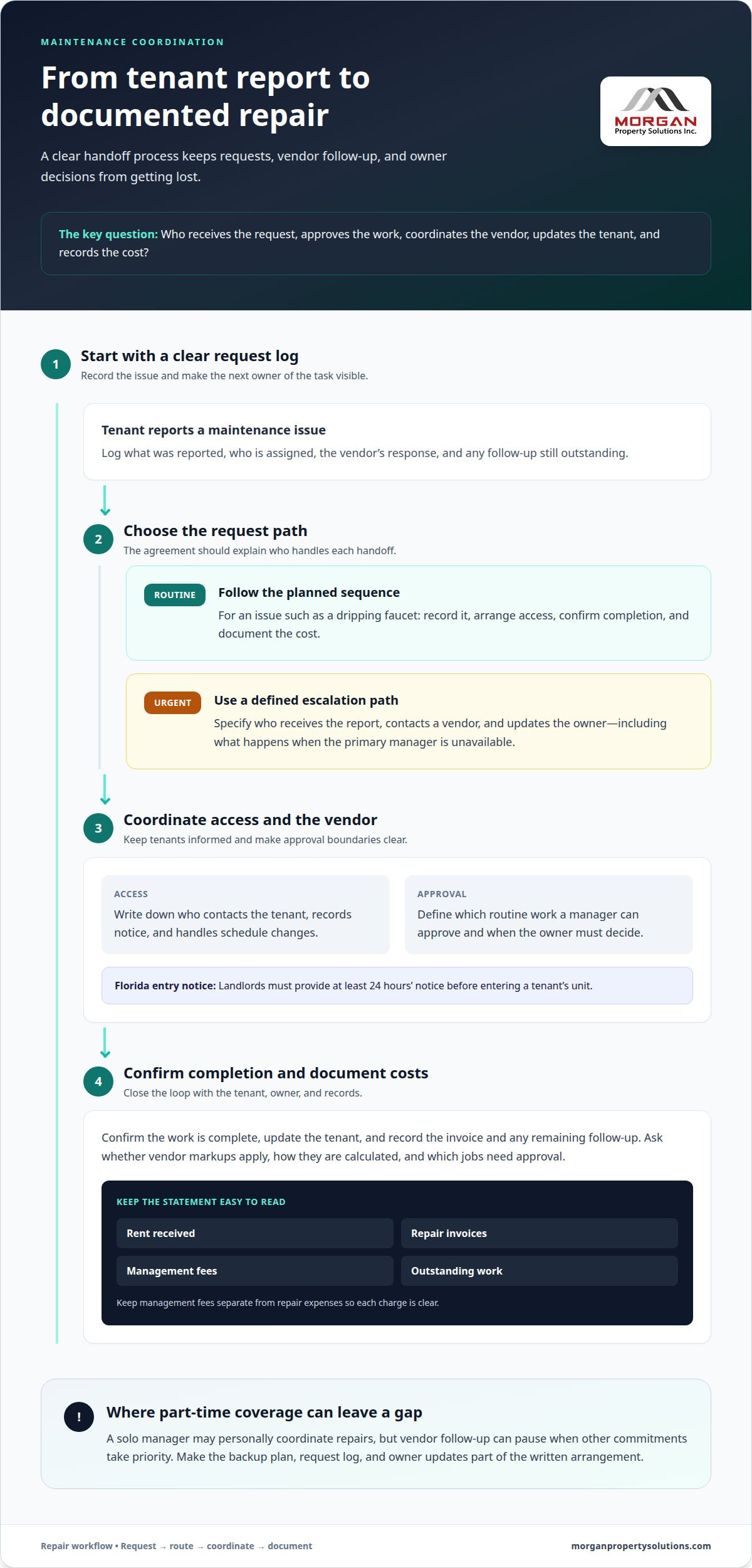
Repair coordination affects the tenant experience, property condition, and rental income. Compare who receives requests, approves work, tracks invoices, and follows up with vendors.
Maintenance Coordination
Coordination covers the steps between a tenant reporting an issue and a repair being completed. A manager can log the request, arrange a vendor visit, update the tenant, and record the invoice. With self-management, the owner handles these steps. One risk of hiring a solo part-time property manager is that vendor follow-up may pause when other commitments take priority.
Clarify how vendor charges appear on owner statements. Ask whether maintenance markups apply, how they are calculated, and which jobs require approval. Keep management fees separate from repair expenses so statements show what each charge covers. A written process also makes it easier to track unfinished work and identify recurring property issues.
Maintenance Requests and Emergencies
A routine request, such as a dripping faucet, can follow a planned sequence: record the issue, arrange access, confirm completion, and document the cost. An urgent problem needs a defined escalation path. The agreement should identify who receives the report, contacts a vendor, and updates the owner.
These handoffs matter when a repair affects a tenant’s daily use of the home. Risks of hiring a solo part-time property manager can include delayed communication if the manager receives a request but cannot promptly coordinate the next step. A clear log should show the report, the person assigned, the vendor’s response, and any outstanding follow-up.
Maintenance and Emergency Availability
Availability means more than answering a call. It includes acknowledging the report, assessing the next step, and communicating with tenants. A solo manager may coordinate repairs personally, while a larger operation may use staff or vendor systems. Either way, the written arrangement should explain how urgent requests are handled when the primary manager is unavailable.
Connect maintenance records with rent collection and leasing records. For example, an owner statement can show rent received, repair invoices, and outstanding work separately. This makes maintenance spending easier to distinguish from management fees and rental income. Clear records also help owners plan follow-up, understand recurring issues, and keep tenant communications consistent.
Potential mistakes from a lack of property-management experience
Limited experience can turn routine rental tasks into costly oversights. Assess the manager’s systems, relevant expertise, and ability to follow through on each responsibility.
Manager Experience and Resources
Experience matters most when it matches the property’s needs. Ask for examples involving leasing, tenant communication, records, and maintenance coordination. A manager familiar with single-family rentals may use different processes from one managing multifamily buildings. Relevant examples show how their experience applies to your property type, not just how long they’ve worked in real estate.
Resources matter, too. Find out who covers tenant questions when the manager is unavailable and how requests are tracked. A solo manager without backup may struggle to keep applications, repair updates, and owner reports moving during a busy vacancy. Clear procedures and support arrangements can reduce gaps while keeping the owner involved in important decisions.
Insurance, Licensing, and Credentials
In the United States, licensing requirements depend on the state and the work performed. Ask which licenses or credentials apply to the manager’s role, then review documents that show they match the work. Insurance should also fit the responsibilities in the agreement. Request evidence of coverage and note who is insured, which activities it covers, and when it expires.
No credential replaces relevant property-management expertise. References from owners with similar rental properties can help you assess communication and follow-through. For example, ask how the manager handled a vacancy, a delayed repair, or a tenant dispute. Specific examples reveal more than a general claim of experience.
Tasks Commonly Missed by Part-Time Managers
A part-time schedule can make recurring details easier to overlook. Common pressure points include recording rent collection, following up on unfinished repairs, tracking lease dates, updating vacancy listings, and keeping owner records current. A simple monthly workflow can assign each task, its due date, and its completion record, making missed steps easier to spot.
Tenant screening also requires consistent handling from application to decision. A manager may collect documents but fail to communicate the next step promptly, leaving applicants waiting and extending a vacancy. Ask how the process moves from application review to approval, lease preparation, and move-in coordination. Clear handoffs keep each stage visible.
Use a practical review: match the manager’s experience to your property type, identify backup resources, and assign key tasks to the owner or manager. This comparison helps reveal whether a solo professional has the capacity and systems to manage the rental consistently.
Choosing between self-management and hiring a manager
A landlord choosing between self-management and a manager should compare time, responsibility, and the work covered. The right fit depends on how much direct involvement the rental property requires.
Solo part-time managers and full-service companies do not follow one universal fee structure. Compare each agreement’s management fee, leasing charges, maintenance responsibilities, and availability rather than judging cost by the manager’s title. The listed tasks determine what the landlord still handles and what the fee covers.
For a well-running single-family rental, self-management takes an estimated 5 to 10 hours per month. A vacancy can add work: marketing and leasing one rental commonly takes 10 to 20 hours. That time may include preparing the listing, responding to inquiries, screening applicants, and coordinating move-in details.
Self-management gives you direct control over tenant communication, rent collection, and repair decisions. It can also avoid a separate management fee. The trade-off is that you must handle those tasks and track compliance, records, and follow-up. A full-time job or distance from the property can make urgent issues harder to manage.
Professional management shifts defined day-to-day tasks to a manager, but it does not eliminate every owner decision. The agreement should show who handles leasing, tenant questions, maintenance coordination, and reporting. For example, an owner might retain approval authority for major expenses while delegating routine requests. Clear roles reduce duplicated work and missed handoffs.
Use this simple comparison before deciding:
- Self-management: the owner takes responsibility for daily operations and keeps direct control.
- Solo part-time manager: the manager handles agreed tasks, while the owner may still cover gaps in availability or oversight.
- Full-service management: a broader set of operations may be delegated, depending on the written agreement.
Next, list the tasks you can consistently complete and the time you can set aside each month. Include vacancy work, tenant communication, maintenance coordination, and recordkeeping. Then compare that list with the agreement’s included duties, additional charges, and decision limits. This step-by-step review reveals the practical trade-offs, not just the headline fee.
Self-management may suit a landlord with time, nearby access, and confidence handling rental operations. Hiring a manager may be a better fit when managing an investment competes with work or other responsibilities. Choose based on the time you can reliably commit and the specific responsibilities you want to delegate.
Evaluating a property management agreement
A management agreement defines what the manager handles and which decisions remain with the owner. Review its terms as an operating plan, not just a fee summary.
Start with monthly rent. The agreement should explain who collects it, how receipts are recorded, and when the owner receives funds and statements. For example, a monthly statement can separate rent received, outstanding balances, repair invoices, and other charges. Clear categories help the owner understand rental income and follow up on missing items.
Next, trace each financial responsibility. Identify who pays vendors, approves work, keeps receipts, and reports expenses. If the manager can authorize routine repairs, the agreement should define that authority and explain how the owner is notified. A clear approval process helps prevent surprise charges and avoids delays while the manager waits for a decision.
Property operations need the same level of detail. List who handles leasing, tenant communications, maintenance requests, inspections, and recordkeeping. For example, the manager may coordinate a repair while the owner approves a larger expense. The agreement should describe that handoff, including how the manager records the request and confirms completion.
Check the agreement’s term and exit process before signing. Some guidance recommends looking for cancellation clauses with 60- to 120-day notice periods. Read the actual wording for notice method, final accounting, transfer of tenant records, and responsibility for work already underway. A clear transition process can help avoid confusion if the relationship ends during a vacancy or active repair.
Use this review sequence to make the terms easier to compare:
- Map the money: identify rent collection, owner disbursements, vendor payments, and reporting.
- Mark decision limits: separate routine actions from expenses requiring owner approval.
- Trace each operation: assign leasing, tenant updates, maintenance follow-up, and records.
- Read the exit terms: note notice requirements and the transfer of files and responsibilities.
Pay attention to vague phrases such as “as needed” or “reasonable expenses.” For example, the agreement should clarify who decides whether a repair needs follow-up rather than leaving responsibility open. Specific duties make performance easier to assess and give both parties a shared reference point.
The takeaway is simple: choose an agreement that ties each monthly payment and property operation to a clear responsibility, approval step, and record. If rent collection, financial reporting, and day-to-day work remain unclear, the agreement leaves important decisions unresolved.
Morgan Property Solutions: Orlando Property Manager
Morgan Property Solutions Inc. is a relevant next step if managing an Orlando rental has become difficult to balance with work, travel, or other responsibilities. Its Residential Property Management offering relates directly to owners weighing ongoing professional support against handling every task themselves. The decision still starts with your priorities: which responsibilities you want to delegate and which decisions you want to retain.
An Orlando property owner might consider professional management when tenant communication, leasing, rent collection, and maintenance coordination compete for attention. Before making a change, outline the tasks that take the most time and the decisions that matter most to you. This gives you a practical starting point for discussing how management could fit your property and expectations.
Clear roles matter. For example, you may want help with day-to-day rental responsibilities while retaining approval over major property decisions. Start a useful conversation by outlining your current setup, the tasks you want handled, and the decisions you prefer to keep. This makes the arrangement easier to understand before you commit.
Morgan Property Solutions Inc. also offers Real Estate Seller Representation and Real Estate Buyer Representation. These services may be relevant if your plans extend beyond managing a rental, such as preparing to sell a property or considering a purchase. The right service depends on the decision in front of you, so begin with the real estate need you want to address.
To prepare for a conversation about property management, gather a few practical details:
- The property’s location and type.
- The management tasks taking the most time.
- The decisions you want to keep for yourself.
- Any current concerns about leasing, tenant communication, or maintenance.
These details help clarify whether Residential Property Management matches the support you’re looking for. You can also review the scope of Orlando property management as you consider the difference between delegated tasks and owner decisions. The goal is a clear understanding of responsibilities, not a one-size-fits-all arrangement.
If you’re weighing your next step for an Orlando rental, contact Morgan Property Solutions Inc. to discuss your property management needs.
Frequently Asked Questions
What are the main risks of hiring a solo part-time property manager?
The main risks include limited backup, delayed follow-up, and unclear responsibility for routine tasks. These risks of hiring a solo part-time property manager are easier to spot when a tenant reports an issue while the manager is unavailable. Ask who handles the next step, where updates are recorded, and how unresolved items reach you. A written process helps distinguish an occasional delay from a recurring management gap.
How does a part-time property manager’s availability affect emergency response times?
Availability affects how quickly a report is acknowledged, assessed, and routed to the right person. A tenant reporting a leak needs to know whether to contact the manager, an alternate contact, or the owner if there is no reply. Set separate expectations for urgent and routine messages. The response plan should also explain how the tenant and owner receive updates while a repair is pending.
What happens if a solo property manager is sick, on vacation, or leaves unexpectedly?
Without documented backup arrangements, tenant messages and open work orders can stall until someone takes responsibility. Before management begins, agree on who can access property records, contact tenants, and coordinate ongoing repairs during an absence. If the manager leaves, a handover should include current leases, tenant contact details, payment records, vendor information, and unresolved issues. Keep essential records accessible to the owner.
Who is legally responsible for fair housing, tenant screening, security deposits, and maintenance compliance?
Owners should not assume that hiring a manager automatically transfers every legal responsibility. An agreement can assign tasks, but landlords may still face legal disputes or financial penalties if fair housing, screening, deposit, or local compliance requirements are mishandled. For example, specify who maintains screening records and tracks deposit activity. For a specific dispute or legal interpretation, seek advice from a qualified legal professional.
How can landlords verify a solo property manager’s references, experience, and financial controls?
Ask for references from owners with similar properties, then discuss concrete examples of tenant communication and follow-through. Review a sample owner statement to see how rent, expenses, and outstanding items are recorded. Ask how funds and records are separated, reconciled, and made available to you. A clear answer should describe the process and documentation, not rely only on a general claim of trustworthiness.
What should a property management agreement specify about duties, response times, fees, and termination?
The agreement should name who handles leasing, rent collection, tenant messages, repairs, and owner reporting. It should explain response expectations for urgent and routine requests and list management and additional charges separately. Read the termination clause for notice requirements, the method of notice, and the transfer of records and keys. For example, an open repair should have a named person responsible for its next step.
How do solo part-time managers compare with full-service firms and self-management?
Self-management gives the owner direct control but leaves every task with them. A solo manager can provide a single point of contact, though coverage may depend on that person’s schedule and backup arrangements. A full-service firm may divide tasks among staff, while the owner still needs clear approval boundaries. Compare actual duties, continuity plans, and reporting processes rather than relying on labels such as “part-time” or “full-service.”
What backup plans should landlords require for maintenance emergencies and tenant communications?
Set out an escalation path with a primary contact, an alternate contact, and instructions for notifying the owner if neither responds. Define how tenants report urgent problems and how routine requests are tracked. Give the backup person access to essential details, such as property access instructions, vendor contacts, and open work orders. A simple log showing the report, assigned person, and latest update helps prevent issues from disappearing during a handoff.

Article by
Oliver Overton-Morgan
Oliver Overton-Morgan is a full-time Real Estate Broker since 2003, with years of experience helping thousands of people purchase and sell real estate throughout Central Florida. He holds a Graduate Realtor Institute designation, LCAM, and has held licenses in good standing as a Florida Mortgage Broker and a Notary Public. Oliver immigrated to central Florida in 2001, and within 5 years Oliver built a successful Real Estate brokerage in central Florida, where he recruited over 75 Sales Associates with 25+ million in sales production.