A broken air conditioner in a Florida rental doesn’t automatically trigger a fixed repair deadline. Florida landlord laws on AC repair timelines don’t set a universal 24-hour emergency repair rule, and state law doesn’t generally require landlords to provide AC. But when a rental includes a working system, the lease and the circumstances can affect who must arrange and pay for repairs.
In Florida’s heat, a broken AC can quickly become stressful for tenants and landlords. The first step is to separate the repair timeline from responsibility: the lease, the cause of the breakdown, and written notice can all matter.
This article explains when landlords may have to maintain an existing AC system, how Florida’s written-notice rules work, and why withholding rent or ending a lease without following the required process can create risk. It also explains how professional property management can help Central Florida rental owners organize maintenance requests and lease obligations.
Key Takeaways
- A written notice can start a 7-day period for addressing a material failure to meet the rental agreement or applicable duties. The notice and the circumstances matter.
- Who pays for an AC repair can depend on the lease and what caused the problem. Tenant negligence or wrongful acts may affect the landlord’s responsibility.
- Withholding rent or ending a lease without following the required legal process can create added risk. Understand the notice requirements before taking either step.
- Tenants generally can’t deduct repair costs from rent unless the lease allows it or the landlord agrees in writing.
- Clear, timely written repair requests help document the issue and the response, especially when a maintenance delay becomes a dispute.
Can a Landlord Charge a Tenant for AC Repairs in Florida?
Florida Statute 83.56 gives a landlord 7 days after receiving a tenant’s written notice to address a material failure to comply with the rental agreement or applicable duties. That period is not a universal deadline for every AC repair. Whether a broken system qualifies depends on the lease, the property’s condition, and the circumstances behind the problem.
The notice should describe the AC problem and explain how it relates to the rental agreement or the landlord’s duties. A tenant seeking to end the lease must give written notice stating that intention. Under Florida Statute 83.56(1), the landlord has 7 days after receiving that notice to address the material failure before the tenant may terminate the agreement on that basis.
Keep a clear record. A tenant can send a dated email describing the problem, such as an AC unit that will not turn on, and save the sent message. Certified mail or another delivery method can help establish when the landlord received notice. Keep replies, repair appointments, and photographs together. These details can clarify a later dispute about the notice date or the reported condition.
Repair access has a separate notice rule. Florida law requires at least 24 hours’ notice before a landlord enters to make repairs, except in an emergency. The permitted entry hours for repairs are 7:30 a.m. to 8 p.m., subject to applicable notice requirements. The period changed from 12 hours to 24 hours effective July 1, 2022.
A landlord can provide written notice of the planned entry time and repair purpose, and the tenant can keep that message. If the appointment changes, put the updated arrangement in writing to prevent confusion. A genuine emergency, such as a fire or burst pipe, is different and may allow immediate entry without advance notice.
For a mobile home or subsidized rental, don’t assume the AC repair arrangement is identical to every other tenancy. The written agreement and any applicable housing-program terms matter; keep those documents with the repair notice when clarifying responsibility. Owners can also use landlord resources to organize rental information and maintenance records.
Does Florida require landlords to provide AC?
Florida law doesn’t generally require landlords to install air conditioning in a rental. Florida landlord laws on an AC repair timeline depend on whether the rental includes a system, what the lease says, and which maintenance duties apply.
Providing Air Conditioning
Florida Statute 83.51(2) requires landlords of multifamily rentals to provide running water, hot water, and heat during winter, but not air conditioning. A rental without AC isn’t automatically out of compliance with that provision. However, a lease or applicable building, housing, or health code can affect the landlord’s obligations. A tenant should read the rental agreement’s description of included appliances and repair responsibilities.
Landlord Duties for Provided AC
When a rental includes an AC system, keeping it functional generally falls to the landlord as part of maintaining what was rented. Florida Statute 83.51(1)(a) requires landlords to comply with applicable building, housing, and health codes. Some leases for single-family homes or duplexes assign certain AC repairs to tenants. The lease language matters, but it doesn’t erase applicable code requirements. Tenants must also use and operate AC facilities reasonably.
AC Repair Duties and Timelines
Florida landlord laws on AC repair timelines don’t set one fixed deadline for every breakdown. Timing depends on the lease, applicable duties, the seriousness of the repair, and the reported facts. A failed unit that affects a tenant’s health or safety may need more urgent attention than a minor performance issue. A heat-related illness does not by itself determine responsibility. Relevant questions include whether a maintenance duty applied, whether the landlord knew about the problem, and whether evidence connects the failure to the illness.
A tenant’s written report helps establish when the landlord learned about symptoms such as no cooling during extreme indoor heat. Florida Statute 83.64 also bars retaliation for repair complaints or code reports, including eviction as retaliation. A complaint doesn’t itself determine whether a landlord violated a duty; the lease, code, notice, response, and circumstances all matter.
Cooling Maintenance Requirements
Florida Statute 83.51 requires landlords to maintain structural components and working plumbing and electrical systems, among other duties. It doesn’t name AC as a universal service every rental must have. If AC is included, the agreement and applicable codes help determine the repair obligation. Florida Statute 83.51(4) excludes conditions caused by a tenant’s negligence or wrongful acts, or those of the tenant’s guests. For example, documented damage caused by a guest may affect responsibility for a repair.
Rent withholding and lease termination risks
A broken AC doesn’t automatically give a Florida tenant the right to stop paying rent or end a lease. The consequences depend on the applicable statute, written notices, lease terms, and whether the home remains livable. Withholding rent without following the required process can lead to a dispute over unpaid rent, even while the tenant seeks repairs.
Florida Statute 83.60(1)(b) allows a tenant to raise a defense based on a landlord’s failure to comply with section 83.51(1) after 7 days have passed following written notice. The notice must state the noncompliance and the tenant’s intention not to pay rent because of it. That is a legal defense process, not permission to simply deduct rent or stop paying without notice.
Lease termination has its own written-notice requirements. Under Florida Statute 83.56(1), a tenant may terminate when the landlord materially fails to meet applicable duties or material lease terms within 7 days after receiving notice stating the tenant intends to terminate. A tenant considering this step should distinguish a broken AC from a condition that materially violates the lease or an applicable duty.
Florida Statute 83.201 describes a separate situation: if the lease has no repair procedure and the home is wholly unlivable, a tenant may give at least 20 days’ written notice before withholding rent until repairs are made. A home without cooling is not automatically wholly unlivable under this rule. The condition of the property and the specific repair problem matter to whether that standard applies.
The lease should state whether air conditioning is included and who handles its maintenance. For example, a lease for a single-family rental might assign certain AC repairs to the tenant. An advertisement that mentions AC can also shape expectations about what the rental includes, so compare it with the signed agreement and any written repair arrangements.
Local housing codes can add requirements beyond the lease. Florida law also requires landlords of apartments and other multi-unit rentals to provide heat during winter, running water, and hot water, unless otherwise agreed in writing. These duties are separate from AC. Window screens are a distinct issue: landlords must install them at move-in and repair them once a year when needed.
Before a rent or lease decision, match the facts to the relevant rule: identify the AC duty, preserve written notices, and record the repair response. Florida Statute 83.64 also prohibits retaliation for reporting repairs or code violations, including eviction as retaliation. A repair complaint alone doesn’t establish retaliation; the conduct and surrounding facts matter.
Can a tenant withhold rent for a broken AC in Florida?
A broken AC doesn’t automatically let a tenant withhold rent or deduct repair costs. Responsibility often depends on the lease, the cause of the damage, and whether the tenant followed Florida’s written-notice process.
Rent Withholding and Proportional Reduction
Withholding rent and reducing it proportionally are different actions, and neither follows automatically from an AC failure. Florida Statute 83.60(1)(b) allows a tenant to raise a defense based on certain landlord noncompliance after written notice and the required waiting period. It doesn’t create a general formula for lowering rent based on days without cooling. A tenant who withholds rent without following the process risks a dispute over unpaid rent.
Repair Requests and Documentation
A written repair request records the AC problem and when the landlord was informed. Describe what stopped working, when it happened, and any effects, such as a unit that won’t start or water leaking near electrical equipment. Keep copies of the message and replies. Email provides a timestamp; certified mail or another delivery method can help prove receipt.
Florida has no repair-and-deduct statute. A tenant generally can’t hire a repair service, pay the bill, and subtract the cost from rent unless the lease allows it or the landlord agrees in writing. For example, a tenant in an apartment should get written approval before arranging an AC repair and proposing a rent deduction. Without approval, the landlord may treat the full rent as unpaid.
The cause of the failure also matters. Normal wear or an equipment problem is different from damage caused by a tenant’s negligence or wrongful act. Under Florida Statute 83.51(4), landlords aren’t responsible for conditions caused by a tenant’s negligence or wrongful acts, or by the tenant’s guests. If a guest damages an AC control, the tenant should report the incident promptly and preserve relevant messages or photos.
Tenants must use and operate air-conditioning facilities reasonably, but that doesn’t make them responsible for every breakdown. A clogged filter after missed routine care may raise different issues from an aging component that fails during ordinary use. The lease can assign some AC repair responsibilities, especially in a single-family home or duplex. Compare its terms with the maintenance issue before deciding who pays.
Report maintenance problems promptly to limit further damage. For example, a leaking AC condensate line could affect flooring or nearby plumbing if ignored. Keep the initial notice, follow-up messages, appointment details, and repair findings together. If rent or responsibility is disputed, these documents help establish the sequence of events, though they don’t replace the lease or required legal process.
Florida repair deadlines and emergency claims
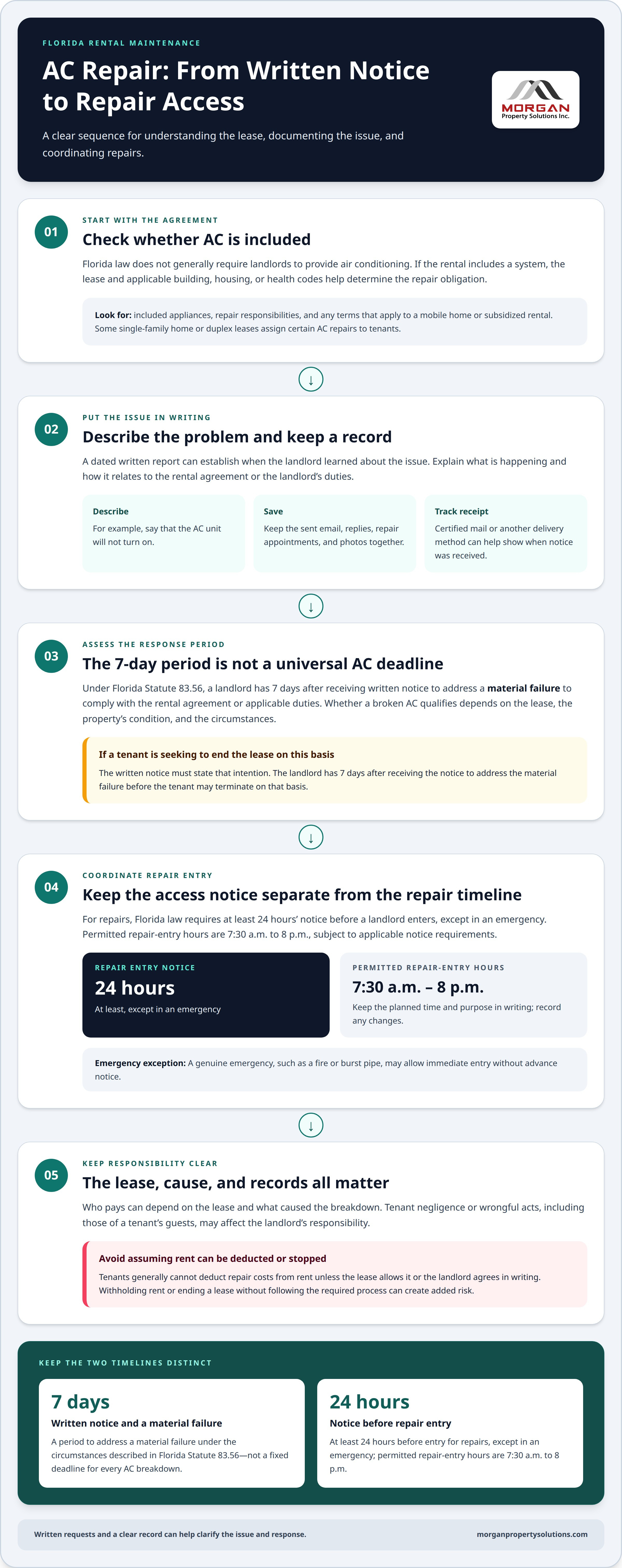
Florida landlord laws on AC repair timelines separate the time to respond to a legal notice from the time needed to complete a repair. The law sets no universal 24-hour deadline for emergency AC repairs. That distinction matters: a 24-hour repair-entry notice concerns access to the rental, not a guarantee that the system will be fixed within 24 hours.
Under Florida Statute 83.56, a tenant’s written notice about a material failure can start a 7-day period for the landlord to address it. Florida landlord laws on an AC repair timeline don’t create one deadline for every broken air conditioner. The lease, the nature of the failure, applicable duties, and the facts affect whether the issue is a material failure and what response is required.
An AC system that stops cooling presents a different issue from a minor problem that leaves the unit operating. A tenant’s notice should describe the problem, its effect on the rental, and when it began. The landlord can then assess the reported condition and arrange access. The notice period and practical repair schedule are related, but they are not the same clock.
Emergency access is another separate question. A genuine emergency, such as a fire or burst pipe, may allow a landlord to enter without advance notice. A broken AC alone does not automatically establish that an emergency-entry exception applies. For ordinary repairs, Florida requires at least 24 hours’ notice before entry, with repair access permitted between 7:30 a.m. and 8 p.m.
Health and safety concerns make prompt communication especially important, but the law doesn’t set a universal AC-specific response time. A tenant reporting dangerous indoor conditions should describe them in writing and keep a copy of the message. The landlord’s response can then be assessed against the lease, applicable housing codes, and reported facts. “Habitable” isn’t determined simply by counting hours without cooling.
Tenants should avoid holding rent or treating a repair delay as an automatic right to stop paying. Florida Statute 83.60(1)(b) provides a defense based on certain noncompliance after 7 days have passed from written notice stating the issue and the intention not to pay rent because of it. Following the correct notice process matters; a delay alone doesn’t replace it.
For owners managing rental investments, a clear record of notices, entry arrangements, and repair decisions can help keep these separate rules organized. Review your real estate investment management options when property oversight and maintenance decisions need a more consistent framework.
Morgan Property Solutions Inc.
Morgan Property Solutions Inc. helps Central Florida rental owners manage the demands of leasing and maintaining residential properties. When AC concerns raise questions about lease terms, repair records, or owner responsibilities, professional property management can help keep the process organized and ease the burden of handling each issue alone.
Whether you’re preparing to lease a property, managing an existing rental, or considering a change in ownership, support can fit your next step. Morgan Property Solutions Inc. offers residential property management, tenant placement and leasing, and real estate representation for buyers and sellers.
If you’d like to discuss your property needs, contact Morgan Property Solutions Inc.
Build a Clear Plan for Your Rental
Use a repair dispute as an opportunity to make future maintenance easier to manage. Clear lease language, consistent records, and a defined process for reporting problems help owners and tenants understand what happens next. Reviewing these practices before another AC issue arises gives everyone a clearer starting point.
Understanding Florida landlord laws on an AC repair timeline is one part of managing a rental. Owners can also consider whether professional support fits their plans, whether they need help with ongoing property responsibilities or are preparing to buy or sell. Morgan Property Solutions Inc. offers Residential Property Management, Real Estate Seller Representation, and Real Estate Buyer Representation.
If you’re ready to discuss your property goals, contact Morgan Property Solutions Inc. A thoughtful next step can make the decisions ahead feel more manageable.
Frequently Asked Questions
Can I just stop paying rent until my landlord makes repairs?
No. Stopping rent without following Florida’s required notice process can create an unpaid-rent dispute. For certain claims under Florida Statute 83.60(1)(b), written notice must identify the noncompliance and state the tenant’s intention not to pay rent because of it; the specified waiting period must also pass. Keep rent records and copies of repair messages. A repair problem alone doesn’t automatically cancel the rent obligation.
Can You Break Your Lease If the Landlord Won’t Repair?
Possibly, but an unresolved repair request alone doesn’t end a Florida lease. Under Florida Statute 83.56(1), termination may be available when a landlord materially fails to meet applicable duties or material lease terms after receiving written notice stating the tenant intends to terminate. The landlord has the statutory cure period. A tenant should distinguish a material failure from a repair delay that doesn’t violate the lease or applicable duties.
Can a landlord enter to fix the AC?
Yes. For ordinary AC repairs, Florida law generally requires at least 24 hours’ notice before entry, and repair entry is permitted between 7:30 a.m. and 8 p.m. A genuine emergency, such as a fire or burst pipe, can allow entry without advance notice. For example, a landlord arranging a routine technician visit should provide the required notice and planned access time.
Can a tenant break the lease if the AC stays broken?
A tenant may be able to terminate a lease if a broken AC amounts to a material failure of applicable duties or lease terms and the statutory notice process is followed. A cooling failure doesn’t automatically qualify in every rental. The lease, applicable codes, the condition’s effect on the home, and the landlord’s response all matter. A written termination notice should clearly state the tenant’s intent to end the agreement.
Is air conditioning legally required in Florida rental properties?
No. Florida law doesn’t generally require a rental property to include air conditioning. For example, a rental without an AC unit isn’t automatically in violation of Florida Statute 83.51(2), which lists certain duties for multifamily housing but doesn’t require cooling. A lease that promises AC or an applicable building, housing, or health code may still affect the owner’s obligations for that particular property.
Who pays for AC repairs in a Florida rental?
The lease and cause of the breakdown help determine who pays. If a system fails through ordinary wear, the landlord’s maintenance duties and the rental agreement are relevant. If a tenant or guest negligently damages the equipment, Florida Statute 83.51(4) may affect responsibility. For instance, damage to an AC control caused by a guest differs from a component failure during normal use.
Does Florida require AC repair within a specific number of days?
No Florida statute sets one universal deadline for completing every AC repair, including a fixed emergency-repair deadline. Florida Statute 83.56 provides a 7-day period after written notice for addressing a material failure to comply with applicable duties or the rental agreement. That period isn’t a blanket AC repair schedule. The lease, the reported condition, and whether a material failure exists shape how the rule applies.
Does Florida law require landlords to provide or maintain air conditioning?
Florida law doesn’t require landlords to provide AC in every rental. If a property includes a system, the lease, applicable codes, and the landlord’s duties can determine whether repairs are required. Florida Statute 83.51 requires maintenance of structural components and working plumbing and electrical systems, among other obligations. It doesn’t list AC as a universal feature every rental must provide.

Article by
Oliver Overton-Morgan
Oliver Overton-Morgan is a full-time Real Estate Broker since 2003, with years of experience helping thousands of people purchase and sell real estate throughout Central Florida. He holds a Graduate Realtor Institute designation, LCAM, and has held licenses in good standing as a Florida Mortgage Broker and a Notary Public. Oliver immigrated to central Florida in 2001, and within 5 years Oliver built a successful Real Estate brokerage in central Florida, where he recruited over 75 Sales Associates with 25+ million in sales production.