
As a Florida landlord, protecting your investment is your top priority. But in a landscape of complex regulations, it’s easy to feel uncertain. A seemingly innocent question during screening or a misunderstood policy on assistance animals could unintentionally violate fair housing laws, putting your business at significant legal and financial risk. The fear of an accidental misstep is a common concern for property owners, and keeping up with the rules can feel overwhelming.
That’s why we’ve created this straightforward guide to help you navigate your responsibilities with confidence. We’re here to make the complex simple. This guide will walk you through the essentials of both federal and Florida’s specific housing regulations, so you can protect your investment and manage your property fairly and professionally. You’ll gain a clear understanding of your legal obligations, learn how to create a consistent screening process, and know exactly how to handle tenant requests without conflict. Let us help you secure your business and operate with peace of mind.
Key Takeaways
- Understand the key differences between federal and Florida’s specific fair housing laws to ensure your property is fully compliant.
- Learn how to structure your advertising and screening process to avoid common and costly violations that even well-meaning landlords can make.
- Get a clear, simple breakdown of who is protected under the law to help you build a fair and legally sound tenant selection process.
- Confidently navigate requests for reasonable accommodations and modifications, one of the most complex areas for property owners.
What is the Fair Housing Act? A Foundation for Landlords
Navigating the world of property management means understanding your legal responsibilities. At the heart of these duties are the federal fair housing laws, designed to ensure everyone has equal access to housing opportunities. The cornerstone of this legislation is the federal Fair Housing Act (Title VIII of the Civil Rights Act of 1968), a landmark law passed to prohibit discrimination in the sale, rental, and financing of housing. Its goal is straightforward: to create a level playing field by guaranteeing equal opportunity, not guaranteed housing.
This critical act applies to nearly everyone involved in a housing transaction, including landlords, property managers, real estate agents, and lenders, making compliance an essential part of your professional practice.
Key Prohibited Actions Under the Act
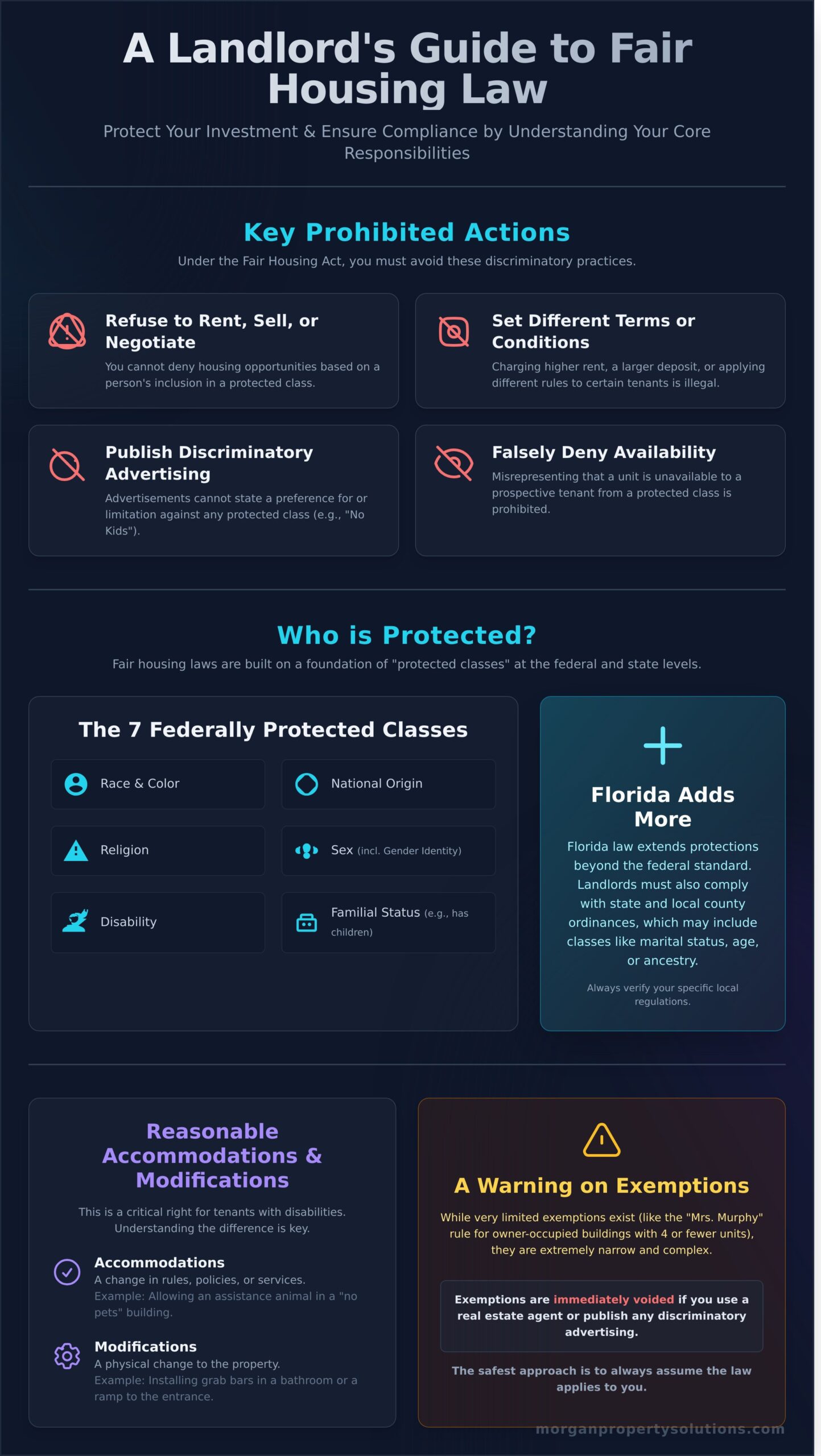
To make compliance simple, it helps to know what actions are explicitly forbidden. The Act protects people from discrimination based on race, color, religion, national origin, sex (including gender identity and sexual orientation), disability, and familial status. Based on these protected classes, you cannot:
- Refuse to rent, sell, or negotiate for housing.
- Set different terms, conditions, or privileges, such as charging a higher rent or a larger security deposit to certain tenants.
- Make, print, or publish any statement or advertisement that indicates a preference, limitation, or discrimination.
- Falsely deny that housing is available for inspection, sale, or rent when it is indeed available.
Are There Any Exemptions?
While the Fair Housing Act is broad, a few very specific exemptions exist. It is crucial to understand that these are extremely narrow and rarely apply to the average landlord or property management company. The most well-known is the “Mrs. Murphy” exemption, which applies to owner-occupied buildings with no more than four units. Exemptions may also apply to housing operated by private clubs or religious organizations for their members.
However, a critical warning: these exemptions are immediately voided if you use a real estate agent or publish any discriminatory advertising. Given the complexity, assuming you are covered by the law is always the safest and most professional approach to protect your investment.
The 7 Federally Protected Classes: Who is Covered?
Understanding who is protected is the first step in navigating fair housing laws. The federal Fair Housing Act establishes a foundation of protection for all Americans by identifying seven specific “protected classes.” This means that no one can legally deny you housing opportunities based on these characteristics. These rules are clearly outlined by the U.S. Department of Housing and Urban Development (HUD), which helps ensure everyone has equal access to housing. It’s also important to remember that these protections extend to you if you are associated with someone in a protected class, such as a family member or partner.
Race, Color, and National Origin
These three classes are often grouped together as they relate to a person’s ancestry and appearance. It is illegal to make any housing decision based on someone’s race, skin color, or the country their family comes from. This includes subtle actions, not just outright refusal.
- Real-World Example: A leasing agent tells a Hispanic couple that there are no available units but then shows an available apartment to a white couple an hour later. Another example is “steering”-guiding a prospective Black tenant toward a specific neighborhood because the agent believes they would “fit in better” there.
Religion and Sex
A person’s religious beliefs (or lack thereof) cannot be a factor in a housing transaction. This protection covers all organized religions as well as those with non-traditional beliefs or no religious affiliation at all. The protected class of sex has also been expanded through recent federal interpretations to prohibit discrimination based on gender, gender identity, and sexual orientation.
- Real-World Example: A landlord with a “Now Renting” sign in the window tells a same-sex couple that the apartment has just been rented after learning they would be living together.
Familial Status and Disability
Familial status protects households with one or more children under 18, pregnant individuals, and anyone in the process of securing legal custody of a child. Landlords cannot impose special rules or restrictions that unfairly single out families with children. Separately, the law protects individuals with a disability, defined as a physical or mental impairment that substantially limits one or more major life activities. This is a critical part of fair housing laws, as it grants tenants the right to request reasonable accommodations (like a designated parking spot) or make reasonable modifications (like installing a ramp) at their own expense.
- Real-World Example (Familial Status): An apartment complex advertises as a “quiet, adult community” and refuses to rent a two-bedroom unit to a single parent with a young child.
- Real-World Example (Disability): A condo association denies a resident’s request to keep an emotional support animal, despite having proper documentation from a doctor, because the building has a strict “no pets” policy.
Florida Fair Housing Laws: Going Beyond the Federal Standard
While the federal Fair Housing Act provides a crucial foundation for preventing discrimination, it’s important for landlords to understand that this is the minimum standard. States, counties, and cities can-and often do-add more protected classes to their own laws. They cannot take away federal protections, but they can expand upon them. In Florida, this means landlords must navigate a multi-layered system of regulations to remain compliant.
The Florida Fair Housing Act builds directly on federal law, creating additional responsibilities for property owners. Staying informed about these state-level requirements isn’t just good practice; it’s essential for protecting your investment and running a lawful rental business. Understanding the specific fair housing laws where your property is located is the key to avoiding costly violations and potential litigation.
State-Level Protected Classes in Florida
Florida law adds specific protections that go beyond the seven federally recognized classes. These state-level mandates are enforced by the Florida Commission on Human Relations and require careful attention from landlords. The two most significant additions are:
- Marital Status: You cannot refuse to rent to an applicant or treat a tenant differently because they are single, married, divorced, or widowed. Your screening criteria must apply equally to all, regardless of their marital status.
- Pregnancy: While often covered under “familial status” at the federal level, Florida law explicitly lists pregnancy as a protected class. This removes any ambiguity and offers clear, direct protection for expectant parents.
Local Ordinances in Cities like Orlando and Tampa
Beyond state law, many of Florida’s counties and major cities have established their own local ordinances that provide even more protections. This is the most granular level of compliance and can vary significantly from one jurisdiction to another. For example, municipalities like Orlando, Tampa, and Miami-Dade County have added protections for:
- Age
- Sexual Orientation
- Gender Identity or Expression
Because these rules are hyper-local, it is crucial for landlords to research the specific regulations in the city and county where their rental property is located. Navigating this complex web of federal, state, and local rules can feel overwhelming, but it’s a non-negotiable part of being a landlord in Florida. Our property managers stay current on all local laws.
Practical Compliance: Avoiding Common Violations Day-to-Day
Understanding the letter of the law is one thing; applying it correctly in your daily operations is another. Many well-meaning landlords and property managers accidentally violate fair housing laws not out of malice, but through simple inconsistency or outdated habits. The best way to protect yourself and ensure fairness is to establish a clear, consistent, and well-documented process for every applicant and tenant, from the first ad to the final move-out.
Here’s a practical guide to help you navigate the three most common areas where violations occur.
Writing Compliant Rental Advertisements
Your rental ad is often the first point of contact with a potential tenant. It’s crucial that your language focuses on the property’s features, not on the type of person you hope will live there. This practice ensures you are welcoming to all qualified applicants.
- Do This: Describe the property itself. Use factual, inviting language about the amenities, such as, “Spacious three-bedroom home with a fenced yard, updated kitchen, and two-car garage.”
- Not That: Describe your ideal tenant or use exclusionary phrases. Avoid language like, “Perfect for professionals,” “quiet Christian home,” or “no kids.” These statements can be interpreted as discriminatory.
Conducting a Fair Tenant Screening Process
A standardized screening process is your best defense against discrimination claims. By creating objective criteria and applying it equally to everyone, you remove subjective bias from your decision-making. This system should be in place before you even list the property for rent.
- Do This: Establish written, objective rental criteria. This typically includes income verification (e.g., gross income is 3x the monthly rent), a minimum credit score, a clean rental history, and a consistent policy for reviewing criminal backgrounds.
- Not That: Ask questions about an applicant’s race, religion, national origin, disability, or familial status. Your application should only gather information relevant to their financial and rental qualifications.
Setting and Enforcing Property Rules
Your responsibility to uphold fair housing laws continues after a lease is signed. All community rules and regulations must be created and enforced in a way that applies to all tenants equally and does not single out any protected class.
- Do This: Implement rules that address behavior, not identity. For example, a rule about “Quiet hours are from 10 PM to 8 AM” is neutral and applies to everyone.
- Not That: Create rules that target families with children. A rule that sets a specific curfew for teenagers or prohibits children from playing in common areas would likely violate protections for familial status.
Navigating these day-to-day scenarios can feel complex, but it doesn’t have to be. By establishing and sticking to a clear system, you create a fair environment for everyone and significantly reduce your risk. If you need support in creating a compliant and stress-free management process, the experienced team at Morgan Property Solutions Inc. is here to help guide you.
Reasonable Accommodations & Modifications: A Deep Dive
Navigating requests for accommodations and modifications is one of the most common and complex areas for landlords. Understanding your responsibilities under fair housing laws is essential for maintaining a compliant and supportive rental environment. The key is to engage in a good-faith “interactive dialogue” with your tenant to find a workable solution that meets their disability-related needs without imposing an undue burden on your business.
These requests fall into two distinct categories: a change in rules (accommodation) or a physical change to the property (modification). Let’s break down what each one means for you.
Reasonable Accommodation: A Change in Rules or Policies
A reasonable accommodation is a change, exception, or adjustment to a rule, policy, practice, or service. The most frequent example is a request to keep an assistance animal in a building with a “no pets” policy. It’s important to know that assistance animals are not pets, and landlords generally cannot charge pet fees or deposits for them. You may ask for reliable documentation of the disability-related need for the animal, but you cannot ask about the nature of the disability itself.
Reasonable Modification: A Physical Change to the Property
A reasonable modification is a structural change made to a unit or common area to allow a person with a disability full use of the housing. Common examples include:
- Installing grab bars in a bathroom
- Adding a wheelchair ramp to an entrance
- Putting in a visual fire alarm for a hearing-impaired tenant
Typically, the tenant is responsible for the cost of the modification. A landlord can, in some cases, require the tenant to restore the property to its original condition upon moving out, particularly if the change would affect a future tenant’s use of the unit.
Handling these requests with care, respect, and a clear understanding of the law is crucial. If you need help navigating the complexities of property management and ensuring compliance with all fair housing laws, the experienced team at Morgan Property Solutions is here to guide you every step of the way.
Your Partner in Compliant Property Management
Navigating the intricate web of federal and Florida-specific regulations is a critical responsibility for every landlord. As this guide has shown, successful compliance isn’t just about memorizing the protected classes; it’s about consistently and fairly applying these principles to your advertising, tenant screening, and daily interactions. Furthermore, understanding how to properly handle requests for reasonable accommodations and modifications is essential to protecting your investment and treating all individuals with the respect they deserve.
Mastering these legal details is non-negotiable, but you don’t have to do it alone. The team at Morgan Property Solutions is your trusted partner in this process. We bring deep expertise in Central Florida’s unique fair housing laws, backed by over 20 years of combined experience and a commitment to excellence reflected in our A+ BBB Rating. We pride ourselves on making the complex simple, giving you the professional support you need to manage your property effectively and ethically.
If you’re ready to eliminate the stress of compliance and focus on the rewards of your investment, we are here to guide you. Let us help you manage your property with confidence and compliance.
Frequently Asked Questions About Fair Housing in Florida
Can I refuse to rent to tenants with children if I’m worried about noise?
No, refusing to rent to prospective tenants with children violates fair housing laws, as “familial status” is a protected class. While noise concerns are understandable, you cannot base a rental decision on the assumption that a family will be noisy. The best practice is to establish a clear, written noise policy in your lease agreement and apply it consistently and equally to all residents, regardless of whether or not they have children. This ensures you remain compliant.
What is the difference between a service animal and an emotional support animal under the FHA?
Under the Fair Housing Act (FHA), a service animal is specifically trained to perform tasks for a person with a disability, such as a guide dog for a visually impaired person. An emotional support animal (ESA) provides therapeutic benefit or comfort but is not required to have specific training. Despite this difference, you must provide a “reasonable accommodation” for both, which includes waiving no-pet policies or pet fees, unless doing so would create an undue financial or administrative burden.
Am I allowed to run a criminal background check on prospective tenants?
Yes, you can run criminal background checks, but you must do so carefully and consistently for every applicant to avoid discrimination. It is critical to avoid blanket policies that deny housing to anyone with any type of criminal record. Instead, you should conduct an individual assessment, considering the nature, severity, and date of the conviction. This helps ensure your screening process is fair, objective, and defensible against a potential discrimination claim based on disparate impact.
What are some specific phrases to avoid in my rental ads to ensure they are compliant?
To keep your advertising compliant, avoid any language that states a preference for or against a protected class. Steer clear of phrases like “no children,” “perfect for a single professional,” “Christian community,” or “must speak English.” Instead, focus on describing the property itself-its features, amenities, and location. For example, describe the unit as a “two-bedroom apartment” rather than “ideal for a couple.” This keeps your ad focused on the property and welcoming to all qualified applicants.
What should I do if a fair housing complaint is filed against me?
If a fair housing complaint is filed against you, it is essential to take it very seriously and act promptly. Do not ignore the notice or attempt to contact the complainant directly. Your first step should be to gather all relevant documentation, such as advertisements, applications, and communication records. We strongly recommend consulting an attorney who specializes in landlord-tenant law. They can provide expert guidance on how to respond properly and protect your interests throughout the process.
Can I set a maximum number of people who can live in a rental unit?
Yes, you can set reasonable occupancy limits for your rental properties. While Florida does not have a specific statewide statute, a widely accepted guideline is the “two persons per bedroom” standard. However, you must apply this standard consistently to all applicants and be prepared to justify it based on the size of the rooms and the overall unit. This practice helps prevent overcrowding while ensuring you do not violate fair housing laws related to familial status discrimination.
Do I have to rent to someone who receives a housing voucher or public assistance?
At the state level, Florida does not include “source of income” as a protected class, meaning you are generally not required to accept housing vouchers like Section 8. However, this is a complex area, as several counties and cities in Florida, including Miami-Dade and Broward, have passed local ordinances that do protect source of income. It is crucial to check your local regulations to ensure you are fully compliant with all applicable fair housing laws in your specific area. When a tenancy does need to end, understanding the Florida eviction process is equally important to ensure you proceed legally and protect your investment.

Article by
Oliver Overton-Morgan
Oliver Overton-Morgan is a full-time Real Estate Broker since 2003, with years of experience helping thousands of people purchase and sell real estate throughout Central Florida. He holds a Graduate Realtor Institute designation, LCAM, and has held licenses in good standing as a Florida Mortgage Broker and a Notary Public. Oliver immigrated to central Florida in 2001, and within 5 years Oliver built a successful Real Estate brokerage in central Florida, where he recruited over 75 Sales Associates with 25+ million in sales production.