
Facing the need to evict a tenant is one of the most stressful challenges a landlord can encounter. The worries about costly legal missteps, confusion over correct timelines, and the financial strain of unpaid rent can feel overwhelming. Navigating the legal system adds another layer of complexity, but understanding the official florida eviction process doesn’t have to be a source of anxiety. As your trusted partner in property management, we’re here to help you handle this situation with confidence and control.
This step-by-step guide is designed to simplify the entire procedure for you. We will walk you through every critical stage, from drafting and serving the correct initial notice to filing with the court and ultimately regaining possession of your property. By following this guide, you will gain the clarity needed to act legally and effectively, protect your investment, and restore the profitability of your rental as quickly and smoothly as possible.
Key Takeaways
- Every eviction must start with serving the correct legal notice; discover the different types and their strict timelines to avoid costly mistakes.
- Understand when and how to file a formal eviction lawsuit in court if a tenant fails to comply with your initial notice.
- Navigating the complete florida eviction process requires following precise legal steps to obtain a Judgment and the final Writ of Possession.
- Your responsibilities don’t end when the tenant leaves-learn the proper procedures for handling any abandoned personal property.
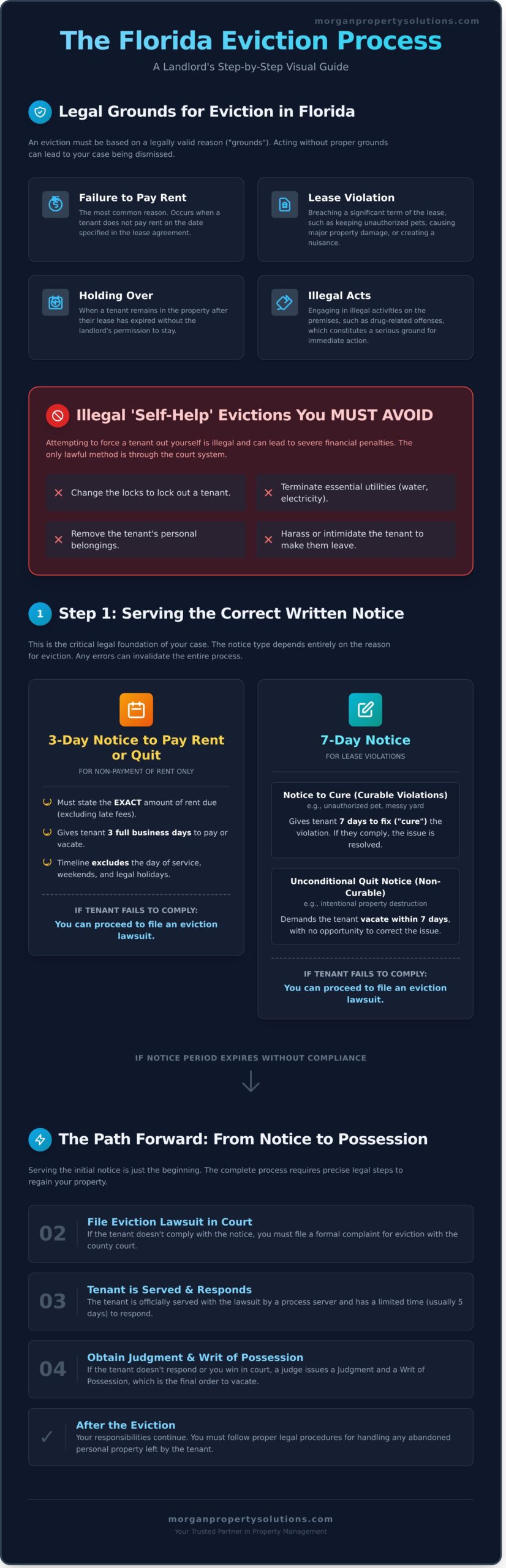
Understanding the Legal Grounds for Eviction in Florida
Navigating an eviction can be a stressful and complicated experience for any property owner. However, approaching it with a clear understanding of the law is the most important first step toward a successful outcome. The florida eviction process is strictly governed by state statutes, and you cannot begin without a legally valid reason, otherwise known as “grounds.”
Establishing proper grounds is not just a suggestion-it is the legal foundation of your entire case. Before you can begin the formal legal process of eviction, you must be able to prove that the tenant has violated the lease agreement or law in a specific way. Acting without this justification can lead to your case being dismissed in court, costing you valuable time, money, and causing unnecessary frustration. Taking this first step correctly protects you and your investment from legal challenges down the road.
Valid Reasons for Eviction Under Florida Law
Florida law is very specific about what constitutes a valid reason to remove a tenant. To ensure your actions are legally sound, your reason for eviction must fall into one of the following recognized categories. The most common grounds include:
- Failure to Pay Rent: This is the most frequent cause for eviction. If a tenant does not pay their rent on time as stipulated in the lease, the landlord can initiate the eviction process.
- Material Violation of the Lease Agreement: This occurs when a tenant breaches a significant term of the lease. Common examples include keeping unauthorized pets, causing excessive property damage, or creating a persistent nuisance for neighbors.
- Holding Over: A tenant is “holding over” when they continue to occupy the property after their lease term has expired without the landlord’s permission to stay.
- Committing Illegal Acts: If a tenant engages in illegal activities on the property, such as drug-related offenses, it serves as a serious ground for eviction.
Illegal ‘Self-Help’ Evictions You Must Avoid
While you have rights as a property owner, there are certain actions you are strictly forbidden from taking. Florida law prohibits landlords from using “self-help” methods to force a tenant out. These actions are illegal and can result in severe penalties, including forcing you to pay damages to the tenant. You must never:
- Change the locks to lock out a tenant.
- Terminate essential utilities like water, electricity, or gas.
- Remove the tenant’s personal belongings from the property.
- Harass or intimidate the tenant in an attempt to make them leave.
Attempting any of these actions can derail a legitimate eviction and create significant financial liability for you. The only lawful way to evict a tenant is by following the legally defined court process.
Step 1: Serving the Correct Written Eviction Notice
Before you can file a lawsuit or change the locks, Florida law requires you to give the tenant a formal written notice. This initial step is the foundation of the entire Florida eviction process, and any mistake-from a wrong date to an incorrect amount owed-can invalidate your case and force you to start over. Think of this notice not just as a warning, but as a critical legal document that must be perfect. For a complete overview, the legal experts at Nolo provide a detailed step-by-step guide to the Florida eviction process that outlines these strict requirements.
Navigating which notice to use is simple once you understand the different types. Choosing the right one depends entirely on the reason for the eviction.
The 3-Day Notice to Pay Rent or Quit
This is the most common notice and is used exclusively for non-payment of rent. It must clearly state the exact amount of rent due, excluding any other fees like late charges. The timeline is very specific: the day of service, weekends, and legal holidays do not count. This gives your tenant three full business days to either pay the rent in full or vacate the property. If they do neither, you can then proceed with filing an eviction lawsuit.
The 7-Day Notice to Cure or Quit
When a tenant violates the lease in a way that can be corrected, you serve a 7-Day Notice to Cure. Common examples include having an unauthorized pet, a messy yard, or an unapproved roommate. The notice gives the tenant seven days to fix (or “cure”) the violation. If they comply, the matter is resolved. If they don’t, you can move forward. For serious, non-curable violations like intentional property damage, you would instead use a 7-Day Unconditional Quit Notice, which demands the tenant leave without offering a chance to fix the issue.
How to Properly ‘Serve’ the Notice to Your Tenant
Delivering the notice correctly is just as important as writing it correctly. Florida law outlines three acceptable methods for “serving” the notice to ensure the tenant receives it. We always recommend documenting the service with a photo, date, and time stamp for your records.
- Personal Delivery: Handing the notice directly to the tenant. This is the best method.
- Substituted Service: If the tenant isn’t home, you can leave the notice with another resident of the property who is at least 15 years old.
- Posting and Mailing: If no one is home, you may post the notice in a conspicuous place, like the front door. If you do this, you must also mail a copy to the tenant.
Step 2: Filing the Eviction Lawsuit in Court
If the tenant has not paid the overdue rent or corrected the lease violation after receiving the official notice, your next step is to escalate the matter legally. You cannot simply change the locks or remove the tenant’s belongings; you must seek the court’s permission. This is where the formal florida eviction process truly begins, and it’s a step where precision is absolutely essential to avoid costly delays.
This legal action is formally known as an “Action for Possession” or, more commonly, an “Unlawful Detainer” lawsuit. By filing this with the court, you are officially asking a judge to grant you legal possession of your property back. This is a critical stage where procedure matters immensely. The entire process is governed by specific statutes, and as government resources like the Volusia County Clerk of Court outline, filing the lawsuit correctly is the first major legal hurdle.
Preparing the Complaint and Summons
To initiate the lawsuit, you must prepare two primary documents. The Complaint is a formal document that details exactly why you are evicting the tenant, citing the specific reasons, such as failure to pay rent or other lease violations. You must attach copies of the signed lease agreement and the eviction notice you served. The Summons is the official court document that notifies the tenant they are being sued and informs them of their deadline to respond. Meticulous accuracy with names and addresses on these forms is non-negotiable.
Where to File and Associated Costs
You must file the Complaint and Summons with the Clerk of Court in the county where your rental property is located. Filing a lawsuit is not free, and it’s important to be prepared for the associated costs, which typically include:
- Filing Fees: Paid directly to the Clerk of Court to officially open your case.
- Summons Issuance Fees: A separate, smaller fee for each Summons the court issues.
- Service of Process Fees: You must pay the county Sheriff’s office or a certified private process server to legally deliver the lawsuit papers to your tenant.
Navigating these steps correctly is crucial for a smooth process. We are here to help guide you, ensuring every document is filed properly and every fee is accounted for, simplifying this complex procedure for you.
Step 3: Service of Process and Tenant Response
Once you have filed the eviction lawsuit, the case officially enters the court system. This next phase of the Florida eviction process is critical, as it involves formally notifying your tenant of the lawsuit and giving them a strict, legally-defined window to respond. How the tenant is served and whether they respond will determine the immediate next steps. For many landlords, this is where having an expert guide can prevent costly procedural mistakes.
Serving the Summons and Complaint
You cannot simply hand the lawsuit papers to your tenant yourself. Florida law requires that the official court documents-the Summons and the Complaint-be delivered by an authorized third party. This ensures the process is impartial and properly documented.
- Who Serves the Papers: The documents must be served by either a county Sheriff’s deputy or a certified private process server.
- Method of Service: The server will first attempt “personal service” by delivering the documents directly to the tenant. If the tenant cannot be found, the server may use “substitute service” by leaving the papers with a resident of the property who is at least 15 years old. As a last resort, they can post the notice conspicuously on the property, a method known as “posting.”
- Proof of Service: After successfully serving the documents, the server files a Proof of Service with the court. This is a sworn statement that confirms the date, time, and method of delivery.
The Tenant’s 5-Day Response Window
After being served, the tenant has exactly five business days to file a written answer with the Clerk of Court. It’s important to note that this count excludes weekends and legal holidays. If the eviction is for non-payment of rent, the tenant must also deposit the full amount of rent owed into the court registry at the same time they file their answer. Failure to respond or deposit the rent within this timeframe can lead to a default judgment in your favor.
What Happens if the Tenant Fights the Eviction?
If the tenant files a formal answer and, if required, deposits the rent, the court will schedule a hearing. At this hearing, both you and the tenant will have the opportunity to present evidence and testimony to a judge. You must be prepared to prove the claims made in your complaint with documentation like the lease agreement, payment ledgers, and copies of all notices. Contested evictions can become complicated quickly, requiring a clear understanding of legal procedures. A complex case? Our experts can manage this for you.
Step 4: The Judgment and Writ of Possession
After successfully presenting your case in court or if the tenant fails to respond, you reach the pivotal goal of the eviction lawsuit: obtaining a Judgment for Possession. This is the official court order that legally grants you the right to reclaim your property. This judgment is the key that unlocks the final, and most crucial, tool in the florida eviction process.
Obtaining a Final Judgment
There are two primary ways to secure this judgment. If the tenant never filed a formal answer with the court after being served, you can request a Default Judgment. If the case proceeded to a hearing and the judge ruled in your favor, you will be granted a Final Judgment. In either scenario, this document is signed by the judge and becomes part of the official court record, allowing you to proceed.
What is a Writ of Possession?
With a signed judgment in hand, the next step is to request that the Clerk of Court issue a Writ of Possession. This is a separate legal document that directs the county Sheriff to remove the tenant from your property. You will need to pay a service fee to the Sheriff’s office to “execute” the Writ. It is absolutely critical to follow this procedure, as it is the only lawful method for having a tenant physically removed. Attempting to remove a tenant yourself can lead to significant legal trouble.
Executing the Writ: The Final 24 Hours
The execution of the Writ is the conclusive action. A Sheriff’s deputy will travel to the rental property and post the Writ of Possession on the front door, which serves as a final 24-hour notice for the tenant to vacate.
- After the 24-hour period expires (weekends and holidays excluded), the deputy will return.
- If the tenant has not left, the deputy will remove them from the premises.
- Once the tenant is removed, you can legally change the locks and secure your property.
Successfully navigating these final steps ensures you regain your property legally and without complication. If you need expert guidance to manage this critical stage, the experienced team at Morgan Property Solutions Inc. is here to help simplify the process for you.
After the Eviction: Next Steps for Landlords
Successfully regaining possession of your property is a significant milestone, but the process doesn’t end when the tenant leaves. Taking the correct steps after an eviction is crucial for protecting your investment, recovering financial losses, and preventing future issues. Handling this final phase with care and diligence ensures you can move forward confidently.
Handling a Tenant’s Abandoned Property
When a tenant leaves belongings behind, you cannot simply throw them away or claim them as your own. Florida law has specific procedures you must follow. You are required to provide the former tenant with a detailed written notice, sent to their last known address, listing the abandoned items and informing them where they can be claimed. Failure to follow these rules can expose you to a new lawsuit, turning a resolved issue into a new legal headache.
Collecting Unpaid Rent and Damages
The initial eviction judgment grants you possession of the property, but it often does not include a monetary award for back rent or damages. To recover these funds, you may need to pursue a second judgment. This legal step is essential for collecting what you are owed and can be used to garnish wages or place a lien on the former tenant’s assets. Always document property damage thoroughly with dated photos, videos, and repair receipts to support your claim.
How Professional Management Prevents Evictions
The most stress-free and cost-effective way to handle an eviction is to avoid one in the first place. This is where professional property management becomes an invaluable asset. A proactive approach focused on prevention is key. At its core, this involves:
- Thorough Tenant Screening: Implementing a rigorous screening process that checks credit, criminal history, and eviction records is the best defense against future problems. It’s equally important that your screening process complies with fair housing laws to protect your business from discrimination claims.
- Ironclad Lease Agreements: Using a clear, legally sound lease that outlines all tenant responsibilities and consequences for violations.
- Consistent Enforcement: Fairly and consistently enforcing all lease terms, from rent collection deadlines to property rules, prevents small issues from escalating.
Navigating the aftermath of the florida eviction process requires careful attention to detail. Beyond managing abandoned belongings and unpaid rent, many landlords also find themselves dealing with practical nuisances like what to do with mail from a previous tenant that continues to arrive long after the eviction is complete. Partnering with an experienced team can help you manage these final steps and implement proven strategies to secure high-quality tenants for the future. To learn how we make owning rental property simple and profitable, contact the experts at Morgan Property Solutions today.
Simplify Your Next Steps with a Trusted Partner
Navigating the florida eviction process requires meticulous attention to detail and strict adherence to the law. As this guide has shown, from serving the correct legal notice to securing a Writ of Possession, every step must be handled correctly to protect your rights as a landlord and your investment. It’s a complex journey that can be both time-consuming and stressful, leaving little room for error.
You don’t have to manage it alone. At Morgan Property Solutions, we specialize in making property management simple. With over 20 years of combined experience, an A+ rating with the Better Business Bureau, and a team of licensed and insured professionals, we are the trusted partner you need to handle these challenges with expertise and care.
The eviction process is stressful. Let our property management experts handle it for you.
Protect your property and regain your peace of mind. Let us help you move forward with confidence.
Frequently Asked Questions About the Florida Eviction Process
How long does the entire eviction process take in Florida?
The timeline can vary, but a straightforward, uncontested eviction in Florida typically takes about 3 to 5 weeks from serving the initial notice to the sheriff removing the tenant. However, if the tenant contests the eviction, the process can become more complex and extended. Factors like court schedules and how quickly the tenant responds play a significant role. Our goal is to help you navigate this timeline efficiently, making a stressful situation as simple as possible for you.
Can I evict a tenant in Florida without a written lease agreement?
Yes, you can evict a tenant even without a written lease. In Florida, a verbal agreement is typically considered a month-to-month tenancy. To terminate this type of tenancy, you must provide the tenant with a written 15-day notice to vacate before the end of the monthly rental period. Following the correct notice procedure is crucial for a successful eviction, and we can guide you to ensure every step is handled properly and professionally.
What are the most common mistakes landlords make during an eviction?
The most common mistakes include serving an improper notice, accepting partial rent after the notice period has begun, and attempting “self-help” evictions like changing the locks or shutting off utilities, which are illegal in Florida. These errors can cause significant delays or even lead to the case being dismissed, forcing you to start over. Following the correct legal procedure is essential, and our team is here to help you avoid these costly missteps.
What happens if a tenant pays part of the rent after I’ve served a 3-day notice?
Accepting partial rent after serving a 3-Day Notice to Pay or Vacate can be a critical mistake. Under Florida law, this action may waive your right to evict the tenant under that specific notice, forcing you to restart the process. To proceed, you must either refuse the partial payment or have the tenant sign a specific non-waiver agreement before you accept the funds. We can help you understand the best course of action to protect your rights.
Can I charge the tenant for the legal fees associated with the eviction?
In many cases, yes. If your written lease agreement includes a provision stating the tenant is responsible for attorney’s fees and court costs in the event of an eviction, you can ask the court to award them. The judge must rule in your favor for you to be awarded these costs. It’s important to review your lease agreement carefully. A well-drafted lease is a key tool in protecting your investment and recovering these expenses during the eviction process.
Do I need to hire a lawyer to evict a tenant in Florida?
While an individual property owner can technically represent themselves, the Florida eviction process is filled with strict legal requirements where small mistakes can derail your case. It is highly recommended to seek professional guidance to ensure compliance and avoid delays. Furthermore, if the property is owned by a corporation or LLC, you are legally required to be represented by an attorney. Partnering with experts simplifies the process and gives you peace of mind.

Article by
Oliver Overton-Morgan
Oliver Overton-Morgan is a full-time Real Estate Broker since 2003, with years of experience helping thousands of people purchase and sell real estate throughout Central Florida. He holds a Graduate Realtor Institute designation, LCAM, and has held licenses in good standing as a Florida Mortgage Broker and a Notary Public. Oliver immigrated to central Florida in 2001, and within 5 years Oliver built a successful Real Estate brokerage in central Florida, where he recruited over 75 Sales Associates with 25+ million in sales production.