
The thought of breaking a lease in Florida can be incredibly stressful. It often brings worries about steep financial penalties, potential lawsuits, and lasting damage to your rental history or reputation. Whether you are a tenant facing an unexpected life change or a landlord dealing with a sudden vacancy, the path forward can seem unclear and intimidating. But it doesn’t have to be a source of anxiety; with the right information, you can handle the situation with confidence.
We’re here to help simplify the process. This comprehensive guide is designed for both landlords and tenants, providing a clear roadmap to your rights and legal options under Florida law. We will walk you through the valid reasons for terminating a lease, the proper steps to take, and how to manage the financial consequences. Our goal is to empower you with the knowledge to end a lease correctly, avoid costly disputes, and protect your financial well-being.
Key Takeaways
- Understand that a Florida lease is a legally binding contract, and ending it early has specific financial and legal consequences.
- Discover the specific, legally protected situations that allow a tenant to terminate their lease early without penalty.
- Learn the proper communication and procedural steps for breaking a lease when a legally justified reason does not exist.
- For landlords, find out your legal duties and best practices for managing the situation and mitigating financial losses.
The Foundation: Understanding Your Florida Lease Agreement
Before diving into the specifics of handling a broken lease, it’s essential to have a firm grasp of the document at the center of your landlord-tenant relationship. A residential Lease Agreement is not just a formality; it is a legally binding contract that outlines the specific rights and responsibilities of both you and your tenant for a set period. When a tenant leaves before the term is over without a legally justified reason, they are breaking a lease, which is a direct violation of this contract.
In Florida, landlord-tenant relationships are primarily governed by Florida Statutes, Chapter 83. This law provides the framework for your rights and the procedures you must follow. It’s also important to distinguish between a tenant breaking their lease and a mutual termination agreement, where both parties agree to end the lease early under specified terms. Understanding this foundation helps you navigate the process with confidence and clarity.
The Lease Document: Your First Point of Reference
When a tenant signals their intent to leave early, your first and most important step is to thoroughly review the signed lease agreement. This document is your guide. Pay close attention to clauses that address this specific situation, such as:
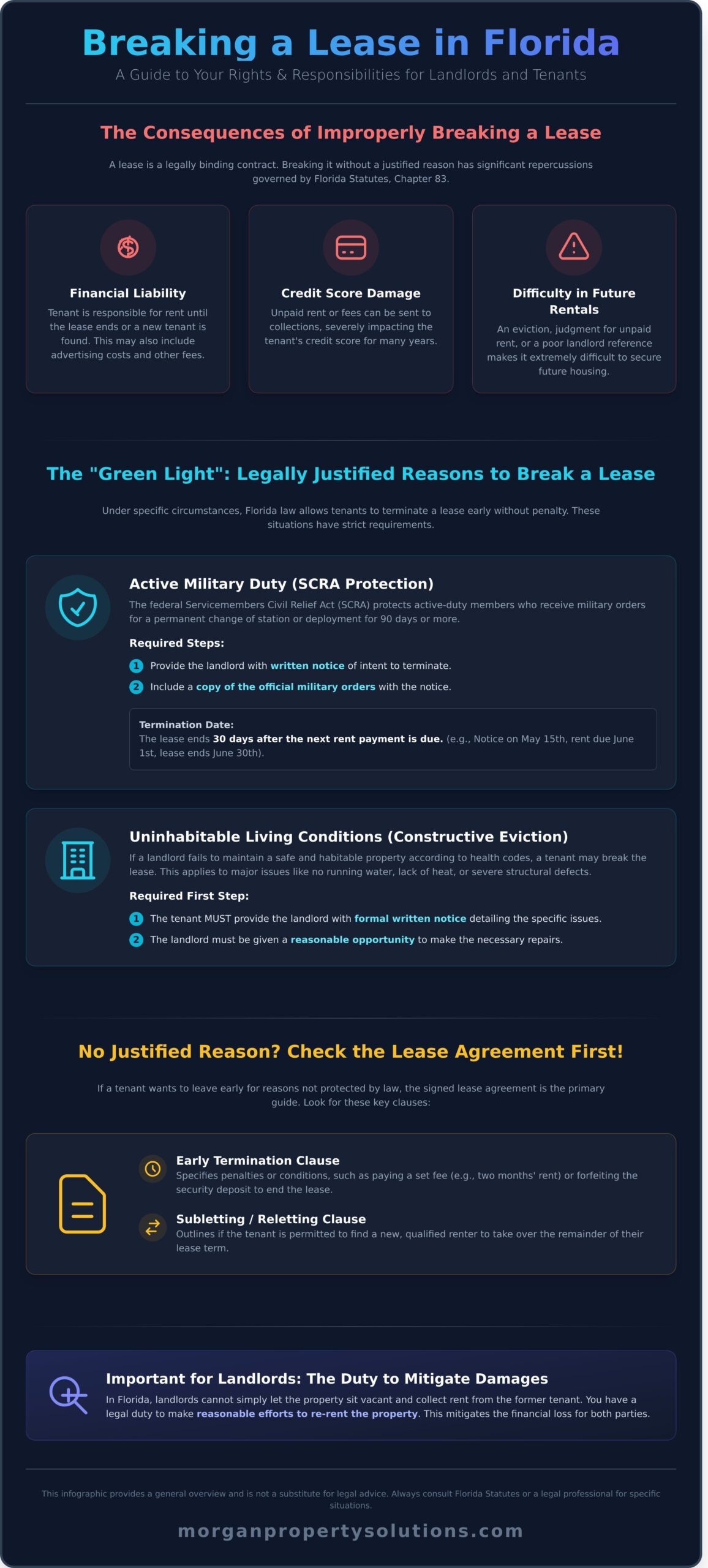
- Early Termination Clause: This may specify penalties or conditions for ending the lease early, such as a fee or forfeiture of the security deposit.
- Subletting/Reletting Clause: This outlines whether a tenant is permitted to find a new renter to take over their lease.
- Notice Requirements: The lease should detail how and when a tenant must provide notice.
Remember, a clear, written lease almost always supersedes any verbal agreements or promises made.
Florida Law vs. Your Lease: Which Takes Precedence?
A common point of confusion is whether the lease or state law holds more power. The answer is simple: your lease cannot take away rights guaranteed to a tenant under Florida law. For example, you cannot include a clause that waives your duty to mitigate damages by finding a new tenant. However, your lease can and should provide specific procedures not detailed in the statute, like the exact amount of an early termination fee (within legal limits). If your lease is silent on an issue, Florida law dictates the default process.
Potential Consequences for the Tenant
Understanding the potential repercussions a tenant faces for improperly breaking a lease is crucial for landlords. It informs your negotiations and legal options. The primary consequences include:
- Financial Liability: The tenant is typically responsible for paying rent until the lease ends or until you find a replacement tenant, whichever comes first. They may also be liable for advertising costs and other fees outlined in the lease.
- Credit Score Damage: Any unpaid rent or fees can be sent to a collections agency, which will negatively impact the tenant’s credit score for years.
- Difficulty in Future Rentals: A prior eviction, judgment for unpaid rent, or a poor landlord reference can make it extremely difficult for a tenant to be approved for future housing.
Legally Justified Reasons for Breaking a Lease in Florida
While a lease agreement is a legally binding contract, it’s important for landlords to understand that Florida law provides a few specific exceptions that allow a tenant to terminate their lease early without penalty. These situations are rare and come with strict procedural requirements. Though statutes like Florida Statute 83.595 clearly outline a landlord’s remedies when a tenant vacates a unit, these protections do not apply in certain legally justified situations. Understanding these exceptions helps you navigate the process with confidence and clarity.
Active Military Duty (SCRA)
Federal law, specifically the Servicemembers Civil Relief Act (SCRA), offers protections to active-duty military members who are relocated. If a tenant receives orders for a permanent change of station or is deployed for 90 days or more, they can terminate their lease. To do so, they must:
- Provide you with written notice.
- Include a copy of their official military orders.
The lease termination becomes effective 30 days after the next rent payment is due. For example, if notice is given on May 15th and rent is due June 1st, the lease ends on June 30th.
Uninhabitable Living Conditions (Constructive Eviction)
Tenants have the right to a safe and habitable home. If a landlord fails to maintain the property according to Florida’s health and safety codes, a tenant may have grounds for “constructive eviction.” This applies to major issues that make the unit unlivable, such as a lack of running water, no heat in winter, a severe mould infestation, or a major structural defect. Before vacating, the tenant must first provide you with written notice detailing the necessary repairs and allow a reasonable time (typically 7 days) for you to fix the problem.
If you’re a landlord facing such a claim, addressing the issue promptly is key to preventing a valid lease break. To get an idea of what professional remediation involves, you can discover ABC Mould Cleaning Solutions.
Landlord Harassment or Privacy Violations
A tenant’s right to quiet enjoyment is protected by law. In Florida, landlords must provide “reasonable notice,” which is generally interpreted as 12 hours, before entering a rental property for non-emergency reasons. Actions that could be considered harassment or a violation of privacy include:
- Entering the property repeatedly without proper notice.
- Changing the locks without the tenant’s permission.
- Shutting off utilities.
- Removing the tenant’s personal property.
If these actions occur, a tenant may have legal grounds for breaking a lease. It is crucial for both parties to document all communication and incidents in writing.
The Standard Process for Early Lease Termination
When a tenant needs to move out but lacks a legally protected reason, the process for breaking a lease is guided by the lease agreement itself and Florida law. While there are specific circumstances where a tenant can legally break a lease in Florida, this section focuses on voluntary early termination. Following a clear, professional process is the best way to minimize financial loss and avoid unnecessary conflict. Florida Statute § 83.595 outlines two primary paths for landlords, depending on the terms of the lease.
Understanding these options helps you handle the situation with confidence and clarity, ensuring a smoother transition for everyone involved.
Option 1: The Early Termination Fee (Liquidated Damages)
This is often the most straightforward solution. If your lease agreement includes an early termination fee or liquidated damages addendum, the tenant has the option to pay a set fee to end the lease early. Under Florida law, this fee cannot exceed two months’ rent. Once the tenant provides proper notice and pays the fee, they are released from all further obligations under the lease. This must be a choice you, the landlord, explicitly offer within the written lease.
Option 2: No Early Termination Clause
If the lease does not contain a buyout clause, the tenant is technically responsible for paying rent for the entire remaining term. However, the landlord has a legal “duty to mitigate damages.” This means you must make reasonable, good-faith efforts to re-rent the property as quickly as possible. The original tenant is liable for rent each month the unit remains vacant, plus any advertising costs. Their responsibility ends once a new, qualified tenant begins paying rent.
Giving Proper Written Notice
A verbal conversation is never enough. To officially begin the process of breaking a lease, the tenant must provide you with formal written notice. This document creates a clear record and protects both parties. A proper notice should always include:
- The date the notice is written
- The full property address
- The specific date the tenant intends to vacate
- The tenant’s signature
For your protection and theirs, it is always wise to request that this notice be sent via certified mail, which provides undeniable proof of delivery.
Navigating these procedures correctly is critical. The experienced team at morganpropertysolutions.com can help you manage tenant communications and ensure you remain fully compliant with Florida law.
Landlord Responsibilities and Best Practices
When a tenant decides on breaking a lease, your response can significantly impact your financial outcome and professional reputation. While it can be a stressful situation, viewing it as a manageable business process is key. By understanding your legal duties and adopting smart practices, you can protect your investment, minimize vacancy, and move forward with confidence.
The Duty to Mitigate Damages Explained
In Florida, landlords have a “duty to mitigate damages.” This legal principle means you cannot simply let the property sit vacant and sue the former tenant for all remaining rent. Instead, you are required to make reasonable efforts to re-rent the unit. To prove you are meeting this obligation, it is crucial to document all your marketing activities.
- Keep copies of your online rental listings (Zillow, Apartments.com, etc.).
- Maintain a log of all inquiries and property showings.
- Document any rental applications you receive and your reasons for accepting or denying them.
Screening New Tenants Efficiently
The faster you can place a new, qualified tenant, the less financial loss you will incur from the broken lease. This is why having a consistent and thorough screening process is so important. It allows you to act quickly without compromising on the quality of the renter. A reliable process ensures you find someone who is likely to fulfill their lease term. Review our tenant screening criteria to see how we find reliable renters for our clients.
Handling the Security Deposit
A tenant’s security deposit can be used to cover losses, including unpaid rent and damages beyond normal wear and tear. However, Florida has strict laws governing this process. You have 15 days to return the full deposit or 30 days to send a written, itemized notice of your intent to make a claim against it. This notice must be sent by certified mail and clearly list each deduction. Meticulous record-keeping is essential to support your claim.
When to Get Professional Help
Navigating the complexities of an early lease termination is time-consuming and can be fraught with legal pitfalls. A professional property manager can simplify the entire process, from communicating with the departing tenant to marketing the property and screening new applicants. This expert guidance ensures legal compliance and helps restore your cash flow as quickly as possible. Let us manage the details. Explore our Orlando property management services and let our experienced team protect your investment.
In cases where disputes escalate and require legal intervention, such as suing for significant damages or unpaid rent, seeking advice from a qualified attorney is essential. A firm like Matthew Fornaro, P.A. can provide the necessary legal support to protect your rights as a landlord or tenant in Florida.
Your Trusted Partner in Florida Landlord-Tenant Law
Whether you are a landlord managing a property or a tenant navigating a difficult situation, understanding your rights and responsibilities is paramount. The key takeaways are clear: your lease agreement is your foundational guide, Florida law provides specific legal grounds for termination, and following the correct process is crucial. The path for breaking a lease is detailed, but it can still feel overwhelming to handle alone.
Navigating landlord-tenant law can be stressful, but our experienced team is here to help simplify the complex. With over 20 years of Central Florida real estate experience and a proven track record reflected in our A+ Rating from the Better Business Bureau, Morgan Property Solutions Inc. offers the expert guidance you can trust. We are committed to helping you understand your options and protect your interests. Explore our landlord resources to learn more. Let us help you move forward with confidence.
Frequently Asked Questions
Does breaking a lease automatically ruin my credit score?
Not automatically. The act of leaving early is not reported to credit bureaus. However, if you leave with unpaid rent or fees, your landlord can send that debt to a collection agency. It is this collection account-not the lease break itself-that can significantly damage your credit score. Settling all financial obligations with your landlord is the best way to protect your credit and ensure a smooth transition.
What is the difference between subletting and assigning a lease?
Think of it this way: subletting is temporary, while assigning is permanent. When you sublet, you find a new tenant to live in the unit, but you are still responsible for the lease and rent payments. You essentially become their landlord. When you assign a lease, you transfer the entire agreement to a new tenant, who then takes over all responsibilities directly with the original landlord, often releasing you from future liability.
Can I break my lease because of a job loss, divorce, or medical issue?
Unfortunately, Florida law does not typically allow you to break a lease without penalty for personal hardships like a job loss, divorce, or medical issue. While these are challenging situations, your lease remains a legally binding contract. We always recommend communicating with your landlord directly to see if a mutual agreement can be reached. Some leases may also contain an early termination clause that can help in these cases.
During such a challenging time, the last thing you need is the additional stress of the move itself. If you’re in South Florida, hiring an insured, family-owned company like All American Moving And Storage can help ensure a smooth transition, allowing you to focus on navigating the lease termination.
What happens if I abandon the property without telling the landlord?
Abandoning your rental is the riskiest option and can lead to severe financial consequences. Your landlord has the right to sue you for all the rent owed until the property is re-rented, plus any damages. They can also report the unpaid debt to credit bureaus, which will harm your credit score and make it difficult to rent in the future. Open communication is always the better path to avoid these outcomes.
Can my landlord charge me a re-letting fee on top of other penalties?
This depends entirely on your lease agreement. In Florida, a lease can include an “early termination fee” or “liquidated damages” clause, which is a pre-set amount you agree to pay. Typically, if you pay this specified fee, the landlord cannot also charge you for all the remaining months of rent. Your landlord cannot usually “double-dip,” so be sure to review your lease carefully to understand your options.
How much notice do I have to give when breaking a lease in Florida?
The required notice for breaking a lease depends on your reason and your rental agreement. If you have a legally protected reason, such as active military duty, specific statutes will dictate the notice period. For all other situations, the terms are governed by your lease. Many agreements require 30 to 60 days’ written notice and may include an early termination fee. Always check your specific lease for the exact requirements. Once a tenant has vacated, landlords often face additional administrative tasks, such as knowing what to do with mail from a previous tenant that continues to arrive at the property.

Article by
Oliver Overton-Morgan
Oliver Overton-Morgan is a full-time Real Estate Broker since 2003, with years of experience helping thousands of people purchase and sell real estate throughout Central Florida. He holds a Graduate Realtor Institute designation, LCAM, and has held licenses in good standing as a Florida Mortgage Broker and a Notary Public. Oliver immigrated to central Florida in 2001, and within 5 years Oliver built a successful Real Estate brokerage in central Florida, where he recruited over 75 Sales Associates with 25+ million in sales production.