
Is your mailbox constantly cluttered with letters and packages addressed to someone who moved out months ago? It’s a frustratingly common issue for property owners. You might be tempted to simply toss it in the recycling bin, but you’re right to hesitate—improperly handling someone else’s mail can lead to legal complications. This persistent problem leaves many landlords asking the same question: exactly what to do with mail from a previous tenant?
Managing a rental property should be rewarding, not a source of constant annoyance. We’re here to help you simplify the process. In this straightforward guide, we will walk you through the simple, legal steps for managing a former tenant’s mail, giving you complete peace of mind. You’ll learn the correct procedures to follow and discover proven strategies to prevent the problem from happening again, saving you time and hassle for good. Let’s clear the clutter and get you back to focusing on what matters.
Key Takeaways
- Discover the critical legal line you must not cross when handling old tenant mail to avoid serious federal offenses.
- Learn the simple, correct process for what to do with mail from previous tenant, ensuring you handle it legally and efficiently every time.
- Implement expert strategies during the move-out process to stop a former tenant’s mail from ever piling up again.
- Turn this common annoyance into a streamlined part of your management process, helping you reduce stress and stay organized as a landlord.
The Annoying Pile-Up: Why You’re Getting Someone Else’s Mail
As a landlord, your goal is a smooth, stress-free operation. So, when a new tenant calls about a growing stack of letters for someone who no longer lives there, it can be a frustrating distraction. If you’re asking yourself what to do with mail from previous tenant, you’re not alone. This is one of the most common, lingering issues after a turnover.
The reason is almost always straightforward: the former resident did not file an official change of address with the USPS. Without proper instruction through official mail forwarding services, the postal service will continue to deliver mail to the last known address on file. This minor oversight can create confusion for your new residents and a logistical headache for you. The good news is that there is a simple, correct way to handle the situation—and a very wrong way that can lead to legal trouble.
Is This a Landlord’s or a New Tenant’s Responsibility?
While your new tenant is the one physically receiving the mail, resolving the issue is a shared interest that ultimately benefits you as the landlord. Taking proactive steps shows your new tenant that you are a responsive and professional property manager, helping them feel respected and settled in their new home. Furthermore, you may discover mail yourself during vacancy periods, making it your direct responsibility to manage.
The Legal Framework: Mail Belongs to the Addressee
Before you do anything, it’s crucial to understand one simple, non-negotiable rule: the mail is not your property. Even though it arrives at your address, federal law is clear that only the person named on the envelope or package (the addressee) has the right to open it. Destroying, hiding, or opening someone else’s mail is a federal offense. This legal principle is the foundation for understanding what to do with mail from previous tenant and why following the correct procedure is so important.
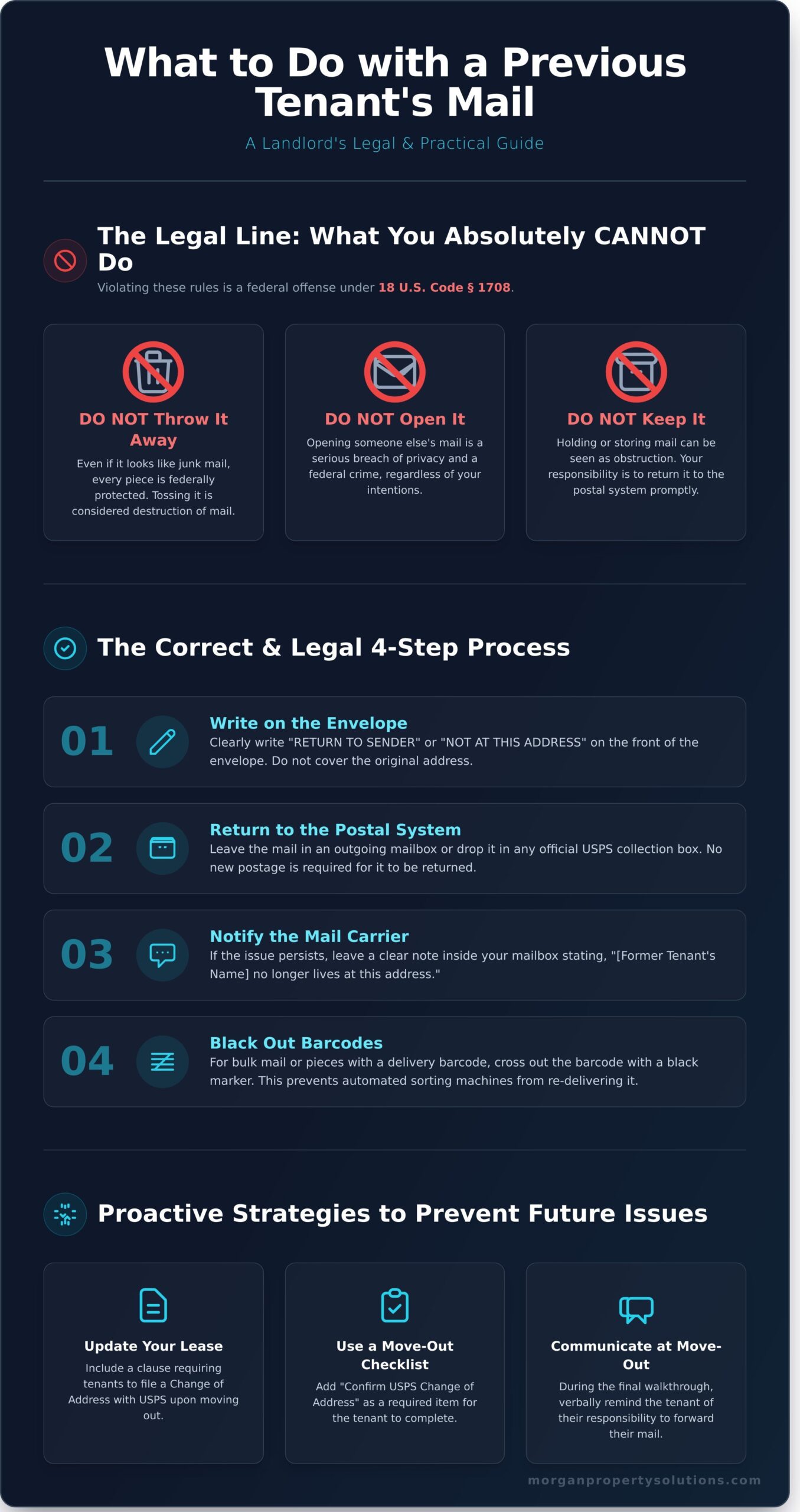
The Legal Line: What You Absolutely CANNOT Do With Old Mail
As a landlord, dealing with a pile of mail addressed to someone who no longer lives at your property is a common annoyance. The temptation to simply toss it in the recycling bin is understandable, but it’s a mistake that can lead to serious legal trouble. When deciding what to do with mail from a previous tenant, your first step is to understand the strict federal laws that protect all mail. Following these rules isn’t just good practice; it’s a legal requirement that keeps you protected.
Under federal law, specifically 18 U.S. Code § 1708, it is a crime to obstruct the delivery of mail. This means that knowingly opening, hiding, or destroying mail that is not addressed to you can result in significant fines or even imprisonment. Our goal is to help you handle this situation professionally and legally, avoiding any unnecessary complications.
Don’t Throw It Away (Even if it Looks Like Junk)
That stack of flyers, credit card offers, and catalogs might look like junk, but the law makes no distinction. Every piece of mail delivered by the United States Postal Service is federally protected. Tossing out a former tenant’s mail—even if you believe it’s unimportant—is considered destruction and a violation of the law. It’s a simple mistake that can have serious consequences, so it’s best to treat every envelope with care.
Don’t Open It
Curiosity can get the better of anyone, especially if an envelope looks official or important. However, you are not authorized to open mail that is not addressed to you. Doing so is a federal offense and a major breach of the former tenant’s privacy. Even if your intentions are good—for example, you want to find a forwarding address inside a bill—opening the mail is a line you must not cross. The contents are legally private and confidential to the addressee.
Don’t Keep It or ‘Hold Onto It’
While you may think you’re helping by collecting the mail to give to the tenant later, this is also a mistake. Intentionally holding onto or storing someone else’s mail can be interpreted as obstruction or theft. Your responsibility is not to act as a personal mail service or storage unit. The simplest, safest, and most legally sound approach is to get the mail back into the postal system promptly, following official USPS guidelines so it can be properly rerouted or returned.
The Correct 4-Step Process for Handling a Former Tenant’s Mail
Dealing with leftover mail can feel like a persistent annoyance, but the solution is surprisingly simple. When you’re wondering what to do with mail from previous tenant, rest assured there is an official, USPS-approved process that protects you legally and requires minimal effort. Ideally, your former resident has already set up USPS mail forwarding services, but when items slip through, this straightforward 4-step guide will help you resolve the issue correctly and efficiently.
Step 1: Clearly Mark the Envelope
Your first step is to signal to the postal service that the recipient is no longer at this address. Take a pen and clearly write one of the following phrases on the front of the envelope, away from the delivery address and postage:
- NOT AT THIS ADDRESS
- MOVED, RETURN TO SENDER
- RETURN TO SENDER
It is crucial that you do not cross out the address or the barcode. The automated sorting machines at the post office use this information to process the mail. A simple, clear note is all that’s needed to get the letter rerouted correctly.
Step 2: Return the Mail to the USPS
Once you’ve marked the envelope, simply place it back in your mailbox for your carrier to pick up. No new postage or extra steps are required. If you prefer, you can also drop the mail into any official blue USPS collection box. This action officially returns the mail to the postal system to be handled by them, releasing you from any further responsibility for that piece of mail.
Step 3: Leave a Note for Your Mail Carrier
If you’ve returned mail but continue to receive items for the same person, it’s time to communicate directly with your local carrier. Write a clear, simple note and place it on the inside of your mailbox where the carrier is sure to see it. A good message would be:
“Please only deliver mail for [Your Name] and [Current Resident Names]. [Former Tenant’s Name] no longer lives here. Thank you!”
This personal note helps your specific carrier remember to filter out the incorrect mail before it even reaches your box, often solving the problem right at the source.
Step 4 (For Persistent Issues): Speak with the Postmaster
In the rare case that mail continues to arrive after you’ve taken the previous steps, your final action is to visit your local post office. Ask to speak with the postmaster or a station manager and explain the situation. They have the authority to put a more permanent stop on deliveries for that individual at your address, providing a definitive solution to the problem and ensuring your mailbox is reserved for your mail only.
Proactive Measures: How Landlords Can Prevent This Problem
While knowing the correct reactive steps is important, the best strategy is to prevent the problem from occurring in the first place. An expert property manager knows that shifting from a reactive mindset to a proactive one not only saves time but also enhances the tenant experience. By implementing a few simple procedures, you can significantly reduce the instances where you have to figure out what to do with mail from a previous tenant.
These professional habits demonstrate thoroughness and care, reducing future complaints and making your property management duties much simpler.
Update Your Lease Agreement
Your lease is the foundation of your landlord-tenant relationship, and it’s the perfect place to set clear expectations regarding mail. Including a specific clause about mail forwarding ensures tenants are aware of their responsibility from the moment they sign. We recommend adding terms that:
- Require the outgoing tenant to file an official change of address with the USPS upon moving out.
- State that any mail received for them more than 30 days after their lease ends will be marked “Return to Sender.”
Implement a Thorough Move-Out Process
A smooth move-out is more than just a key handover; it’s your final opportunity to ensure all loose ends are tied up. Integrate mail forwarding into your standard move-out checklist. During the final walkthrough, verbally confirm that the tenant has a plan to forward their mail. To make it even easier, you can provide them with a direct link to the USPS change-of-address form in their move-out packet. This small, helpful gesture goes a long way in preventing future issues.
To further encourage a seamless transition, you might also suggest they hire a professional moving company. An organized mover can reduce the stress of a move, making it more likely that tenants will remember administrative tasks like mail forwarding. Reputable companies such as All American Moving And Storage often provide checklists and reminders that benefit both the tenant and the landlord.
Communicate With New Tenants
Preparing your new residents is just as important as preparing your old ones. During the move-in orientation, take a moment to address the possibility of receiving stray mail. Let them know that if mail for a previous resident arrives, they should simply write “Not at this address” or “Return to Sender” on the envelope and place it back in an outgoing mailbox. This simple instruction empowers them to handle the situation correctly and prevents them from becoming frustrated or improperly discarding someone else’s property.
By integrating these steps into your routine, you can nearly eliminate the recurring question of what to do with mail from previous tenant. It’s about creating a system that protects you, supports your former tenants, and provides a seamless experience for your new ones. For more expert advice on streamlining your processes, explore our comprehensive Landlord Resources.
Simplifying Your Role: When a Property Manager Can Help
As this guide has shown, learning the proper steps for what to do with mail from a previous tenant is just one of many small but crucial responsibilities landlords face. This single task is a perfect example of the countless details that can make self-managing a rental property feel like a full-time job. From late-night maintenance calls to navigating complex rental laws and screening applicants, these duties accumulate and can create significant stress for property owners. Understanding your rights and obligations under Florida landlord tenant law—including situations like breaking a lease in Florida—is essential to protecting yourself and your investment.
Instead of letting your investment become a source of anxiety, consider it an opportunity to build a professional team. Partnering with an experienced property management company can transform your experience as a landlord, giving you back your valuable time and, most importantly, your peace of mind.
Beyond Mail: Managing All Tenant Communication
A professional property manager acts as the single, reliable point of contact for all tenant matters. We don’t just handle mail; we manage the entire tenant lifecycle with proven systems. This ensures every interaction is handled consistently, professionally, and in full compliance with the law. Our role includes:
- Fielding and coordinating all maintenance requests, 24/7.
- Addressing tenant questions, concerns, and disputes promptly and fairly.
- Managing lease renewals, negotiations, and enforcement.
- Conducting thorough move-in and move-out inspections and documentation.
Let Us Handle the Details for You
Your focus should be on the big picture—growing your portfolio and enjoying the returns on your investment. Let a dedicated team manage the daily operations. You no longer have to worry about the specifics of what to do with mail from a previous tenant or any other minor complaint, because we take care of all the details so you don’t have to.
At Morgan Property Solutions, we are dedicated to making rental property ownership simple and stress-free. Our experienced team is here to protect your asset, eliminate vacancies, and boost your profits. Learn more about our Orlando Property Management services and discover how we can help you achieve true passive income.
A Clear and Simple Path Forward
Ultimately, knowing what to do with mail from previous tenant is a straightforward responsibility that protects you legally and maintains professionalism. Always remember the golden rule: you cannot open, destroy, or withhold mail. The correct and simplest action is to write “Not at this address, Return to Sender” on the envelope and let the postal service handle the rest. By taking proactive steps during the move-out process, you can significantly reduce the chances of this becoming a recurring issue.
While handling stray mail is a minor task, it represents the many small details that make property management a demanding job. If you’re ready to offload these responsibilities and enjoy a truly passive investment, Morgan Property Solutions is your trusted partner. Our team brings over 20 years of combined experience and an A+ BBB Rating to deliver professional, stress-free management for your property. We handle the details so you can enjoy the rewards. Let us make your life as a landlord easier. Explore our property management services.
Frequently Asked Questions
Is it illegal to throw away a previous tenant’s mail in Florida?
Yes, it is illegal to throw away or open mail that is not addressed to you. This is a federal offense, not just a state law in Florida. According to U.S. Code, intentionally destroying, hiding, or opening another person’s mail is a crime. The proper and legal course of action is to return any letters or packages to the postal service so they can be handled correctly and returned to the original sender.
How long does a former tenant have to change their address?
While there is no legal deadline for a tenant to change their address, the USPS mail forwarding service has its own timeline. A standard Change of Address (COA) order forwards First-Class Mail for 12 months and periodicals for 60 days. It is the tenant’s responsibility to set this up. As a landlord, your best course of action is to simply return any mail that arrives after they have moved out.
What if I receive a package for a previous tenant?
Handling packages requires a similar, careful approach. Do not open them. If the package was delivered by the USPS, you can write “Not at this address” on the label and give it back to your mail carrier or drop it at the post office. For packages from private carriers like UPS or FedEx, you should contact their customer service directly to report the incorrect delivery and schedule a pickup. They will guide you on the next steps.
Can I find the previous tenant’s new address and forward the mail myself?
While it may seem helpful, we strongly advise against this. Forwarding mail yourself can create privacy concerns and potential liability for you as the landlord. The simplest and most legally sound solution is to let the postal system do its job. By writing “Not at this address, Return to Sender” on the envelope, you place the responsibility back with the USPS, which is the correct and safest procedure for everyone involved.
What should I do if I receive mail that looks like a government check or official document?
This situation requires immediate and proper handling. When you receive what appears to be an official document, like a tax refund or court summons, it is critical that you do not discard it. The correct action is to clearly write “Not at this address, Return to Sender” on the envelope and promptly place it back in a mailbox. This ensures the important document is returned to the issuing agency so they can locate the recipient.
Does the post office eventually stop delivering the old tenant’s mail automatically?
Yes, the postal service will eventually stop the deliveries, but it often requires your consistent help. If a tenant fails to set up mail forwarding, the local carrier may not know they have moved. The key is to consistently mark any mail with “Not at this address” and return it. This signals to the carrier that the recipient is gone, and over time, they will cease delivering that person’s mail to your property.
As a landlord, can I put a clause in the lease about mail forwarding?
Absolutely, and this is an excellent, proactive step we highly recommend. Including a clause in your lease agreement that requires the tenant to submit a change of address form with the USPS upon vacating is a smart practice. This sets clear expectations from the beginning and helps prevent future mail issues. It is one of the best ways to simplify the answer to the question of what to do with mail from previous tenant.
What’s the difference between ‘Return to Sender’ and ‘Forwarding’?
This is a great question that often causes confusion. ‘Forwarding’ is a service the former tenant sets up with the USPS to have their mail automatically rerouted from the old address to their new home. ‘Return to Sender’ is the action you, the landlord, take on a piece of mail that was delivered to your property for someone who no longer lives there. It sends the item back to the original sender, not to the former tenant.

Article by
Oliver Overton-Morgan
Oliver Overton-Morgan is a full-time Real Estate Broker since 2003, with years of experience helping thousands of people purchase and sell real estate throughout Central Florida. He holds a Graduate Realtor Institute designation, LCAM, and has held licenses in good standing as a Florida Mortgage Broker and a Notary Public. Oliver immigrated to central Florida in 2001, and within 5 years Oliver built a successful Real Estate brokerage in central Florida, where he recruited over 75 Sales Associates with 25+ million in sales production.