
Imagine handing over the keys to your beautiful Winter Park rental, only to realize three months later that your resident hasn’t paid rent and knows exactly how to exploit the legal system to stay for free. It’s a nightmare scenario that keeps many Central Florida landlords awake at night. With Orlando vacancy rates hovering around 8% to 9% in 2026, the pressure to fill units quickly is real, but skipping steps is never the answer. You’ve likely felt the stress of trying to find a reliable florida tenant screening checklist that protects your investment without accidentally triggering a Fair Housing lawsuit.
This guide is designed to take the guesswork out of the vetting process and provide you with a clear, repeatable path to success. By following a professional strategy, you can significantly lower your eviction risk and gain the peace of mind that comes with knowing your property is in good hands. We will walk you through the essential steps for verifying income, managing security deposits under the latest Florida statutes, and navigating the seven-year criminal history lookback period with total confidence.
Key Takeaways
- Learn why Central Florida’s 2026 market trends make a rigorous vetting process essential for protecting your property’s long-term value.
- Discover how to build a comprehensive florida tenant screening checklist that includes credit, criminal background, and eviction history to find reliable residents.
- Master the legal nuances of the Fair Housing Act and Florida’s specific 2026 regulations to avoid costly litigation and compliance errors.
- Identify key red flags, such as incomplete applications and “rental hopper” patterns, that help you spot problematic applicants before they move in.
- Understand how partnering with an Orlando property manager can simplify the screening process and remove the emotional stress of handling resident rejections.
Why a Robust Tenant Screening Checklist is Essential in Florida’s 2026 Market
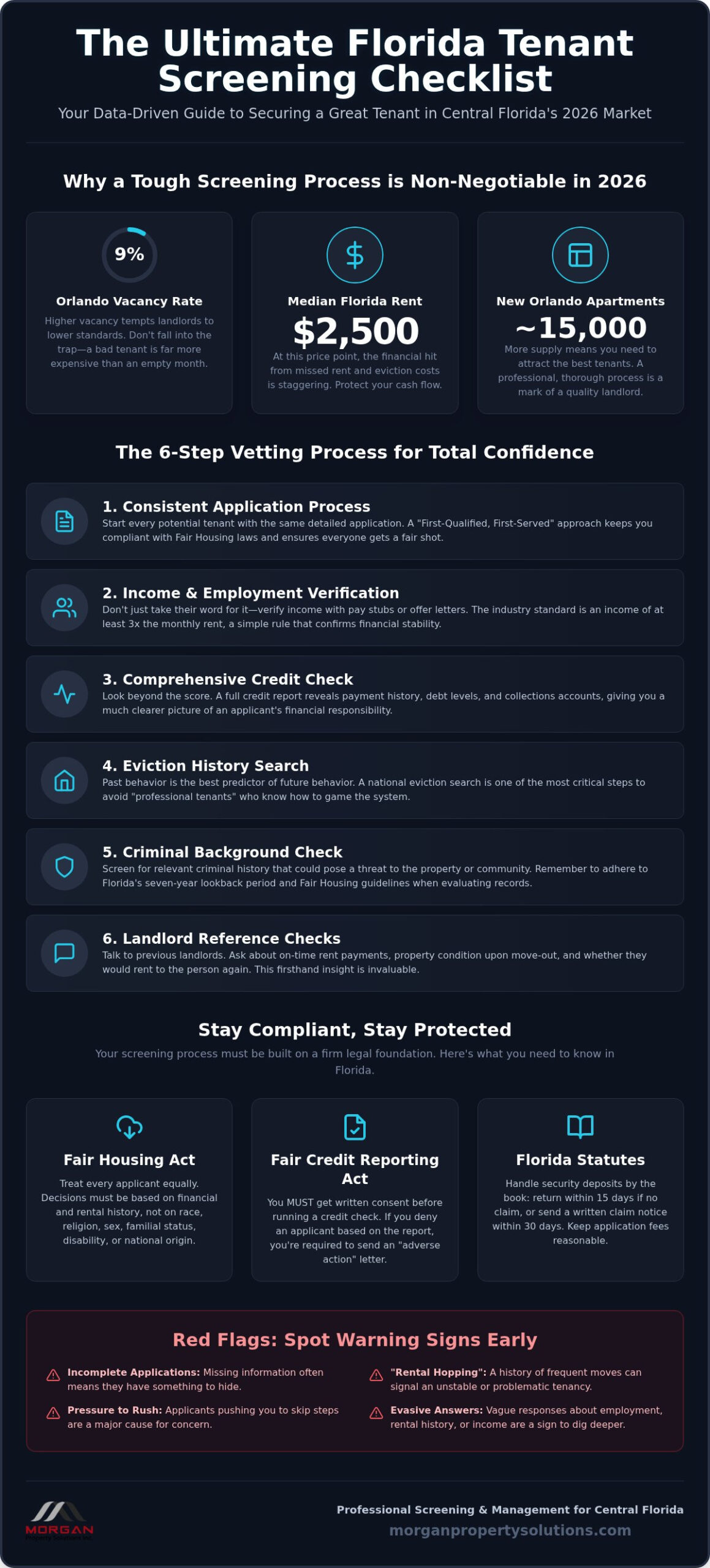
Owning a rental property in Central Florida is a significant financial move, but it comes with risks that can’t be ignored. A single “professional tenant” who knows how to game the system can cost you thousands in lost rent, legal fees, and property damage. In the current market, where the median rent in Florida has reached $2,500 as of June 2026, the stakes are higher than ever. You aren’t just looking for someone to fill a room; you’re looking for a reliable partner to help maintain your investment’s value. Relying on a “gut feeling” during an interview is one of the most dangerous mistakes a landlord can make. Intuition is often just a mask for unconscious bias, which can lead to devastating Fair Housing lawsuits. A standardized florida tenant screening checklist removes the emotion from the equation and replaces it with cold, hard data.
Consistency is your best defense against legal trouble. When you apply the same rigorous tenant screening process to every applicant, you demonstrate a commitment to fair and equal treatment. This professional approach doesn’t just protect you legally; it also sets a tone for the entire tenancy. High-quality residents want to know that their landlord is organized, thorough, and follows the law. By using a clear set of screening criteria, you filter out mismatched applicants before they ever set foot in your property, saving you time and preventing future headaches.
The High Stakes of the Central Florida Rental Market
The Central Florida landscape is changing. While Orlando saw a slight 2.2% decrease in median asking rents in early 2026, high-growth pockets like Winter Garden and Clermont continue to see steady demand. With roughly 12,000 to 15,000 new apartment units delivered to the Orlando metro area recently, vacancy rates have climbed to about 8% or 9%. It might be tempting to lower your standards just to get a lease signed quickly. However, rushing a vacancy is a short-term fix that often leads to long-term disasters. We’ve found that maintaining a professional image and a strict vetting process actually attracts the stable, long-term residents you want. It’s always better to have a property sit empty for an extra week than to spend six months trying to evict a tenant who should never have been approved in the first place.
Protecting Your Investment with Reliable Data
True protection comes from a holistic view of an applicant. A credit score only tells part of the story. You need to verify employment, check for eviction history within the state of Florida, and confirm rental references. At Morgan Property Solutions Inc., we focus on a “reassuring and helpful” communication style during this phase to keep the process moving smoothly for everyone involved. This level of detail is exactly what we provide through our Orlando property management services. We believe that thorough screening is the foundation of a high ROI. When you have the right data, you can make decisions with confidence, knowing your property is in good hands and your financial future is secure.
Navigating the Legal Landscape of Florida Tenant Screening
Vetting a potential resident is about more than just checking a credit score. It’s a formal legal process used to evaluate an applicant’s rental history, financial stability, and criminal background. To do this correctly, you must operate within a framework of federal and state laws. Every florida tenant screening checklist should begin with a solid understanding of the Fair Credit Reporting Act (FCRA). This federal law requires you to get written consent before running any reports. It also dictates how you must handle the data you find. If you decide to deny an applicant based on their credit report, you’re legally obligated to send an “adverse action” letter explaining the decision. This isn’t just a courtesy; it’s a requirement that protects you from claims of unfair treatment.
Florida’s specific statutes add another layer of responsibility. The Florida Residential Landlord and Tenant Act governs how you handle application fees and security deposits. As of August 2026, Florida does not have a statewide cap on application fees, but they should remain reasonable to cover the actual costs of the reports. When it comes to security deposits, the law is very clear. If there’s no claim against the deposit, you must return it within 15 days of the tenant moving out. If you intend to make a claim, you have 30 days to provide written notice. Staying compliant with these timelines is vital for maintaining your professional reputation in the Central Florida market.
Fair Housing Act Compliance in Central Florida
Discrimination is the quickest way to find yourself in a legal battle. The Fair Housing Act protects applicants from being treated differently based on race, color, national origin, religion, sex, familial status, or disability. In competitive areas like Orlando, many owners adopt a “First-Qualified, First-Served” policy. This means you process applications in the order they’re received and accept the first person who meets your written standards. You also need to be prepared for reasonable accommodation requests, such as a service animal in a “no-pet” property. Be careful with criminal background checks, too. Using a blanket ban on anyone with a record can lead to “disparate impact” claims. Instead, focus on recent history that directly impacts the safety of your property or other residents.
Understanding Local and State Regulations
Rules can feel like they’re constantly shifting. For a deeper dive into the specific rules that govern your investment, check out our Florida landlord tenant law guide. It provides the legal context you need to manage properties in Winter Park or Lake Nona without fear. Following high Orlando property management standards ensures you don’t miss small details like the seven-year lookback period for criminal history. If you’re feeling overwhelmed by these regulations, our team can help you navigate the screening criteria required for a successful rental. We’re here to be your ally and simplify these complex steps so you can focus on growing your portfolio.
The Ultimate Florida Tenant Screening Checklist: 5 Essential Steps
Moving from the legal theory into actual practice requires a methodical approach. A well-structured florida tenant screening checklist ensures that every applicant is treated fairly while protecting your property from avoidable risks. By following these five steps, you can filter out residents who aren’t a good fit for your Central Florida rental and focus on those who will treat your home with respect. This process isn’t just about finding a tenant; it’s about finding the right tenant for your specific investment goals.
Step 1 & 2: Setting the Foundation
Success begins before you even show the property. You must establish clear, written screening criteria before you post your first advertisement. In the Orlando market, common benchmarks include a monthly income of at least three times the rent and a credit score of 600 or higher. Since the median asking rent in Orlando was $1,675 in May 2026, you should look for applicants earning roughly $5,000 per month. Mentioning these requirements directly in your listing saves everyone time by discouraging unqualified leads from applying in the first place.
Once the inquiries start rolling in, use a pre-screening phone call as your first filter. Ask simple, direct questions about their desired move-in date, whether they smoke, and if they have pets. If they need to move in tomorrow or have four large dogs for a small condo in Windermere, you can politely let them know the property isn’t a match. This conversational approach allows you to build a rapport while maintaining your professional standards. It’s much easier to have these discussions early than to wait until after they’ve paid an application fee.
Step 3 & 4: Data Collection and Verification
Every adult who plans to live in the home must submit a signed rental application and a copy of their government-issued ID. This is a non-negotiable part of understanding landlord and tenant responsibilities during the vetting phase. You need to know exactly who is occupying your property to stay compliant with local occupancy limits and insurance requirements. During this stage, most landlords run a “soft” credit pull, which provides a detailed look at financial habits without negatively impacting the applicant’s credit score.
Don’t just look at the score, though. Examine the Previous Address Tenant History (PATH) report to see if their stated rental history matches public records. Discrepancies here are often a sign that an applicant is trying to hide a difficult past with a previous landlord. A comprehensive background check should also include criminal and eviction history. This data-driven approach gives you a holistic view of the applicant’s reliability and financial health.
Step 5: The Power of Reference Checks
The final step is the most human one: personal verification. Talk to previous landlords and ask specific questions about property care and late payments. When verifying income, don’t just take their word for it. Require recent pay stubs, W-2s, or tax returns if they’re self-employed. Professional verification relies on objective data and neutral third-party conversations to ensure accuracy, whereas calling a friend often leads to biased information that puts your investment at risk. This level of diligence is what separates successful investors from those who struggle with constant turnover.
Identifying Red Flags and Making a Fair Decision
Once you have the data from your florida tenant screening checklist, the next step is looking for the subtle details that numbers alone might miss. Red flags aren’t always glaring neon signs. Sometimes, they’re as simple as an incomplete application or a missing signature. If an applicant is unwilling to provide basic documentation like a government ID or recent pay stubs during the vetting phase, it’s a strong indicator of how they’ll handle lease requirements later. You should also be wary of the “rental hopper.” While people move for many reasons, a pattern of moving every six to nine months suggests instability that could lead to high turnover costs for your Central Florida investment.
Urgency is another major warning sign. Be cautious of anyone who insists on moving in “today or tomorrow.” While legitimate emergencies happen, extreme haste often masks a pending eviction or a recent conflict with a previous landlord. In a market like Florida, where the median rent is $2,500 as of June 2026, you have the right to take the time needed for a thorough review. A rushed decision is rarely a good one and often leads to the very “professional tenant” issues you’re trying to avoid.
Spotting Discrepancies in Rental and Employment History
Fake references are a common hurdle for independent landlords. We’ve seen plenty of applicants list a “landlord” who is actually just a friend with a script. A professional eye can spot these by asking specific questions about the property’s layout or the exact dates of the tenancy. Don’t overlook late utility payments on a credit report, either. Even if the rent was paid, a history of shut-off notices for power or water suggests a struggle with basic financial management. Regarding criminal history, follow HUD guidelines by focusing on the nature of the offense and how long ago it occurred rather than using a blanket rejection policy. This case-by-case approach keeps you compliant while still protecting your property’s safety.
How to Legally Deny an Applicant in Florida
Denying an applicant is a delicate process that must be handled with care to avoid legal pushback. If your decision is based on a credit report, you’re legally required to provide an Adverse Action Notice. This document informs the applicant of their right to see the report and dispute inaccuracies with the credit bureau. Always document your specific, objective reasons for denial based on your pre-set criteria. This record is your best defense if a claim of discrimination ever arises. Handling these difficult conversations requires poise and years of experience. This is one reason many owners choose residential property management to act as a professional buffer between themselves and the applicant pool.
If you want to ensure your vetting process is both bulletproof and stress-free, let our team handle the details with our expert Orlando property management services. We’re here to help you navigate the complexities of the 2026 market with confidence.
How Professional Management Simplifies Screening in Orlando
Running through a florida tenant screening checklist on your own is a great way to understand the basics, but doing it consistently for every applicant can quickly become a full-time job. Professional property management takes that weight off your shoulders by using advanced software that accesses databases most individual owners simply can’t reach. These tools provide a deeper look into an applicant’s history, from nationwide eviction records to detailed financial patterns that a standard credit report might miss. By automating the data collection, we reduce the risk of human error and ensure that every decision is based on objective, high-quality information. This streamlined approach doesn’t just improve the quality of your residents; it also gets them moved in faster, which is vital in a cooling market where speed and accuracy are equally important.
One of the biggest benefits of professional help is having a reliable buffer for the “uncomfortable” moments of landlording. Calling a previous landlord to verify a difficult move-out or sending a formal denial notice isn’t exactly a pleasant task. We handle those interactions with the poise and professionalism that comes from over 20 years of experience in the Central Florida market. This doesn’t just save you from personal stress. It also protects you from accidentally saying the wrong thing and inviting a legal claim. Our team stays current on every shift in state statutes, so you never have to wonder if your process is still compliant with the latest regulations.
The Morgan Property Solutions Inc. Advantage
At Morgan Property Solutions Inc., we pride ourselves on being more than just a service provider. We are your steady ally in the complex world of real estate. Our about page highlights our deep roots and specialized knowledge in Orlando, Winter Park, and Lake Nona. We use a streamlined digital application process that residents find easy to use, which helps us capture high-quality leads before they move on to the next listing. Through our secure online portal, you can stay informed about the screening progress without having to manage the paperwork yourself. It’s all about giving you the freedom to enjoy your investment profits while we handle the fine print.
Ready to Simplify Your Rental Property Management?
Partnering with a local expert is the most effective way to maximize your financial returns and protect your valuable time. If you’re tired of the anxiety that comes with vetting strangers and worry about the legal nuances we’ve discussed, it is time to see what a professional can do. We offer a free rental analysis to help you understand your property’s true potential in the current market. Whether you have a single home in Windermere or a growing portfolio in Winter Garden or Oviedo, our Orlando property management team is ready to step in and provide the expert care you deserve. We’re here to help you navigate every step of the journey.
Secure Your Investment with Confidence
Vetting residents in a cooling 2026 market requires a careful balance of objective data and local intuition. You’ve learned how a standardized florida tenant screening checklist prevents legal pitfalls and why spotting red flags early saves you from the stress of a problematic tenancy. By following these steps, you can protect your rental’s ROI and ensure your property stays in good hands. Managing these details on your own can be a heavy lift; however, you don’t have to navigate the complexities of the Central Florida market alone.
With 20+ years of expertise and an A+ rating, Morgan Property Solutions Inc. is here to be your steady ally. We provide comprehensive, FCRA-compliant screening that takes the guesswork out of finding reliable residents for your Orlando or Winter Park property. Ready to take the stress out of landlording? Simplify Your Tenant Screening with Morgan Property Solutions Inc. and let us handle the fine print for you. We look forward to helping you achieve long-term success and peace of mind with your rental portfolio.
Frequently Asked Questions
What is the maximum application fee I can charge in Florida?
Florida law does not set a specific statewide cap on rental application fees. You’re free to set your own fee, but it should be reasonable and reflect the actual costs of background checks and administrative processing. Most professional managers keep these fees competitive to ensure they don’t discourage high-quality applicants from applying to your Central Florida property.
Can I legally deny a tenant for having a low credit score in Orlando?
You can legally deny an applicant for a low credit score as long as you apply this standard consistently to every person on your florida tenant screening checklist. If you use credit as a reason for rejection, federal law requires you to send an Adverse Action Notice. This document explains the decision and tells the applicant how to contact the credit bureau for a free copy of their report.
How much income does a tenant typically need to show for a Central Florida rental?
Most landlords in the Orlando market require applicants to show a gross monthly income of at least three times the monthly rent. For example, since the median asking rent in Orlando was $1,675 in May 2026, a tenant would typically need to prove they earn roughly $5,000 per month. This standard helps ensure the resident can comfortably afford the home and stay current on their payments.
Are criminal background checks legal for tenant screening in Florida?
Criminal background checks are a legal and standard part of the vetting process in Florida. However, you should follow a seven-year lookback period for most records to stay aligned with industry standards. It’s also vital to follow HUD guidelines by evaluating the nature and severity of an offense rather than using a blanket ban, which can help you avoid claims of disparate impact discrimination.
What happens if I accidentally violate Fair Housing laws during screening?
Accidentally violating Fair Housing laws can lead to expensive lawsuits and significant fines from government agencies. Even a small mistake in how you phrase a rejection can trigger a formal investigation. This is why we recommend having a written, repeatable process and keeping detailed records of every decision. If you’re feeling anxious about compliance, a professional property manager can act as a legal buffer.
How long does the tenant screening process usually take?
A thorough screening process usually takes between 24 and 72 hours to complete. While digital background and credit reports are often instant, verifying employment and reaching previous landlords for references can take a bit longer. We’ve found that keeping applicants updated during this phase helps maintain a professional relationship and prevents them from moving on to a different rental while they wait for your decision.
Should I screen every adult who will be living in the property?
You should definitely screen every person aged 18 or older who intends to live in the home. Each adult occupant should be treated as a co-applicant on your florida tenant screening checklist and be named as a responsible party on the lease. This ensures that every adult is legally accountable for the rent and that you have a clear understanding of everyone’s background before they move in.
Can a landlord refuse to accept a cosigner or guarantor?
Landlords are not legally required to accept cosigners or guarantors in Florida. You have the right to set your own criteria, such as requiring the primary resident to meet income and credit standards on their own. If you do choose to accept a guarantor, make sure they go through the same rigorous screening process as the tenant to ensure they have the financial strength to cover the lease.

Article by
Oliver Overton-Morgan
Oliver Overton-Morgan is a full-time Real Estate Broker since 2003, with years of experience helping thousands of people purchase and sell real estate throughout Central Florida. He holds a Graduate Realtor Institute designation, LCAM, and has held licenses in good standing as a Florida Mortgage Broker and a Notary Public. Oliver immigrated to central Florida in 2001, and within 5 years Oliver built a successful Real Estate brokerage in central Florida, where he recruited over 75 Sales Associates with 25+ million in sales production.