Did you know that the cost of living in Orlando Florida is now approximately 7% higher than the national average? While the sunshine remains a major draw, the reality of 2026 is that a three-bedroom apartment in the city center averages about $3,028 per month. It’s a significant shift that requires more than just a surface-level look at your budget before you pack your bags.
We understand that the financial side of moving can feel stressful. You might be worried about rising homeowners insurance premiums or the hidden costs of a daily commute on I-4. It is perfectly normal to feel a bit of anxiety when you’re trying to figure out which neighborhoods actually offer the best value for your family. At Morgan Property Solutions, we’ve spent over 20 years helping people navigate these exact transitions with confidence.
This guide will provide you with a clear, neighborhood-by-neighborhood breakdown of what it truly costs to live here in 2026. We will explore everything from utility changes like the OUC DemandLevel program to property tax caps and professional property management insights. By the end, you’ll have a realistic view of monthly expenses and the confidence to make an informed decision about your relocation to Central Florida.
Key Takeaways
- Get a realistic look at the 2026 cost of living in Orlando Florida, including how new utility pricing and insurance trends affect your bottom line.
- Understand why your neighborhood choice, from the premium streets of Winter Park to the innovation of Lake Nona, is the biggest factor in your monthly expenses.
- Learn how to navigate Florida’s unique tax landscape, including the “Save Our Homes” assessment cap and property tax rates for new homeowners.
- Discover the “sun tax” realities of living in Central Florida, from the necessity of toll budgets to managing high electric bills during the summer months.
- Explore how professional property management services can streamline your relocation and help you find the best value in a competitive rental market.
Is Orlando Still Affordable? A 2026 Reality Check
Many people look at generic online calculators and think they have a handle on the cost of living in Orlando Florida. However, as we move through 2026, those numbers don’t always capture the “real feel” of our local economy. Orlando is a city in transition. Massive population growth has shifted the local landscape, making it feel quite different than it did even a few years ago. While the lack of a state income tax remains a major draw for relocators, you have to balance that against the rising costs of local services and goods.
The 2026 reality is that your budget depends heavily on your lifestyle and your specific neighborhood choice. A generic calculator won’t tell you about the local nuances of insurance or the specific ways toll roads can eat into your monthly take-home pay. It is about looking past the surface to see how your daily life will actually look. Moving here is a big step, and understanding the true economic landscape is the first part of making it a success.
Orlando vs. The National Average
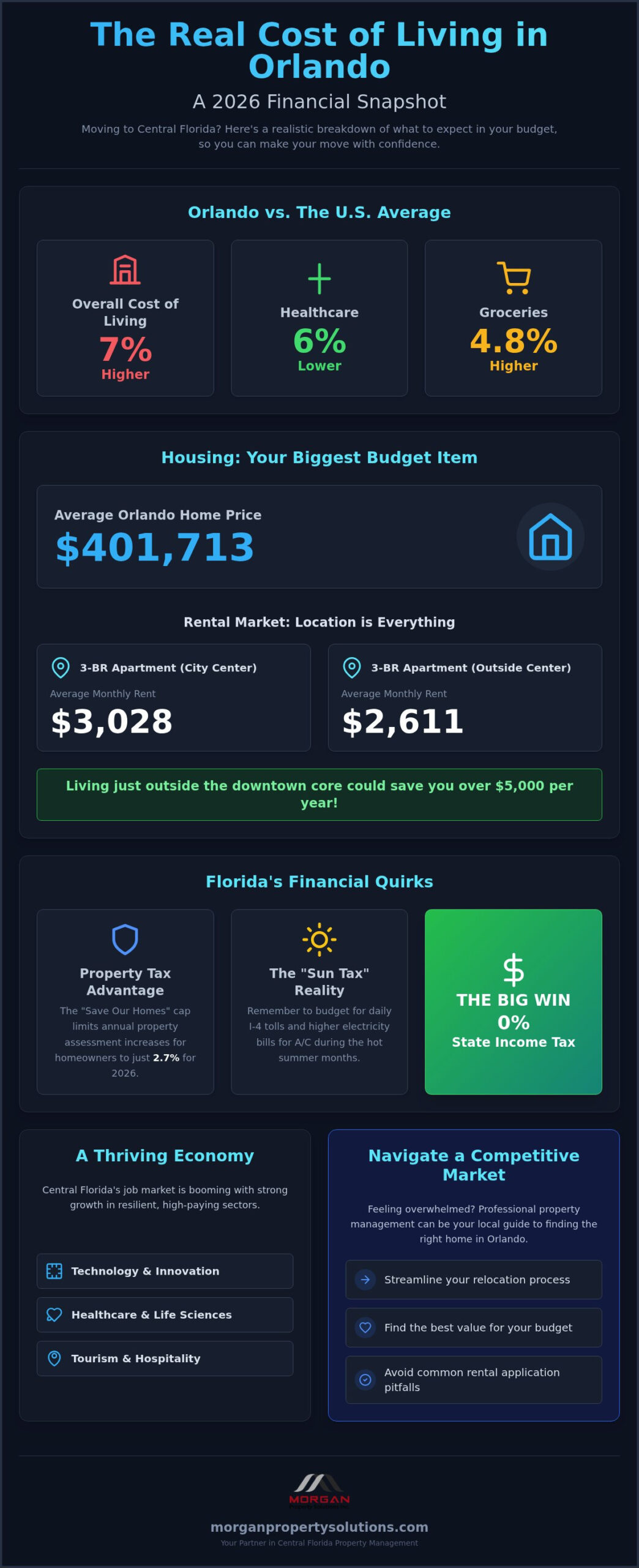
Some older online reports might claim that Orlando is significantly cheaper than the rest of the country. However, current 2026 data shows that the cost of living in Orlando Florida is actually about 7% higher than the national average. This shift is a direct result of our city’s incredible popularity and the resulting demand for housing and services. The city offers a unique trade-off. For example, healthcare expenses in Orlando are roughly 6% below the national average. This is a significant benefit for retirees and families who prioritize medical access.
On the other hand, you’ll likely notice higher prices at the supermarket. Groceries in Orlando are currently about 4.8% more expensive than the national average. For a deeper look at our city’s structure and demographics, this Overview of Orlando, Florida provides excellent context on how our diverse economy functions. Understanding these differences helps you set a realistic expectation for your new life in the sun.
The 2026 Economic Outlook for Central Florida
The job market in Central Florida is currently thriving. We are seeing incredible growth in tech, healthcare, and our world-class tourism sector. This diversification means that the local economy is more resilient than ever. It provides a stable foundation for those looking to relocate and work here, offering a variety of paths for career advancement and financial security.
Even with a strong job market, managing a move in a shifting economy requires a bit of local expertise. At Morgan Property Solutions, we bring over 20 years of experience to the table. We help our clients understand how to maximize their purchasing power in a competitive market. If you are considering an investment while you live here, our Orlando property management services can help you find the right balance between cost and return. Having a steady ally makes it much easier to avoid common pitfalls and find a neighborhood that truly fits your budget.
Housing and Real Estate: The Foundation of Your Budget
Your monthly housing payment is the single largest factor in the cost of living in Orlando Florida. Whether you are looking to buy a home or secure a rental, the 2026 market requires a strategic approach. The average home price in Orlando has reached $401,713, which is a major reason many people choose to rent before they commit to a purchase. According to recent Orlando economic data, our city’s growth remains steady, but that popularity means you need to be prepared for competitive pricing across all neighborhoods.
Location within the “City Beautiful” dictates your monthly budget more than any other variable. For instance, a three-bedroom apartment in the city center currently averages $3,028 per month. If you are willing to look just outside the downtown core, that same space drops to approximately $2,611. These differences can add up to thousands of dollars in savings each year, which is why we always suggest exploring multiple suburbs before signing a lease.
Renting in Orlando: What to Expect
Most rental agreements in Central Florida follow a standard 12-month lease term. It is common for rent to cover basic maintenance and sometimes trash collection, but you’ll usually be responsible for water and electricity. Because the market is so active, landlords have become very specific about who they let into their properties. Understanding our screening criteria is a vital first step to ensure your application stands out. If you’re feeling overwhelmed by the options, we’ve put together a guide on finding homes for rent in Orlando to help you navigate the process with ease.
The Hidden Costs: Insurance and Property Taxes
New residents are often surprised by how Florida handles property taxes. Thanks to the “Save Our Homes” assessment cap, long-term homeowners have their annual increases limited to 3% or the Consumer Price Index, whichever is lower. For 2026, that cap is 2.7%. This means your neighbor might pay significantly less in taxes than you will as a new owner. You should budget for property taxes based on the median rate of 1.19% applied to your purchase price rather than the seller’s current bill.
Homeowners insurance is another critical budget line item that generic calculators often miss. Premiums have risen significantly across the state, and it is essential to get a quote before you finalize a home purchase. For those who choose to rent, the Florida Landlord Tenant Law provides important protections regarding security deposits and notice periods. Working with a professional Orlando Property Manager can help you find a home that fits your financial goals while ensuring all local regulations are followed correctly.
Utilities, Transportation, and the ‘Florida Sun’ Tax
Once you have settled your housing costs, it is time to look at the daily expenses that make up the rest of the cost of living in Orlando Florida. We often call this the “Florida Sun Tax.” It is not an official government levy, but rather the cumulative cost of keeping your home cool and your car moving through our sprawling metro area. While our healthcare costs are lower than the national average, your utility and transportation budgets will likely take a larger bite out of your paycheck here than in other states.
Living in Central Florida means your air conditioning will likely run for ten months of the year. This constant demand makes energy efficiency a top priority for any resident. Water service is also a factor, with a base charge of $10.50 per month plus volumetric rates. Most municipalities bundle trash and recycling services into your utility or tax bill, which simplifies the process but still requires room in your monthly budget.
Powering the AC: Monthly Utility Expectations
The average monthly electric bill in Orlando is about $278. This can fluctuate wildly between the mild winter months and the peak of August. In March 2026, the Orlando Utilities Commission (OUC) introduced the DemandLevel program. This plan adds a fixed monthly charge of $5 to $15 based on your peak usage but offers a 14% lower variable cost per kilowatt-hour. This change rewards those who can shift their energy consumption to off-peak hours.
If you are looking at rentals, check for energy-efficient upgrades. Many owners who utilize professional Orlando property management services have already installed smart thermostats and updated insulation to help tenants manage these costs. High-speed internet and phone plans are comparable to other major hubs, but you should always verify which providers serve your specific neighborhood before you move in.
Getting Around: Gas, Tolls, and Public Transit
Orlando is a car-centric city. While the LYNX bus service offers a 30-day pass for $50, most residents find a personal vehicle necessary for work and errands. You must budget for toll roads, which are a way of life here. Using an E-PASS or SunPass is essential for navigating the 408, 417, and the I-4 Express lanes. These costs can add up quickly if your commute involves several major highways.
According to recent Orlando Economic Data, transportation remains a significant portion of consumer spending in our region. Don’t forget to factor in Florida’s unique insurance requirements and registration fees. We recommend setting aside a specific “toll fund” in your monthly budget to avoid any surprises at the end of the month. While the SunRail provides a great alternative for North-South commuters, its limited schedule means it may not work for everyone.
Essentials and Lifestyle: Groceries, Healthcare, and Fun
Managing the cost of living in Orlando Florida involves more than just keeping the lights on. Once you step outside your home, you’ll find that daily essentials and lifestyle choices play a huge role in your monthly budget. For a single person, these costs often reach about $1,225 per month, excluding rent. For a family of four, that number jumps to roughly $4,441. It’s about finding the right balance between the convenience of a tourism hub and the smart habits of a local resident.
The Grocery Bill: Publix, Aldi, and Farmers Markets
Groceries here lean about 4.8% higher than the national average. Most locals have a love-affair with Publix, which is known for quality and service but can be pricier for a full weekly haul. To keep the budget in check, many residents mix in trips to Aldi or local farmers markets. The Winter Park Farmers Market and the Sunday market at Lake Eola offer fresh, local produce that often beats supermarket prices. If you’re planning a night out in Thornton Park or Winter Park, expect to pay a bit of a premium for the atmosphere, as these areas cater to both locals and the city’s many visitors.
Healthcare and Wellness Costs
Healthcare is one area where Orlando actually saves you money. Expenses in our city are roughly 6% below the national average. This affordability is largely driven by the high concentration of providers and specialized facilities within the “Medical City” area of Lake Nona, which fosters a competitive market for care. Having world-class facilities like Nemours Children’s Hospital and the VA Medical Center in your backyard doesn’t just provide peace of mind; it keeps local costs down through increased service availability and provider density.
Living in a global tourism destination means you’re never short on things to do, but it also means you have to be careful about “tourist pricing” in certain zones. Thankfully, Central Florida is packed with free and low-cost recreation. You can spend a Saturday paddleboarding on the Winter Park Chain of Lakes or exploring the many paved trails in neighborhoods like Lake Nona. Navigating these lifestyle choices is much easier when you have a partner who knows the area inside and out. If you want to learn more about how we support residents in finding the perfect home, feel free to reach out to the local experts at Morgan Property Solutions.
Choosing Your Neighborhood: Budget vs. Lifestyle
Orlando is not a monolith. It is a collection of unique communities, each with its own price tag and personality. Your personal cost of living in Orlando Florida will look very different if you choose a historic bungalow in Winter Park versus a new build in the rolling hills of Clermont. Matching your lifestyle to your budget is the most critical part of your relocation strategy. It’s about more than just the rent or mortgage; it’s about the time you spend in your car and the amenities right outside your front door.
As we move through 2026, we are seeing a clear divide between established luxury hubs and high-growth suburban value areas. Finding the right fit requires a “boots on the ground” perspective that you won’t find on a generic real estate app. We’ve spent over 20 years helping people navigate these local nuances to find a place that feels like home without breaking the bank.
High-End Hubs: Winter Park and Windermere
If you are looking for prestige and established charm, Winter Park (32789) and Windermere (34786) are the top contenders. In Winter Park, you’re paying for walkability, brick-lined streets, and world-class dining. Windermere offers a more secluded, lakefront lifestyle. The rental market in these areas is exceptionally tight. You can expect to pay a premium for any available unit, and competition among tenants is fierce. If you prefer a more modern, innovation-focused community that still offers a high-end feel, our Lake Nona buyer’s guide provides a detailed look at how that market compares in 2026.
Value-Driven Suburbs: Clermont and Apopka
For families who need more space, suburbs like Clermont and Apopka have exploded in popularity. These areas offer significantly more square footage for your dollar compared to the city center. Clermont is known for its hills and active outdoor lifestyle, while Apopka offers a more traditional suburban feel with great access to state parks. The primary trade-off here is the commute. You’ll likely spend more time on the 408 or 429, which means higher toll expenses.
Is the trade-off worth it? For many, the answer is yes. The monthly savings on housing in these suburbs can often offset the increased transportation costs. However, you have to run the numbers carefully. Learning more about us and our two decades of experience in the Central Florida market can help you weigh these pros and cons. We pride ourselves on being a steady ally, helping you find the perfect balance for your 2026 cost of living in Orlando Florida.
Take the Next Step Toward Your Orlando Future
Relocating to Central Florida in 2026 is an exciting journey, but success depends on a clear-eyed view of the numbers. The cost of living in Orlando Florida is influenced by many moving parts, from the new OUC utility programs to the specific property tax nuances for new homeowners. By choosing your neighborhood strategically and accounting for the “sun tax” of tolls and air conditioning, you can build a lifestyle that is both enjoyable and sustainable. It’s about finding that perfect balance between your desired amenities and your monthly budget.
You don’t have to navigate these complex transitions alone. With over 20 years of Central Florida expertise, Morgan Property Solutions serves as a steady ally for families and investors alike. As a top-rated property management firm, we bring comprehensive local market knowledge to help you find the right value in a competitive landscape. Simplify your move with Orlando’s trusted property experts. Contact Morgan Property Solutions today. We look forward to helping you find your place in the City Beautiful.
Frequently Asked Questions
Is Orlando expensive to live in compared to Miami or Tampa?
Orlando is generally more affordable than Miami but sits at a similar price point to Tampa. While Miami’s housing and lifestyle costs are significantly higher, Orlando’s 2026 market offers a wider range of suburban price points. The city’s growth in tech and healthcare provides a stable economic base that Miami’s tourism-heavy market sometimes lacks. You’ll find that your dollar often stretches further here when comparing mid-range housing and daily essentials.
How much money do you need to live comfortably in Orlando in 2026?
To live comfortably in 2026, a single person should budget approximately $1,225 per month for essentials, excluding rent. For a family of four, that baseline rises to roughly $4,441. When you add the average rent for a three-bedroom apartment outside the city center, which is $2,611, a family should aim for a household income that covers at least $7,000 in monthly expenses to maintain a high quality of life.
What is the average electric bill for a 3-bedroom house in Orlando?
The average monthly electric bill for a home in Orlando is about $278. However, this varies based on your usage habits and the efficiency of your cooling system. With the OUC DemandLevel program starting in March 2026, you can lower your variable costs by shifting heavy energy use to off-peak hours. It is a smart way to manage the cost of living in Orlando Florida during those long, hot summer months.
Are property taxes high in Orlando Florida?
Property taxes in Orlando are moderate, with a median rate of 1.19%. The city’s specific millage rate is 6.65 mills. New buyers should be aware that their tax bill will likely be higher than the previous owner’s due to the assessment cap resetting upon sale. While the annual increase for homesteaded properties is capped at 2.7% for 2026, your initial assessment will be based on the current purchase price of the home.
Do I really need a car to live in Orlando?
Yes, a car is almost essential for most residents due to the city’s sprawl. While the LYNX bus service offers a 30-day pass for $50 and the SunRail is a great option for north-south commuting, public transit is difficult for daily errands. You should also budget for toll roads like the 408 and 417. These routes are often the only way to avoid heavy traffic on I-4 during your daily commute.
How much should I budget for homeowners insurance in Central Florida?
Budgeting for homeowners insurance requires careful attention because premiums have risen across the state. While costs vary based on the age and location of the home, it is a significant line item in the cost of living in Orlando Florida. We recommend getting a specific quote during your due diligence period. Many owners find that installing wind-mitigation features or upgrading to a newer roof can help lower these annual costs.
What are the most affordable safe neighborhoods in Orlando?
Neighborhoods like Clermont and Apopka are currently the top choices for families seeking safety and value. These areas provide more square footage for your money compared to premium hubs like Winter Park or Windermere. While you’ll have a longer commute, the community atmosphere and access to local parks make them very attractive. Winter Garden also offers a great balance of historic charm and modern amenities, though prices there have risen steadily.
Can a property management company help me find a better rental deal?
A professional property management company is a great resource for finding a fair rental deal. We have our boots on the ground and understand which neighborhoods offer the best value for your specific needs. By utilizing our tenant placement services, you gain access to high-quality listings that meet strict safety and maintenance standards. It simplifies the process and gives you confidence that you’re paying a market-appropriate rate for your new home.

Article by
Oliver Overton-Morgan
Oliver Overton-Morgan is a full-time Real Estate Broker since 2003, with years of experience helping thousands of people purchase and sell real estate throughout Central Florida. He holds a Graduate Realtor Institute designation, LCAM, and has held licenses in good standing as a Florida Mortgage Broker and a Notary Public. Oliver immigrated to central Florida in 2001, and within 5 years Oliver built a successful Real Estate brokerage in central Florida, where he recruited over 75 Sales Associates with 25+ million in sales production.