
You’ve found the perfect rental, but your application hits a snag. Suddenly, you’re faced with unfamiliar terms like ‘guarantor’ and ‘cosigner,’ and the pressure to secure your new home feels immense. This situation can be overwhelming, whether you’re a renter trying to strengthen your application or a landlord seeking financial protection. The debate of guarantor vs cosigner often adds a layer of stress and confusion to an already complex process, leaving you worried about making the right choice for your financial future.
At Morgan Property Solutions, we believe in making these moments easier. We’re here to be your trusted guide. In this article, we’ll break down everything you need to know in simple, clear terms. We will help you confidently understand the roles, responsibilities, and risks for everyone involved. You’ll walk away knowing exactly which option is right for your situation, so you can navigate your rental application with peace of mind and get one step closer to handing over-or receiving-the keys.
Key Takeaways
- A cosigner shares immediate responsibility for the lease, while a guarantor is a financial backstop-a key distinction that impacts everyone involved.
- Clarify your landlord’s preference in the guarantor vs cosigner decision to streamline your application and avoid potential delays.
- Discover why property managers may prefer one option over the other to better prepare your application or secure your investment property.
- Before asking for help, understand the significant financial and legal risks your supporter is taking on to ensure a transparent and trustworthy agreement.
Guarantor vs. Cosigner: The Core Differences at a Glance
Navigating the rental or loan application process can be challenging, especially if you don’t quite meet the strict income or credit requirements. That’s where a guarantor or a cosigner can help. While both roles involve taking on financial responsibility to support an applicant, they are not interchangeable. Understanding the core differences in the guarantor vs cosigner debate is crucial for everyone involved.
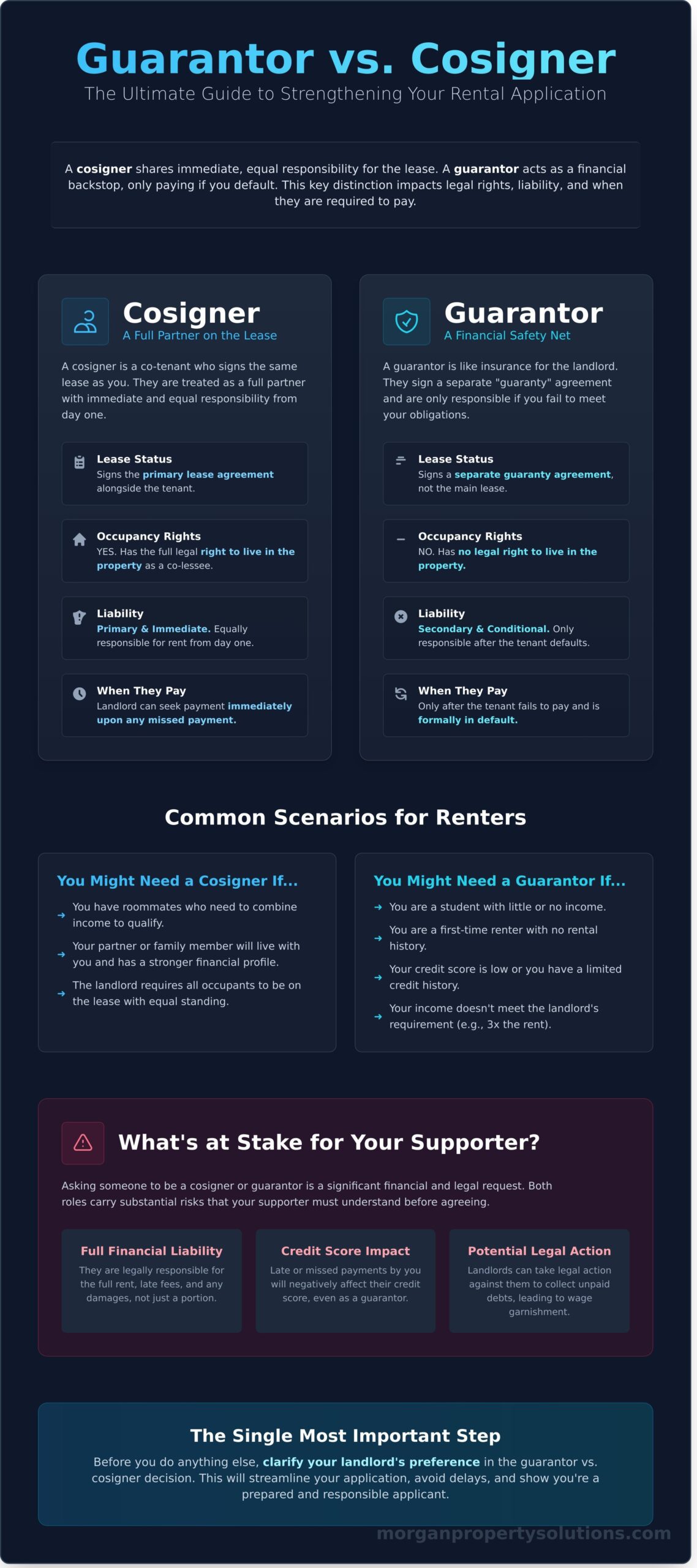
To put it simply: a cosigner is treated as a full partner on the agreement, while a guarantor serves as a financial backstop. The key distinctions lie in their legal rights, their liability, and when they are expected to pay.
What is a Cosigner? A Full Partner on the Lease
A cosigner is essentially a co-tenant or co-borrower. They sign the exact same lease or loan agreement as the primary applicant, making them a co-lessee with equal responsibility. This means they have full legal rights to live in the property. Their liability is immediate and direct; if a payment is late, the landlord or lender can seek payment from the primary applicant or the cosigner without distinction from day one.
What is a Guarantor? A Financial Safety Net
A guarantor acts as a form of insurance for the landlord or lender. They do not sign the primary agreement but instead sign a separate document called a “guaranty.” This role grants them no rights to occupy or use the property. Their liability is secondary, meaning they are only required to pay if the primary applicant defaults on their obligations first. This financial pledge is a formal arrangement, legally understood as a type of surety, where one party guarantees the debt of another.
Side-by-Side Comparison: The Ultimate Cheat Sheet
To make things even clearer, here is a simple breakdown of the key differences. Use this cheat sheet to quickly see how these two important roles compare.
| Feature | Cosigner | Guarantor |
|---|---|---|
| Lease Status | Signs the primary lease agreement | Signs a separate guaranty agreement |
| Occupancy Rights | Yes, has the right to live in the property | No, has no right to live in the property |
| Liability | Primary (equally responsible with the tenant) | Secondary (responsible only after tenant defaults) |
| When They Pay | Immediately upon any missed payment | Only after the tenant fails to pay and defaults |
A Renter’s Guide: When Do You Need One and Which is Better?
Finding your perfect rental home is an exciting step, but sometimes your application needs a little extra financial support to get approved. This is a common situation for many renters, whether due to a limited credit history, a new job, or income that falls just short of a landlord’s requirements. Understanding when you might need help and navigating the guarantor vs cosigner choice is key to a stress-free process.
Ultimately, the decision often depends on the property owner or management company’s specific policies. Some landlords may use the terms interchangeably, while others have strict definitions for each role. Our goal is to help you understand the common scenarios so you can be prepared.
Common Scenarios for Needing a Cosigner
A cosigner is typically required when the additional person will also live in the rental unit and share responsibility for the lease. They are, in effect, a co-tenant with a stronger financial profile. This is common for roommates who may not individually meet the income requirements but do as a group, or for an unmarried couple where one partner has a weaker application. The cosigner signs the same lease and has the same rights to occupy the property.
Common Scenarios for Needing a Guarantor
A guarantor is most often someone who will not live in the property but agrees to be legally responsible for the rent if you fail to pay. This arrangement provides a safety net for the landlord. You might need a guarantor if you are a student with no income, a first-time renter without a rental history, an individual rebuilding after past financial issues, or an international applicant who lacks a U.S. credit history.
How to Ask Someone for This Major Favor
Asking a friend or family member to take on this financial risk is a significant request that requires trust and transparency. To approach the conversation responsibly and show you value their support, we recommend you:
- Be prepared. Gather all your financial documents-like pay stubs and bank statements-to demonstrate that you are organized and have a plan to meet your rental obligations.
- Explain the commitment clearly. Be completely transparent about the legal and financial risks they are accepting. They must understand they are responsible for the full rent amount if you default.
- Discuss the landlord’s requirements. Before you ask, make sure you fully understand the property’s tenant screening criteria. This shows you’ve done your homework and can explain exactly what is expected of them.
- Create a personal agreement. Offer to sign a simple, written agreement between the two of you that outlines a repayment plan in the unlikely event they ever have to cover your rent.
The Landlord’s Perspective: Which Option Offers More Security?
As experienced property managers, our primary goal is to protect our clients’ investments. When a promising applicant doesn’t quite meet the income or credit requirements, requiring a third party to guarantee the lease is a sound strategy. However, the choice in the guarantor vs cosigner debate significantly impacts how that security is structured and enforced, which is why understanding the landlord’s perspective is crucial.
Why Property Managers Often Prefer a Guarantor
From a risk management standpoint, a guarantor often provides a cleaner, more straightforward solution. Because a guarantor’s responsibility is purely financial and they hold no rights of tenancy, they cannot occupy the property. This simplifies the legal process immensely if the primary tenant defaults on rent. If an eviction becomes necessary, we only have to deal with the individuals on the lease, not an additional person who has tenant rights but doesn’t live there.
Screening a Guarantor or Cosigner: What We Look For
Accepting a third party does not mean lowering our standards; in fact, we raise them. The screening process for a guarantor or cosigner is exceptionally rigorous because they must be financially strong enough to cover their own expenses plus the full rent of your property. Our criteria typically include:
- Exceptional Income: We often require verifiable income of at least 5-6 times the monthly rent.
- Excellent Credit: A high credit score with a strong payment history is non-negotiable.
- Stable Employment: A consistent and verifiable history of employment provides confidence in their financial stability.
This thorough vetting process is a key part of our comprehensive Orlando property management services, designed to ensure your investment is always protected.
The Pros and Cons of Accepting a Cosigner
While a guarantor is often preferred, a cosigner has one distinct advantage: they are equally and immediately responsible for rent from day one. There is no need to wait for a default to pursue payment. However, this comes with significant drawbacks. A cosigner legally has the same rights as a tenant, which can complicate an eviction. Furthermore, if a dispute arises between the cosigner and the tenant they are supporting, it can create payment headaches and place you, the landlord, in the middle of their conflict. When a new tenant moves in mid-month, landlords also need to be prepared to calculate prorated rent accurately to ensure the first partial payment is handled fairly and correctly.
Understanding the Risks: What’s at Stake for the Person Helping?
Agreeing to be a guarantor or cosigner is a generous act of trust, but it’s also a significant legal and financial commitment. Before anyone signs a lease on another person’s behalf, it’s crucial for both the applicant and the potential helper to understand the full scope of the responsibilities. This isn’t just a character reference; it’s a binding contract with real-world consequences. Being transparent about these risks is a key part of the guarantor vs cosigner decision-making process.
Financial Liability: It’s More Than Just One Month’s Rent
A common misconception is that a guarantor or cosigner is only responsible for a single missed payment. In reality, their financial liability extends to the entire lease agreement. This means they are legally obligated to cover:
- The full rent amount for the entire lease term if the tenant defaults.
- Any unpaid utilities, late fees, or other charges accrued by the tenant.
- The cost of repairing any damages to the property beyond normal wear and tear.
Landlords can, and often will, pursue the cosigner or guarantor for these funds directly, sometimes without even pursuing the tenant first.
Impact on Credit Score and Future Loans
The lease agreement can appear on the guarantor or cosigner’s credit report as a financial obligation. Any late or missed rent payments by the tenant are reported as delinquencies, which can significantly lower the helper’s credit score. Furthermore, this rental obligation may be included in their debt-to-income (DTI) ratio, making it more difficult for them to qualify for their own major loans, such as a mortgage or a car loan, in the future.
Can a Guarantor or Cosigner Be Removed from a Lease?
Once a lease is signed, removing a guarantor or cosigner is very difficult and rarely happens before the lease term expires. It is not an automatic process. Removal requires the express written consent of the landlord, who has no obligation to agree. Typically, the landlord will only consider it if the tenant can re-qualify for the apartment on their own, proving they have sufficient income and a strong credit history. For this reason, the commitment should be viewed as lasting for the entire initial lease term.
Navigating the nuances of rental agreements can feel complex, but our team is here to help make the process simple and clear for everyone involved. For expert guidance you can trust, visit us at morganpropertysolutions.com.
Navigating Your Lease with Confidence
Understanding the distinction between a guarantor and a cosigner is crucial for both renters and landlords. A cosigner shares equal, immediate responsibility for the lease, while a guarantor acts as a financial safety net, only becoming liable if the tenant defaults. This core difference in the guarantor vs cosigner debate directly impacts risk, responsibility, and the security of the rental agreement for everyone involved.
These details can feel overwhelming, but you don’t have to navigate them alone. At Morgan Property Solutions, we leverage over 20 years of combined real estate experience and an A+ Rating from the Better Business Bureau to provide trusted, expert guidance for landlords and tenants across Central Florida. Whether you’re a landlord seeking security or a renter needing support, we are here to help you make the best decision for your unique situation.
Making real estate simple is our promise. Let us help you navigate the Orlando rental market.
Armed with the right knowledge and a trusted partner, you can move forward with certainty. We wish you the best in your rental journey!
Frequently Asked Questions
Is a guarantor the same as a co-applicant?
No, these are two distinct roles in a rental agreement. A co-applicant, such as a roommate, shares equal responsibility for the lease and has the right to live in the property. In contrast, a guarantor is only financially liable if the primary tenant fails to pay. They do not have occupancy rights and only step in when there is a default. Understanding this difference is key to a simple and successful leasing process.
Does a cosigner have to live in the apartment?
Typically, a cosigner does not live in the apartment. Their primary purpose is to add financial strength to an application and guarantee payment. However, it is essential to read the lease agreement carefully. Some documents might use the term “cosigner” when they mean “co-tenant,” who would be expected to live there. We can help you review these terms to ensure everything is clear and straightforward before you sign.
How does being a guarantor affect my ability to get a mortgage?
Acting as a guarantor can impact your ability to secure a mortgage. Lenders view this obligation as a potential liability, which increases your debt-to-income (DTI) ratio. This contingent debt will be factored into their calculations, potentially reducing the loan amount you qualify for. It is a significant financial commitment, so we advise you to consider the potential impact on your own borrowing power before agreeing to be a guarantor for someone else.
What are the typical income requirements for a guarantor in Florida?
While this can vary between landlords, a common standard in Florida requires a guarantor to have a gross annual income of 80 to 100 times the monthly rent. For an apartment renting at $2,000 per month, this would mean demonstrating an income between $160,000 and $200,000. Landlords will also require a strong credit score and stable employment history to ensure you are a reliable financial backstop for the tenant.
What happens if the primary tenant breaks the lease or causes damages?
If the tenant breaks their lease or causes damage, the financial responsibility falls to the person who provided the guarantee. Whether you are a guarantor or a cosigner, you are legally obligated to cover any unpaid rent, early termination fees, and repair costs that exceed the security deposit. The landlord can pursue you directly for these funds, which can also negatively impact your credit score. This is a critical risk to understand in the guarantor vs cosigner debate.
Are there professional third-party guarantor services I can use?
Yes, several trusted companies offer professional guarantor services for a fee, which is typically about one month’s rent. These services are an excellent solution for renters who do not have a personal contact who meets the high-income requirements. They are often used by students, international residents, or those with a limited credit history. Using a professional service can make the rental application process simple and stress-free for both the tenant and the landlord.

Article by
Oliver Overton-Morgan
Oliver Overton-Morgan is a full-time Real Estate Broker since 2003, with years of experience helping thousands of people purchase and sell real estate throughout Central Florida. He holds a Graduate Realtor Institute designation, LCAM, and has held licenses in good standing as a Florida Mortgage Broker and a Notary Public. Oliver immigrated to central Florida in 2001, and within 5 years Oliver built a successful Real Estate brokerage in central Florida, where he recruited over 75 Sales Associates with 25+ million in sales production.