
The keys are ready, the lease is signed, and your new tenant is excited to move in. But one final calculation can cause unexpected stress and confusion: the first month’s partial payment. If you’ve ever felt uncertain about getting the math right-especially when dealing with the different lengths of February versus March-you’re not alone. A simple miscalculation can start a tenancy on the wrong foot, which is why knowing exactly how to calculate prorated rent is such a crucial skill for every landlord.
We’re here to help you manage this process with confidence and ease. In this simple guide, we will walk you through the correct, industry-standard formulas to ensure accuracy and fairness every time. You will learn a clear, step-by-step method to eliminate the guesswork, feel confident that you are charging the right amount, and start your new landlord-tenant relationship on a foundation of trust. Let’s make this part of property management simple.
Key Takeaways
- Understanding prorated rent is the first step to creating a fair and professional experience for your new tenants from day one.
- Discover three proven methods for how to calculate prorated rent and learn why consistency is key to simple, effective property management.
- Navigate Florida’s specific landlord-tenant laws with confidence by learning the difference between legal requirements and industry best practices.
- Avoid common and costly calculation errors by proactively addressing the most frequent pitfalls landlords encounter.
What is Prorated Rent and Why is it Essential for Landlords?
As a landlord, one of the first financial details you’ll manage with a new tenant is their initial rent payment. If they aren’t moving in on the first day of the month, this is where prorated rent comes in. Simply put, prorated rent is a partial rent payment calculated to cover only the portion of the month a tenant occupies the property. This applies to both mid-month move-ins and move-outs.
While it may seem like a minor detail, handling this calculation correctly is a crucial first step in building a positive landlord-tenant relationship. It demonstrates fairness, transparency, and professionalism from the very beginning, setting a supportive tone for the entire tenancy.
Defining Prorated Rent: More Than Just Partial Payment
The term ‘prorated’ is derived from the Latin phrase Pro rata, which translates to ‘in proportion.’ This principle is the very heart of prorated rent: it ensures that a tenant’s payment is directly proportional to their time in the property. Instead of charging a full month’s rent for, say, 15 days of occupancy, you calculate the fair amount due for only those specific days. This simple act of fairness prevents the initial friction that can arise from a tenant feeling overcharged before they’ve even unpacked.
The Importance of Getting Proration Right
Understanding how to calculate prorated rent accurately is more than just a math exercise; it’s a foundational practice for successful property management. Getting it right from the start provides several key benefits that help you manage your property more effectively and build a stronger business.
- First Impressions Matter: A clear, accurate, and fair prorated rent calculation immediately establishes you as a professional and trustworthy landlord. This positive first interaction can influence the entire landlord-tenant relationship.
- Dispute Prevention: Ambiguity leads to arguments. By using a standard, easily explained formula, you eliminate potential misunderstandings about rent payments and prevent future disputes.
- Financial Accuracy: Precise calculations ensure your accounting and rent ledgers are accurate from day one. This simplifies bookkeeping and provides a clear financial record for both you and your tenant.
Ultimately, these practices are hallmarks of a well-run rental business. For landlords looking to ensure every detail is handled with expertise, partnering with a professional team like Regal Gateway Property can provide peace of mind and free up valuable time.
3 Proven Methods for Calculating Prorated Rent
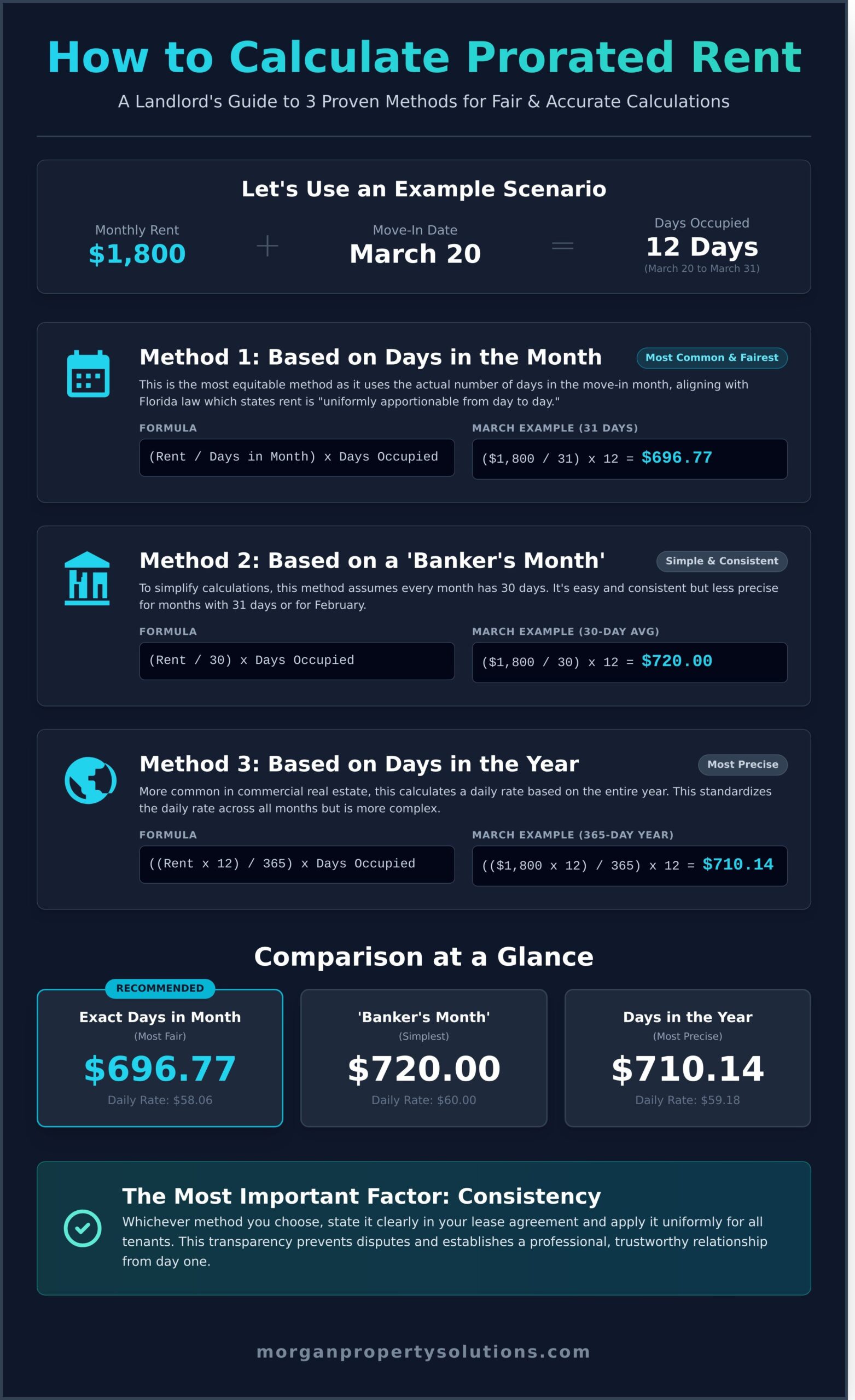
Once you understand the basics, learning how to calculate prorated rent is straightforward. Landlords and property managers typically use one of three proven methods. The most important factor is consistency-choose one method, state it clearly in your lease agreement, and apply it uniformly to avoid confusion or disputes. We’re here to make this simple for you.
To help you compare, we’ll use the same scenario for each method:
- Monthly Rent: $1,800
- Move-In Date: March 20th
- Days in March: 31
- Number of Days Occupied: 12 (from March 20th to March 31st)
Method 1: Based on the Exact Number of Days in the Month
This is the most common and arguably the fairest method because it uses the actual number of days in the move-in month. This day-by-day approach is often seen as the most equitable and aligns with legal principles in many areas. For instance, a review of the statutes governing Prorated Rent in Florida: Legal Considerations shows that state law specifies rent is “uniformly apportionable from day to day,” making this method a solid choice for legal compliance.
Formula: (Monthly Rent / Days in the Month) x Number of Days Occupied
- Example (March): ($1,800 / 31 days) x 12 days = $696.77
- Example (February): ($1,800 / 28 days) x 12 days = $771.43
Method 2: Based on a ‘Banker’s Month’ (30 Days)
To simplify calculations, some landlords assume every month has 30 days, regardless of whether it’s February, July, or October. This method is consistent and easy to calculate but can result in a slightly higher daily rate for months with 31 days and a lower rate for February.
Formula: (Monthly Rent / 30) x Number of Days Occupied
- Example (March): ($1,800 / 30 days) x 12 days = $720.00
Method 3: Based on the Number of Days in the Year
This is the most precise way to determine a daily rental rate, though it’s more common in commercial real estate than residential leases. It calculates the cost per day based on the entire year, which standardizes the daily rate across every month.
Formula: ((Monthly Rent x 12) / 365) x Number of Days Occupied
- Example (March): (($1,800 x 12) / 365 days) x 12 days = $710.14
Comparison at a Glance
As you can see, the method you choose affects the final amount. Here’s a quick summary of the results from our scenario:
- Method 1 (Actual Days): $696.77
- Method 2 (Banker’s Month): $720.00
- Method 3 (Annual): $710.14
No matter which approach you use for how to calculate prorated rent, the key is to document it in the lease so everyone is on the same page from day one.
A Step-by-Step Guide to Calculating Prorated Rent (with Example)
Calculating prorated rent might seem complex, but it’s a straightforward process when you break it down. Having a clear, repeatable method ensures fairness for both you and your new tenant. Let’s walk through a common scenario to show you exactly how to calculate prorated rent with confidence. For this example, imagine you are a landlord in Orlando, Florida, with a tenant moving in mid-month.
Step 1: Gather the Necessary Information
Before you can use any formula, you need to collect three key pieces of data. Accuracy here is crucial for getting the calculation right the first time. You will need:
- The full monthly rent amount: For our example, let’s say the rent is $2,000 per month.
- The tenant’s official move-in date: Let’s use May 15th. Always confirm this date in writing.
- The total number of days in that specific month: May has 31 days. Remember to double-check this, as it changes month to month!
Step 2: Choose Your Method and Calculate the Daily Rate
Your lease agreement should specify the proration method you use. If it doesn’t, using the number of days in the actual month is the most common and widely accepted approach. First, you’ll determine the daily rent rate. Simply divide the total monthly rent by the number of days in the month.
Example Calculation:
$2,000 (Monthly Rent) ÷ 31 (Days in May) = $64.52 per day
Step 3: Calculate the Final Prorated Amount
Next, count the number of days the tenant will occupy the property during that first month. A critical tip: always include the move-in day in your count. Since the tenant is moving in on May 15th, they will be in the unit for 17 days in May (from the 15th to the 31st). Now, multiply the daily rate by the number of days.
Example Calculation:
$64.52 (Daily Rate) x 17 (Days of Occupancy) = $1,096.84
The prorated rent due for May is $1,096.84.
Step 4: Communicate and Document in the Lease Agreement
Transparency is key to a healthy landlord-tenant relationship. Clearly communicate the prorated rent amount to your new tenant before they sign the lease. To prevent any future misunderstandings, your lease agreement should explicitly state the prorated amount due and the calculation method used. A well-drafted Florida residential lease agreement will include all mandatory disclosures and protective clauses to keep you legally covered. For more guidance on creating a solid lease and other essential documents, explore our comprehensive landlord resources.
Prorated Rent in Florida: Legal Considerations and Best Practices
While the math behind prorating rent is universal, applying it correctly often depends on local laws and industry customs. As Florida-based property management experts, we believe in providing landlords with clear, actionable advice. Understanding the specific landscape in the Sunshine State is key to managing your property professionally and avoiding potential conflicts.
Navigating these details helps build trust with your tenants and protects your investment for the long term.
Does Florida Law Mandate Prorated Rent?
This is a common question, and the direct answer is no. The Florida Residential Landlord and Tenant Act does not contain a specific statute that legally requires a landlord to prorate rent. However, this is where legal requirements and industry best practices diverge. Prorating rent for a partial month is a standard, widely accepted practice in the rental market. Tenants expect it, and refusing to prorate can make your property less competitive and may lead to disputes before a tenancy even begins. In our experience, fairness is the foundation of a positive landlord-tenant relationship.
Best Practices for Florida Landlords
To ensure a smooth and professional process, we always guide our property owners to adopt clear, consistent policies that go beyond the bare minimum. Following these best practices will help you prevent misunderstandings and manage your rental with confidence.
- Define Your Method in the Lease: Your lease agreement is your most important document. It should explicitly state your proration policy and explain how to calculate prorated rent for any partial month. A comprehensive Florida residential lease agreement that includes this clause leaves no room for ambiguity and helps protect you from costly legal disputes.
- Provide a Clear Breakdown: Transparency builds trust from day one. Before a tenant signs, give them a simple, written breakdown of their total move-in costs, including the exact prorated rent calculation. This simple step prevents confusion and starts the relationship on a positive note. You may also want to inform new tenants about protecting their belongings with renters insurance Florida policies, which can be an important part of their overall move-in preparation.
- Maintain Consistency: Use the same proration method for every tenant across all your properties. Whether you calculate based on the current month’s days or a 30-day average, consistency is crucial for demonstrating fairness and reducing your liability.
Managing these financial details and ensuring legal compliance can be demanding. Our experienced Orlando property management team is here to handle the complexities for you, making the entire process simple and stress-free.
Common Mistakes to Avoid When Prorating Rent
Knowing how to calculate prorated rent is the first step, but avoiding common errors is what ensures a smooth, professional process. As experienced property managers, we’ve seen how small oversights can lead to confusion and disputes. By being aware of these pitfalls, you can protect your investment and maintain a positive relationship with your tenants from day one.
Calculation and Calendar Errors
The most frequent mistake is using a generic number of days, like 30, for every month. This simple error can lead to an incorrect calculation and tenant frustration. A month can have 28, 29 (in a leap year), 30, or 31 days, and using the wrong number will skew the daily rent rate.
The Solution: Always use the actual number of days in the specific move-in month. Before you do any math, pull up a calendar and confirm. This small, diligent step guarantees your calculation is accurate and fair.
Lease Agreement Oversights
A verbal agreement on the prorated amount isn’t enough. If a disagreement arises later, having nothing in writing leaves you vulnerable. Failing to specify the calculation method in the lease creates ambiguity that can easily lead to conflict down the road.
The Solution: Your lease agreement should include a clear proration clause. This clause must state exactly how the prorated amount will be determined, removing any doubt. Putting it in writing makes the terms official and enforceable for both parties.
Inconsistent Application
Using different methods for different tenants is a serious risk. One tenant might get a calculation based on the calendar month, while another gets one based on a 30-day “banker’s month.” This inconsistency can open you up to claims of discrimination or unfair housing practices.
The Solution: Create a standard proration policy and apply it uniformly to every single tenant. Consistency is key to fair and effective property management. This same principle of fairness applies to all landlord-tenant interactions; for instance, our tenant screening criteria is applied consistently to every applicant to ensure compliance and equal opportunity.
Avoiding these mistakes helps build trust and sets a professional tone for the entire tenancy. If you’re looking for support in managing these details, the experts at Morgan Property Solutions Inc. are here to make your experience simple and stress-free.
Simplify Your Rent Collection for Good
Ultimately, knowing how to calculate prorated rent is more than just a mathematical skill-it’s a cornerstone of fair and professional property management. By selecting a consistent method, documenting it in your lease, and avoiding common calculation errors, you build trust with your tenants and ensure a smooth, conflict-free tenancy from the very beginning. This simple act of precision protects your investment and sets the stage for a positive landlord-tenant relationship.
Tired of the calculations and paperwork? At Morgan Property Solutions, we specialize in making Central Florida real estate simple. With over 20 years of combined experience and a trusted A+ Rating with the Better Business Bureau, our team is here to handle all the details. Let us give you back your time and peace of mind by managing the day-to-day tasks so you can enjoy the benefits of your investment. Discover our expert Orlando property management services today.
We’re here to help you succeed every step of the way.
Frequently Asked Questions
Do landlords have to prorate rent?
Whether a landlord must prorate rent depends on state and local laws, as it is not federally mandated. However, it is a widely accepted and fair business practice that helps build a positive landlord-tenant relationship from the start. We always recommend checking your local regulations and, most importantly, ensuring the policy is clearly outlined in your lease agreement. This simple step provides clarity and prevents future misunderstandings, ensuring a smooth and stress-free tenancy for everyone.
How do you calculate prorated rent for a move-out?
The process for calculating prorated rent for a move-out is identical to a move-in. First, determine the daily rent rate by dividing the total monthly rent by the number of days in that specific month. Then, multiply that daily rate by the number of days the tenant will occupy the property during their final month. This straightforward method ensures the tenant only pays for the exact time they are in the home, providing a fair conclusion to the lease.
Which method of calculating prorated rent is the best or most fair?
The fairest and most transparent method is calculating the daily rate based on the actual number of days in the current month. While some use an “average” number like 30 days, this can lead to inaccuracies for months with 31 or 28 days. Using the actual calendar days is simple, easy to defend, and ensures that both the landlord and tenant are treated equitably. We find this approach helps build trust and avoids unnecessary confusion.
How do you handle prorating rent for a leap year?
Handling a leap year is simple: you just use 29 days for your February calculation instead of 28. If the monthly rent is $1,450, the daily rate would be $50 ($1,450 ÷ 29). The core principle remains the same-always divide the monthly rent by the actual number of days in that specific month. This consistency ensures your calculation is always accurate and fair, regardless of the year, making the process easy to manage.
Should the prorated rent amount be written in the lease agreement?
Yes, absolutely. To ensure complete clarity and prevent any future disputes, the exact prorated rent amount should be clearly written into the lease agreement. It is also a best practice to specify the calculation method used. This transparency establishes clear expectations from day one and is a key part of fostering a trustworthy and professional relationship between a landlord and tenant. It’s a simple step that provides peace of mind for both parties.
What happens if a tenant moves in on the first of the month?
If a tenant moves in on the first day of the month, no prorating is necessary. In this situation, the tenant is responsible for the full month’s rent because they will have possession of the property for the entire rental period. The need to calculate prorated rent only arises when a lease term begins or ends on any day other than the first, requiring a partial payment for that initial or final month. As you prepare new tenants for move-in, it’s also worth directing them to resources like a comprehensive guide to renters insurance Florida tenants should consider, so they are fully protected from their very first day in the property.

Article by
Oliver Overton-Morgan
Oliver Overton-Morgan is a full-time Real Estate Broker since 2003, with years of experience helping thousands of people purchase and sell real estate throughout Central Florida. He holds a Graduate Realtor Institute designation, LCAM, and has held licenses in good standing as a Florida Mortgage Broker and a Notary Public. Oliver immigrated to central Florida in 2001, and within 5 years Oliver built a successful Real Estate brokerage in central Florida, where he recruited over 75 Sales Associates with 25+ million in sales production.