
What if the secret to a stress-free sale isn’t a fresh coat of paint or a new roof, but the right legal paperwork? You might feel a bit of a knot in your stomach when you think about selling a house as-is in Florida. It’s normal to worry that you’ll only attract lowball offers from predatory investors or get stuck in a legal mess because you didn’t fix a minor issue.
We understand that anxiety, and we’re here to tell you that you can sell your home quickly while still protecting your bottom line. This guide will show you how to navigate the standard as-is contract, meet your legal disclosure duties under the Johnson v. Davis ruling, and secure a fair price without making a single repair.
We’ll walk you through the 15-day buyer cancellation right, the latest 2026 flood disclosure requirements, and the best ways to market your property to attract retail buyers who see the true potential in your home. By the end of this guide, you’ll have a clear, step by step path to a successful closing that keeps your equity where it belongs.
Key Takeaways
- Learn how the standard Florida Realtors/Florida Bar contract protects you from repair costs while managing the buyer’s 15-day cancellation window.
- Protect yourself legally by understanding your mandatory disclosure requirements, ensuring you don’t face a lawsuit after the keys change hands.
- Find out why targeting retail families instead of wholesalers is the best strategy for selling a house as-is in Florida for the highest possible price.
- Streamline your path to the closing table with a step-by-step checklist for gathering documents and completing honest property disclosures.
- See how over 20 years of local experience can help you filter out lowball offers and find a buyer who truly values your home’s current condition.
What Does Selling a House “As-Is” Actually Mean in Florida?
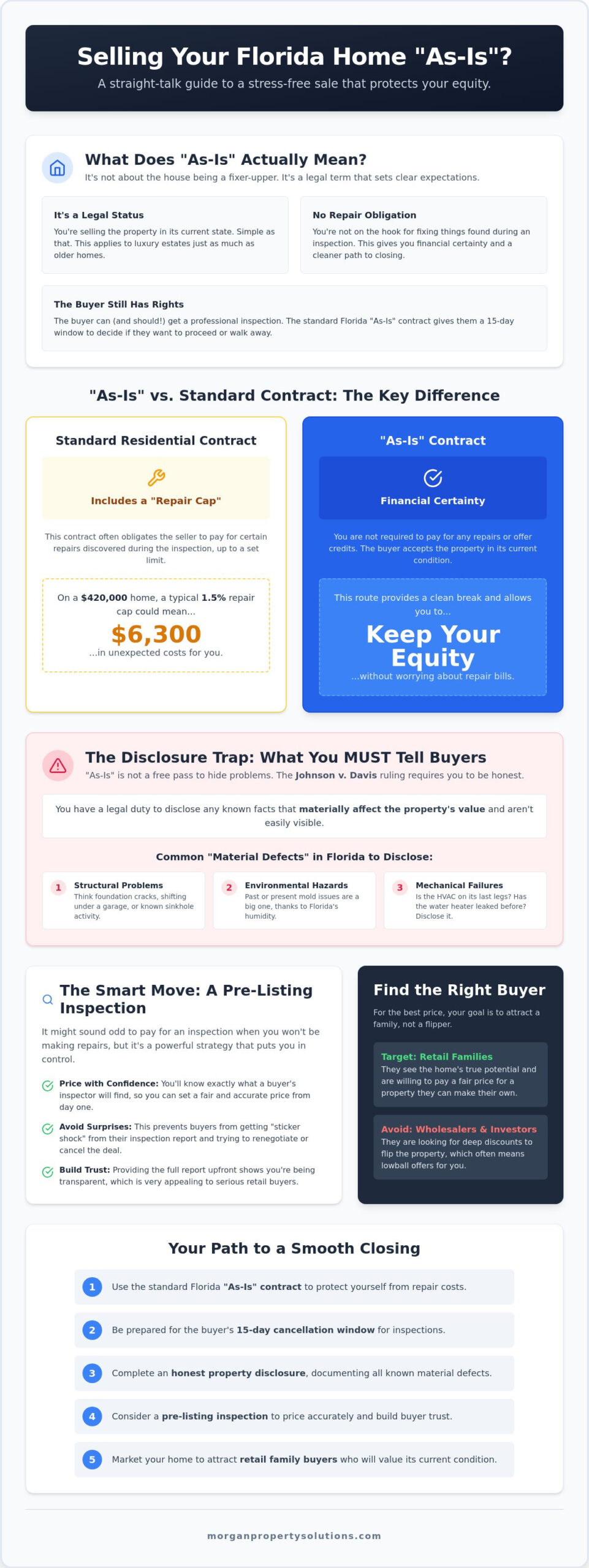
Many homeowners assume that an “as-is” listing is a red flag, signaling a property that’s falling apart. In reality, selling a house as-is in florida is a common strategy used for everything from pristine luxury estates to older family homes. At its core, this designation is a legal status rather than a commentary on the home’s condition. It means the seller is offering the property in its current state, with no intention of paying for repairs or offering credits for defects discovered later.
To understand the legal foundation, it helps to look at What Does ‘As-Is’ Actually Mean? in a contractual sense. In Florida, this is primarily handled through the Florida Realtors/Florida Bar (FR/BAR) “As-Is” Residential Contract for Sale and Purchase. This document explicitly states that the seller doesn’t provide warranties regarding the condition of the property. However, it’s a two-way street. The buyer still maintains the right to walk through the home with a professional inspector to decide if they want to move forward.
The “As-Is” vs. Standard Residential Contract
The biggest difference between these two documents is the financial obligation for repairs. A standard residential contract often includes a “repair cap,” which is typically set at 1.5% of the purchase price. If an inspection reveals issues with the roof or HVAC system, the seller is often contractually obligated to pay for those fixes up to that limit. For a home priced at the early 2026 median of $420,000, that could mean an unexpected $6,300 bill right before closing.
Choosing the as-is route allows for a clean break. You aren’t on the hook for those costs, which provides much-needed financial certainty. Just remember that “as-is” isn’t a license to be dishonest. You still have a legal duty to disclose any known material defects that aren’t easily visible to the buyer. Being upfront protects you from future litigation and builds trust with serious buyers.
Why Central Florida Sellers Choose This Route in 2026
The Orlando market has shifted toward a more balanced state in 2026, and many sellers are prioritizing simplicity. We see many clients in areas like Winter Park or Clermont who are managing inherited properties or relocating quickly for work. They don’t want to spend months interviewing contractors or dealing with the rising costs of labor and materials. By listing as-is, they can bypass the renovation headache entirely.
Partnering with an experienced team like Morgan Property Solutions Inc. can help you navigate this process. We’ve spent over 20 years helping sellers understand how to position their homes to attract retail buyers who are looking for a fair deal without the drama of a long repair list. It’s about moving forward with confidence and keeping your equity intact.
The Disclosure Trap: What You Legally Must Tell Buyers
You might think that checking the “as-is” box on your contract means you can just hand over the keys and walk away from any hidden problems. That’s a dangerous assumption that could land you in a courtroom months after the sale. In our state, the 1985 Supreme Court ruling in Johnson v. Davis changed the game for anyone selling a house as-is in florida. It established that sellers have a legal duty to disclose any known facts that materially affect the value of the property, provided those facts aren’t easily seen by the buyer.
An as-is clause protects you from being forced to pay for repairs, but it doesn’t protect you from a claim of fraud if you hide a major issue. To get a better handle on the legal nuances, it’s helpful to review the formal definition of What You Legally Must Tell Buyers. Essentially, if you know the roof leaked during a summer storm or the foundation is shifting under the garage, you have to put it in writing. If a defect isn’t readily observable, you must document it. Failing to do so can lead to expensive lawsuits long after the closing date has passed.
Common “Material Defects” in Florida Homes
In Central Florida, certain issues pop up more often than others. Structural problems like foundation cracks or historical sinkhole activity in areas like Clermont are major red flags. Environmental hazards are another concern. Because of our high humidity, mold can quickly become a deal-breaker. You also need to be honest about mechanical failures. If your HVAC system is struggling to keep up with the 95-degree heat or has been serviced multiple times for the same failing part, that is something a buyer needs to know before they sign.
The Benefits of a Pre-Listing Inspection
One of the smartest moves you can make is paying for your own inspection before the house ever hits the market. It might seem counterintuitive to spend money when you don’t plan on making repairs, but it gives you the upper hand. When you know exactly what the buyer’s inspector is going to find, you can price the home accurately from day one. This prevents a buyer from trying to renegotiate or using their 15-day cancellation right to back out at the last minute because they feel surprised.
A material defect is any hidden issue that would make a reasonable buyer lower their offer. By identifying these early, you can provide a full disclosure package upfront. This transparency actually builds trust with retail buyers who might otherwise be suspicious of an as-is sale. If you’re feeling overwhelmed by the paperwork, checking out real estate articles from Morgan Property Solutions Inc. can give you more specific guidance on staying compliant and protected.
Pricing Your As-Is Property for the Orlando Market
Finding the right price for your home in the 2026 Orlando market requires looking beyond a simple spreadsheet. Many people think you just take the price of a renovated neighbor’s house and subtract the cost of a new roof. It’s actually more nuanced than that. When selling a house as-is in florida, you’re often selling a “convenience premium.” There’s a specific group of buyers looking for a property they can customize from the ground up; they’ll often pay more for a house that hasn’t been cheaply renovated by a flipper.
To find the sweet spot between leaving money on the table and scaring off potential buyers, it’s wise to get a professional valuation from a local expert at Morgan Property Solutions Inc. We look at the After Repair Value (ARV) to see what the home could be worth, then weigh that against the current demand in your specific zip code. This helps you understand if a repair is actually worth the investment or if you’ll net more by selling exactly as it stands today.
Cash Buyers vs. Retail Buyers: Who Should You Target?
Investors and “cash for houses” companies are usually looking for a significant discount. Current market data suggests that homes sold as-is to cash buyers typically close for 5% to 20% below traditional market value. They need that margin to cover their own renovation costs and turn a profit. However, retail buyers are often more flexible. In popular areas like Lake Nona or Winter Garden, new construction prices have pushed many people toward older homes. These “DIYers” are often happy to pay a higher price for an as-is home because they plan to live there long-term and fix it up slowly. Small efforts like mowing the lawn, trimming the hedges, and clearing out clutter can boost your curb appeal and help these buyers see the home’s true potential.
The Cost of Doing Nothing
One thing many sellers overlook is the hidden cost of holding onto a property while trying to fix it up. In Central Florida, property taxes, insurance, and HOA fees eat into your profits every single month the house sits empty. If a major renovation takes six months to complete, you could easily spend thousands of dollars just on “holding costs.” When you add the rising price of labor and materials in 2026, a fast as-is sale often results in a higher net profit than a drawn-out renovation project. For more tips on finding the right balance, check out our sibling article on how to choose the best real estate agent to sell your house in Central Florida.
The Step-by-Step Process of Selling As-Is in Central Florida
Moving through the steps of selling a house as-is in florida doesn’t have to feel like a guessing game. It’s a structured journey that starts with organization. First, you’ll want to gather all your property documents. In Central Florida, this means more than just the deed. You’ll need HOA bylaws, any CDD (Community Development District) information, and records of past repairs. Having these ready in a folder makes you look like a pro and speeds up the process for everyone involved.
Next, you’ll fill out the Florida Seller’s Property Disclosure form. As we discussed earlier, honesty is your best legal shield. Once that’s done, it’s time for marketing. Use professional photos that show the home’s potential. If you’re selling a tenant-occupied property, you’ll need to be mindful of their rights. Check out our guide on Florida Landlord Tenant Law to ensure you’re handling those notifications correctly. Finally, you’ll head to the closing table. A reputable Florida title company will handle the deed transfer and ensure the documentary stamp taxes, currently $0.70 per $100 of the sale price, are paid correctly.
Handling the 15-Day Inspection Period
This phase is where deals often face their biggest test. In a standard Florida as-is contract, the buyer usually has a 15-day window to inspect the property. This is the “danger zone” because they can walk away for any reason or no reason at all. Some buyers use this time to “re-trade,” which is just a fancy way of saying they’ll ask for a price drop after their inspector finds a few minor issues. Your best leverage here is a backup offer. If you have another buyer waiting in the wings, you don’t have to cave to unreasonable demands. It’s about staying calm and knowing the value of your property’s current condition.
Navigating HOA and CDD Requirements
In Central Florida, many homes are tucked into communities with strict HOAs, especially in areas like Windermere or Winter Garden. You’ll need to order an “estoppel” letter. This proves you’re caught up on all your dues and fines. If there are any outstanding liens, they must be cleared before the title company can close the sale. Getting ahead of these requirements prevents last-minute delays that can frustrate buyers. If you want a steady ally to help you manage these moving parts, reach out to our team at Morgan Property Solutions for expert seller representation.
Why Partner with a Local Ally Like Morgan Property Solutions?
Deciding to sell your home is a major transition, and it’s easy to feel overwhelmed by the technicalities of the process. When you’re selling a house as-is in florida, having a partner who knows the local landscape is your best defense against stress. We aren’t just real estate agents; we are property experts with over 20 years of experience right here in Central Florida. We understand the nuances of neighborhoods from Lake Nona to Apopka, ensuring you don’t leave money on the table just because you’ve chosen an as-is sale.
Our team is here to handle the mental load for you. This includes:
- Distinguishing between a predatory “lowball” investor and a serious retail buyer.
- Providing accurate valuations based on 2026 market data rather than generic online estimates.
- Managing the logistics of showings, paperwork, and the final closing signature.
We’ve seen every type of market shift in Orlando over the last two decades. That tenure gives us a unique perspective that a national referral network simply can’t match. We know the local streets, the local buyers, and the local expectations.
Our “Manageable Steps” Approach to Selling
We believe in distilling the complex Florida real estate market into a simple, stress-free plan. Because we also specialize in residential property management, we have a unique understanding of what buyers actually look for in a property. We can spot the issues that might scare off a family and help you address the narrative of your home’s potential. Our goal is to provide personalized support that makes you feel like you have a steady ally by your side through every phase of the journey.
Ready to Move Forward?
If you’re ready to explore your options, we invite you to take the next step without any pressure. Our commitment is to maximize your profit while reducing the friction of a traditional sale. We’ll help you navigate selling a house as-is in florida with confidence and clarity. Reach out to our team today for a no-obligation consultation and let’s discuss how we can help you achieve a fast, fair, and successful closing.
Your Path to a Stress-Free Florida Sale
Choosing to move forward with your sale shouldn’t feel like a gamble. By now, you’ve seen that selling a house as-is in florida is a powerful strategy for maintaining your equity and avoiding the headache of pre-sale renovations. The key is to lead with transparency. When you are honest about your home’s condition, you build the trust necessary to secure a serious buyer who appreciates the convenience of an as-is transaction.
Whether you’re navigating the strict HOA rules of Winter Garden or setting a competitive price in Lake Nona, local expertise makes all the difference. Our team at Morgan Property Solutions brings over 20 years of Central Florida experience to your side. We specialize in distilling these complex legal and market shifts into a manageable plan that protects your interests. We’ve helped countless neighbors across Orlando and Clermont find success, and we’re ready to do the same for you.
Don’t let the fear of repairs or lowball offers hold you back from your next big move. Let us help you sell your Florida home for the best price—contact Morgan Property Solutions today. You deserve a partner who cares about your success as much as you do.
Frequently Asked Questions
Do I have to clean the house if I sell it as-is in Florida?
You aren’t legally required to deep clean or stage the property, but it’s usually in your best interest to do so. While the as-is contract doesn’t mandate a sparkle-clean home, removing trash and personal clutter helps buyers visualize the space. A home that looks cared for, even if it needs updates, often attracts better offers from retail families who are looking for a project they can handle.
Can a buyer back out of an as-is contract after the inspection?
Yes, the buyer has the right to cancel for any reason within the inspection period. This is a standard feature of the Florida Realtors/Florida Bar as-is contract. As long as they provide written notice before the deadline, they can walk away and receive their deposit back. This is why we emphasize the importance of having backup offers to maintain your leverage during the “danger zone.”
Is an as-is sale faster than a traditional home sale?
Yes, it typically moves much faster because you eliminate the “repair dance” that often stalls closings. In a traditional sale, you might spend weeks getting quotes and waiting for contractors to finish work before a buyer is satisfied. When selling a house as-is in florida, you bypass these delays entirely. It’s an ideal path if you’re relocating or need to settle an estate quickly in the Orlando area.
Will I get a better price from a cash buyer or on the MLS?
You’ll almost always get a higher price by listing on the MLS. While cash buyers offer speed, they typically expect a discount of 5% to 20% to cover their risks and profit margins. By listing on the MLS, you open the door to retail buyers who want a home to live in. These buyers are often willing to pay closer to market value because they aren’t looking for a quick flip.
What is the most important thing to disclose when selling as-is?
You must disclose any known material defects that aren’t easily visible to the buyer. This includes things like past sinkhole activity, structural issues, or recurring leaks. Under the Johnson v. Davis ruling, failing to mention these “hidden” problems can lead to legal trouble long after the sale. Being upfront protects your profit and ensures a smooth transition without the threat of future lawsuits.
Do I need a lawyer to sell my house as-is in Florida?
No, Florida law doesn’t require you to hire an attorney to sell your home. Most sellers work with a licensed real estate agent and a reputable title company to handle the paperwork and escrow. However, if you’re dealing with a complex probate situation or a messy title dispute, a lawyer can provide extra protection. For most standard residential sales, our team handles the heavy lifting for you.
Can I sell my house as-is if it has a mortgage?
Yes, you can absolutely sell a home with an existing mortgage. The title company will coordinate with your lender to get a payoff statement before the closing date. At the table, the mortgage balance is paid directly from the sale proceeds. Any remaining equity is then distributed to you as your profit. It’s a standard part of the process that happens in the majority of Florida home sales.
How long is the typical inspection period for a Florida as-is contract?
The default inspection period in a standard Florida as-is contract is 15 days. However, this timeframe is negotiable and can be shortened or lengthened during the initial offer phase. In a competitive market, you might see buyers offer a shorter window, like 7 or 10 days, to make their offer stand out. It’s important to keep a close eye on this calendar to ensure the deal stays on track.

Article by
Oliver Overton-Morgan
Oliver Overton-Morgan is a full-time Real Estate Broker since 2003, with years of experience helping thousands of people purchase and sell real estate throughout Central Florida. He holds a Graduate Realtor Institute designation, LCAM, and has held licenses in good standing as a Florida Mortgage Broker and a Notary Public. Oliver immigrated to central Florida in 2001, and within 5 years Oliver built a successful Real Estate brokerage in central Florida, where he recruited over 75 Sales Associates with 25+ million in sales production.