A rental can be leased and still leave its owner managing every detail. An East Orlando property management company can handle tenant screening, leasing, rent collection, maintenance, and vendor coordination; long-term residential leases in East Orlando are generally 12 months. The right fit depends on how much support you need and how clearly the company explains its process.
Looking beyond tenant placement makes sense. Owners also need a dependable plan for communication, repairs, and the work that continues after move-in. A clear process can make rental ownership easier to manage, whether you live nearby or oversee a property from a distance.
This guide explains what professional management can cover, how screening and leasing work, and what to consider when comparing services and costs. It also looks at maintenance coordination and local options, helping you assess East Orlando and the wider Orlando area.
Key Takeaways
- Compare management options by how they handle leasing, rent collection, maintenance, and vendor coordination, not by a company name alone.
- Long-term residential leases in East Orlando are generally 12 months, and community rules can affect when and how a home may be rented.
- A clear maintenance process helps owners track repair requests, coordinate vendors, and keep property needs organized.
- Consistent rent collection practices make it easier to monitor payments and follow up on missed rent.
- Use the local company listings to narrow your options and find a management approach that fits your property and level of involvement.
Rental property maintenance and vendor coordination
Maintenance works best when each request follows a clear process: report the issue, assess its urgency, arrange service, document the work, and follow up. For an East Orlando rental, this can cover routine upkeep, urgent repairs, and inspections. A written record helps owners track the problem, action taken, and any work still needed.
Florida owners hiring a property manager should define the manager’s authority, property access, maintenance priorities, and repair approval process. Put these expectations in the management agreement, including how requests are communicated and vendor work documented. A clear framework helps both sides handle issues such as a leaking fixture, appliance problem, or air-conditioning concern.
Vendor coordination involves more than forwarding a repair request. A manager can describe the issue, arrange access, share relevant property details, and follow up after the visit. Owners can simplify the process by agreeing in advance on which repairs need approval and how updates will be shared. Keep invoices and service notes with the property’s maintenance history.
Local conditions also shape maintenance planning. East Orlando’s Waterford Lakes community has more than 3,100 homes, while Avalon Park spans 8,000 acres and includes wetlands and man-made lakes. These neighborhood differences make property-specific records useful: note the home’s systems, prior repairs, and recurring maintenance needs rather than treating every rental alike.
Maintenance is one part of long-term residential management. A coordinated process connects property upkeep with rental marketing, tenant screening, leasing, and rent collection. Before advertising a home, document its condition and identify repairs that could affect showings. After move-in, direct service requests through a consistent channel and record completed work.
Rental pricing also affects the leasing plan. Compare the home’s condition, features, and location with similar rentals, then adjust the asking rent to reflect its appeal and the current market. Rental-IQ analytics may inform that review, but the useful output is a defensible price decision, not a number without context. Owners can explore Orlando property management services as one local way to connect leasing and ongoing care.
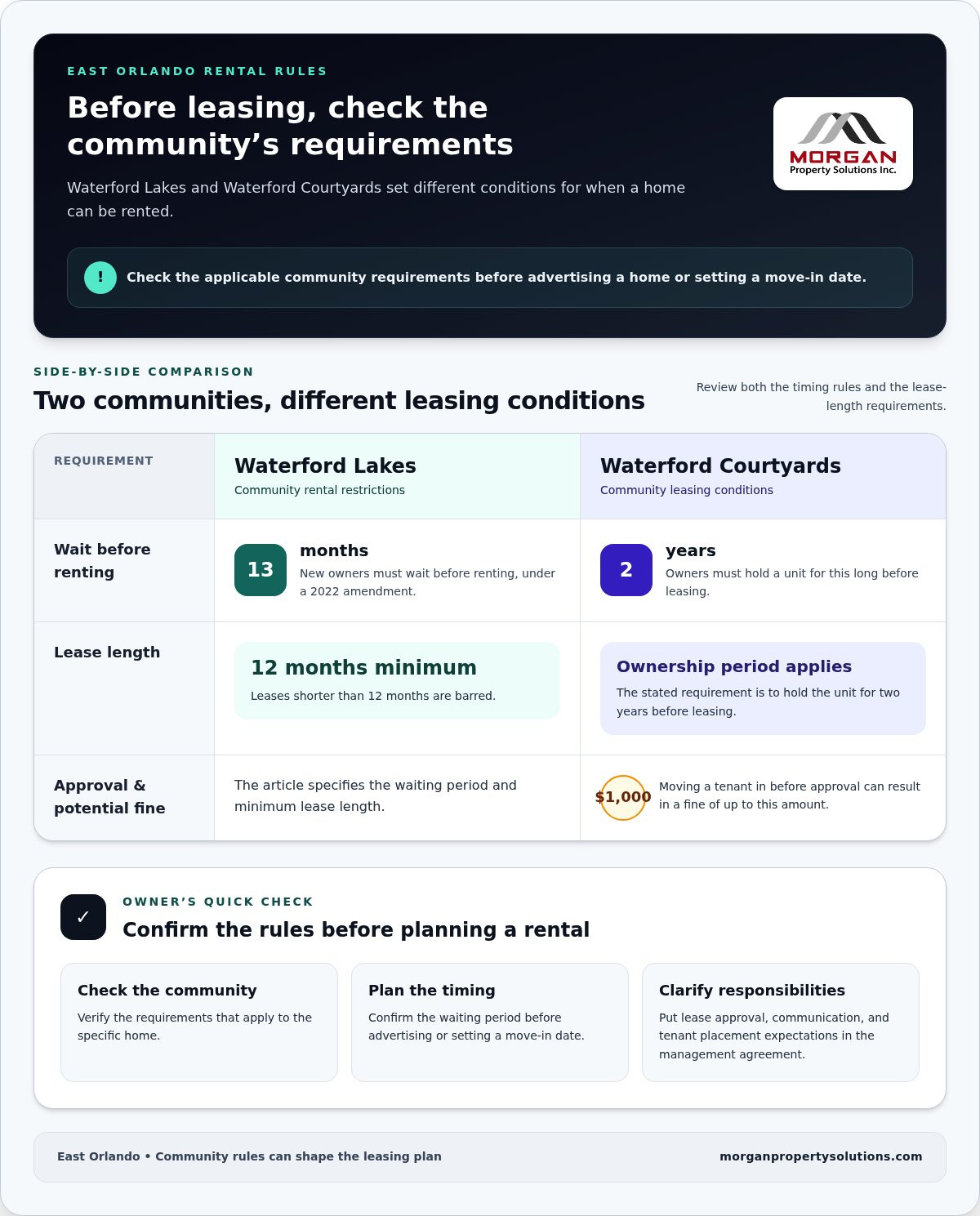
Waterford Lakes has a rental restriction adopted through a 2022 amendment requiring new owners to wait 13 months before renting. Waterford Courtyards requires ownership for two years before leasing, and moving a tenant in before approval there can result in a fine of up to $1,000. Check the community’s applicable requirements before advertising or setting a move-in date.
Tenant screening and leasing
To hire a property manager in Florida, define the work you want handled and document it in a signed management agreement. Before providing property access, clarify how marketing, screening, lease approval, communication, and tenant placement will work.
For East Orlando rentals, leasing decisions can depend on both the home and its community rules. Waterford Lakes bars leases shorter than 12 months, while Waterford Courtyards requires owners to hold a unit for two years before leasing.
Tenant Marketing and Placement
Marketing presents a vacant home to prospective tenants. Ask how the manager prepares the listing, presents the property, handles inquiries, and arranges showings. Details such as the home’s features, location, and lease terms help prospective tenants decide whether it suits their needs.
Leasing speed depends on the property’s condition, asking rent, timing, and responses to inquiries. Ask how the manager tracks interest and adjusts the approach if showings do not lead to applications. Tenant placement then proceeds from an approved applicant to a signed lease and coordinated move-in.
Resident Screening
Screening should use a consistent process for every applicant. Ask what application details are collected, how identity and rental history are reviewed, and how income and references inform the decision. Applying the same stated criteria helps owners compare applicants fairly instead of relying on impressions.
Central Florida’s population and rental demand vary by neighborhood, so screening should focus on the individual applicant and the written criteria. Review the resident screening criteria to understand the standards used. Keep applicant communication and document collection organized from submission through the decision.
Leasing and Renewal Fees
Read the agreement’s fee schedule carefully. It should distinguish tenant placement or leasing charges from renewal fees, explain when each applies, and identify any separate charges for advertising or lease preparation. Don’t assume renewal is included in the initial leasing service.
Compare the services covered by each charge, not just the fee label. Clarify what happens if a tenant leaves before renewal or the owner decides not to extend the lease. The cost depends on the management scope and leasing work involved, so request a quote based on your needs.
Before signing, clarify who approves lease terms, where tenant records are kept, and how notices and updates are delivered. National listing channels can broaden exposure, while neighborhood-specific details help applicants understand the property. The agreement should make responsibilities, communication, and the steps from application to move-in clear.
Rent collection and maintenance coordination
A reliable workflow connects rent collection with accurate records and repair follow-up. Reviewing monthly statements, open maintenance requests, and inspection notes together helps owners understand a property’s performance.
Resident Portals and Requests
A resident portal gives tenants one place to report a repair, describe the issue, and share relevant details. For example, a leaking sink report should identify its location and say whether water is still running. Clear categories help route requests to the right person.
Owners should look for status updates, message history, and records of completed work. A portal that separates new requests from scheduled repairs makes follow-up easier. Clarify how tenants can report an issue if they cannot access the portal and how owners receive updates about requests affecting the property.
Emergency Maintenance Support
An emergency process should distinguish urgent problems from routine repairs. An active leak, for example, needs prompt attention because water can damage floors and belongings. The manager’s process should explain how tenants report urgent issues, who assesses them, and how owners receive updates.
Before signing an agreement, define repair approval limits, vendor authorization, and the communication process for urgent work. Owners should know who can authorize a repair and how its scope and cost are recorded. A written escalation process helps avoid confusion when a tenant reports an issue outside regular business hours.
Inspections provide context for individual repair reports. Move-in records, periodic reviews, and move-out inspections can help identify changes over time. In Central Florida, note recurring concerns such as air-conditioning performance or moisture near a window. Compare new findings with earlier notes before deciding what work is needed.
Rent collection records also support practical decisions. Monthly statements can show payments received, outstanding balances, and property expenses together. Owners should understand how payments are recorded, late balances communicated, and completed repairs reported. Keeping these records together connects maintenance costs with the property’s overall income.
For useful oversight, agree in writing on reporting frequency, inspection documentation, and repair approval steps. A straightforward process helps owners track rent activity and maintenance without losing sight of individual requests.
Rent collection
Reliable rent collection starts with clear lease terms, consistent records, and a defined follow-up process. Owners should know when rent is due, how tenants submit payment, and how receipts appear in financial reports. In Florida, a written monthly accounting can help connect rental income with property expenses and show the owner’s current cash position.
Ask how the manager records payments and handles any unpaid balance. A useful report separates rent received, outstanding rent, management expenses, and repair costs. If a tenant pays part of the rent, for example, the ledger should clearly show the amount received and the balance remaining. This lets owners follow the account without confusing rent with maintenance charges.
Rent pricing affects both collection and vacancy. Compare East Orlando rentals by location, condition, included features, and lease terms. A home near Waterford Lakes may attract different interest from a similar property elsewhere, so use relevant local comparisons. If showings draw little interest, reassess the listing and asking rent rather than assuming applicants will appear.
A rent decision should balance income goals with the property’s market position. Rent set too high can prolong vacancy; rent set too low can reduce potential income. Consider the home’s condition, nearby rental options, and showing feedback. Investors can weigh these factors against ownership costs when deciding what supports their long-term goals.
Financial reporting is most useful when it explains changes as well as totals. Review monthly statements for collected rent, unpaid balances, bills paid, and expenses awaiting approval. Match each expense to an invoice or work record. If a repair reduced net income, the supporting entry should make the cost easy to identify.
Before choosing a collection process, clarify how tenants receive payment instructions, how owners receive funds and statements, and how questions are recorded. A consistent process keeps the lease, payment history, and account report aligned. It also helps owners distinguish a temporary vacancy from a collection issue and decide whether to adjust pricing, leasing, or follow-up.
Rent collection decisions also sit within a broader affordability context. In Orlando, 21% of tenants spent 30% or more of their income on rent as of 2008. In Florida, 20.5% of renters had gross rent above 30% of income in the 2006-2008 comparison data, while in the United States, 19.2% of renters had gross rent above 30% of income in the 2006-2008 comparison data. These figures describe historical affordability measures, not a current estimate for a particular household or property. They can help frame why clear payment communication and prompt, documented follow-up matter, while an individual tenant’s account still needs to be handled according to the lease and the facts of that tenancy.
Market measures can add another point of context: Orlando’s rent-to-price ratio was 0.4% in the housing market figures presented. That ratio is not a substitute for checking whether a proposed rent fits the home, its local alternatives, and the owner’s costs. Keep affordability and market indicators in perspective when reviewing collection performance; a missed payment should be assessed from the ledger and communication history, rather than presumed to reflect a broader trend. This keeps a practical distinction between market conditions and the status of each rental account.
Orlando-area property management company listings
Compare Orlando-area management options by service area, property type, communication, and scope of service, rather than relying on a company name alone. Reviews are more useful when considered alongside their recency, recurring themes, and specific comments about customer service.
For single-family homes, condos, or multifamily properties, look for a service description that addresses your property type and its day-to-day needs.
Company Listings
A useful listing explains which parts of property management a company handles, such as leasing, rent collection, maintenance coordination, and financial reporting. Check whether East Orlando is within its stated service area, then compare the listed services with your property’s needs and priorities.
A condo owner may need coordination around building access, while a single-family rental may call for property-specific maintenance follow-up. Compare each service description’s scope and communication approach. A broad description is less useful if it does not explain how routine tasks and updates are handled.
Reviews and Ratings
How do East Orlando property management companies compare by reviews and ratings? Consider each company’s rating alongside review count, recency, and recurring comments about communication, rent reporting, maintenance, and customer service. Several reviews describing similar experiences offer more context than a single score.
Look for specific examples, not just praise or frustration. Landlords may value comments about repair updates, clear income statements, or timely responses to tenant concerns. Consider how a company responds to criticism: a calm, specific reply can show whether it addresses the issue directly. No single review tells the whole story.
Property Type Specialties
Which East Orlando property managers specialize in single-family homes, condos, or multifamily properties? Start with services that name your property type, then compare the management tasks described with your building’s needs. A condo may require coordination around shared spaces, while multifamily housing involves communication across multiple units.
Ask how the company organizes leasing, maintenance records, and owner reporting for your property type. Its stated focus should fit the actual property, not just the broad label “residential real estate.” This distinction helps narrow an Orlando-area search to services suited to the property.
Before choosing, make a comparison table with columns for service area, property type, included management tasks, review themes, and reporting approach. Record specific details from each listing, such as whether it describes income reporting or tenant communication. This makes options easier to assess than relying on ratings alone.
Eviction-related comments in reviews deserve careful reading, but one account doesn’t establish how a company handles every case. Look for descriptions of communication and process, and distinguish management coordination from legal representation. For an Orlando-focused starting point, explore Orlando property management options and compare the stated services with your property’s needs.
Morgan Property Solutions Inc.: Residential Property Management
Morgan Property Solutions Inc. provides Residential Property Management for owners who want help coordinating the ongoing work of a rental home. Tenant Placement and Leasing supports the transition from listing to lease. The right service depends on whether you need leasing assistance or ongoing management after move-in.
Owners considering a sale or purchase can also explore Real Estate Seller Representation or Real Estate Buyer Representation. These services support the next stage of ownership, whether you are selling a rental or considering another investment.
To discuss your property needs, contact Morgan Property Solutions Inc.
Choose the Next Step for Your Property
Before choosing an East Orlando property management company, decide what role the property should play in your plans. It may remain part of a long-term investment strategy, or changing circumstances may make selling or buying a better next step. That decision can help clarify the professional support you need.
Define your priorities and the outcome you want. Morgan Property Solutions Inc. offers Residential Property Management, Real Estate Seller Representation, and Real Estate Buyer Representation. These services can support different stages of property ownership, from managing a rental to planning a sale or purchase.
When you’re ready to discuss your next step, contact Morgan Property Solutions Inc. today. A clear plan can make your next property decision feel more manageable.
Frequently Asked Questions
Which property management companies serve East Orlando, Florida?
Morgan Property Solutions Inc. serves Orlando, including East Orlando, and communities across Central Florida such as Lake Nona, Winter Park, Winter Garden, Windermere, Clermont, Apopka, Wedgefield, and Hunters Creek. When comparing local services, match the stated service area to your property’s address. Then consider whether the management approach suits your home, condo, or investment property.
What services do East Orlando property management companies offer?
Services can range from tenant placement to ongoing residential management. Morgan Property Solutions Inc.’s property management includes an online owner portal, online payments, inspections, and financial reporting. This can suit owners who want coordinated oversight of rental operations. Consider whether you need help finding a tenant or continued support after the lease begins.
How do East Orlando property managers screen tenants and handle leasing?
Managers may collect applications, review applicant information, and coordinate lease preparation and move-in. Morgan Property Solutions Inc. processes a full application for each adult applicant using a screening process designed to comply with Fair Housing laws. Its leasing service also includes marketing and showing coordination. Owners should understand how application decisions are communicated and what information they receive before a lease is finalized.
What local East Orlando rental market trends affect property owners?
Rental demand and achievable rent vary by property type and neighborhood, so compare similar homes. For example, compare a townhouse with other townhouses rather than relying only on nearby detached homes. Track inquiries and showing feedback once the listing is active. If interest is limited, review the property’s presentation, condition, and asking rent together before changing the leasing plan.
How do property managers handle maintenance, repairs, and emergencies in East Orlando?
Managers can receive tenant reports, assess issues, coordinate repairs, and keep owners informed. For smoother handling, agree on repair approval authority and provide current access details. A tenant reporting an active leak needs a clear reporting path and documented follow-up after the repair. Inspection records can also reveal recurring issues that need attention.

Article by
Oliver Overton-Morgan
Oliver Overton-Morgan is a full-time Real Estate Broker since 2003, with years of experience helping thousands of people purchase and sell real estate throughout Central Florida. He holds a Graduate Realtor Institute designation, LCAM, and has held licenses in good standing as a Florida Mortgage Broker and a Notary Public. Oliver immigrated to central Florida in 2001, and within 5 years Oliver built a successful Real Estate brokerage in central Florida, where he recruited over 75 Sales Associates with 25+ million in sales production.
One Response