A rental’s performance depends on more than finding a tenant. A Windermere property manager can coordinate rental pricing, rent and security deposit collection, lease execution and renewals, inspections, and financial records. These day-to-day tasks give property owners a clearer view of how their rental is managed.
It’s understandable to want these details handled carefully, especially when balancing tenant needs with the condition and performance of your investment. This article explains property management in Windermere, from reviewing rental market conditions and setting prices to coordinating maintenance and organizing monthly and year-end accounting statements. You’ll also learn what to expect from lease and inspection processes, and how repair records can help keep your property’s activity organized.
Key Takeaways
- Review how rental income, expenses, repairs, and maintenance are documented so you can follow your property’s financial activity.
- Clear lease execution and renewal processes help keep rental arrangements organized as tenancies begin or continue.
- Walk-through inspections before and after occupancy create a record of the property’s condition at each transition.
- Understand how rent and security deposits are collected and accounted for on your behalf.
- When considering a property manager, look at how their services address pricing, tenant administration, inspections, and ongoing records.
Accounting and recordkeeping
Reliable rental records show how a property performs and what needs attention. In Windermere, property management accounting can bring rent activity, expenses, and maintenance documentation into one organized view. That makes it easier to understand the rental’s financial activity without piecing together separate notes and receipts.
Ask for a clear reporting routine. Monthly accounting statements summarize activity, while year-end statements help organize records for annual review. A useful report makes income and expenses understandable, identifies recorded transactions, and keeps the rental’s activity distinct from unrelated finances. Consistent categories make month-to-month comparisons more useful.
Repair and maintenance records matter alongside financial statements. A complete record connects the work performed with supporting documentation, such as an invoice or service note. For example, an appliance repair record can identify the issue, describe the work, and show the related expense. Keeping these details together helps owners understand recurring needs and review how maintenance affects the property over time.
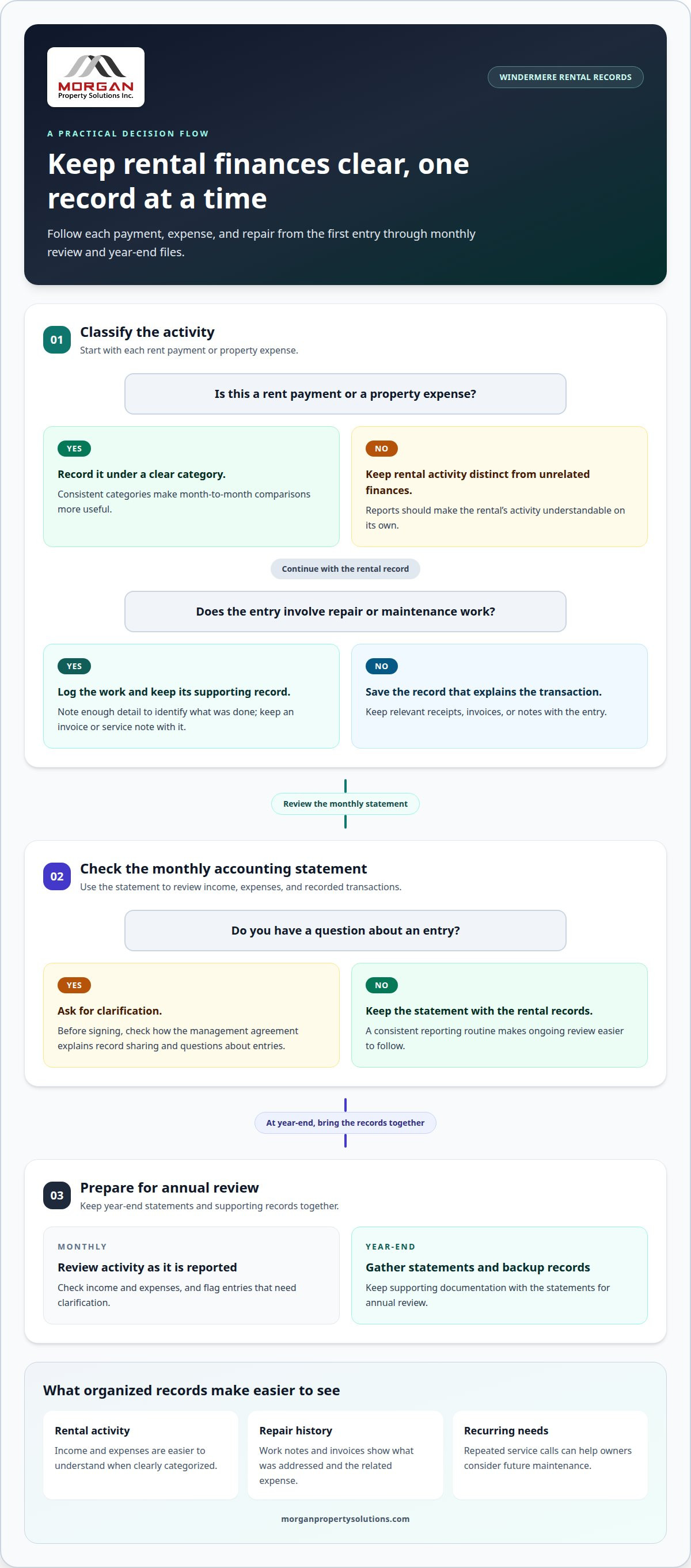
A practical recordkeeping process follows a simple cycle:
- Record each rent payment and property expense under a clear category.
- Save receipts, invoices, and notes that explain the transaction.
- Log repair and maintenance activity with enough detail to identify the work.
- Review monthly statements for questions or entries that need clarification.
- Keep year-end statements and supporting records together for annual review.
This routine can also reveal patterns. If records show repeated service calls for the same system, an owner can consider the repair history when planning future maintenance. A statement may show that an expense occurred, while its supporting record explains what was addressed. That detail makes financial information more actionable.
When choosing a property manager in Windermere, compare the reporting process, statement schedule, and maintenance documentation. Before signing, make sure the management agreement explains how records are shared and how questions about entries are handled.
Florida licensing requirements can depend on a manager’s activities and role. Landlords should also account for applicable rental housing rules, clarify responsibilities in the agreement, and seek qualified Florida legal advice about specific obligations.
Owners can use landlord resources to support an organized approach to rental records. Clear statements and repair documentation give each review a practical starting point, whether you’re checking a monthly expense or preparing year-end files.
Lease execution and renewals
A lease sets out the rental arrangement and gives both parties a written reference during the tenancy. In Windermere, property managers can handle lease execution and renewals, organizing each step from document preparation through completion. Owners should understand how the manager communicates with tenants and tracks important lease dates.
Tenant screening, leasing, and maintenance can work together as parts of one management process. Screening criteria guide the review of prospective tenants, while tenant placement and leasing cover the steps leading to an executed agreement. Property management can also coordinate necessary repairs, giving maintenance concerns a clear route for follow-up during the tenancy.
Before a lease is signed, the manager coordinates the agreement and ensures the relevant parties receive the documents they need. A clear process can include confirming proposed terms, preparing the lease, arranging signatures, and providing copies. Once complete, the agreement gives everyone a shared reference for responsibilities and occupancy conditions.
Renewal planning starts with reviewing the existing agreement and deciding whether the tenancy will continue. The manager can prepare a renewal agreement and coordinate its execution, keeping the transition orderly. If the parties agree to updated terms, the renewal should clearly record those changes rather than leave them to informal messages.
Before hiring, Windermere owners should review the management agreement’s service scope, authority to execute or renew leases, communication process, and termination terms. Clarify who approves lease changes and how maintenance decisions are handled, so responsibilities remain clear once a tenant is in place.
- Confirm which party prepares and coordinates lease signatures.
- Understand how renewal dates and tenant communication are managed.
- Review how screening criteria are applied during tenant placement.
- Clarify the manager’s role in coordinating repairs and maintenance.
- Check how the management agreement can be ended or changed.
These terms matter because a lease affects the tenant relationship, while the management agreement defines the owner-manager relationship. For a practical view of how leasing and property management fit together, consider the service process alongside the lease responsibilities. Clear expectations at the start make it easier to address renewals, tenant questions, and maintenance needs as they arise.
Move-in and move-out inspections
A walk-through before occupancy records the rental’s condition as a tenancy begins. A second walk-through after occupancy provides a comparison point when the tenant leaves. For a Windermere rental, these inspections create a practical record of visible conditions at two important transitions. The notes can help owners understand what changed and what may need attention before the next tenancy.
Consistency makes the comparison more useful. The person conducting each inspection can follow the same route through the home, checking each room and recording observations clearly. For example, notes might describe a living-room wall, kitchen counters, flooring, doors, and visible appliances. If the move-in record mentions an existing mark, the later review can compare that area rather than relying on memory.
Photographs can add detail to written notes when they show the same area from a useful angle. A dated image of a stained carpet or scratched cabinet, paired with a brief description, gives the record context. Clear labels matter: “hallway floor near the entry” is more helpful than simply “floor.” The goal is an organized account, not a collection of unlabeled pictures.
A practical inspection process can follow these steps:
- Walk through each room before occupancy and note visible conditions.
- Record relevant details in writing, including the room and location.
- Take supporting photos where they clarify an observation.
- Repeat the walk-through after occupancy using the same room order.
- Compare the records and separate previously noted conditions from new observations.
For example, an entry could note a small chip on a bedroom door before move-in. If the move-out inspection shows that chip unchanged, the paired records make the comparison clear. If it identifies a new issue, the notes can describe its location and appearance. This record helps distinguish observations without relying on vague recollections of the home.
Inspections also help organize follow-up. A manager can identify items needing further review, such as a dripping faucet or damaged cabinet hinge. Inspection notes should describe what was seen, while separate maintenance records document any subsequent work. This distinction keeps condition observations separate from repair history.
Owners can review completed records after each walk-through and ask for clarification about entries that lack a location or description. A consistent process across both inspections creates a clearer condition history, supports more organized transitions between occupants, and helps identify maintenance needs before the next resident moves in.
Rent and security deposit collection
Rent collection turns the lease’s payment terms into a clear monthly process. A property manager can collect rent and security deposits for the owner, then record each payment against the correct rental account. Separating rent from the deposit helps show what each payment represents.
At the start of a tenancy, the manager follows the agreed collection process and records the security deposit separately from recurring rent. If a tenant pays both amounts before move-in, for example, the record should identify each payment by purpose and date. That distinction makes account reviews easier and reduces confusion when the owner checks rental activity.
Monthly collection also benefits from consistent tracking. A manager can record when rent is received, which rental it applies to, and whether it covers the full amount due under the lease. If a payment is partial, the account should show the amount received and the remaining balance. Clear entries give owners a useful account history instead of a general note that rent came in.
A straightforward collection record can include:
- The rental property and tenant account associated with the payment.
- The date rent or a security deposit was received.
- The payment purpose, such as monthly rent or deposit.
- The amount received and any outstanding balance.
- A record of communication about an incomplete or missed payment.
A rent entry should not be confused with a deposit entry, even if both arrive during the same period. If a tenant asks about a payment, an organized ledger helps the manager trace the entry and explain how it was recorded. The owner can then review the account alongside the monthly statement, rather than relying on memory or scattered messages.
Before hiring a manager, review how the management agreement describes collection responsibilities, payment records, owner reporting, and communication about missed or incomplete payments. Ask how collected funds and related entries appear in account records. These details clarify what the manager handles and what information the owner receives.
Collection procedures should also fit the lease. The manager uses its payment terms to track rent, while the agreement between owner and manager defines the manager’s role. If a tenant’s payment is delayed, timely, factual communication helps establish what remains due and what action follows. Keep that communication with the payment record.
For Windermere rental owners, an organized collection process connects tenant payments with useful financial records. Separating rent from deposits, tracking each transaction, and keeping payment communications together makes account reviews more straightforward. The result is a clearer view of collections and a practical record for follow-up.
Which property management companies serve Windermere, Florida?
Windermere rental owners can look for residential property management firms that serve the area and manage long-term rentals. A suitable firm should explain how it handles rental pricing, tenant placement, leases, inspections, rent collection, maintenance, and owner records. These services connect throughout a tenancy, so consider the full process rather than one task alone.
Start by identifying the work you want handled. An owner who lives outside Windermere may value coordinated rent collection and property inspections. Someone preparing a home for rent may need pricing analysis, advertising, and lease execution. A firm’s service area matters, as does whether its approach matches the property and the owner’s priorities.
Compare the service details in writing. Look for a clear explanation of how the company approaches:
- Rental market analysis and pricing strategy.
- Advertising and tenant placement.
- Lease execution and renewal agreements.
- Move-in and move-out walk-through inspections.
- Rent, security deposit, and monthly payment collection.
- Repair oversight and owner accounting records.
Ask for specifics about the process, not broad promises. Find out what information appears in monthly and year-end statements, and how repair activity is recorded. Ask how the manager documents property condition during inspections. Clear answers help you understand what you’ll receive and how the company keeps you informed.
Also review the management agreement before deciding. Pay attention to included tasks, the manager’s authority, owner responsibilities, communication methods, and termination terms. If rent collection matters, understand how payments are recorded and reported. If repair coordination is a priority, clarify how requests are handled and how completed work appears in property records. These details make proposals easier to compare.
Windermere property management is a local service, but a company’s service area alone doesn’t show how it will manage your rental. Consider whether its process covers the property’s needs from marketing through ongoing records. An owner seeking help with a vacant home may focus on pricing and advertising, while an owner with a tenant may prioritize lease administration and consistent reporting.
Before choosing, bring your property’s priorities into the discussion. Note whether you need support with leasing, rent administration, maintenance coordination, inspections, or accounting. Then compare how each company describes those responsibilities and what updates it provides. A well-defined scope helps prevent misunderstandings and gives you a clearer basis for selecting a management partner in Windermere.
Morgan Property Solutions: Orlando Property Manager
Morgan Property Solutions Inc. provides Windermere property management for owners who want help coordinating rental operations. The service includes rental market analysis, pricing strategy, advertising, lease execution and renewals, rent and security deposit collection, and walk-through inspections before and after occupancy. Monthly and year-end accounting statements, along with repair and maintenance records, help keep property activity organized.
If you’re considering professional management for a Windermere rental, this service brings leasing and ongoing property oversight together. Morgan Property Solutions Inc. provides residential property management for owners who want help managing a rental. Contact Morgan Property Solutions Inc. to discuss your Windermere property management needs.
Choose the Next Step for Your Property
Your rental strategy should support the role you want the property to play in your plans. Before moving forward, consider whether you want to remain a hands-on owner, get management support, or explore a future sale or purchase. Choosing a Windermere property manager can make rental ownership more manageable, while a real estate decision may call for different guidance.
Morgan Property Solutions Inc. offers residential property management for owners who want help overseeing a rental. If your plans shift, the company also provides real estate seller representation and real estate buyer representation. Considering your priorities first can make the next conversation more focused, whether you plan to keep an investment property or consider a change.
For a helpful conversation about your real estate needs, contact Morgan Property Solutions Inc. Take the next step at a pace that feels right for you.
Frequently Asked Questions
What does a Windermere property manager do?
A Windermere property manager coordinates the practical work of operating a rental home, including leasing, payment administration, property oversight, and financial records. The benefit is having these tasks handled as a connected process. When a tenancy changes, for example, the manager can organize transition details alongside the updated lease and account information, giving the owner a clearer view of the handoff.
How much rent can a home in Windermere earn?
A home’s potential rent depends on its features and current rental market conditions, so no single figure applies to every Windermere property. A pricing analysis can consider the home’s size, condition, layout, and features alongside comparable rental homes. Two homes in the same area may support different asking rents if one has updated finishes or a different layout. Market conditions can also shift, so pricing may need review.

Article by
Oliver Overton-Morgan
Oliver Overton-Morgan is a full-time Real Estate Broker since 2003, with years of experience helping thousands of people purchase and sell real estate throughout Central Florida. He holds a Graduate Realtor Institute designation, LCAM, and has held licenses in good standing as a Florida Mortgage Broker and a Notary Public. Oliver immigrated to central Florida in 2001, and within 5 years Oliver built a successful Real Estate brokerage in central Florida, where he recruited over 75 Sales Associates with 25+ million in sales production.
One Response